
Your cart is currently empty!
Bizarre Reason Why Trump Travels in $1,500,000 Bulletproof Limousine ‘The Beast’ With Fridge Full of Blood

The idea of a world leader traveling with a refrigerator stocked with their own blood might sound like something lifted straight from a dystopian science fiction novel, yet for Donald Trump, it is an everyday reality. Known simply as The Beast, the $1.5 million armored limousine has become one of the most talked-about symbols of presidential power and paranoia. This car isn’t just a mode of transportation it’s a fortress on wheels, designed to ensure survival in scenarios most of us would only encounter in action films. For Trump, a man who thrives on projecting strength, the vehicle represents both his vulnerability and his untouchable status.
Contents
show
But The Beast is more than just a car. It is a carefully crafted stage prop in the theater of politics, one that sends a message about the stakes of leadership in a dangerous and unpredictable world. Hidden behind its Cadillac-styled exterior lies a combination of cutting-edge security technology, battlefield-level armor, spy-gadget trickery, and a mobile emergency room complete with medical supplies and life-saving blood. And while Trump’s critics may scoff at the excess, it’s important to remember that every U.S. president in recent history has had their own version of this fortified limousine. Still, Trump’s association with The Beast especially after the near-fatal shooting at a rally last year has reignited fascination with just how far presidential security goes.
The Origins of ‘The Beast’
The Beast has not always been a part of presidential lore. Earlier presidents traveled in armored cars, but the full transformation into a rolling bunker only began in earnest during Barack Obama’s first inauguration in 2009. That was when the first iteration of The Beast, engineered to withstand nearly any imaginable attack, rolled onto the world stage. The latest model, commissioned by the Secret Service in 2014, has since become the standard for safeguarding the commander-in-chief.
This limousine doesn’t just look intimidating because of its sheer size close to 20,000 pounds of reinforced engineering it is intimidating because of what it represents: the recognition that the U.S. president is always a target. It is designed to survive direct attacks from small arms fire, rocket-propelled grenades, and even chemical or biological warfare. In this sense, it’s more than a car.
It’s a continuation of the Cold War mentality of constant preparedness, where survival is calculated down to the smallest detail, even to the point of carrying blood for transfusions.
The irony here is hard to ignore. The president, often portrayed as the most powerful person in the world, is also arguably one of the most fragile. Every appearance, every movement, every handshake is choreographed with security in mind, and The Beast is the embodiment of this reality. When Trump rode in the vehicle during his UK state visits, its presence was as much about optics as protection a rolling signal to both allies and protestors that America’s leader would remain untouchable, no matter what.
More Than Armor: A Mobile Emergency Room

The most bizarre and headline-grabbing feature of The Beast is, of course, the fridge full of blood. According to reports, the car is equipped with several pints of blood matching the president’s type, ensuring that in the event of a major injury, doctors could perform an immediate transfusion. This feature came under renewed attention after Trump’s brush with death at a rally, where a bullet grazed his ear. While the incident was not fatal, it served as a chilling reminder of why such extreme precautions exist.
But the blood supply is only one part of a much broader medical arsenal. The limousine carries a built-in oxygen supply that can be piped into the cabin if the car is attacked with biochemical agents. It is stocked with trauma kits, defibrillators, and advanced first-aid equipment that allows a military physician who always travels nearby to treat wounds on the spot. In essence, The Beast is not just a car; it is a mobile intensive care unit.
For the general public, this detail might seem extravagant, even unnecessary. But when you consider the president’s role, the calculation changes. Every second counts in an emergency. The presence of blood and medical equipment is not simply about saving one individual it is about ensuring continuity of government. In the chaotic aftermath of an attack, stabilizing the president could mean the difference between order and collapse.
Gadgets Straight Out of a Spy Thriller

While the medical features of The Beast may capture the public’s imagination, the vehicle’s offensive and defensive gadgets are no less dramatic. Reports suggest it comes armed with the ability to launch smokescreens, release tear gas, and even spill oil slicks to disable chasing vehicles.
The doors are said to be capable of delivering electric shocks to unauthorized individuals attempting to gain entry. Add to this night vision systems and run-flat tires, and you have a car designed to operate in practically any environment, no matter how hostile.
It doesn’t stop there. The Beast can also act as a mobile command center. In an extreme situation, the president can reportedly authorize the use of nuclear weapons from within its armored shell. For critics, this capability embodies the militarization of civilian transport; for the Secret Service, it’s simply another layer of insurance in a long list of worst-case scenarios.
The car’s sheer bulk nearly 20,000 pounds makes it an engineering marvel, though it comes with challenges. Roads have to be carefully chosen to accommodate its weight, and fuel consumption is astronomical. Yet for a vehicle designed to withstand catastrophic events, efficiency takes a backseat to survival.
A Price Tag Beyond Luxury
The Beast is estimated to cost around $1.5 million per unit, with a fleet of around a dozen always on standby. Compared to Trump’s other travel accommodations such as the $400 million private jet he accepted from Qatari royalty this may almost seem modest. Yet unlike gold-plated chairs and luxury television screens, the expenses associated with The Beast are not about indulgence. They are about necessity.
Every detail, from the thickness of its eight-inch walls to the special seals that guard against biochemical infiltration, has been designed with precision. Unlike a luxury yacht or a private jet, The Beast is not meant to impress with style or comfort. Instead, its opulence lies in its invisibility the quiet assurance that, should disaster strike, the president will emerge unharmed.
Critics of such extravagant measures argue that the extreme level of protection creates an unnecessary barrier between the president and the people he serves. But history has repeatedly shown the vulnerability of leaders from John F. Kennedy’s assassination in 1963 to the near-fatal attempts on Ronald Reagan and now Donald Trump. The Beast is a direct answer to those tragedies.
Trump, The Beast, and the Politics of Security
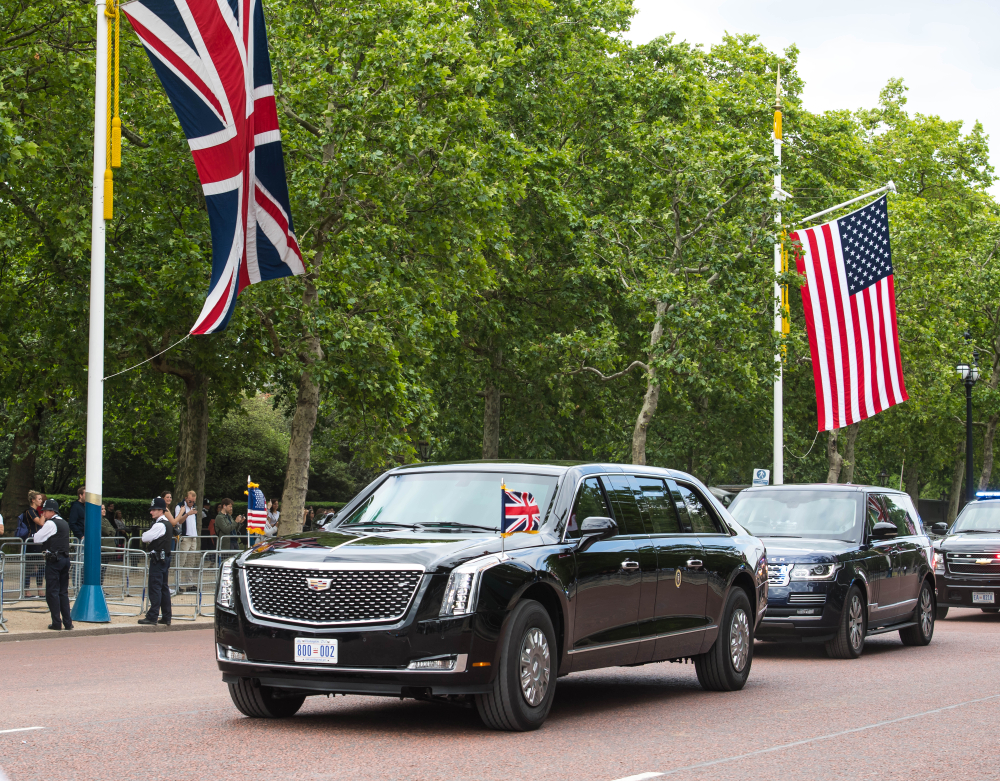
When Trump brought The Beast to the UK during his state visit, it became a symbol not only of American security but also of Trump’s polarizing global presence. As he received a royal welcome at Windsor Castle alongside Melania, protestors lined the streets demanding his departure. Demonstrators projected images of Trump with Jeffrey Epstein onto the castle walls, and coalition groups rallied against his stances on climate, immigration, and foreign policy.
Through it all, The Beast loomed in the background a silent player in the political theater. It carried Trump to ceremonies, meetings, and receptions, a visible reminder of both his power and his isolation. Its armor protected him from physical danger, but it also reinforced the gulf between leader and public. For supporters, it represented strength and preparedness. For detractors, it symbolized arrogance and detachment.
This tension is at the heart of modern presidential politics. Leaders are expected to be accessible and relatable, yet the security measures necessary to protect them often create distance. The Beast encapsulates this paradox perfectly: a car that allows Trump to move among crowds while simultaneously shielding him from them.
Mortality in the Midst of Power
In the end, the most fascinating aspect of The Beast is not its spy gadgets, medical gear, or even its price tag. It is what those features reveal about the fragility of leadership. The fridge full of blood is not a bizarre indulgence. It is a stark acknowledgment that even the most powerful person in the world is vulnerable to the same fragility as anyone else.
Presidential power rests not just on military might or political influence, but also on the ability to endure moments of chaos. The Beast, with its blood-filled fridge and bunker-like shell, is an insurance policy against the chaos of history. It reminds us that politics is as much about managing mortality as it is about managing policy.
Trump’s limousine may seem absurdly overbuilt to the casual observer, but in the context of global instability, assassination attempts, and nuclear responsibilities, it makes grim sense. It’s a paradox on wheels: a vehicle that embodies invincibility while quietly admitting vulnerability. And in that paradox lies the true story of power in the modern age.