
Your cart is currently empty!
Archaeologists Uncover 5,500-Year-Old Weapons Factory That Brings Biblical History to Life

Archaeology has a way of making the past feel startlingly close. Every now and then, a discovery reshapes how we view the stories humanity has carried for millennia, stories that live in both scripture and soil. The recent uncovering of a 5,500-year-old weapons workshop in Israel has done exactly that, offering physical evidence that intertwines ancient craftsmanship, social complexity, and biblical history. The significance lies not in the tools or the ruins themselves, but in what they reveal about a civilization that lived, worked, and created with enduring purpose.
Contents
show
The site, located in Nahal Qomem, dates back to the early Bronze Age and appears to have been a hub of production for bladed tools and weapons. What makes it remarkable is not only its age but also what it reveals about the Canaanite people, a group often referenced in the Bible, and how advanced their society truly was. These findings do not merely add to the archaeological record; they bridge the distance between belief and evidence, showing that the stories told thousands of years ago had roots in real human endeavor. The story of this discovery reminds us that human history and spiritual narratives often overlap, each offering a piece of the puzzle that helps us understand who we are and where we came from.

A Workshop Frozen in Time
When archaeologists from the Israel Antiquities Authority began excavating Nahal Qomem earlier this year, they didn’t expect to find what now appears to be one of the earliest known weapons production centers in the region. Among the discoveries were flint blades, tools used to assemble them, and remnants of harvesting implements that hint at a community capable of both warfare and agriculture. These items were not randomly scattered artifacts but part of a deliberate system of production, evidence that this was not a small camp but a thriving workshop that served a greater purpose in early Canaanite society.
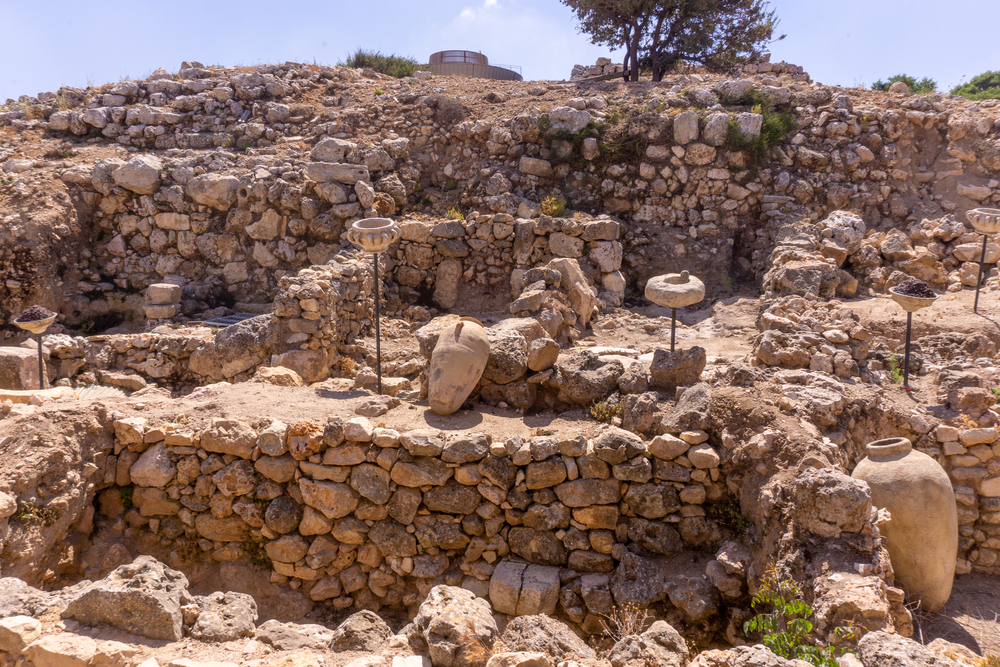
Hundreds of underground pits were also unearthed, serving as both storage spaces and homes. This detail paints a vivid picture of life more than five millennia ago, a society that not only survived but thrived, crafting weapons and tools with skill and purpose. The presence of such a structured site reveals an organized community with clear roles and specializations, showing that even in an age before written records, humans had already developed systems that reflected cooperation, trade, and knowledge-sharing. It is easy to imagine the sounds of flint being shaped, the careful passing down of methods, and the quiet rhythm of daily life that carried meaning and order long before the written word captured it.
Dr. Jacob Vardi, prehistorians leading the excavation, described the site as an example of an advanced industry requiring an extremely high level of expertise. Their findings suggest that the people who worked there were specialists, a rare glimpse into how early societies began dividing labor and developing technical knowledge. The precision of the blades and the care taken in maintaining production secrecy show that this was not merely survival-level craftsmanship, but a form of proto-industry guided by intelligence and structure. Their words highlight how even in antiquity, humans valued knowledge and skill as much as strength, a pattern that continues in every technological era since.
The Canaanite Connection
The Canaanites have long occupied a central role in biblical narratives, described as inhabitants of a prosperous and fertile land and often portrayed as both neighbors and rivals of the Israelites. Yet outside of scripture, physical traces of their civilization have often been fragmented or open to debate. The Nahal Qomem discovery bridges that gap. The weapons factory, likely operated by Canaanite craftsmen, provides tangible proof of a complex and organized society. Far from mythical, they were artisans, traders, and innovators who left a tangible legacy that endures through time.
The fact that production debris, the small flint fragments left over from toolmaking, was deliberately contained rather than scattered suggests that these early artisans valued secrecy, perhaps to protect their techniques from rival groups. This reveals an intriguing layer of professionalism, as though we are witnessing the ancient equivalent of guarding intellectual property. The Canaanites’ attention to detail, their methodical processes, and their apparent understanding of trade value all speak to a people who had mastered not only technology but also the social and economic systems that sustained it. Their civilization was far more than what is described in brief biblical references. It was vibrant, organized, and dynamic in ways that continue to shape historical understanding.
“This is a sophisticated industry,” Dr. Vardi said, noting that the intentional absence of waste fragments may indicate an effort to preserve professional knowledge. “We now understand that this site served as a center from which Canaanite blades were distributed across broad regions in the Levant.” Such specialization reflects a society far more structured than often assumed for the era, one that traded goods, mastered complex technologies, and influenced neighboring cultures. This also reinforces the idea that ancient economies were interlinked, operating through trade and shared craftsmanship, much like today’s global markets.
Science Meets Scripture
For those who study both archaeology and theology, findings like these carry profound significance. While the Bible remains a spiritual and historical text rather than a scientific record, archaeological evidence can illuminate aspects of the world it describes. The Canaanites’ existence, trade networks, and craftsmanship have been documented in both biblical and extra-biblical sources, but this discovery grounds those narratives in physical evidence. It connects faith with fact, allowing history to speak through the stones and revealing that stories passed through generations often hold grains of truth buried beneath the soil.
Dr. Aren Maeir, an archaeologist at Bar-Ilan University not involved in the excavation, explained that such findings help scholars contextualize the people mentioned in ancient texts, demonstrating how they lived, worked, and interacted. His perspective underlines how archaeology and scripture can work together, not in competition but in dialogue. While not a direct validation of every biblical claim, discoveries like this one align with known historical frameworks of the Canaanite civilization described in the Old Testament. It reminds us that stories, whether passed down through religion or preserved in ruins, often share the same origin point in human experience, and that science and faith are not opposing forces but two lenses focused on the same truth.
These findings also provide an opportunity to reexamine the role of faith in understanding history. When discoveries confirm elements of ancient narratives, they offer a sense of continuity between belief and knowledge. Rather than weakening faith, such evidence enriches it, providing depth and context. It encourages both believers and skeptics to see the Bible not only as a sacred text but as part of the broader story of civilization itself, where divine inspiration and human achievement coexist within the same timeline.
A Window into Early Innovation
What makes this weapons factory extraordinary is not simply its age, but what it reveals about human ingenuity. Flint blades, when properly crafted, could be as sharp as modern surgical steel. The artisans of Nahal Qomem were not primitive; they were early engineers mastering a craft that required precision, patience, and community organization. They worked with an understanding of materials and design that would have taken generations to perfect, showing a clear lineage of knowledge passed down and refined with care.
Archaeologists note that such sites reflect an early form of mass production. The careful planning required to sustain a production center, sourcing flint, maintaining trade routes, and organizing labor, points to a society already navigating the complexities of industrialized work thousands of years before modern industry began. This was not the image of scattered tribes surviving in isolation, but of a networked people working together under shared goals and systems of knowledge. These findings challenge the notion that ancient communities were small, isolated, or unsophisticated. Instead, they reveal networks of expertise and cooperation, the kind of collaborative intelligence that has always defined human progress. Innovation, it seems, is not a product of modernity, but a fundamental human trait stretching back to the earliest civilizations.
Beyond the tools themselves, the workshop provides evidence of a thriving social order built on craftsmanship, trade, and teaching. Every blade or harvested tool tells a story of teamwork, apprenticeships, and perhaps even competition between craftsmen. Such complexity demonstrates that even five thousand years ago, people sought purpose in their work, pride in their mastery, and meaning in their contribution to their communities. The Canaanite workshop at Nahal Qomem, therefore, was not just an industrial center, but a reflection of the enduring human spirit of creation.

Beyond Religion: What This Means for Us
The Nahal Qomem discovery is as much about understanding humanity as it is about verifying scripture. Whether one reads the Bible as sacred truth, historical account, or literary heritage, discoveries like this one remind us that human civilization has deep and connected roots. The craftsmanship of the Canaanites, the structure of their settlements, and their early social organization reflect traits that persist in us today: creativity, collaboration, and a drive to innovate. Our ancestors’ ability to shape their environment, preserve knowledge, and develop tools for both survival and advancement remains a cornerstone of what it means to be human. Their story speaks to our own instinct to build, protect, and pass wisdom forward.
Modern parallels can be drawn in how societies continue to guard intellectual property, develop specialized trades, and distribute goods across regions. The instincts that shaped the Canaanite workshop, skill, secrecy, and commerce, are the same that drive industries today. The tools may have changed, but the motivations behind them remain strikingly similar. The story of the Canaanite blades, therefore, is not just about ancient technology, but about the timeless nature of human ingenuity. It also serves as a reminder that even our most modern systems of production, trade, and learning are built on foundations first laid by people who lived thousands of years ago, their ingenuity echoing across the ages.

The Enduring Power of Discovery
Archaeology’s greatest gift is perspective. Every artifact, every buried tool or home, narrows the distance between us and the people who came before. The Nahal Qomem site may not prove every detail of the Bible, but it confirms that behind its stories were real people, industrious, creative, and as human as we are. Their legacy lives not only in the flint and stone they shaped but in the curiosity that drives us to uncover their world. Through such discoveries, we gain a better understanding of ourselves, as each excavation becomes a mirror reflecting our shared humanity.

In an age where information is often fleeting, this 5,500-year-old factory stands as a quiet reminder that truth endures. Beneath the layers of myth and history, the earth continues to whisper back: they were here, they built, they thrived. The discovery does more than echo a story from scripture. It highlights something greater: our past connects us in ways that endure. And every time we dig a little deeper, we find that history, science, and faith are not in opposition but in conversation, each helping us understand what it means to be human. The stones of Nahal Qomem reveal not only traces of history but the lasting connection between knowledge and belief, bound by the timeless human drive to understand.