
Your cart is currently empty!
Federal Court Says Trump Administration Cannot Erase Slavery Exhibit
A federal judge has ordered the Trump administration to restore a slavery-related exhibit at Philadelphia’s President’s House Site, setting off a new chapter in the ongoing national debate over how America tells its own story.
Contents
show
The ruling, issued on Presidents’ Day by U.S. District Judge Cynthia M. Rufe, temporarily blocks the removal of 34 educational panels and video displays that had documented the lives of nine people enslaved by George Washington while he lived in Philadelphia. The National Park Service had dismantled the exhibit in January following an executive order from President Donald Trump titled “Restoring Truth and Sanity to American History.”
In a sharply worded opinion that invoked George Orwell’s dystopian novel 1984, Judge Rufe rejected the administration’s argument that it could unilaterally reshape historical interpretation at federally managed sites. The case now stands as one of the most consequential legal battles yet in the broader struggle over public memory, presidential authority, and the meaning of historical truth.
A Presidents’ Day Ruling With Symbolic Weight
The timing of the ruling carried its own resonance. On Presidents’ Day, a holiday that honors the nation’s commanders in chief, the court addressed whether the federal government could remove an exhibit detailing the enslaved people who lived in the household of the first president.
The President’s House Site sits within Independence National Historical Park in Philadelphia, near the Liberty Bell and Independence Hall. The location once served as the official residence of George Washington and later John Adams during the period when Philadelphia functioned as the nation’s capital in the 1790s.
In 2010, after years of historical research and collaboration between the City of Philadelphia and federal officials, an open-air exhibit was installed at the site. It included 34 panels and video displays explaining not only the political importance of the residence but also the lives of nine enslaved individuals who were held there by Washington. Their names are etched into a memorial wall: Oney Judge, Austin, Christopher Sheels, Giles, Hercules Posey, Joe Richardson, Moll, Paris, and Richmond.
The exhibit sought to acknowledge what historians have long described as a central contradiction of the American founding. While the Declaration of Independence proclaimed that all men are created equal, slavery remained embedded in the lives of many of the nation’s leaders. Washington himself rotated enslaved individuals between Pennsylvania and Virginia in order to prevent them from qualifying for freedom under Pennsylvania law.
Judge Rufe’s ruling restores those historical accounts, at least temporarily, and prohibits the installation of replacement materials that would alter or omit the slavery narrative while litigation continues.
The Executive Order That Sparked the Dispute
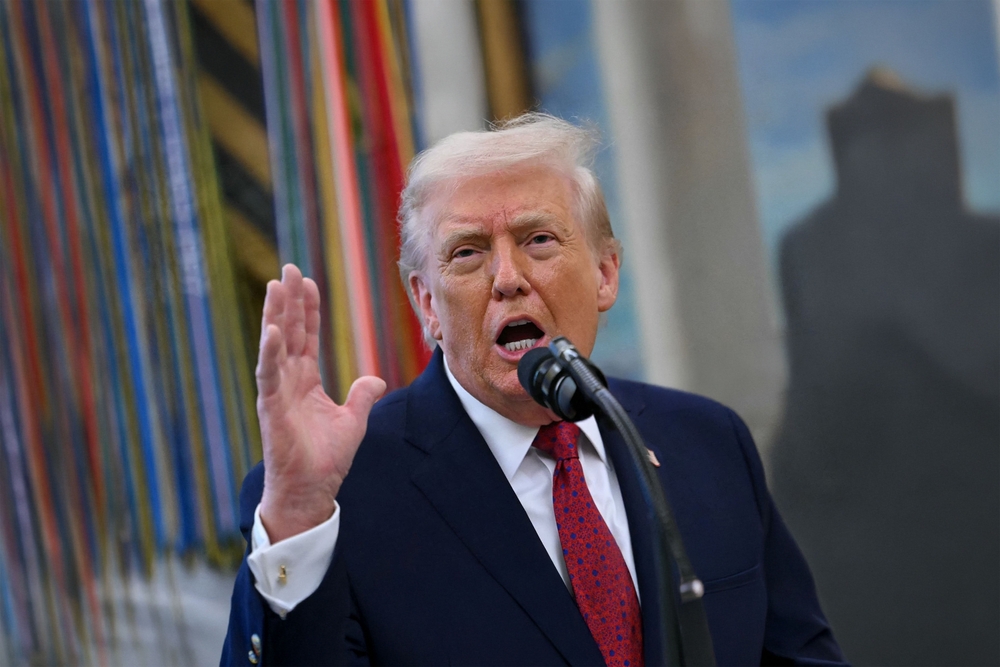
The exhibit’s removal followed President Trump’s March 2025 executive order titled “Restoring Truth and Sanity to American History.” The order directed the Department of the Interior to eliminate what it described as divisive and race-centered ideology from federal cultural institutions, including national parks.
In the text of the order, the administration argued that over the past decade, a revisionist movement had replaced objective facts with a distorted narrative driven by ideology. It specifically referenced Independence National Historical Park and criticized previous programming that, in its view, cast America’s founding principles in an excessively negative light.
National Park Service workers were seen dismantling panels at the President’s House Site in late January. According to reports, the removal included displays titled “Life Under Slavery” and “The Dirty Business of Slavery.” Only the engraved names of the nine enslaved individuals remained on the memorial wall after the panels were pried off.
The City of Philadelphia filed suit shortly thereafter, arguing that the removal violated cooperative agreements between the city and federal authorities and unlawfully altered a memorial that had been jointly developed. The city also contended that the changes caused irreparable harm by concealing essential historical context.
During court proceedings, administration lawyers argued that the federal government has authority to determine the messaging presented at sites under its control. Judge Rufe described that argument in her ruling as both dangerous and horrifying.
Invoking Orwell and the Question of Historical Truth
One of the most striking elements of the court’s opinion was its literary framing. Judge Rufe began by quoting from George Orwell’s 1984, the novel that depicts a totalitarian regime constantly rewriting historical records to maintain power. She drew a parallel between the fictional Ministry of Truth and the government’s asserted authority to alter or erase historical interpretation.
“As if the Ministry of Truth in George Orwell’s 1984 now existed, with its motto ‘Ignorance is Strength,’ this Court is now asked to determine whether the federal government has the power it claims to dissemble and disassemble historical truths when it has some domain over historical facts,” she wrote. “It does not.”
The opinion criticized the notion that truth could become the property of elected officials, subject to revision at their discretion. Judge Rufe stated that an agency cannot arbitrarily decide what is true based on the preferences of new leadership.
She emphasized that the removed displays were not mere decorations but part of a memorial. They served as a tribute to enslaved men and women and an acknowledgment of the contradictions embedded in the country’s founding era. To remove them, she argued, would deprive visitors of an accurate understanding of the site’s historical significance.
The court also noted that the exhibit connected the site to the National Underground Railroad Network to Freedom, particularly because Oney Judge escaped from the Washington household in 1796 and later built a life in New Hampshire. Removing references to her story, the judge wrote, concealed crucial information linking the site to that broader history of resistance and flight.
The Lives Behind the Panels
At the center of the dispute are the nine individuals whose lives were commemorated in the exhibit. Historical research conducted at the turn of the twenty-first century identified the precise location of the presidential residence and uncovered records detailing the enslaved people who lived there.
Oney Judge was born into slavery at Mount Vernon and later brought to Philadelphia. In 1796, she escaped to freedom. Washington attempted to have her returned and published advertisements seeking her capture, but she ultimately settled in New Hampshire. Her story has become emblematic of resistance and self-determination.
Hercules Posey, a cook in Washington’s household, also escaped after being returned to Mount Vernon. He eventually lived in New York under a different name. Other individuals at the site, including Austin, Christopher Sheels, Giles, Joe Richardson, Moll, Paris, and Richmond, left fewer historical traces but were nonetheless central to the functioning of the presidential household.
The exhibit did not seek to diminish Washington’s role in founding the republic. Instead, it placed his presidency within the full context of the era, acknowledging both leadership and contradiction. Historians have argued that such contextualization reflects decades of scholarship aimed at presenting a more comprehensive view of early American history.
Judge Rufe wrote that each visitor who does not learn of the realities of founding-era slavery receives a false account of the nation’s past. That statement underscored the broader stakes of the case.
A Broader Pattern of Removals

The President’s House Site is not the only federal location where historical interpretation has shifted in recent months. Reports indicate that signage at Grand Canyon National Park referencing the displacement of Native American tribes was removed. At the Stonewall National Monument, a rainbow flag was taken down and references to transgender participants in the 1969 uprising were eliminated from official webpages.
At the Smithsonian’s National Portrait Gallery, a revised caption accompanying President Trump’s portrait reportedly omitted references to his impeachments and the events of January 6. These changes have fueled accusations from critics that the administration is engaged in a systematic effort to reshape public history.
Supporters of the executive order argue that federal institutions had adopted ideological frameworks that portrayed the United States in an unduly negative light. A White House spokesperson stated that the president is fulfilling a promise to restore truth and common sense to American institutions and to honor the fullness of the American story.
Civil rights organizations and several local officials in Philadelphia have characterized the removals differently. They describe the elimination of slavery references as an attempt to whitewash history and to sideline the experiences of marginalized communities.
The court’s preliminary injunction does not resolve the broader political disagreement, but it does limit the executive branch’s ability to act unilaterally while the lawsuit proceeds.
Executive Authority and Cooperative Agreements

A central legal question in the case concerns the scope of presidential authority over federal lands and the obligations created by cooperative agreements with local governments.
The President’s House exhibit was created through collaboration between the National Park Service and the City of Philadelphia. The city argued that those agreements required consultation before significant changes could be made. Judge Rufe appeared sympathetic to that position, noting that the removal undermined the city’s statutory and long-standing interests in the site.
The administration maintained that, as the federal entity responsible for managing national parks, it retains discretion over interpretive materials. During hearings, government attorneys suggested that different audiences may feel strongly in different ways about how history is presented and that the government gets to choose the message it conveys.
The judge rejected the implication that historical interpretation at federally funded memorials can shift solely with political leadership. Her ruling framed the issue not as a matter of policy preference but as one of legal limits and constitutional structure.
Federal officials may appeal the injunction. The timeline for full restoration of the exhibit remains unclear, though the court ordered that it be returned to its physical status as of the day before removal.
The Politics of Memory

The controversy surrounding the President’s House Site reflects a deeper tension in American public life. How should a nation commemorate figures who advanced democratic ideals while simultaneously participating in systems of oppression? Can acknowledgment of historical injustice coexist with celebration of national achievement?
Over the past two decades, historians and curators have increasingly embraced what they describe as a fuller narrative approach. This method presents founding documents alongside the lived realities of enslaved people, Indigenous communities, and others excluded from political power at the time.
Critics of that approach argue that it risks overshadowing the achievements of the founding generation and fostering cynicism about the nation’s origins. Advocates counter that confronting contradictions strengthens rather than weakens democratic culture.
Judge Rufe’s opinion did not attempt to resolve that philosophical debate. Instead, it focused on whether the executive branch can erase or conceal established historical research without legal constraint. By invoking Orwell, the court signaled concern about the concentration of interpretive authority in the hands of political actors.
The case arrives at a moment when debates over school curricula, museum exhibits, and public monuments have become deeply polarized. State legislatures across the country have passed laws regulating how race and history may be taught. Universities and cultural institutions face scrutiny from both sides of the political spectrum.
In that environment, the President’s House Site has become more than a local dispute. It stands as a symbol of the broader contest over who controls the narrative of American history.
Community Response and Public Reaction
Local politicians and community leaders in Philadelphia celebrated the court’s decision. Some described it as a victory for historical integrity and public accountability. State Representative Malcolm Kenyatta said the community prevailed against an effort to sanitize the past.
Rallies at the site in recent weeks drew residents, historians, and activists who called for the exhibit’s restoration. For many participants, the issue was not only about panels and plaques but about recognition of lives that had long been marginalized in public storytelling.
The federal government has not yet provided detailed comment on how it will proceed. If the administration appeals, the case could move to a higher court, potentially setting precedent on the limits of executive power over historical interpretation.
For visitors to Independence National Historical Park, the dispute has underscored that history is not static. It is curated, interpreted, and sometimes contested. The question before the court was whether that curation can disregard established scholarship and cooperative agreements.
What the Case Signals Going Forward
The preliminary injunction ensures that the slavery exhibit will return while the lawsuit unfolds. Yet the broader debate is unlikely to fade.
If higher courts uphold Judge Rufe’s reasoning, federal agencies may face clearer limits when altering historical exhibits developed in partnership with local entities. If the ruling is overturned, the executive branch could gain wider discretion to reshape interpretive content at national sites.
Beyond the legal ramifications, the case highlights the enduring power of historical memory in contemporary politics. Public monuments and museum panels may appear static, but they represent choices about what stories to tell and whose experiences to foreground.
At the President’s House Site, the engraved names on the wall remain constant. The surrounding context, however, has become the subject of national debate. Judge Rufe’s ruling suggests that while interpretations may evolve with new research, they cannot be erased solely at the direction of political authority.
As the litigation proceeds, the restored exhibit will once again present visitors with a layered portrait of the early republic. It will recount Washington’s leadership alongside the lives of those he enslaved, including individuals who resisted and escaped.
The outcome of the case may ultimately shape how federal institutions navigate the tension between patriotic celebration and historical reckoning. For now, the court has drawn a line, asserting that truth in public history cannot be rewritten at will.
In a nation still grappling with its past, that assertion carries weight far beyond a single park in Philadelphia.