
Your cart is currently empty!
A Five-Month-Old Bird Just Flew 13,500 km Non-Stop. Scientists Still Can’t Explain How It Knew Where to Go.
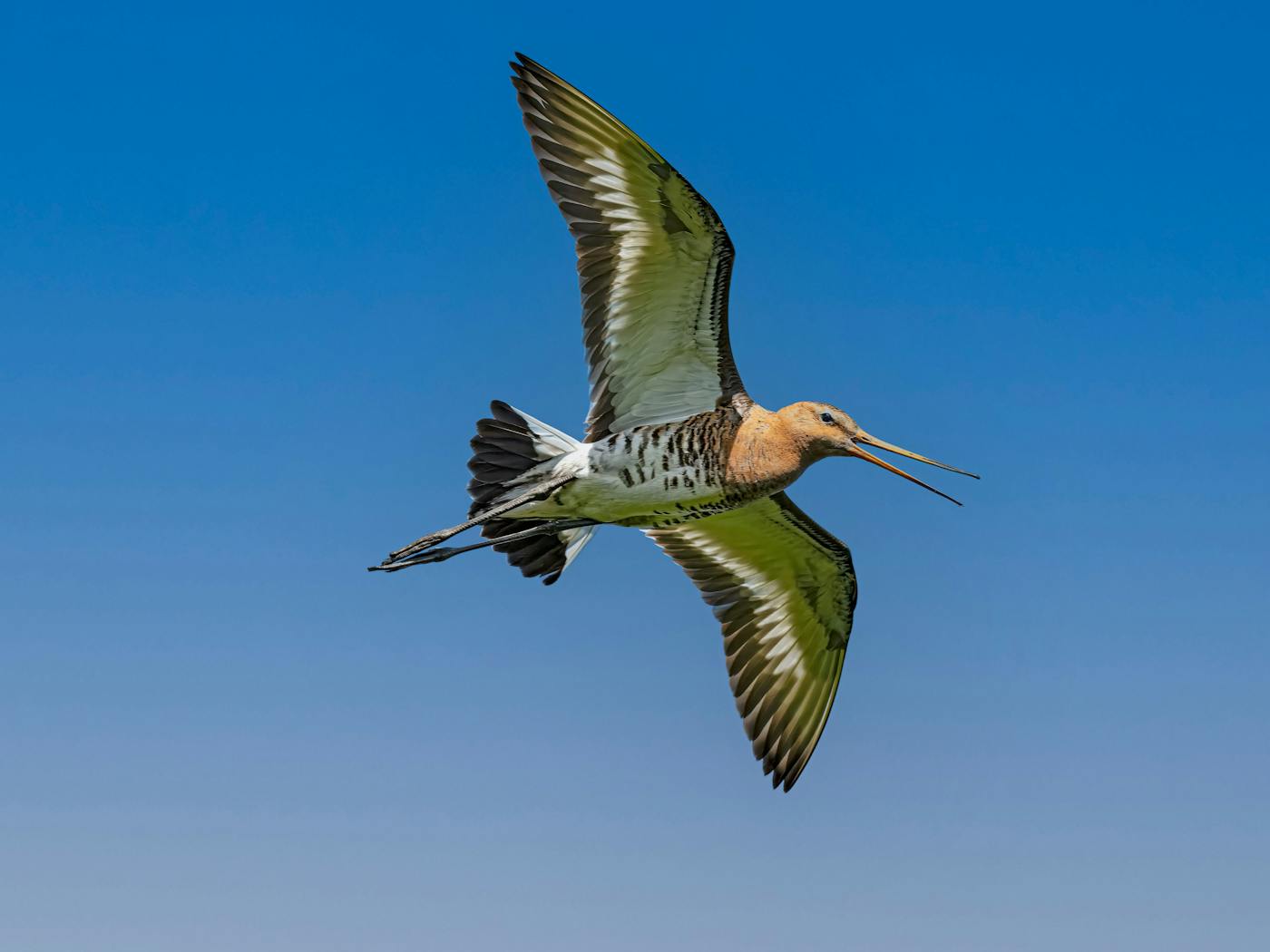
Somewhere over the Pacific Ocean, roughly halfway between Alaska and the southern coast of Australia, a small brown bird was doing something that had never been recorded before. No land beneath it. No landmarks to follow. No parent beside it to show the way. Just open water in every direction, and a destination it had never seen. At five months old, on its very first migration, this juvenile bar-tailed godwit was already 8,000 kilometers into a journey that would rewrite the record books. Scientists watching its satellite signal in real time knew they were seeing something extraordinary. So did the millions of people who read about it afterward. Records are one thing. A five-month-old bird crossing half the planet alone, on instinct, with no prior experience and no guide, is another matter entirely. How it knew where to go is a question researchers are still working to answer.
Contents
show
Eleven Days. No Stops. No Exceptions.
In October 2022, a juvenile bar-tailed godwit designated B6 departed Alaska’s Kuskokwim Delta and flew continuously for 11 days, covering 13,560 kilometers before landing in Tasmania, Australia. B6 ate nothing during that time, drank nothing, and did not rest once. Every kilometer was completed in a single, unbroken flight across one of the most remote stretches of ocean on earth.
Scientists confirmed the journey using a 5-gram solar-powered satellite transmitter attached to B6’s rump, along with a U.S. Geological Survey metal band and a uniquely coded leg flag. B6 left on October 13 and touched down on October 24. When the data came in, researchers knew immediately they were looking at the longest non-stop flight ever recorded for any animal in history.
What made it stranger still was B6’s age. At the time of departure, B6 was five months old and had never made this journey before. It was, in every sense, a first attempt.
A Species Built for the Impossible
Bar-tailed godwits, known scientifically as Limosa lapponica, are shorebirds that breed in Alaska and spend their winters as far south as New Zealand and southeastern Australia. Two subspecies use the East Asia/Australasia Flyway, and B6 belongs to the baueri race, which breeds in western Alaska and migrates annually to New Zealand and eastern Australia. Population estimates put the total flyway count at around 325,000 birds. A typical baueri godwit, if it survives long enough, will log more than 460,000 kilometers across its entire lifespan.
Ornithologists had long suspected these birds were capable of extraordinary non-stop distances, but confirmation required technology. In 2007, researchers from the Pacific Shorebird Migration Project, a joint initiative between the U.S. Geological Survey and PRBO Conservation Science, used satellite telemetry to track individual birds for the first time. What they found changed the record books almost immediately.
A Record That Keeps Getting Broken
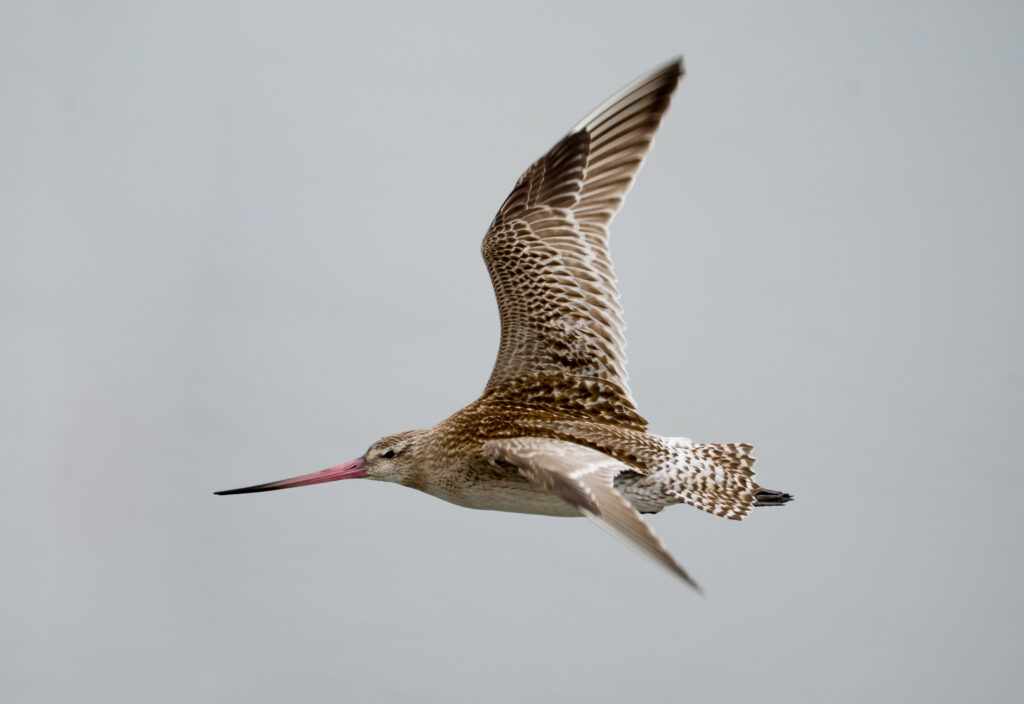
USFWS – Pacific Region
In 2007, a female godwit named E7 flew 11,680 kilometers from Alaska to New Zealand in just over eight days, setting the first confirmed world record for non-stop bird flight. Scientists celebrated what seemed like a ceiling.
Thirteen years later, a male known as 4BBRW departed the same Alaskan mudflats and flew more than 12,000 kilometers to New Zealand in 11 days, breaking E7’s record. Satellite data logged point-to-point distances of 12,854 kilometers, with researchers estimating the actual route at around 12,200 kilometers after accounting for rounding. Scientists celebrated again.
Two years after that, B6 broke 4BBRW’s record by more than 1,000 kilometers and became the first juvenile godwit ever tracked on a southbound migration. Each successive record has been set by the same species, each pushing further than the one before. At this point, the question is less whether the record will be broken again and more when.
What the Body Does Before Takeoff
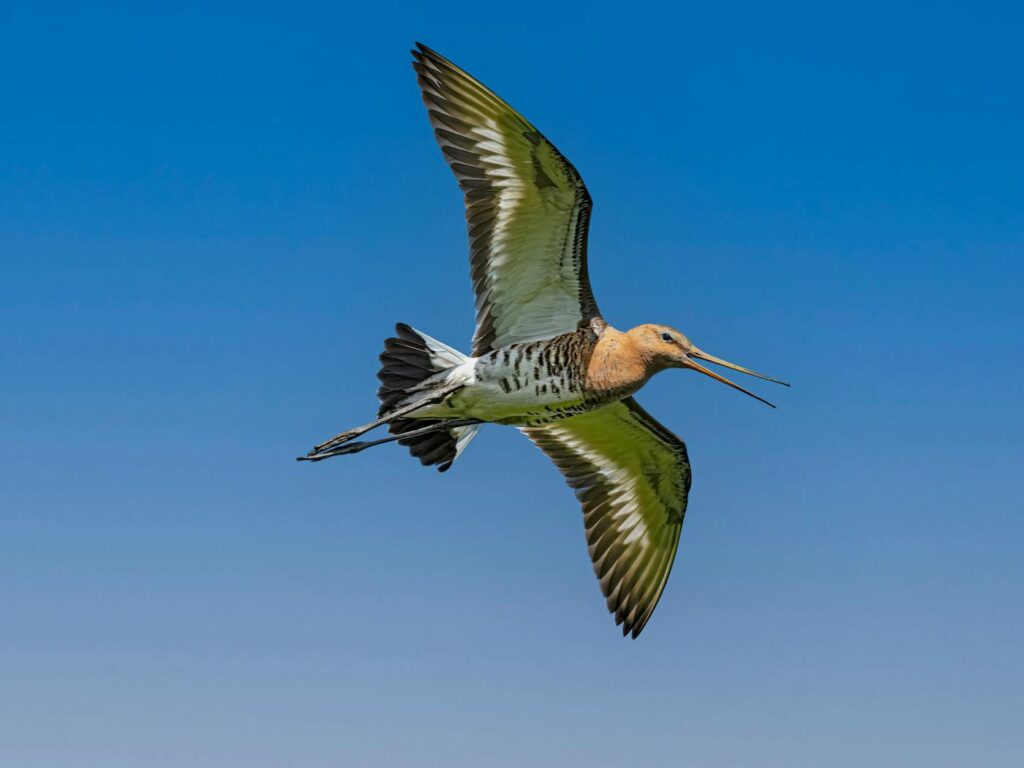
Understanding how godwits survive 11 days of continuous flight requires understanding what happens in the weeks before departure. At coastal staging sites like Kuskokwim Shoals, the birds feed intensively, accumulating fat reserves that eventually exceed half their total body weight. Males can roughly double in size during this period. Fat becomes the only fuel source for the entire journey, and none of it gets replenished until the bird lands.
More striking is what happens internally. Gizzards and intestines, organs that serve no purpose during sustained flight, shrink to near nothing before departure. By stripping away the digestive infrastructure it does not need, the bird reduces weight and energy demands simultaneously. What lifts off from the Alaskan coast is not quite the same bird that spent the summer feeding. It has, in a real physiological sense, rebuilt itself into something optimized purely for distance.
During flight, godwits average around 56 kilometers per hour, aided by tailwinds where conditions allow. At its peak, 4BBRW was recorded flying at speeds of up to 90 kilometers per hour. B6 crossed the Pacific in 11 days. At no point during that crossing did any of it slow down enough to land.
The Question Everyone Is Asking
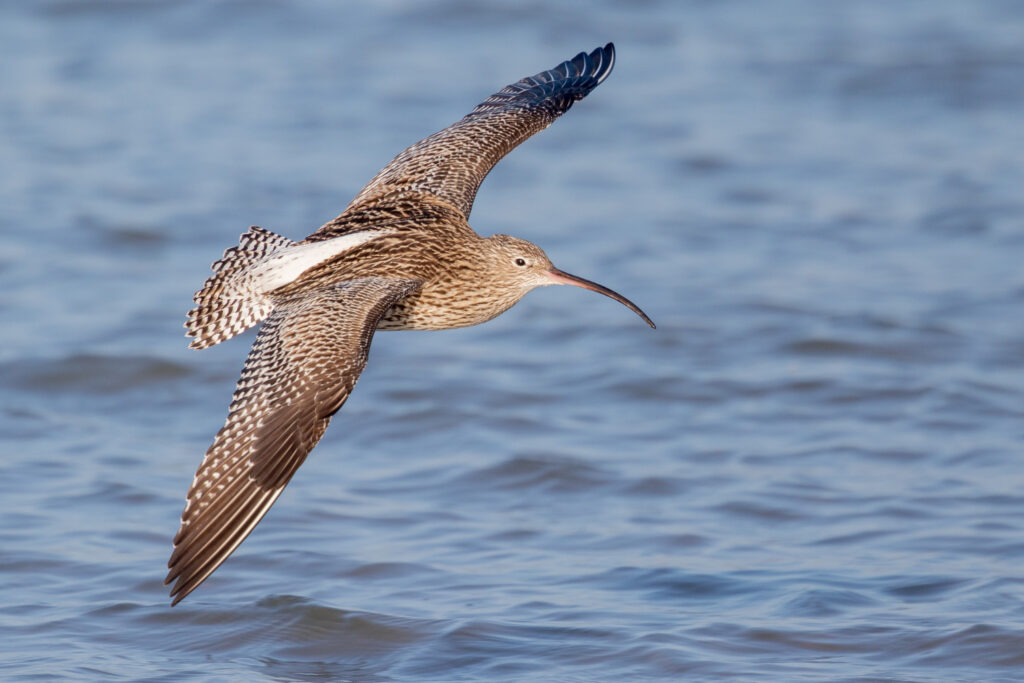
When news of B6’s journey spread, one question dominated the response more than any other. How does a five-month-old bird, on its very first migration, know where to go?
Dr. Jesse Conklin of the Global Flyway Network put it plainly. “They seem to have some capability of knowing where they are on the globe,” he said. “We can’t really explain it, but they seem to have an onboard map.” For days at a stretch, godwits fly over open ocean with no land visible anywhere in the mid-Pacific. No reference points. No corrections possible. Just an internal sense of direction that, somehow, keeps delivering birds to the right continent.
What makes B6’s case particularly hard to explain is that no experienced bird led the way. Adult godwits migrate separately. Juvenile birds depart on their own, navigating a route they have never flown by mechanisms science has not yet fully decoded. Magnetic field sensitivity, star navigation, and inherited route memory all feature in current research, but none has been confirmed as the primary explanation. A five-month-old animal crossed nearly half the planet on its first try, and researchers still cannot say exactly how.
Conklin offered one observation that caught public attention widely. As godwits approach the island chains near New Caledonia and Papua New Guinea, after days of flying over featureless ocean, their flight paths begin to shift. “It really looks like they start spotting land,” he said, “and sort of think: ‘Oh, I need to start veering or I will miss New Zealand.’” Whether that reflects genuine spatial recognition or something else entirely, science has not yet settled the matter.
Why Tracking a Juvenile Changed What Researchers Know
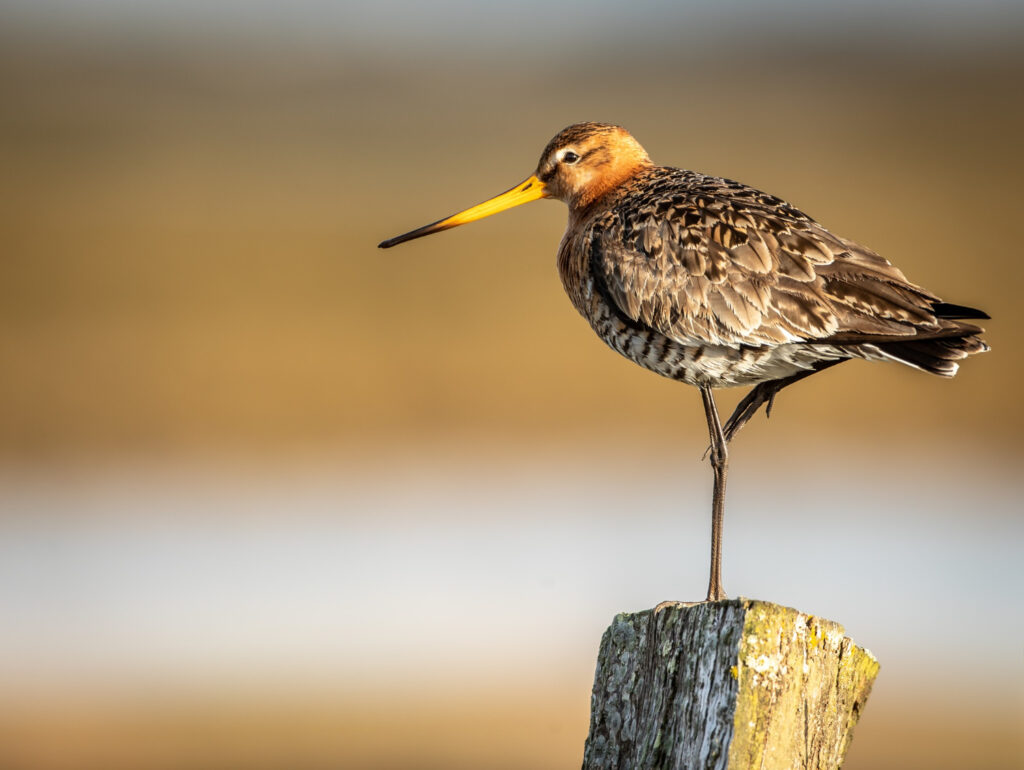
B6’s journey was not only a record. It was also a scientific first. Juvenile godwit migrations from Alaska had never previously been tracked on the southbound route, leaving researchers without data on how young birds navigate their first crossings and where along the route they face the greatest risk.
B6’s tracking formed part of a broader study run jointly by the U.S. Geological Survey, the Max Planck Institute, and the U.S. Fish and Wildlife Service, designed to map where juvenile godwits go and what conditions they encounter. Alaska provides breeding and stopover habitat for 37 shorebird species, many of which have declined sharply in recent decades. Shorebirds depend on interconnected wetland and coastal networks spread across thousands of miles, making them exposed to habitat loss, rising sea levels, and ecosystem disruption in ways that other bird groups are not. Knowing which parts of the migration carry the highest mortality risk for young birds is essential for effectively targeting conservation resources.
Getting Back Is No Easier
After wintering in Australia and New Zealand, bar-tailed godwits begin the return journey in March. Northbound migration happens in two stages rather than one. First, the birds fly nonstop to the Yellow Sea, a crossing of more than 10,000 kilometers, which they complete in six to eight days. Around the Yalu Jiang Nature Reserve in the North Yellow Sea, which functions as a critical staging site for nearly the entire baueri population, the birds rest and refeed for several weeks before pushing on to their Alaskan breeding grounds.
Across a full year, a single round trip covers roughly 29,000 kilometers. Bar-tailed godwits do this annually, year after year, for as long as they live. B6 completed the southbound leg of that trip faster and farther than any bird on record, as a juvenile, without guidance, on a route it had never flown.
Scientists will keep tracking it. For now, the question of how it knew where to go remains a question.
Reference: Battley, P. F., Warnock, N., Tibbitts, T. L., Gill, R. E., Piersma, T., Hassell, C. J., Douglas, D. C., Mulcahy, D. M., Gartrell, B. D., Schuckard, R., Melville, D. S., & Riegen, A. C. (2012). Contrasting extreme long‐distance migration patterns in bar‐tailed godwits Limosa lapponica. Journal of Avian Biology, 43(1), 21–32. https://doi.org/10.1111/j.1600-048x.2011.05473.x
Alaska Wildlife, animal migration, Animal Navigation, Avian Endurance, B6 Godwit, Bar-Tailed Godwit, Bird Migration, Bird Tracking, Bird World Record, conservation science, Juvenile Bird Migration, Migratory Birds, Non-Stop Flight Record, Pacific Flyway, Pacific Ocean Migration, Satellite Telemetry, Shorebirds, Tasmania Australia, USGS Research, Wildlife Science