
Your cart is currently empty!
April’s Pink Moon Rises on April 1. Here’s Exactly When and How to See It

April’s opening act arrives not on a stage but in the sky. On Wednesday, April 1, the full Pink Moon will reach peak illumination at 10.13 p.m. EDT and 7.13 p.m. PDT, marking the first full moon of spring in the Northern Hemisphere. It will glow bright and round on the nights before and after as well, appearing full to the naked eye on March 31 and April 2. But Wednesday alone offers a particular alignment that skywatchers on the West Coast have reason to circle on their calendars, and the moon’s proximity to one of the brightest stars in the night sky gives everyone else a reason to look up, too. Before any of that, though, one popular misconception deserves clearing up.
Contents
show
No, It Won’t Actually Look Pink
Every April, the same question surfaces. Will the moon turn pink? According to The Old Farmer’s Almanac, “While the name ‘Pink Moon’ might suggest a rosy-colored Moon, the reality is a bit less magical. The name comes from the early spring bloom of a wildflower native to eastern North America: Phlox subulata, commonly known as creeping phlox or moss phlox.” Moss phlox, sometimes called “moss pink,” carpets fields and hillsides across eastern North America each spring, and its bloom cycle happened to coincide with April’s full moon often enough that the name stuck.
Rather than pink, the moon on the evening of April 1 is far more likely to appear orange or amber as it rises low on the horizon. At that angle, reflected sunlight passes through a denser slice of Earth’s atmosphere, which scatters shorter blue and violet wavelengths and allows only warmer, redder hues to reach the observer. As the moon climbs higher through the night, that warm tint fades into the familiar silvery white.
April’s full moon carries several other names rooted in Indigenous traditions across North America. Among the Algonquin people, it is known as the Breaking Ice Moon. Dakota communities call it the Moon When the Streams Are Again Navigable. In Tlingit tradition, it becomes the Budding Moon of Plants and Shrubs, while the Oglala refer to it as the Moon of the Red Grass Appearing. Among the Anishinaabeg (Ojibwe) people of the Great Lakes region, it goes by the Broken Snowshoe Moon, according to the Center for Native American Studies. Other common names, Sprouting Grass Moon, Egg Moon, and Fish Moon, each point to seasonal markers that predate modern calendars and served as practical tools for tracking the passage of months.
A Rare Sync on the West Coast
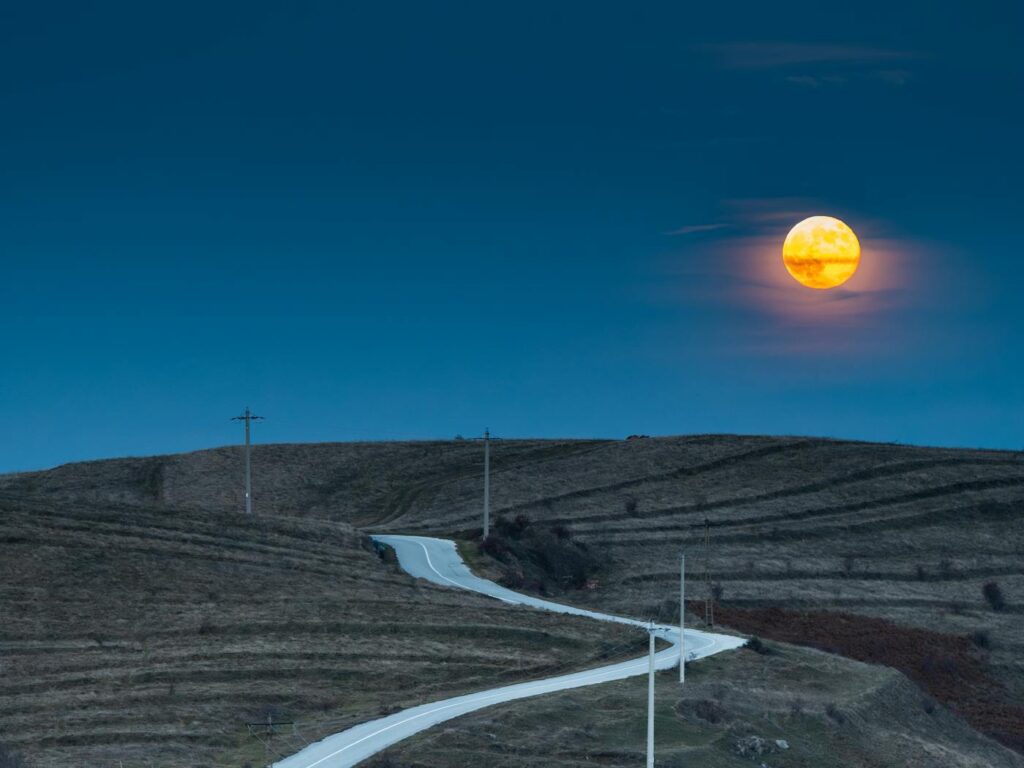
Knowing when to look matters almost as much as knowing where. A full moon always delivers its most dramatic visual when it first appears above the eastern horizon during dusk, rising into the fading light of “blue hour” and creating a contrast that no photograph quite captures. April’s Pink Moon offers an especially strong version of that effect across North America.
On the West Coast, a rare triple alignment occurs on April 1. Sunset, moonrise, and the exact moment of full illumination all converge at 7.13 p.m. PDT, according to sunrisesunset.com. Observers in Los Angeles and along the Pacific coast will see the full moon lift above the eastern horizon at the precise instant the sun drops below the western horizon, with the moon reaching technical fullness at that same moment. It is the kind of synchronicity that happens once in a generation of lunar cycles.
In New York, the timing is nearly as favorable. Sunset arrives at 7.20 p.m. EDT, and moonrise follows five minutes earlier, at 7.15 p.m. EDT, meaning the moon will already sit just above the horizon as twilight settles in. For viewers in any time zone, the advice remains the same. Find an elevated location, an open field, or an east-facing coastline with an unobstructed view of the horizon. A moonrise calculator can pinpoint the exact minute for any given location.
Star-Hop to Spica for a Double Feature
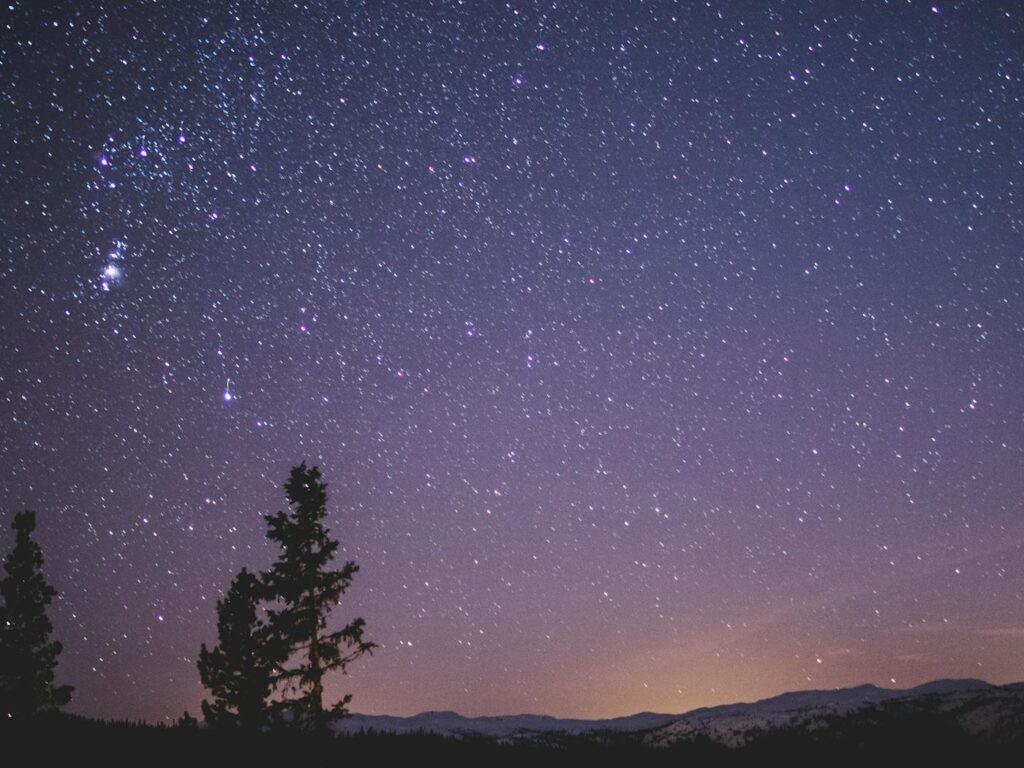
April 1 delivers more than just the Pink Moon. Spica, the brightest star in the constellation Virgo and the 16th brightest in the entire night sky, will sit just below the moon as it rises. By the following evening, April 2, the waning gibbous moon will have drifted even closer, passing within 1.8 degrees of Spica according to AstroPixels.
Finding Spica requires no telescope and only a passing familiarity with one of the most recognizable patterns in the sky. As darkness falls and the Pink Moon rises, look to the northeast for the Big Dipper, which in early April will appear to be standing on its handle. Trace the arc of that handle downward and follow the curve to reach Arcturus, a bright orange star low in the east. From Arcturus, continue along the same sweeping line toward the horizon to arrive at Spica, glowing just beneath or beside the Pink Moon. Astronomers have long used the mnemonic “arc to Arcturus, speed on to Spica” to teach this particular star-hop, and April 2026 provides one of the best backdrops for trying it.
One Moon, Two Holy Calendars

Beyond its appeal as a visual event, April’s full moon plays a quiet but decisive role in two of the world’s major religious traditions. As The Old Farmer’s Almanac notes, “In Christianity, it’s known as the Lenten Moon if it’s the last Full Moon of winter (before the spring equinox) or the Paschal Full Moon if it’s the first ecclesiastical Full Moon of spring (after the equinox).”
Because the astronomical spring equinox fell on March 20 in 2026, the Pink Moon qualifies as the Paschal Moon. Western Christian tradition places Easter on the first Sunday after the first full moon following the spring equinox, though the church uses a fixed equinox date of March 21 for its calculations rather than the fluctuating astronomical one. With the Pink Moon arriving on April 1 (or April 2 in UTC), Easter Sunday falls on April 5.
Eastern Orthodox Easter operates on a different timeline. Many Eastern European churches still use the Julian calendar for liturgical purposes, even while observing the Gregorian calendar for civil events, which means Orthodox Easter lands a week later, on April 12.
On the Jewish calendar, the full moon falls at the midpoint of each lunar month. April’s full moon coincides with the 15th day of Nisan, and Passover (Pesach) begins at sunset on April 1. It is a purely calendrical relationship, a product of the Hebrew lunisolar system, but the practical result is that one full moon anchors two of the most widely observed religious holidays of the spring season.
Spring’s Invitation to Pause and Reflect

For those drawn less to liturgical calendars and more to personal ritual, the Pink Moon carries its own kind of weight. As the first full moon of spring and a Libra full moon in astrological terms, many observers treat April 1 as a natural checkpoint for reflection. Journaling, meditation, and letters of release are popular practices tied to full moon observance, and the symbolic shift from winter’s stillness to spring’s renewal gives these rituals a seasonal resonance that feels earned rather than forced. Whether or not one subscribes to astrological frameworks, there is something to be said for pausing at a moment when the natural world itself appears to be starting over.
What Comes After the Pink Moon
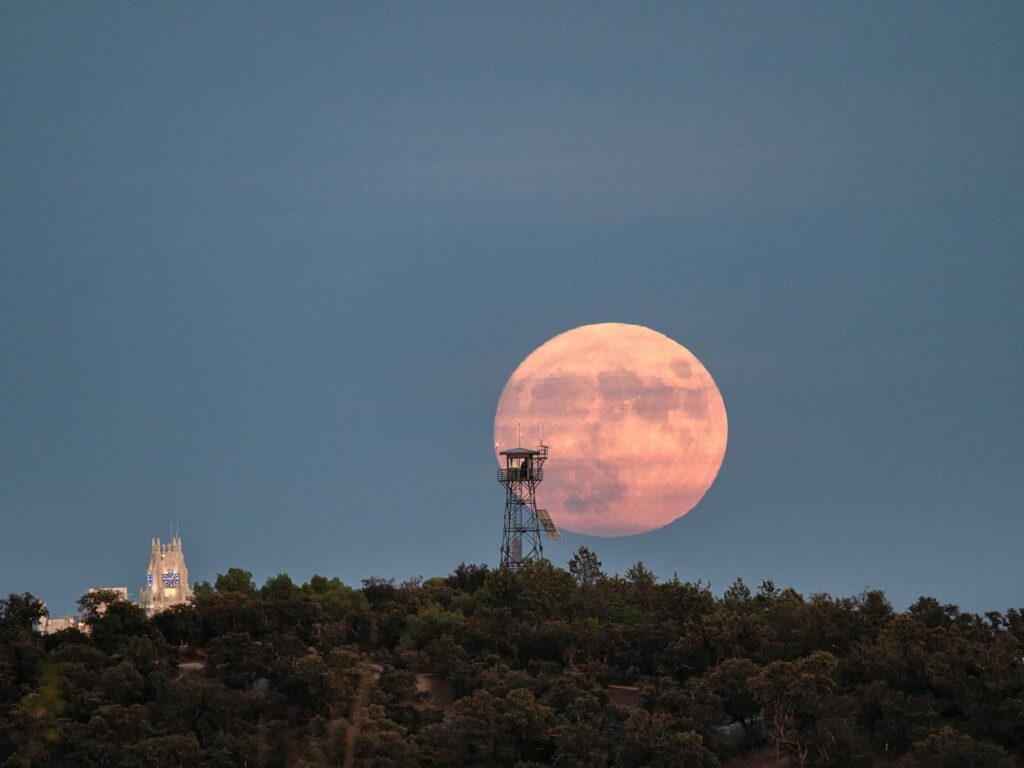
April’s display is just one chapter in a lunar year that has already been eventful and will only grow more so. “Thanks to this seasonal connection, the April Full Moon became known as the Pink Moon!” the Old Farmer’s Almanac notes, but the calendar does not stop here.
May 1 brings the Flower Moon, also known as the Corn Planting Moon and the Milk Moon, and it will be the first of two full moons in the same calendar month. A second full moon on May 31 will qualify as a Blue Moon, defined as the second full moon within a single calendar month. 2026 features 13 full moons in total, a quirk that occurs because a solar year (365.24 days) runs about 11 days longer than a lunar year (354.37 days), occasionally squeezing an extra cycle into the calendar.
Earlier in 2026, March delivered a “blood moon” total lunar eclipse. Looking ahead, November and December will each produce a supermoon, with December’s falling on Christmas Eve. For anyone whose interest in the night sky begins with the Pink Moon, the rest of the year offers plenty of reasons to keep looking up.
How to Make the Most of April 1
A few practical reminders for Wednesday evening. Head outside around 15 to 20 minutes before your local moonrise time and face east. Give your eyes a few minutes to adjust. Binoculars will sharpen the view of Spica near the moon, but the naked eye will catch everything else. Clear skies are ideal, and checking a local weather forecast beforehand will save a trip into the cold if clouds roll in.
No special equipment is needed, no app is required, and no expertise separates the casual observer from the seasoned astronomer on a night like April 1. A full moon rising during blue hour, a bright star glowing just beneath it, and the first warm evenings of spring creating the backdrop are more than enough on their own.
astronomy 2026, Blue Moon May 2026, Easter 2026, Flower Moon, full moon April 2026, full moon photography, lunar calendar, moonrise, Native American moon names, Paschal Moon, Passover 2026, Phlox subulata, Pink Moon 2026, Pink Moon viewing guide, skywatching, Spica star, spring equinox, star-hopping guide, supermoon 2026