
Your cart is currently empty!
Apple’s iPhone Fold Surfaces in Leaked Dummy Unit Photos Next to iPhone 18 Pro
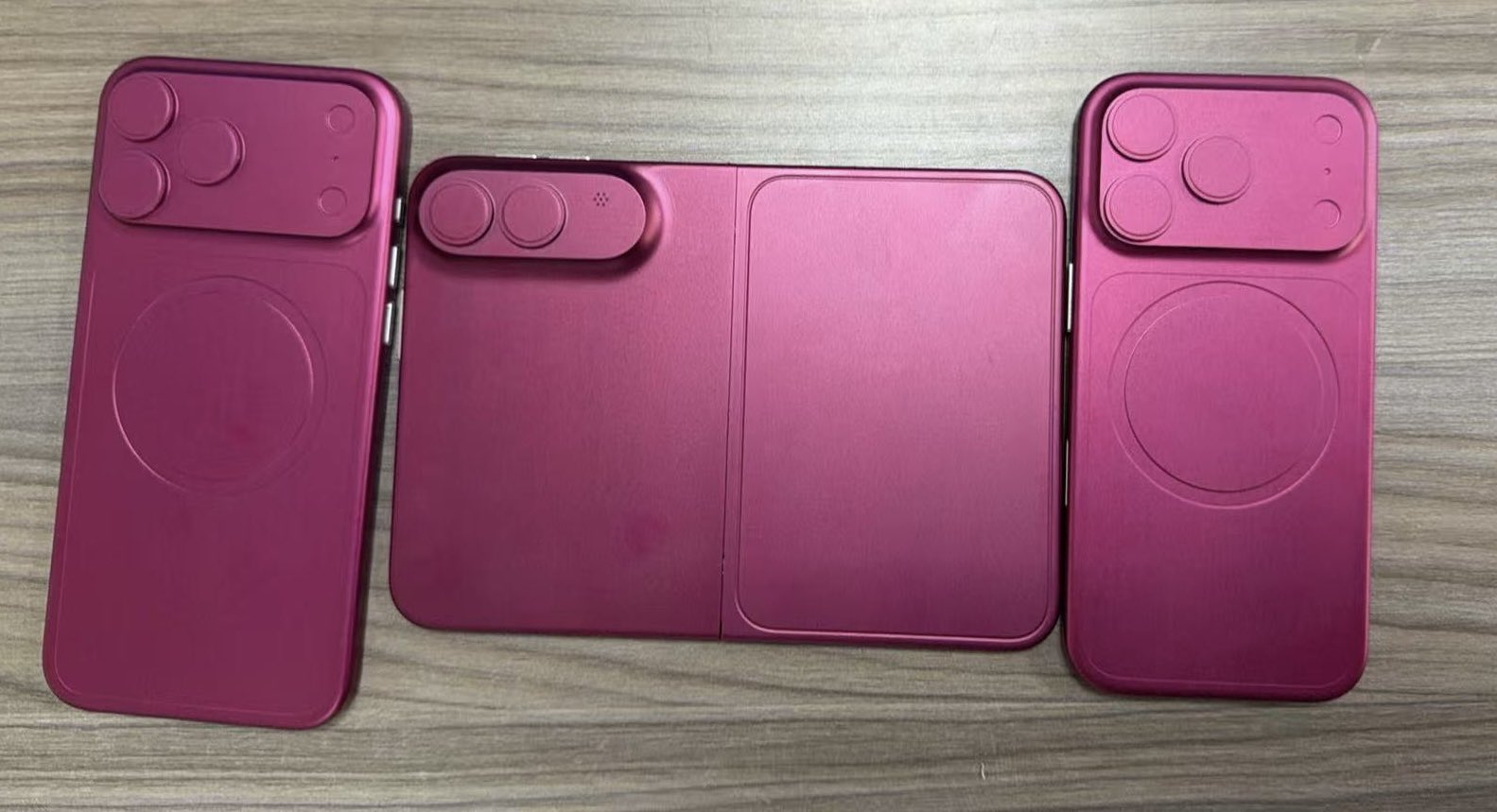
For years, Apple watched from the sidelines as Samsung, Google, and a wave of Chinese manufacturers released foldable after foldable. Speculation about whether Cupertino would ever enter the category became an annual tradition, right up there with leaked case designs and supply chain whispers. Now, thanks to a set of dummy units shared by leaker Sonny Dickson, we have our most concrete look yet at what Apple has been building behind closed doors. And it looks like nothing the company has ever made.
Contents
show
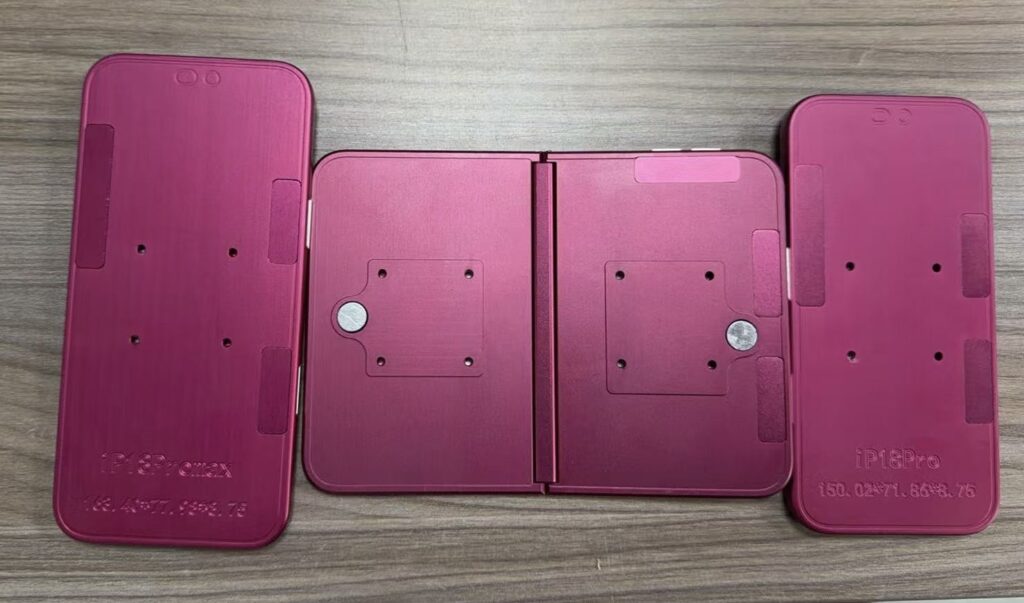
Dickson, who has a strong track record when it comes to sourcing accurate pre-release hardware mockups, posted images on Bluesky showing three devices side by side. Two of them, the iPhone 18 Pro and iPhone 18 Pro Max, look almost identical to their current-generation counterparts. Minor changes in dimensions aside, neither would turn heads on a spec sheet. Between them, though, sits something entirely new. Something wide, squat, and unmistakably different from every iPhone that came before it.
Dummy units like these are produced for accessory manufacturers who need to design and mass-produce cases, screen protectors, and other add-ons well before Apple releases official schematics. While they lack finer details like camera cutouts, MagSafe charging rings, and internal display features, their dimensions and overall proportions tend to be reliable. What Dickson’s images reveal is a device that breaks sharply from both Apple’s own design language and the conventions established by Android’s foldable market.
A Passport in Your Pocket
Pick up a passport, hold it in one hand, and you have a rough sense of what Apple’s foldable iPhone will feel like when closed. Rather than the tall, narrow slab shape that has defined every iPhone since 2007, the Fold adopts a wider, shorter profile that prioritizes horizontal screen real estate when opened. Closed, it sits in the hand differently than any current iPhone. Some users may find the extra width awkward for one-handed use, a trade-off Apple appears willing to accept.
When unfolded, the inner display measures roughly 7.8 inches diagonally with an aspect ratio close to 4:3, similar to what you would find on an iPad mini. On paper, 7.8 inches does not sound dramatically larger than the 6.9-inch display on the Pro Max. In practice, though, the difference is substantial. Because the Fold’s screen is closer to square than the elongated rectangle of a standard iPhone, its total usable surface area lands much nearer to Apple’s smallest tablet than to its largest phone. For reading, browsing, multitasking, and media consumption, that gap matters more than the raw diagonal number suggests.
Among existing foldables, Google’s first-generation Pixel Fold comes closest in overall shape, though the iPhone Fold appears wider still. Samsung, too, is rumored to be working on a “Wide Fold” variant of its Galaxy Z Fold line for later in 2026, a sign that multiple manufacturers see value in this kind of form factor. If both devices ship as expected, consumers could soon have two very different takes on the same basic idea to compare.
Why Apple Went Wide
Apple’s decision to build a wider foldable is not arbitrary. It reflects a clear bet on what the unfolded experience should feel like. Most book-style Android foldables open to a nearly square display, which works well enough for apps and general productivity but creates visible black bars when watching widescreen video. Movies, television shows, and most streaming content are shot in 16:9 or wider aspect ratios, and a square screen wastes a meaningful portion of its area on those black bars.
By going wider when closed, Apple created an unfolded display that stretches into landscape orientation more naturally. Video fills more of the screen. Games benefit from a broader field of view. Apple is also planning to update iOS so that apps on the Fold’s large display will resemble their iPad counterparts, blurring the line between phone and tablet software in a way that no Android foldable has yet managed with stock software.
Whether that trade-off is worth a potentially clunky closed-phone experience will depend on individual users. Early reactions have been mixed, and Dickson’s images make clear just how different the proportions are compared to a standard iPhone. For those who value the big-screen experience above all else, though, Apple’s approach has a compelling logic.
Razor-Thin Build, Camera Compromises
Perhaps the most striking engineering detail to emerge from recent leaks concerns thickness, or rather, the lack of it. Unfolded, the iPhone Fold will measure less than 5 millimeters, making it the thinnest iOS device Apple has ever produced. When closed, it grows to approximately 9.5 millimeters, a bit thicker than the 8.75-millimeter profile of the iPhone 18 Pro and Pro Max but hardly pocket-busting.
Achieving that thinness, however, required sacrifice. Apple was unable to fit its Face ID sensor array into the Fold’s slim body, so the device will rely on Touch ID built into the side button instead. For users who have grown accustomed to Face ID over the past several years, the return to fingerprint authentication may feel like a step backward, even if Touch ID remains a proven and fast biometric system.
On the back, the dummy unit shows a horizontal dual-camera array housed in a raised, pill-shaped island that stretches about two-thirds of the way across the device’s width. Unlike the iPhone 18 Pro’s camera plateau, which extends the full width of the phone, the Fold’s camera module stops short, suggesting a different internal arrangement. Rumors also indicate that the device’s entire rear panel may be glass, similar to the iPhone Air, rather than a unibody design with a separate glass insert for wireless charging.
As for the crease, that perennial bugbear of foldable phones, multiple sources suggest Apple has developed a near-invisible fold line on the inner display. Dickson’s dummy unit shows a visible hinge seam, but dummy models are not designed to replicate display technology. If Apple has indeed cracked the crease problem, it would address one of the most common complaints consumers have about competing foldables.
How It Differs from Earlier Renders
Before Dickson’s dummy images surfaced, the best visual reference for the iPhone Fold came from a community-made 3D model published by a MacRumors forums user earlier in 2025. Based on circulating rumors at the time, the speculative render predicted several features that the dummy now confirms, including a horizontal camera layout and volume buttons positioned along the top edge of the device.
Key differences have also emerged. Most visibly, the Fold does not appear to share the iPhone 18 Pro’s unibody rear construction. Where the Pro models feature a window for a glass insert to enable wireless charging, the Fold’s back shows no such separation, pointing toward an all-glass design. And while the earlier render depicted a camera bar running the full width of the phone, the actual dummy shows a shorter module, a distinction that may hint at different internal component placement or thermal management needs.
September Launch Still on the Table
Production timelines for a device this complex were always going to attract scrutiny, and a report from Nikkei Asia on Tuesday added fuel to speculation about a potential delay. According to Nikkei, early engineering test runs encountered challenges that could push back the Fold’s production and shipment schedule. “Apple and the supply chain are working under a pressured timeline and the current solutions are not enough to completely solve the engineering challenges,” one source told Nikkei. “More time is needed.” Apple’s stock dropped as much as 5.1 percent on the news before recovering later in the session.
Hours later, Bloomberg’s Mark Gurman pushed back on the delay narrative. According to people familiar with Apple’s plans, the company still intends to introduce the foldable iPhone in September, right alongside the iPhone 18 Pro and Pro Max. “While the complexity of the new display and materials may limit initial supply for several weeks, Apple is currently operating with a plan to put the device on sale around the same time — or very soon after — the new non-foldable models,” Bloomberg reported. Apple shares pared their losses following Bloomberg’s report, closing down about 2.1 percent.
Still, September is six months away, and mass production has not yet begun. Apple declined to comment, and the usual caveats about pre-production timelines apply. Even if the Fold does arrive on schedule, early supply constraints could make it difficult to purchase for weeks after launch.
Pricing and Apple’s Bigger iPhone Roadmap

Expect sticker shock. Multiple sources now agree that the iPhone Fold will carry a starting price above $2,000, placing it well above even the most expensive Pro Max configuration. For Apple, that premium price point serves a dual purpose. It positions the Fold as an aspirational, top-of-line product while boosting the company’s average iPhone selling price, a metric Wall Street watches closely.
“The product’s price is expected to cross the $2,000 threshold, which could deter some consumers, but should boost Apple’s average sales price and help fuel revenue growth for the company,” Bloomberg noted.
Beyond the Fold itself, Apple’s iPhone roadmap for the next two years is unusually ambitious. Last year’s launch brought overhauled Pro and Pro Max models and the slim iPhone Air. If the Fold ships in September as planned, it will represent step two in what appears to be a three-year effort to reshape the entire iPhone lineup. An entry-level iPhone 18, a refreshed iPhone Air, and a budget-oriented iPhone 18e are all expected in spring 2027, marking a deliberate move away from the single annual launch window that defined iPhone releases for over a decade. Hardware chief John Ternus, widely reported as a leading candidate to eventually succeed Tim Cook as CEO, has been closely involved in steering that product vision.
For now, all eyes remain on September. If Apple can deliver a foldable that lives up to its engineering promises, solves the crease problem, survives daily use, and justifies a $2,000 price tag, it could reshape how millions of people think about what a phone can be. If early production hiccups prove more serious than Bloomberg’s sources suggest, the wait may stretch a bit longer. Either way, after years of patience, Apple appears ready to fold.
Image Source: Sonny Dickson
x.com/SonnyDickson/status/2041395690598019402/photo
Apple foldable display, Apple foldable phone, Apple September 2026, foldable iPhone release date, iPhone 18 Pro, iPhone Fold, iPhone Fold design, iPhone Fold dummy unit, iPhone Fold price, iPhone Fold specs, iPhone Fold vs iPhone 18 Pro Max, Mark Gurman Bloomberg, Sonny Dickson leak, Touch ID iPhone Fold