
Your cart is currently empty!
A Plasma Physicist Says Ancient Mars Was Nuked from Space. Here’s His Case.
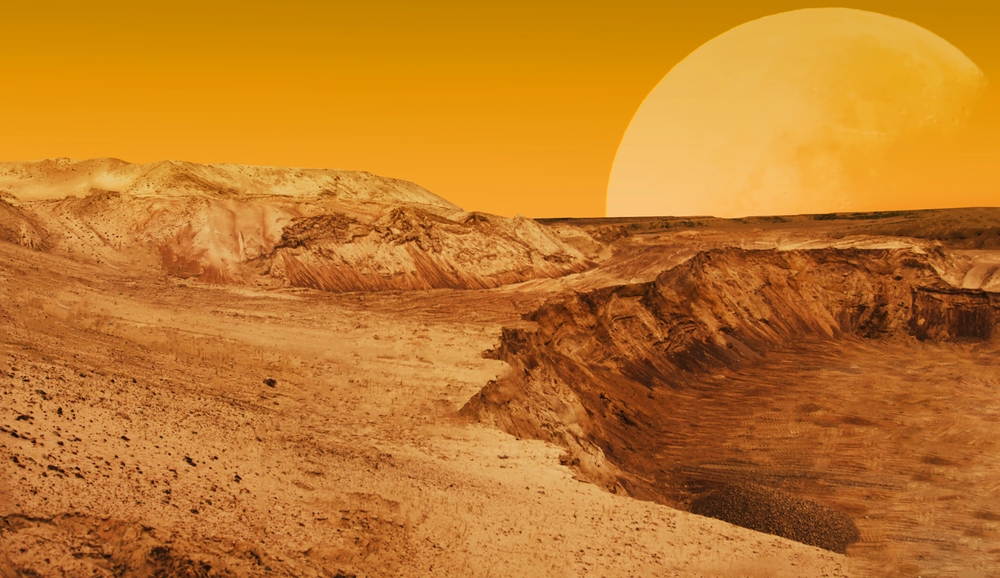
John E. Brandenburg spent years studying plasma physics. He earned his Ph.D. and built a career in applied physics, working on projects ranging from missile defense to space propulsion. But in 2014, he published a paper that veered far from conventional planetary science and into territory most of his peers would never touch.
Contents
show
Brandenburg proposed something extraordinary. He argued that Mars once harbored a primitive civilization, one that built monuments and spread across the planet’s northern hemisphere. And he claimed that civilization met a violent end, not through climate change or asteroid impact, but through deliberate nuclear annihilation by an alien intelligence. His evidence? Isotopic signatures in the Martian atmosphere, gamma ray data from orbiting spacecraft, and formations on the surface that he interprets as eroded archaeological ruins.
Published in the Journal of Cosmology, his paper weaves together atmospheric chemistry, nuclear physics, and what he considers archaeological analysis into a single, sweeping argument. Most planetary scientists reject his conclusions. But the data he points to, particularly the unusual composition of noble gases in Mars’s atmosphere, represents a genuine scientific puzzle that researchers have debated for decades.
Fermi Asked First
Before Brandenburg could make his case about Mars, he needed a frame. He found one in a question posed over lunch at Los Alamos in 1950.
Enrico Fermi, the physicist who had helped build the first nuclear reactor, was eating with Edward Teller and other scientists when the conversation turned to extraterrestrial life. Fermi ran the numbers in his head. Given the age of the universe, the abundance of planets, and the chemical building blocks of life scattered everywhere, intelligent civilizations should have arisen countless times. Radio signals, spacecraft, or at least some detectable trace of their existence should be obvious.
“Where the hell are they?” Fermi asked. Brandenburg believes the answer may sit on the surface of Mars, written in isotopes and carved in stone.
Strange Gases in a Thin Atmosphere
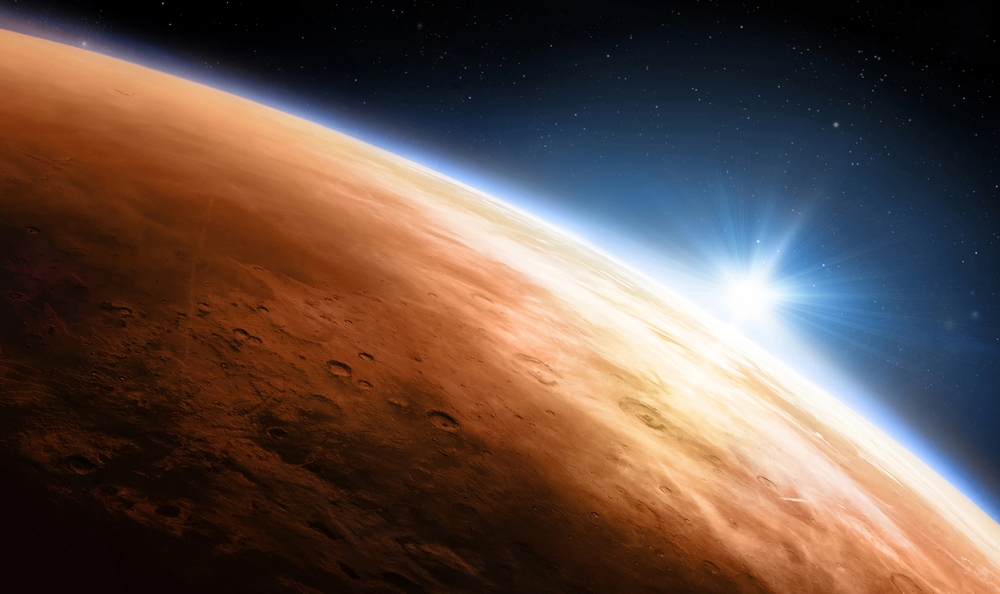
Brandenburg’s argument begins with chemistry, specifically with xenon and krypton isotopes measured in Mars’s atmosphere by landers and analyzed in Martian meteorites found on Earth.
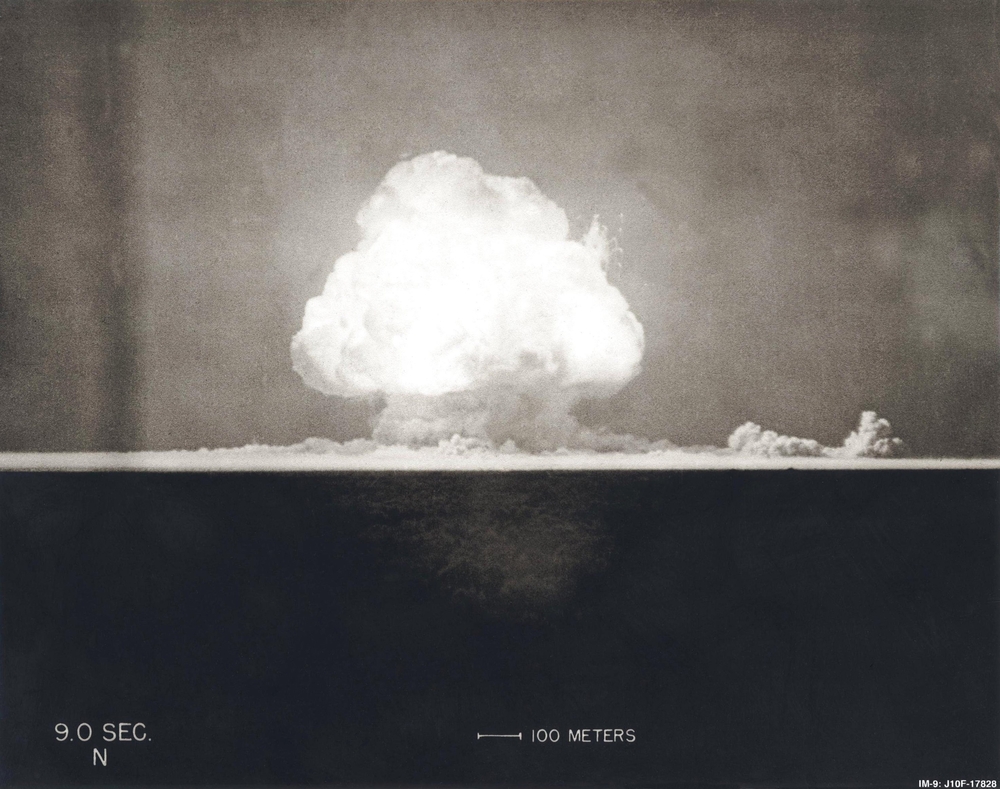
Xenon-129 appears in Mars’s atmosphere at concentrations far higher than expected. On Earth, a similar spike in xenon-129 exists, but scientists can trace it directly to atmospheric nuclear weapons testing during the Cold War. When hydrogen bombs detonate, fast neutrons cause fission in uranium and thorium casings, producing a characteristic isotopic signature dominated by xenon-129. Brandenburg mapped the Martian xenon spectrum against this weapons-testing signature and found a close match. His analysis suggested Mars’s xenon could be approximated as a mixture of roughly 70 percent nuclear-testing xenon blended with 30 percent natural xenon, as if something had dramatically altered an atmosphere that once resembled Earth’s.
Krypton isotopes on Mars show a similar disturbance. Rather than following the expected pattern where atmospheric erosion strips away lighter isotopes and leaves heavier ones behind, Martian krypton favors lighter isotopes over heavier ones. Brandenburg argues that mass fractionation cannot produce such a pattern, and only a nuclear process can.
He also points to argon-40, which appears on Mars at seven times the concentration relative to argon-36 compared with Earth. Since argon-40 results from neutron capture on potassium-39, Brandenburg interprets its abundance as further evidence that intense neutron radiation once bathed the Martian surface.
Why a Natural Reactor Falls Short
If something nuclear happened on Mars, could nature be responsible? Brandenburg considered and rejected that possibility.
Natural fission reactors have occurred on Earth. Around two billion years ago, groundwater-moderated uranium deposits at Oklo in Gabon sustained chain reactions for hundreds of thousands of years. But those reactors ran on slow, moderated neutrons. Brandenburg’s xenon data points to fast neutron fission, a process requiring conditions that natural uranium deposits cannot produce without artificial enrichment.
Fast neutron chain reactions demand highly concentrated fissile material in compact configurations, essentially weapons-grade conditions. Natural uranium, even at its higher ancient enrichment levels, cannot sustain such reactions without moderation. Brandenburg also noted that natural reactors, breeding uranium-233 from thorium in subsurface ore bodies before blowing apart, would have left large craters. No such craters exist at either of his proposed blast sites.
Two Blast Zones, One Debris Pattern
Brandenburg identified two centers of radiation on Mars. One sits in Mare Acidalium at approximately 50 degrees north latitude and 30 degrees west longitude, near the region known as Cydonia Mensa. A second, smaller signature appears in Utopia Planum near Galaxias Chaos, at roughly 50 degrees north and 120 degrees west.
Data from the Mars Odyssey spacecraft’s Gamma Ray Spectrometer revealed concentrated hotspots of thorium and radioactive potassium at both locations. A third concentration appears at the approximate antipode of the larger hotspot, a feature Brandenburg attributes to shockwaves traveling around the planet from a massive blast. Maps of radioactive potassium-40 show the same spatial features, including the antipodal deposit.
Mars meteorites tell a split story. Subsurface rock samples show uranium and thorium levels depleted by a factor of three to ten compared with Earth, while surface measurements register near-Earthlike abundances. Brandenburg interprets this discrepancy as evidence that a concentrated body of uranium and thorium once existed on Mars’s surface, exploded, and scattered enriched debris across the planet.
No large impact crater marks either blast center. Combined with the fast neutron spectrum and the energy scales involved, Brandenburg concluded that the only known phenomenon matching all these observations is thermonuclear weapons detonated in mid-air, where the Mach Stem effect would have amplified shockwave overpressure across vast areas.
Estimating the Yield
Brandenburg calculated the total energy release through three independent methods, each arriving at approximately 10^25 joules, or roughly 10 billion megatons. For comparison, that figure rivals the Chicxulub asteroid impact that ended the age of dinosaurs on Earth 66 million years ago.
His first calculation drew on the abundance of xenon-129 in Mars’s atmosphere and the fraction produced per fission event. His second used the neutron fluence of 10^14 neutrons per square centimeter required to explain krypton-80 anomalies in Martian meteorites. His third estimated fission yield from the surface layer of uranium and thorium measured by the Gamma Ray Spectrometer, assuming 90 percent burnup of a fissionable casing.
At such energy levels, the explosions would have generated a global ejecta layer roughly four meters deep. Brandenburg characterized the devices as extremely “dirty,” meaning they would have induced radiation poisoning across the planet, killing any life that survived the initial blasts and subsequent climate collapse.
Monuments in the Dust
Brandenburg’s nuclear hypothesis does not exist in isolation. He tied it directly to formations on Mars that he interprets as eroded archaeological sites, a connection rooted in what he calls the Cydonian Hypothesis.
On July 25, 1976, Tobias Owen spotted an unusual formation in Viking orbiter frame 35A72 while reviewing images of Cydonia Mensa. NASA publicized it as “Head” at a press conference, then dismissed it as a trick of light and shadow. Image processing specialists Vincent DiPietro and Gregory Molenaar later obtained the electronic data, enhanced it, and discovered a second image taken roughly four weeks later. When compared, the formation appeared to show a symmetric face enclosed in a helmet-like structure.
Brandenburg argues that newer imagery from Mars Odyssey and the Mars Global Surveyor confirmed anatomical details, including eyes, nostrils, mouth, and what he calls helmet ornaments. He makes similar claims about the nearby five-sided D&M Pyramid, where high-resolution images appear to show a collapsed rectangular region that he interprets as evidence of brickwork.
At Galaxias Chaos in the Utopia region, Brandenburg identified additional face-like formations sharing ornamental details with the Cydonia structure. Mars Reconnaissance Orbiter images of one formation revealed what he describes as symmetric brickwork flanking the nose area. He reads these shared features as evidence of a connected culture spread along the shores of a hypothetical northern ocean.
Fallout Follows the Wind
One detail Brandenburg considers especially significant involves Martian wind patterns. Prevailing Coriolis-driven winds on Mars blow from the northwest to the southeast. Both proposed blast centers sit northwest of the archaeological sites Brandenburg identifies. Radioactive fallout from explosions at Mare Acidalium and Utopia Planum would have drifted directly over Cydonia Mensa and Galaxias Chaos, blanketing those regions in lethal debris.
Brandenburg views this alignment as too precise to dismiss as a coincidence, suggesting the blasts were aimed at population centers.
A Warning Written in Isotopes
Brandenburg frames his findings through what he calls a “Dark Star Scenario,” borrowing from astronomer Edward Harrison’s theory that older predatory civilizations might destroy younger species once they become detectable through radio emissions. “It is possible the Fermi Paradox means that our interstellar neighborhood contains forces hostile to young, noisy civilizations such as ourselves,” Brandenburg wrote. He speculates these forces could range from rogue artificial intelligence to bureaucratic alien powers, drawing comparisons to science fiction to illustrate possibilities that remain, for now, entirely speculative.
Where Science Meets Skepticism
Brandenburg’s paper appeared in the Journal of Cosmology, a publication that has drawn persistent criticism from mainstream scientists for its editorial standards and its willingness to publish fringe research. Most planetary scientists attribute the xenon and krypton anomalies on Mars to natural processes, including volcanic outgassing, solar wind interactions, and atmospheric loss over billions of years. NASA’s own researchers have addressed the isotopic data without invoking nuclear explosions.
His archaeological claims face even steeper resistance. Planetary geologists have attributed the formations at Cydonia to natural erosion processes common on Mars, including mesa formation and aeolian sculpting. Pareidolia, the human tendency to perceive familiar patterns in random stimuli, is the standard explanation offered for the “Face.”
Brandenburg himself acknowledged this objection in his paper but pushed back with equal force. “In an unknown and occasionally dangerous universe, to look for signs of past intelligent activity on the nearest terrestrial planet is merely prudent,” he wrote. “To ignore possible signs of such activity in an unknown and dangerous cosmos, is negligence.”
A Mission He Says We Cannot Delay
Brandenburg closed his paper with urgency. He called for an immediate international human mission to Mars with archaeologists included in the crew manifest, with landings at Cydonia Mensa, Galaxias Chaos, and other sites he considers promising. He framed permanent settlement not as optional exploration but as a survival strategy, arguing that whatever destroyed Martian civilization could threaten Earth.
Whether Brandenburg’s interpretation holds any merit remains a question most scientists answer with firm skepticism. But the isotopic anomalies he built his case around are real measurements from real instruments, and they continue to generate discussion among researchers studying Martian atmospheric evolution. His paper, whatever its ultimate scientific legacy, asks a question worth sitting with. If something catastrophic did happen on Mars, understanding it fully may matter more than we assume.