
Your cart is currently empty!
American Shares 9 Realizations About the U.S. After 13 Years Abroad, and They’re Eye-Opening

There is something quietly unsettling about leaving home long enough to realize that many of its “truths” are really habits, stories, and systems that could have been arranged differently. That is the tension running through American creator Evan Edinger’s reflections after more than a decade in London: not simple culture shock, but the slow unraveling of assumptions.
Contents
show

In his video, How I View the US After 13 Years Living in Europe, Edinger describes what changed once distance gave him perspective. His observations have resonated because they are not really about one man choosing Europe over America. They are about what happens when everyday life becomes a comparison point.
That comparison deserves care. Europe is not one uniform place, and the United States is too large and varied to flatten into a single experience. Still, Edinger’s nine realizations strike a nerve because they touch questions many people are already asking: What makes a life feel safe? What makes it affordable? And what kinds of rights are meaningful if ordinary people struggle to use them?
1. Walkability and Public Transport Changed His Idea of Freedom
For many Americans, a car is still tied to adulthood, independence, and control. Edinger’s experience abroad pushed him toward a different definition. After years in London, he says, “It is truly one of the most life-changing parts of living over here.” He is talking about something deceptively ordinary: being able to walk, cycle, and take transit without arranging your whole life around a vehicle.
That point lands because it is not just aesthetic. It shapes time, stress, and health. An open-access study on neighborhood walkability, physical activity, and obesity among U.S. adults found that higher perceived walkability was associated with more physical activity. In other words, urban design can nudge healthier behavior before anyone joins a gym or makes a New Year’s resolution.
Edinger’s reflection also challenges a very American instinct: the idea that mobility must come from private ownership. In much of Europe, freedom often means not needing a car for every errand, appointment, or social plan.
2. Healthcare Stopped Feeling Like a Financial Gamble
One of Edinger’s bluntest observations concerns illness and money. He says, “If my health does have issues, I am glad it’s not something that would ever bankrupt me.” That line likely resonates because it captures a uniquely American anxiety: not just whether care is available, but whether seeking it will trigger debt.
The broader numbers support the sense that the U.S. is an outlier. According to the OECD’s Health at a Glance 2025: United States, the U.S. spends far more per person on healthcare than the OECD average, while still posting lower life expectancy and higher preventable mortality than the OECD average.

That does not mean every European system works flawlessly. Waiting times, staffing pressures, and uneven access remain real problems across different countries. But Edinger’s point is less ideological than practical: many people judge a health system by whether it adds fear to an already difficult moment.
3. Worker Rights Felt Less Like Perks and More Like Baseline Protections
Another shift came through work. Edinger contrasts years of restaurant work in New Jersey with part-time retail work in London, where paid leave felt normal rather than exceptional. His point is not that every European job is humane or every American job is harsh. It is that the minimum floor often starts from a different place.
In the UK, GOV.UK states that most workers who work a five-day week are legally entitled to at least 28 days’ paid annual leave a year. That alone helps explain why paid time off can feel less like a luxury item and more like part of a functioning social contract.
A few distinctions matter here:
- Time off is treated as a right: not merely a reward for senior staff.
- Rest becomes structural: recovery is built into the calendar instead of squeezed into emergencies.
- Work is not the whole identity: labor still matters, but it is less often treated as the only measure of adulthood.
For readers in burnout-heavy cultures, that realization can feel deeply personal. It asks whether a society values people only when they are producing.
4. Guns Looked Different Once Fear Was No Longer Ambient
Edinger grew up around guns and describes a childhood in which gun ownership felt normal, even foundational. That history makes his shift more striking. What changed him was not a talking point. It was the experience of living somewhere that he did not carry the same background fear.
As he puts it, “I’ve pretty much never felt that level of fear in London at all.”
That is, of course, one person’s lived experience rather than a full policy argument. But it sits against a hard public-health backdrop. The CDC’s firearm mortality data tracks firearm death rates across the United States, underscoring that guns are not just a cultural symbol; they are also a measurable source of mortality.

A balanced reading matters here. For many Americans, gun ownership is tied to self-defense, recreation, family tradition, or constitutional rights. Yet Edinger’s reflection speaks to something equally real: the everyday psychological cost of living in a country where public spaces can feel unpredictably fragile.
5. Consumer Protections Made Him Rethink What Ordinary Buyers Should Expect
One of the less emotional but surprisingly revealing sections of Edinger’s account involves a faulty MacBook. In Europe, he explains, he expected the product to work properly for a reasonable period, and the law backed that expectation.
That is not a small distinction. It changes the relationship between ordinary people and major companies. Under official EU consumer rules, consumers generally have a minimum two-year legal guarantee for goods that turn out to be faulty or not as advertised.
The practical lesson is bigger than one laptop:
- Durability becomes a consumer expectation, not a bonus.
- The burden does not fall entirely on the buyer to absorb bad luck.
- Trust in the marketplace grows when remedies are clear.
That may sound dry, but it is really a story about dignity. People notice when systems assume they deserve recourse.
6. Food Quality and Price Made Everyday Health Feel Easier, Not More Performative
When Edinger talks about food, he is not just comparing flavors or supermarket aesthetics. He is describing the cumulative effect of regulation, proximity, and routine. He argues that in Europe, it feels easier to buy fresh ingredients regularly and harder to normalize highly processed convenience as the default.

This is one area where nuance matters especially. The U.S. has extraordinary farmers, excellent local food cultures, and many communities doing serious work on nutrition and access. Europe, meanwhile, is not a dietary utopia. Prices, inequality, and food insecurity still shape what people eat there, too.
Even so, Edinger’s broader point is understandable: healthy eating often depends less on willpower than on what a place makes easy. If groceries are nearby, portions are more moderate, and cooking from fresh ingredients fits into daily life, health stops feeling like a niche hobby for the disciplined few.
7. Government Looked Less Like a Trophy and More Like a Tool
Edinger also says living abroad weakened the idea he was taught in school that American democracy was the unquestioned pinnacle of governance. His conclusion is not that Britain or Europe solved politics. It is that comparison that punctures certainty.
That is an important distinction. Parliamentary systems can be chaotic. Coalition politics can be unstable. European governments face polarization, populism, and institutional distrust of their own. But Edinger’s argument is that functioning government should be judged by outcomes as much as mythology.
That thought can feel uncomfortable in highly patriotic cultures. Yet it can also be healthy. A mature civic identity leaves room for criticism without collapsing into cynicism. It recognizes that loving a country and expecting more from it are not opposing instincts.
8. Money Looked Different Once Quality of Life Entered the Calculation
Edinger acknowledges that Americans often earn more. He does not dismiss that. Instead, he questions what higher pay means once transport costs, healthcare exposure, and weaker labor protections begin eating into the headline number.
This is where his reflections move beyond policy and into values. Some people do want the highest possible earnings and are willing to accept more volatility in exchange. Others place greater value on predictability, downtime, and lower background stress.
Put simply:
- Higher salary is only one metric.
- Free time is part of compensation.
- Lower daily friction can function like an invisible pay raise.
That framing helps explain why debates about prosperity often feel so emotionally charged. People are not only arguing about money. They are arguing about what a good life costs.
9. Romanticizing Europe May Really Be Another Name for Noticing What Is Missing
One of Edinger’s most thoughtful points is that what gets dismissed as “romanticizing Europe” may sometimes be something more grounded: longing for systems that feel more humane. In that sense, admiration is not always fantasy. Sometimes it is a comparison sharpened by dissatisfaction.
This is also where readers should slow down. Europe is not a single social model, and immigration, housing costs, bureaucracy, wage stagnation, and political backlash affect millions of Europeans in serious ways. Leaving the U.S. is not a universal solution, nor is it available to everyone.
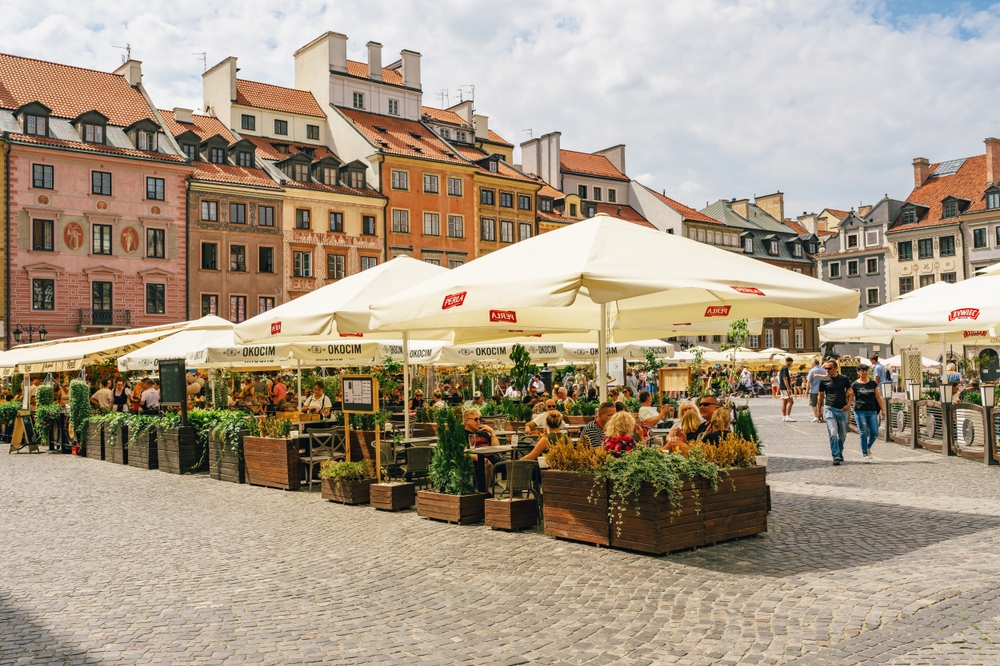
Still, Edinger’s argument has force because many of the things Americans admire abroad are not whimsical. They are concrete: walkability, paid leave, healthcare security, transit, and consumer protections. Those are not dreamy abstractions. They are policy choices.
Why His Story Lands: Perspective, Not Escape
What makes this story travel so widely online is that it speaks to more than geography. It speaks to the human experience of stepping outside a familiar system and seeing, often for the first time, which parts of it nourish you and which parts quietly exhaust you.
That is why Edinger’s reflections feel less like a lecture and more like an invitation. Readers do not need to move abroad to understand the question at the center of his story. They only need to ask, honestly, what in their own daily lives feels unnecessarily hard.
Three takeaways stand out:
- Comparison can be clarifying. Looking elsewhere does not weaken civic loyalty; it can sharpen expectations.
- Systems shape character more than slogans do. Safety, rest, mobility, and healthcare influence how people relate to work, family, and themselves.
- A better life is often built from ordinary protections. The most meaningful rights are not always dramatic. Sometimes they look like paid leave, reliable transit, or a doctor’s visit that does not threaten your finances.
And in perhaps the most human closing note of all, Edinger says the thing he misses most is not a grand theory of freedom, but “just Mexican food and good ice cream.” That final line works because it reminds us that even the biggest political realizations still live alongside ordinary cravings, loyalties, and homesickness. Perspective can change a person profoundly. It rarely erases where they came from.