
Your cart is currently empty!
Zeroes Were Non-Negotiable for This Florida Teacher. Her School Had Other Ideas
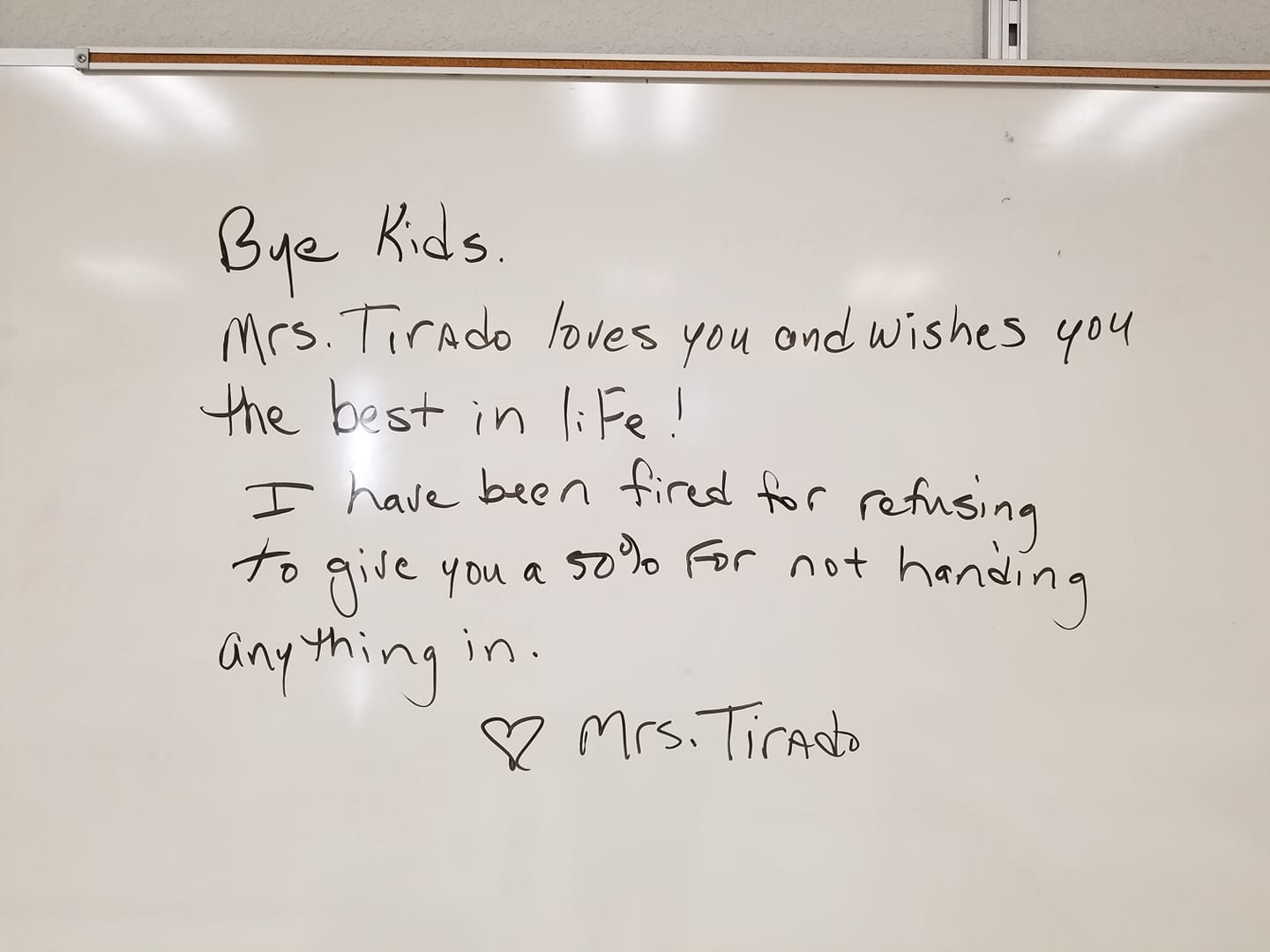
Diane Tirado walked into her classroom on the morning of September 14, 2018, knowing it would be her last. After 17 years in education, she had been fired from West Gate K-8 School in Port St. Lucie, Florida, less than two months after being hired. Her termination letter offered no official explanation. Her principal offered none either. But Tirado had no doubt about what had cost her the job, and before she left the building for the last time, she picked up a marker and made sure her students would not be left wondering.
Contents
show
What she wrote on that whiteboard set off a national conversation about grades, accountability, and what schools are actually teaching children about effort, fairness, and earning their place in the world.
A Veteran Teacher, a New School, and an Old-Fashioned Assignment
Tirado, 52 at the time, brought nearly two decades of classroom experience to West Gate when she joined as an eighth-grade social studies teacher at the start of the 2018-2019 school year. Her expectations for students were shaped by years of practice. Grades meant something in her room. Credit had to be earned. Work had to be done. Those beliefs felt self-evident to her, the kind of professional foundation that 17 years in front of students tends to build.
For her first major assignment of the semester, she asked students to keep what she called an “explorer’s notebook” over a two-week period. Students were to journal as if they were 15th-century explorers documenting the world around them, recording historical events and drawing maps by hand. It was a creative, structured project that asked for sustained effort and imagination in equal measure. Middle schoolers with two weeks and a clear set of instructions had more than enough time to complete it. Some students submitted strong work. Others handed in nothing at all.
What happened next would cost Tirado her job.
A Policy She Never Agreed To
When parents complained about the homework load reaching administration, Tirado was called to the principal’s office. Families had pushed back, saying the project placed too heavy a demand on students. During one of those meetings, Tirado heard for the first time about West Gate’s approach to failing grades.
According to Tirado, West Gate’s student and parent handbook set the floor for any grade at 50 percent, a rule printed in red capital letters that was hard to miss or misread. West Gate’s published grading scale made the policy concrete. An A ran from 90 to 100, a B from 80 to 89, a C from 70 to 79, a D from 60 to 69, and an F from 50 to 59. A zero was listed only for work never attempted at all, but in practice, teachers were expected to give students who submitted nothing the same score as students who had tried and failed.
To Tirado, that arrangement made no sense, and she said so plainly. “I don’t give a grade for nothing,” she said.
She gave zeroes to the students who had not submitted the explorer’s notebook. She knew what the school expected of her. She weighed it against what she believed was right and acted accordingly. A grade in her classroom had to reflect real work, real effort, something a student had produced. Awarding 50 percent for a blank submission was not something she could bring herself to do, no matter what the handbook said or who said it.
Administration did not share her position. On September 14, West Gate terminated her employment. Because she was still in her probationary period, the dismissal letter required no formal cause, and none was given. No explanation appeared in writing. But Tirado told reporters she knew exactly what had happened. She had pushed back against a policy she believed was wrong, said so out loud, and refused to comply. She called it defiance. Her employer apparently agreed.
A Whiteboard Message Goes Viral

Before leaving West Gate on her final day, Tirado addressed her students one last time. She wrote on the classroom whiteboard, told her class she loved them and wished them all the best, and explained plainly why she would not be returning. She took a photo of the message and sent it through a class app before sharing it publicly on Facebook.
Students responded with messages of their own. At least one wrote that handing out half-credit for an assignment never submitted had never made sense to them. Public reaction followed fast and came in volume. Parents, educators, and commenters from across the country added their voices, many sharing long-held frustrations about grading policies they felt rewarded passivity over effort. Some were teachers who had faced similar policies in their own schools and stayed quiet. Tirado had not stayed quiet, and that seemed to matter to people.
Her story, and the image of that whiteboard, became a flashpoint for a debate that had lived mostly in faculty meetings and education forums for years.
West Gate Tells a Different Story

West Gate and St. Lucie Public Schools moved quickly to address the coverage, and their version of events looked very different from Tirado’s.
Kerry Padrick, the district’s chief information officer, stated that no district-wide or school-level policy barred teachers from recording a zero for work not submitted. District representatives acknowledged that some faculty groups had discussed grade ranges and settled on 50 as the lower bound for the F category, but they stopped short of calling that a binding rule.
As Tirado’s story continued to gain national attention, the school released a much fuller statement. A district spokesperson said, “Ms. Tirado was released from her duties as an instructor because her performance was deemed sub-standard and her interactions with students, staff, and parents lacked professionalism and created a toxic culture on the school’s campus.”
District officials also alleged that Tirado had refused to apply the accommodations required under students’ Individualized Education Plans, calling that refusal defiant and a risk to affected students. A separate investigation into an allegation of possible physical abuse, the statement noted, was already underway. West Gate had, according to district officials, received numerous complaints from students, parents, and colleagues during Tirado’s brief time at the school.
A Whistleblower or a Problematic Employee?

Tirado rejected the school’s account in full. She called the post-viral statement a smear campaign, pointing out that the more damaging allegations had only surfaced after she had gone public and drawn widespread media attention. She described herself as a whistleblower who had exposed a dishonest grading policy, and she saw what followed as retaliation rather than a legitimate account of her conduct.
At the time of reporting, she was considering legal action against the district. Her view of what the no-zero policy represented extended well beyond a single school rule. She saw it as a reflection of something broader in how young people were being conditioned to think about work and reward.
“I’m so upset because we have a nation of kids that are expecting to get paid and live their life just for showing up and it’s not real,” she said.
Why Schools Adopt “No Zero” Policies

Tirado’s case brought fresh public attention to a debate that has divided educators for years. Minimum-grade policies are far from rare across American schools, and teacher opposition to them has been equally consistent.
Advocates argue that a zero, in a traditional averaged grading system, can permanently sink a student’s grade for an entire term before the semester has barely begun. Education writer Tyler Rablin laid out the mathematics in a piece for Edutopia, calculating that a student who earns a zero on a first assignment must then score an 85 on each of the next 13 assignments just to recover to a B. Under those conditions, some students stop trying altogether rather than attempt a recovery they see as impossible.
From that angle, setting a floor at 50 is less about excusing laziness and more about keeping students in a position where continued effort can still change the outcome. Removing the zero, supporters argue, preserves a student’s motivation to keep working rather than checking out entirely.
Critics see it differently. A zero, they argue, is not a punishment but an accurate record of what a student produced. Removing it sends a clear message that effort is optional and that missing an assignment carries no real consequence. For students who do complete their work, it raises a harder question: what does a grade actually mean when it can be earned by doing nothing? Tirado had a clear answer to that. A grade meant something. It always had.
A Debate With No Easy Answers
Tirado’s case did not settle the argument. If anything, it gave the debate a face and a story that made it harder to ignore.
Her dismissal moved the grading conversation out of faculty lounges and into living rooms, social media feeds, and broadcast news. Parents who had never thought much about grading policy found themselves with an opinion. Teachers who had quietly disagreed with similar rules at their own schools had a name to put to what they had long been feeling.
Was she a principled educator who drew a line over a policy she believed was wrong? Or was there, as the district alleged, far more to the story than a disagreement over grades?
Her case made one thing clear. Grading policy is never just about numbers on a report card. It reflects what a school believes about fairness, about accountability, and about what education is supposed to do for the children it serves. When Tirado walked out of West Gate on September 14, she left behind a viral moment and a question her story never fully answered.
She posted on Facebook after her dismissal that teachers teach content, students complete assignments to the best of their ability, and teachers grade that work against a scale that has existed for a very long time. She called the whole situation ridiculous. She said teaching should not be this hard.
For many educators watching from a distance, that sentiment carried more weight than any grading scale ever could.
Featured Image credit: Diane Tirado/Facebook https://www.facebook.com/diane.tirado.33/posts/10216718689976583?ref=embed_post
Diane Tirado, Education Debate, education news, Florida Education, Florida Teacher Fired, Grade Inflation, Homework Policy, Minimum Grade Policy, No Zero Grading, No Zero Policy, Port St. Lucie Florida, Public School Policy, School Grading Policy, St. Lucie Public Schools, Student Accountability, Teacher Fired Florida, Teacher Grading Policy, Teacher News, West Gate K-8 School