
Your cart is currently empty!
You See Either a Young Woman or an Old Woman. Which One Says More About You Than You’d Expect.
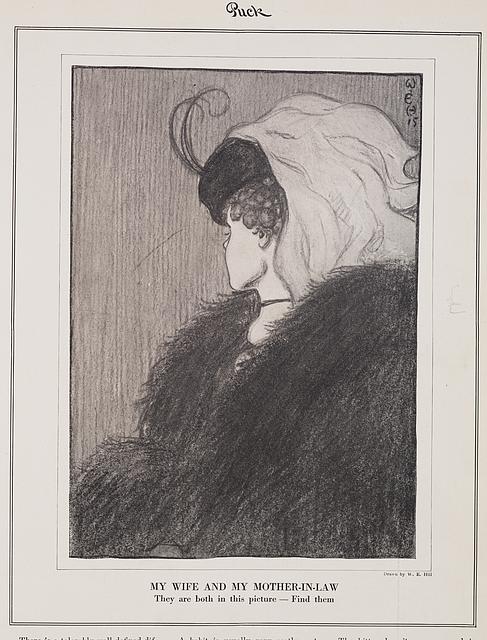
Look at a drawing long enough, and your brain will eventually find what it wants to find. That is the ordinary logic of perception, the idea that what you see is shaped by how carefully you look and how much attention you bring to the task. Now consider a different possibility: that what you see in the first fraction of a second, before you have had any time to look carefully at all, reveals something about who you are rather than simply what is in front of you.
Contents
show
A single illustration, more than a century old, has been quietly demonstrating that second possibility to anyone willing to pay attention. Two people can look at it simultaneously, and one will see a young woman while the other sees an old one. Both are right. Neither can fully explain why they saw what they saw first. And according to a study published in 2018, the difference between them may have everything to do with their age.
A Drawing With Two Faces and a Long History
“My Wife and My Mother-in-Law” is one of the most reproduced optical illusions in history, and its origins stretch back further than most people realize. A version of it appeared on a German postcard in 1888, but it was British cartoonist William Ely Hill who gave it its lasting form and its memorable title, publishing it in a humor magazine in 1915. For more than a hundred years, it has been stopping people mid-page and sending them back for a second look.
What makes it work is a set of visual overlaps so precisely constructed that the brain cannot hold both interpretations at once. A young woman faces away from the viewer, her head turned so she looks over her right shoulder, her jawline clean, and her posture suggesting youth. But look again, and the same lines become something else entirely. An older woman faces to the left in profile, her features settled into age, her expression unreadable. Crucially, certain elements serve both figures simultaneously. The younger woman’s necklace becomes the older woman’s mouth. What reads as the older woman’s nose becomes the younger woman’s jawline. Knowing this helps, but it does not make the switch any easier. Most people who try to see both at once find that one keeps sliding away just as the other comes into focus.
Half a Second to See What Your Brain Defaults To

Researchers at Flinders University in Australia designed a study around this illusion that was published in the journal Scientific Reports in August 2018. Using Amazon’s Mechanical Turk crowdsourcing platform, they recruited 393 participants from the United States, ranging in age from 18 to 68, and showed each of them the image for exactly 500 milliseconds, half a second, before the screen went blank.
Participants were then asked two questions in sequence. First, had they seen a person or an animal? Second, what was the sex of the person? Those who answered both correctly were then asked to estimate the woman’s age. No one was told the study had anything to do with aging. No one was given time to deliberate, analyze, or reconsider. Half a second is not enough time for conscious thought to intervene in any meaningful way, and that was precisely the point.
What the researchers found was both statistically significant and intuitively striking. Younger participants tended to see the younger woman. Older participants tended to see the older woman. When the researchers compared the very youngest 10% of participants, aged 18 to 22, against the very oldest 10%, aged 49 to 68, the difference in estimated age for the woman in the image came to 12.1 years. As a participant’s own age increased, so did the age they assigned to the figure in front of them, a correlation that held across every method of analysis the researchers applied.
Own-Age Bias and the Brain’s Social Shortcuts
To understand why this happens requires a brief step into how the brain processes faces, particularly faces of people who feel socially familiar versus those who feel distant.
Researchers have established through multiple lines of inquiry that people recognize and remember faces from their own age group more accurately than faces from other age groups, a phenomenon known as own-age bias. But the Flinders University study pushed the question further, asking whether this bias operates not just at the level of memory and recognition but at the very earliest stage of perception, before any conscious processing has had a chance to begin. “Faces from a social in-group, such as people of a similar age, receive more in-depth processing and are processed holistically,” the research found.
That finding has a specific neural explanation that the researchers drew on to interpret their results. When an image reaches the eye, a partially analyzed version of it travels to the prefrontal cortex before full conscious processing occurs. At that stage, higher-level expectations, shaped by social experience, identity, and group membership, feed back into the interpretation and shape what the visual system settles on as its initial read. In the case of an ambiguous image with two equally valid interpretations, that social predisposition effectively casts the deciding vote before the viewer is even aware a vote is being taken.
What this means in practical terms is that seeing the younger woman first is not simply a matter of paying more attention to one set of lines than another. It reflects, at a level below conscious awareness, that your brain has been shaped to process younger faces as more familiar, more central to your social world, and more worthy of detailed attention. When the image is ambiguous enough to support either reading, the brain defaults to the face it knows best.
Culture Makes It Sharper

Interestingly, the researchers made a deliberate choice about whose responses to analyze. They had initially recruited participants from both the United States and India, but they focused their final analysis on the American sample for a reason that goes beyond logistics.
Americans, research has consistently shown, tend to hold more negative views toward aging than people in many other cultures, and elderly people occupy a more peripheral social role in Western society than in cultures where age is more closely associated with status and wisdom. Scholars studying cultural attitudes toward the elderly have written about this tendency. “In the Western world, old age has often been conceived of as a period of life without meaningful roles.”
That cultural backdrop matters for the own-age effect because in-group and out-group dynamics are partly shaped by how sharply a society draws lines between age groups. In a culture where older people are less socially integrated, younger and older people may develop stronger separate identities, which in turn amplifies the tendency to process faces from one’s own age group differently from those of other ages. The researchers chose the American sample specifically because it would be most likely to yield a strong own-age effect, and the data supported that reasoning.
Older participants also showed something else worth noting. Their estimates of the woman’s age were not just higher on average but also more variable, spread across a wider range than those of younger participants. One explanation for this is an exposure effect: people who have lived longer have encountered a broader range of ages in their daily lives, which may soften the sharpness of the own-age bias even as it persists. Younger participants, by contrast, tend to move in age-homogeneous social environments, particularly during adolescence and early adulthood, which may make their own-age processing bias more pronounced and more consistent.
One More Thing the Data Revealed
Across all age groups, there was a baseline tendency to see the younger woman first. The researchers noted that roughly 70% of participants reported a younger woman as their initial perception, regardless of age. In their framing, seeing the younger woman appears to be something like the brain’s default setting for this particular image, a preference that gets overridden when the observer’s own-age social group pulls strongly enough in the other direction.
That detail adds a layer to what the illusion reveals. It is not simply a mirror held up to your age. It is also a window into how the brain handles ambiguity under pressure, defaulting to the familiar, the socially central, the face that most resembles what it has learned to look for first. When that default aligns with your age group, you see the younger woman. When your own social experience has made older faces feel like your in-group, that default gives way.
What a Half-Second Glimpse Actually Tells You
Optical illusions are easy to dismiss as novelties, visual puzzles that reveal nothing beyond how cleverly a cartoonist arranged a set of lines. What the 2018 study suggests is that dismissal is too quick. An ambiguous image shown for half a second, before conscious thought can intervene, becomes something closer to a test of subconscious social cognition. What you see is not simply what is there. It is what your brain, shaped by your age, your social experience, and the culture that formed you, decided to find.
“My Wife and My Mother-in-Law” has been around since 1915, and people have been puzzling over it ever since without fully understanding why different viewers see different things. It turns out that the answer was never really about the drawing. It was about the person looking at it, and specifically, about how old that person is and which faces their brain has learned to process as familiar.
Which woman did you see first? And now that you know what that might mean, does looking at the image again feel any different?
Featured Image Source: W.E. Hill, “My Wife and My Mother-in-Law,” 1915. Library of Congress / Public Domain.
aging perception psychology, ambiguous figure illusion, brain and age bias, brain perception science, face perception science, Flinders University study, illusion age reveal, optical illusion age test, optical illusion psychology, own-age bias psychology, psychology of perception, social in-group bias, visual illusion science, William Ely Hill 1915