
Your cart is currently empty!
A Little Girl Drew “I Love You Dad” Before She Died. Her Father Made Sure He Would Carry It Forever.
Some losses arrive with a kind of weight that no language has ever managed to hold adequately. People reach for words, and the words come back insufficient, unable to carry what they are asked to carry. Among those losses, there is one that sits apart from the others, the one that no parent ever fully prepares for, no matter how many times they have been told that life offers no guarantees. Losing a child is a grief that reshapes everything around it, and the people who have lived through it tend to say the same thing in different ways: that the world after is simply not the same as the world before.
Contents
show
One father knows that world now. He lost his daughter to cancer, and in the aftermath of that loss, he made a decision that has been seen by hundreds of thousands of people online. What he chose to do was quiet in one sense and permanent in every other, and the response it has drawn says something about how deeply people recognize love when they see it carried in an unexpected form.
What She Left Behind

Before his daughter died, she made something for him. Children make things for their parents constantly, drawings pulled from nowhere in particular, handed over with the uncomplicated generosity of a child who does not yet understand how much any single piece of paper might one day mean. Most of those drawings end up on refrigerators or in folders or tucked into drawers, kept but not always looked at, saved against a future in which they might carry more weight than they do in the present moment.
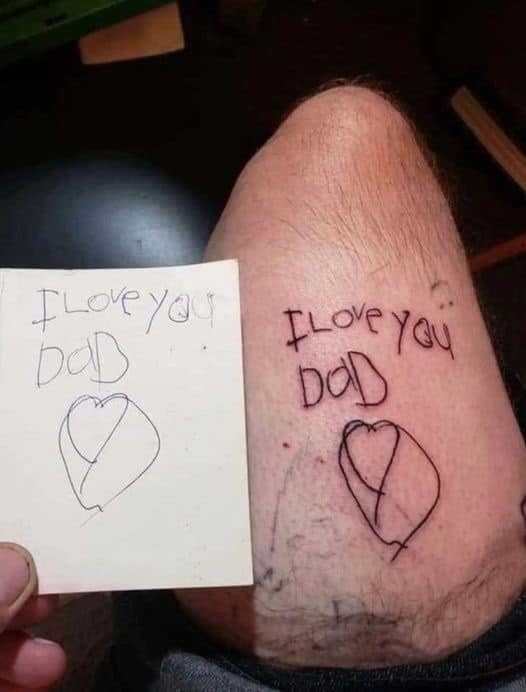
For this father, one drawing became something he could not put in a drawer. His daughter created it for him before she lost her battle with cancer, and it carried words that were among the last she would communicate to him. Written in the uneven, earnest hand of a child who meant every letter of it, the drawing said something simple and total: “I love you dad.”
What he did with that drawing was not something he arrived at quickly or lightly. Grief does not move quickly, and the decisions made within it tend to carry the full weight of everything a person has been through to reach them. When he finally made his choice, he made it permanently.
Ink Over Skin, Memory Over Loss
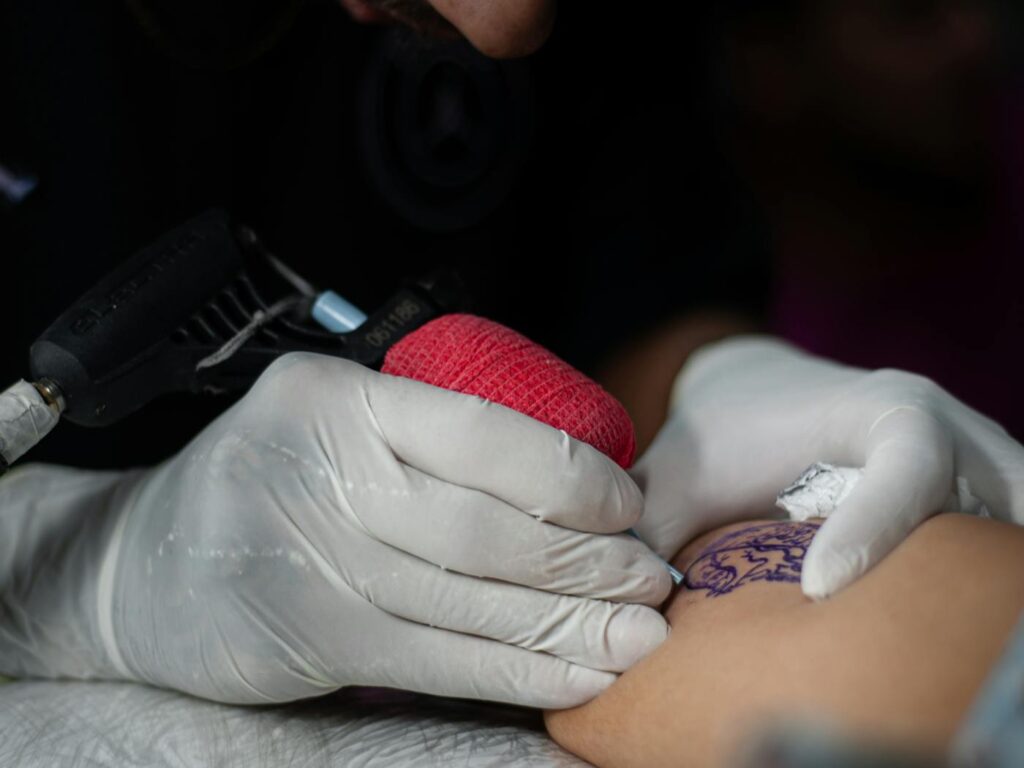
He took his daughter’s drawing to a tattoo artist and had it placed on his body exactly as she had made it, her lines, her handwriting, her words, transferred from paper to skin in a way that nothing could take back and nothing could take away.
When he shared the story on Instagram, he described it in terms that said everything and asked for nothing in return. “Before my daughter lost her battle with cancer, she created this drawing for me, and now I carry it on my skin.”
That word, carry, is doing more work in that sentence than it might initially seem. A drawing on a wall can be taken down. A photograph can be lost. A piece of paper, however carefully kept, can be damaged or destroyed by time. What he chose was a form of preservation that would last exactly as long as he did, a child’s message written into her father’s body so that he would never, for the rest of his life, be entirely without it.
Criticism He Did Not Ask For

When the post spread across social media, much of what came back to him was tenderness and recognition. But not all of it. Some people responded with disapproval, and the criticism was directed in part at the father’s appearance. He was heavily tattooed, and some viewers found that detail difficult to separate from the meaning of the tribute, as if the presence of other ink on his body somehow diminished the significance of this particular piece.
He did not retreat from his choice. He remained steadfast in the decision, holding to the belief that each tattoo on his body tells part of his daughter’s story rather than obscuring it, and that the love behind the gesture transcends whatever judgment others bring to the surface of what they see. His daughter’s drawing sits on his skin alongside everything else he has chosen to carry there, and he has not suggested he would change any of it.
There is something worth sitting with in that. Grief expresses itself differently in every person who carries it, and the way a father chooses to honor a child he has lost is not a matter that invites outside arbitration. What he wears on his skin belongs to the relationship between a father and his daughter, and that relationship existed entirely outside the view of anyone who later had opinions about how it should be commemorated.
What Strangers Recognized in It
For every person who responded with criticism, many more responded with something that looked more like recognition. Parents especially seemed to feel the post land somewhere specific, in the part of the mind that knows, without wanting to know it, how quickly everything that matters can change.t
Other comments described people going into their children’s rooms after seeing the post, waking them up in the dark just to hold them, because the image of a father carrying his daughter’s last words on his skin made the ordinary fact of a living child feel suddenly, acutely precious. Parents wrote about the small moments they had been rushing past, the morning routines and the homework help and the drawings left on kitchen tables, all of it reassembled in their minds as something worth noticing and holding before it moved on.
Several people wrote that they could not imagine gathering the strength to continue after a loss of that magnitude, and then said that watching this father do exactly that had moved them in ways they did not expect. Strength, in his case, had not looked like moving forward with composure. It had looked like taking his daughter’s drawing and making it part of himself so that she could not be entirely gone as long as he remained.
What a Child’s Drawing Can Hold
Children’s drawings are made without calculation. A child who sits down to draw something for a parent is not thinking about legacy or permanence or what the image might mean to someone in the future. She is thinking about her dad, and she is putting that thought on paper in the only way she knows how, with whatever colors are nearby and whatever words feel truest. “I love you dad” is not a sophisticated sentiment. It is also, in certain circumstances, everything.
What this father understood, in the particular grief of losing a child to an illness that gave him time to watch her and to hold what she made for him, is that a drawing like that one is not just a piece of paper. It is evidence. It is proof that she was here, that she knew him, that she reached toward him in the way children reach toward the people they love, with their whole selves and no reservation.
He chose to make that evidence permanent, and he chose to make it visible, and in sharing it on Instagram, he allowed it to reach people who had never met his daughter and who found in her four words something that connected to their own lives in ways they immediately felt.
A Father, a Drawing, a Decision
People who have seen the tattoo described their responses in terms that kept returning to the same place, the place where grief and love and the particular tenderness of a parent-child relationship all meet at once.
“It’s simultaneously heartrending and inspiring. The strength displayed is beyond what I could imagine. May your daughter rest in peace. I’m going to express my gratitude to the Lord that I still have my children. Hats off to you.”
That response, and the hundreds like it, reflects something real about what the image of this tattoo carries when it travels from one screen to another. It asks nothing of the people who see it except that they look at it and understand what it represents. A father and a daughter. A drawing made with love and given without reservation. A decision, made in grief, to carry that love somewhere it could never be lost.
She drew it for him. He wears it for her. Whatever else either of them faced, that exchange between a father and his daughter holds, permanently, in the only place he could put it to keep it safe.
Featured Image Source: Facebook https://www.facebook.com/groups/796127321584507/posts/1105298587334044
cancer grief story, cancer loss tribute, child cancer death tribute, child drawing tattoo, child loss grief, childhood cancer grief, daughter’s last drawing tattoo, father daughter bond, father daughter love story, father honors daughter, father tattoo viral, heartwarming grief tribute, Instagram grief story, memorial tattoo child, memorial tattoo story, parent child loss story, parent outlives child, parental love viral, tattoo tribute viral