
Your cart is currently empty!
This New Nasal Spray Could Transform Emergency Stroke Care

A stroke can destroy brain tissue in minutes. For decades, doctors have raced against an unforgiving clock, trying to restore blood flow before permanent damage sets in.
Contents
show
Now, researchers in Hong Kong say they may have found a way to protect the brain before patients even reach the hospital.
Scientists at the University of Hong Kong have developed what they describe as the world’s first emergency nasal spray designed specifically for ischemic stroke. In preclinical animal studies, the spray reduced brain damage by more than 80% when administered within 30 minutes of stroke onset.
The treatment, called NanoPowder, does not require surgery, injections, or specialized hospital equipment. Instead, it delivers neuroprotective medicine directly from the nose to the brain using microscopic particles engineered to bypass one of medicine’s toughest obstacles: the blood-brain barrier.
The implications could be massive.
Researchers believe the spray could eventually be carried by paramedics, stocked in care facilities, and even sold in pharmacies as an emergency first-aid treatment for stroke.
Why Stroke Treatment Has Always Been a Race Against Time
Stroke remains one of the leading causes of death and long-term disability worldwide.
An ischemic stroke happens when a blood clot blocks blood flow to part of the brain. Without oxygen, brain cells begin dying almost immediately. Doctors often describe the condition with a simple phrase: time is brain.
Current treatments focus on reopening blocked blood vessels as quickly as possible. That usually means clot-busting drugs or mechanical thrombectomy procedures performed inside hospitals.
The problem is that many patients never reach treatment in time.
According to the Hong Kong research team, more than 85% of stroke patients globally fail to receive timely intervention within the narrow therapeutic window where current treatments work best.
Even patients who do receive treatment often face lasting neurological problems.
Researchers say stroke-related healthcare costs now exceed $890 billion globally every year. Those costs include hospital care, rehabilitation, disability support, and long-term medical treatment.
For years, scientists have searched for ways to protect the brain during those critical early moments after a stroke begins.
That search has repeatedly run into one major obstacle.
The Human Brain’s Biggest Defense System

The human brain is protected by something called the blood-brain barrier.
This barrier acts like an ultra-selective filter between the bloodstream and brain tissue. It blocks toxins, bacteria, and harmful substances from entering the brain.
Unfortunately, it also blocks many medicines.
Professor Aviva Chow Shing-fung, who led the Hong Kong research team, explained that more than 90% of central nervous system drugs fail during clinical development because they cannot effectively cross the blood-brain barrier.
That has made neurological diseases some of the hardest conditions in medicine to treat.
Researchers around the world have spent decades trying to solve this problem.
The Hong Kong team approached it from a completely different angle.
Instead of trying to force medicine through the bloodstream and into the brain, they developed a way to send treatment directly through the nose.
“We use ‘nano-in-micron’ technology to bypass the blood-brain barrier, a natural shield that typically blocks most drugs from entering the brain,” Professor Chow said.
“By using the nose-to-brain pathway, the treatment delivers medication directly to target areas, eliminating the need for surgery or injections.”
That approach could fundamentally change how emergency stroke care works.
How the NanoPowder Nasal Spray Works
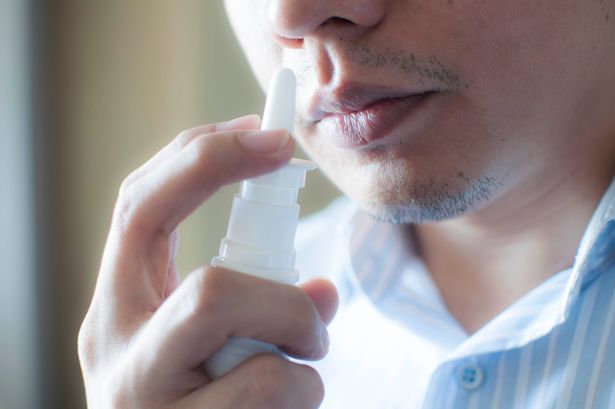
The technology behind the spray took more than a decade to develop.
Researchers created what they call a “Nano-in-Micron” platform.
The medicine itself is packaged into microscopic powder particles small enough to travel through the nasal cavity but engineered to break down into nanoparticles after entering the nose.
The process works in four stages:
- Inhalation into the nasal cavity
- Deposition in targeted nasal regions
- De-agglomeration into nanoparticles
- Direct delivery along the nose-to-brain pathway
Once the powder contacts nasal mucus, the particles rapidly separate into nanoparticles that travel directly toward the brain.
This allows the medication to bypass the bloodstream entirely.
Scientists say that direct delivery dramatically increases both speed and efficiency.
Unlike traditional hospital-based stroke treatments, the spray is designed to be portable and easy to administer.
That simplicity may become one of its biggest advantages.
“The nasal spray is characterised by its quick response, portability, and user-friendliness,” Professor Chow said.
“It allows patients to receive early protection en route to hospital or even within the community, significantly slowing the death of brain cells under ischemic conditions and effectively preserving still-viable brain tissues.”
Researchers say the treatment is not intended to replace hospital care.
Instead, it is designed to buy time.
The Results That Caught International Attention

The spray recently won the Special Grand Prize and a gold medal at the 51st International Exhibition of Inventions Geneva.
That recognition came after preclinical animal studies produced striking results.
According to the research team, administering the nasal spray within 30 minutes of stroke onset reduced ischemic brain damage by more than 80%.
Scientists also observed protection of neurological and motor functions.
The medication appeared to reduce inflammation, prevent cell death, and preserve the integrity of the blood-brain barrier itself.
Those findings are especially significant because many stroke patients lose mobility, speech, memory, or cognitive function even after surviving the initial event.
The difference between treatment arriving five minutes earlier or ten minutes later can permanently alter a person’s future.
Dr. Shao Zitong, a postdoctoral fellow involved in the project, emphasized just how critical those early moments are.
“After a stroke, every second matters,” Dr. Shao said.
“Even an additional ten minutes of brain protection might determine whether a patient can walk or speak in the future.”
That statement captures why researchers believe this technology could represent a major shift in stroke care.
For decades, treatment has largely focused on repairing damage after patients arrive at the hospital.
This spray focuses on protecting the brain before irreversible damage spreads.
A Major Shift From Hospital Treatment to Prehospital Protection

One of the most important aspects of the research is where the treatment could eventually be used.
Current stroke therapies are heavily dependent on hospital infrastructure.
Patients must be transported, scanned, evaluated, and cleared for treatment. Every step consumes valuable time.
The NanoPowder spray was designed with a completely different philosophy.
Researchers envision a future where stroke intervention begins almost immediately.
Paramedics could carry the spray inside ambulances. Nursing homes and assisted living centers could store it for emergency use. Family members could potentially administer it while waiting for emergency responders.
The concept is similar to how EpiPens transformed emergency treatment for severe allergic reactions.
Instead of waiting for hospital intervention, patients receive immediate protection at the scene.
Dr. Shao explained that the breakthrough lies in moving treatment out of the hospital.
“The key breakthrough of this technology lies in shifting stroke treatment from the ‘in-hospital’ setting to the ‘prehospital’ stage,” she said.
Researchers believe that shift could dramatically improve outcomes for patients who currently live too far from specialized stroke centers or who experience delays in emergency response.
In many rural or underserved areas around the world, rapid stroke treatment remains extremely difficult.
A portable spray that anyone can use could help close that gap.
Why the Discovery Matters Beyond Stroke

While the current focus is ischemic stroke, the underlying technology could have much broader applications.
The blood-brain barrier creates problems for many neurological diseases, not just stroke.
Scientists say the same “Nano-in-Micron” platform may eventually be adapted for:
- Alzheimer’s disease
- Motor neuron diseases
- Brain infections such as meningitis
- Other neurodegenerative conditions
- Delivery of biologic medicines and small-molecule drugs
Neurological disorders remain one of medicine’s most difficult frontiers.
Many promising drugs fail simply because they cannot effectively reach brain tissue.
If this delivery platform proves successful in humans, it could open entirely new pathways for treating diseases that currently have limited options.
That possibility has generated significant interest among researchers.
The project has already received support from Hong Kong’s Innovation and Technology Commission, the Hong Kong–Shenzhen Innovation and Technology Park, and HKUMed’s Technology Transfer Unit.
The research team is also consulting emergency physicians and neurologists to ensure the spray fits real-world clinical workflows.
That practical focus may help accelerate adoption if clinical trials succeed.
The Important Reality Check Scientists Are Acknowledging

Despite the excitement surrounding the breakthrough, researchers are also being careful not to oversell the results.
The spray has only completed preclinical testing in animals.
Human clinical trials have not yet begun.
That distinction matters.
Medical history is filled with treatments that showed extraordinary promise in laboratory studies but failed during human testing.
The human brain is vastly more complex than animal models.
Safety testing, toxicology studies, dosing evaluations, and regulatory reviews will still take years.
Researchers currently expect clinical trials to move forward before 2030.
If those trials succeed, approval from health authorities would still be required before public rollout.
Even the Hong Kong team acknowledges that the process could take five to seven years or longer.
Still, scientists say the simplicity of the delivery system gives this project unusual potential.
Unlike many advanced neurological therapies that require expensive hospital equipment, the nasal spray is portable, relatively straightforward, and designed for rapid use.
That combination could make it accessible to patients who have historically struggled to receive timely care.
Researchers are hopeful, but cautious.
They know that real-world medicine rarely moves as fast as headlines.
Stroke Symptoms People Should Never Ignore

Even with emerging technologies like NanoPowder, experts stress that immediate emergency care remains critical.
Recognizing stroke symptoms quickly can still save lives.
Doctors commonly use the FAST acronym to help people identify warning signs:
- Face drooping
- Arm weakness
- Speech difficulty
- Time to call emergency services
Other possible symptoms include sudden confusion, severe headache, dizziness, trouble walking, or sudden vision problems.
Many stroke patients delay seeking treatment because symptoms initially seem mild or temporary.
That delay can be devastating.
Brain tissue begins dying within minutes after blood flow is interrupted.
Even if a future nasal spray becomes widely available, researchers say emergency medical care would still remain essential.
The spray is designed to complement hospital treatment, not replace it.
Doctors would still need to identify the type of stroke, restore blood flow, monitor complications, and manage recovery.
The difference is that patients may arrive at the hospital with far less damage than before.
The Future of Emergency Medicine Could Be Changing
The idea of treating brain injuries before reaching a hospital once sounded almost impossible.
Now, researchers are actively exploring ways to bring emergency neurological care directly into homes, ambulances, and communities.
The Hong Kong nasal spray represents part of a much larger shift happening across medicine.
Scientists are increasingly focused on portable, fast-acting treatments that can stabilize patients immediately instead of waiting for full hospital intervention.
That approach is already transforming heart attack treatment, allergic reactions, diabetes care, and opioid overdoses.
Stroke treatment may eventually follow the same path.
For families affected by stroke, even small improvements can completely alter the future.
The difference between severe disability and partial recovery often comes down to minutes.
That reality is what makes the Hong Kong research so compelling.
It is not simply another laboratory breakthrough.
It is an attempt to rewrite the first moments after one of the world’s deadliest medical emergencies.
Whether the spray ultimately succeeds in human trials remains unknown.
But for millions of patients worldwide, the possibility of protecting the brain before reaching a hospital may represent one of the most important ideas stroke medicine has seen in decades.