
Your cart is currently empty!
Meet the Ocean’s Newest, Palm-Sized Blue Octopus
When you picture the Galápagos Islands, giant tortoises and marine iguanas likely come to mind. But thousands of feet below those famous sunlit shores, the dark ocean floor hides secrets that are just now coming to light.
Contents
show
Scientists recently identified a shockingly bright, golf ball-sized creature surviving in this extreme environment, revealing just how much of the deep sea remains a complete mystery.
The Ocean’s Newest Blue Resident
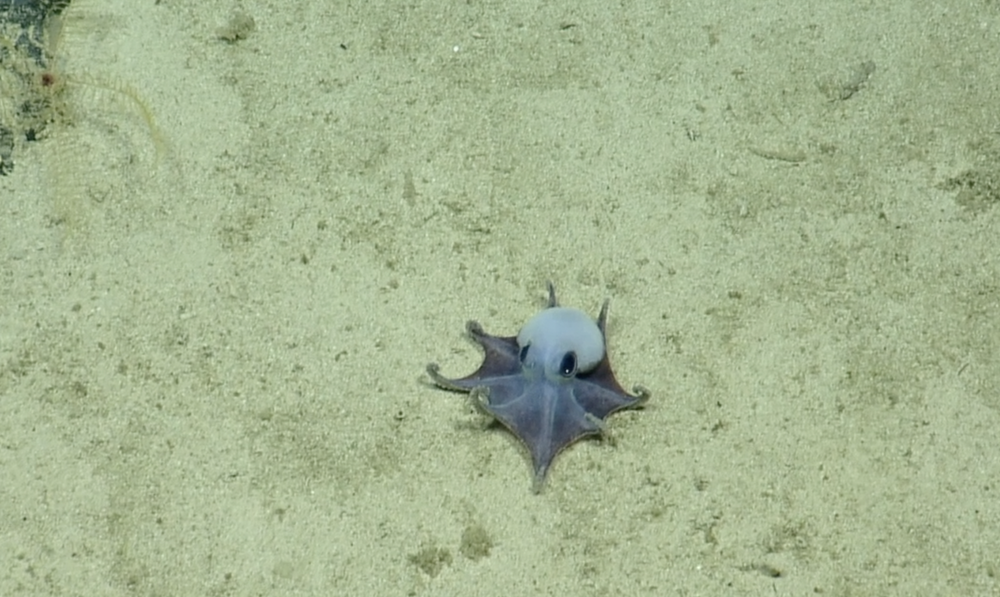
Nearly 5,800 feet below the ocean surface near Darwin Island, an underwater camera captured a rare sight. Measuring no larger than a golf ball, a small cephalopod caught the attention of researchers with its smooth skin and bright blue color. While this footage was taken during a 2015 deep ocean expedition, experts only recently classified the animal as a new species, officially named Microeledone galapagensis.
Salome Buglass, a marine scientist at the University of California, Los Angeles, recalled reviewing the footage and physical samples. “When we were sorting through dozens of specimens collected during the expedition, this tiny blue octopus fascinated us,” Buglass shared in a statement. Because the animal looked unlike anything they had seen before, the team reached out to specialized experts for help.
Janet Voight, curator emerita of invertebrates at the Field Museum in Chicago, recognized the uncommon traits as soon as she saw the photographs. “Right away, I knew it was something really special,” Voight noted. “I’d never seen anything like it.”
This newly named octopus features short, stubby arms with a single row of suckers, setting it apart from other known species in the region.
Solving a Biological Mystery, Safely
When marine biologists need to officially describe a new octopus, they normally dissect the animal. This process allows them to carefully examine the mouth, beak, and internal organs. However, because researchers only had one preserved specimen of this unique blue creature, they wanted to keep its fragile body completely intact.
Voight and her team knew that cutting into the rare find was out of the question. To solve this problem, they turned to non-invasive technology. The scientists used micro-computed tomography, or micro-CT scanning, to safely peer inside the animal.
Stephanie Smith, the X-ray laboratory manager at the Field Museum, helped compile thousands of very thin X-ray images. By putting these pictures together, they built a highly detailed, three-dimensional model of the cephalopod. This modern imaging allowed scientists to see everything from its stomach to unlaid eggs, all without making a single cut.
“There’s nothing like spending the day looking at something no other human has ever seen,” Smith shared in a public statement. Thanks to this gentle approach, the original specimen remains perfectly whole for future study.
Mastering Deep-Sea Camouflage
The striking blue color of this new species is not just for show; it is a clever survival tool. While the top of its body is a pale, nearly pigment-free blue, the underside of its arms and mantle is a deep, dark purple. Scientists refer to this unique color pattern as reverse countershading, and it plays a vital role in keeping the tiny creature safe in the deep ocean.
Down in the dark waters where this octopus lives, many small marine animals produce their own light, a trait known as bioluminescence. When the octopus hunts these glowing creatures, the light could easily act as a beacon, alerting larger predators to its exact location. The dark purple belly of the octopus acts as a blackout curtain.
Janet Voight explained how this natural camouflage works during a hunt. “When a prey is located, the octopus covers it with its dark web to make sure the light doesn’t attract predators,” Voight told National Geographic. By smothering the light of its meal, the small cephalopod avoids becoming a meal itself.
At the same time, the pale blue color on its back helps it blend in with the faint light filtering down from the surface or against the sandy ocean floor. Because this octopus has unusually short arms and fewer suckers than most of its relatives, relying on stealth and camouflage is its best defense. This fascinating color trick allows a creature no larger than a golf ball to successfully navigate a harsh and hungry environment.
A Hidden World Worth Protecting
Much of our oceans are still entirely unmapped. While the Galápagos Marine Reserve is famous for the animals living on its islands and near the surface, the deep, dark water below remains largely unexplored.
“People don’t realize that just the Pacific Ocean covers more of the planet’s surface than all the land areas combined,” Janet Voight pointed out. She explained that every part of this vast, three-dimensional space supports animal life. Finding such a unique and fragile animal hidden nearly 5,800 feet down highlights just how much we still have to learn about these unseen ecosystems.
Salome Buglass echoed this sense of wonder, noting that there are still so many unexplored areas in the deep sea of the Galápagos. When we protect these marine environments, we are not just saving the animals we already know. We are also safeguarding bizarre and beautiful creatures we have not even met yet.
Featured Image Source: Charles Darwin Foundation