
Your cart is currently empty!
New York Bill Would Replace ‘Mother’ and ‘Father’ in State Law

A two-word change buried inside a family law bill has generated the kind of political reaction in New York that most legislative sessions never produce. Before the state legislature closed for the year, Democratic lawmakers passed a measure that would strip the words “mother” and “father” from large sections of New York’s legal code and replace them with terms most people have never encountered in everyday conversation.
Contents
show
Governor Kathy Hochul has the bill on her desk and has until the end of the year to decide what to do with it. What she decides will say something about where New York’s Democratic leadership wants to position itself on a question that has drawn criticism from Republican officials, conservative commentators, and, perhaps more notably, some members of her own party.
What the Bill Changes, Precisely
Bill A8382A/S9316 makes specific substitutions across New York’s family court proceedings, domestic relations law, child support statutes, and education law. “Mother” becomes “gestating parent.” “Father” becomes “non-gestating parent” or simply “parent” depending on the context. “Paternity,” the legal term used in proceedings to establish a child’s biological father, would be replaced with “parentage.” A “putative father,” meaning an unestablished biological parent whose legal relationship to a child has not yet been confirmed, would appear in official records as “alleged parent.”
If Hochul signs the bill, all of those changes take effect November 1. State Senator Luis Sepúlveda, a Bronx Democrat who chairs the Senate Judiciary Committee, co-sponsored the legislation alongside Assemblywoman Amy Paulin, a Westchester Democrat. Sepúlveda defended the measure when asked about it, and his explanation was functional rather than ideological. “The bill was needed to be consistent with current statute and case law,” he said.
That framing positions the bill less as a social statement and more as a legal housekeeping measure. Supporters argue that New York’s family courts have already been navigating cases involving same-sex parents, surrogacy arrangements, and assisted reproduction for years, and that the statutory language governing those cases has not kept pace with either practice or precedent.
The Argument for Changing the Language

Adoption lawyer Leslie Silver-Hoffman laid out the practical reasoning to the New York Post in terms that cut through the political noise. “You have adoptive parents who are of the same gender in New York,” she said. “There are two male parents, two female parents.” From her perspective, family law language built around the assumption of one mother and one father produces friction in cases that no longer fit that model, and updating the terminology is a matter of aligning the law with the reality of how families are actually structured.
A memo accompanying the bill made a similar point, stating that the changes bring state law into line with how family courts already handle surrogacy cases and cases involving same-sex parents. Supporters consistently emphasized that the bill does not alter existing parental rights, create new legal categories, or change who qualifies as a parent under New York law. What it changes is the vocabulary used to describe those relationships in official documents and proceedings.
The bill passed the Assembly in March before clearing the Senate 38 to 23 as the legislative session closed. Those numbers reflect a legislature that is Democratic-controlled and broadly supportive of LGBTQ-inclusive legislation, but the margin was not unanimous, and the debate that surrounded the final vote was not clean along party lines.
How Hochul Has Responded
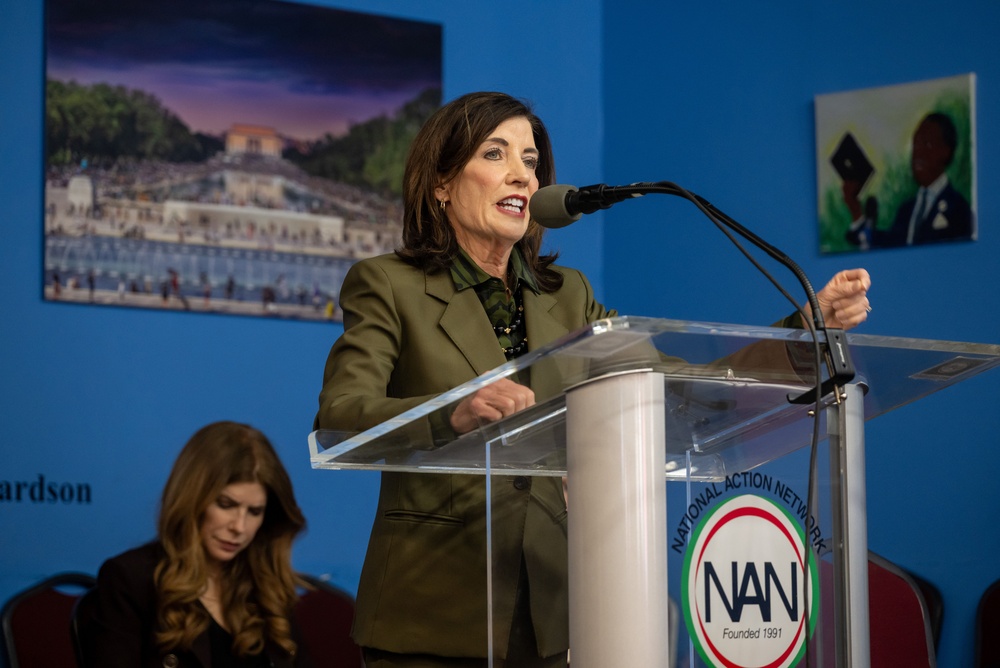
Kathy Hochul, who has described herself publicly as New York’s “first mom governor,” was asked about the bill at an unrelated event in Brooklyn and said she was not yet familiar with its contents. Her stated practice for five years has been to review legislation before commenting on it, and she noted she has until the end of the year to act.
A spokesperson for the governor’s office offered a more pointed statement to CBS 6 Albany, saying that Hochul believes mothers are mothers and fathers are fathers, and that no legislation changes that. Whether that statement signals a veto, an eventual signature with public reservations, or a delay until the political temperature shifts is not yet clear.
The Republican Response

Republican opposition arrived fast and in volume. State Senator Patricia Canzoneri-Fitzpatrick, who voted against the bill, focused her criticism on timing and priorities rather than on LGBTQ inclusion specifically. “At a time when New Yorkers are being crushed by utility bills, rising costs, and public safety concerns, Albany Democrats have decided one of their final priorities should be replacing mothers and fathers in state law,” she said. “That is not what families are asking for. I am a mother and proud to be called ‘mother.’”
Republican gubernatorial candidate Bruce Blakeman described the bill as a declaration of war on New York families and made it a cornerstone of his campaign positioning, promising to reverse it if elected governor and framing it as emblematic of a broader disconnect between Albany Democrats and ordinary New Yorkers. Representative Claudia Tenney called mothers the foundation of families and society and characterized the bill as out-of-touch politicians prioritizing progressive ideology over the concerns that actually matter to working people in the state.
Gerard Kassar, chairman of the New York Conservative Party, warned that the bill would trigger a wave of similarly worded legislation across other areas of state law and expressed concern that businesses and prospective residents would take the measure as a signal about where Albany’s attention sits. He raised the specific complaint that state lawmakers had been nearly two months late in passing the $268 billion state budget while apparently finding time to restructure the language of family law.
Fox News host Maria Bartiromo responded to the bill on air with extended criticism, questioning what the point of the change was and arguing that stripping the word “mother” from legal documents failed to honor what women go through in having and raising children.
Where the Dissent Gets Interesting
Republican opposition to a bill passed by New York Democrats is a predictable feature of the state’s political environment and carries its own predictable weight. What made the response to this particular bill somewhat different was the dissent that came from within the majority party itself.
One Democratic lawmaker, speaking to the New York Post without attribution, offered a one-word response to the legislation. “I have a word we can use for this: ‘unnecessary,’” the lawmaker said.
State Assemblyman Sam Pirozzolo, a Republican from Staten Island, delivered a sharper version of a similar argument. He said the bill was not a mother-and-father issue, not a gay issue, and not a civil rights issue. He framed it as a problem of legislative judgment and suggested that the average New Yorker was not walking around troubled by the appearance of gendered parental language in state statutes.
That view, coming from both a Republican and at least one anonymous Democrat, points to a specific critique that is separate from opposition to LGBTQ-inclusive legislation more broadly. For those critics, the issue is not whether same-sex parents deserve equal legal standing, which is settled law in New York, but whether restructuring the vocabulary of family law was the most useful thing a legislature could do in the final days of a session that had already stumbled badly on its budget.
The Broader Pattern in New York Law

Supporters of the bill placed it in a longer arc of legislative updates rather than treating it as an isolated change. In 2023, Hochul signed a measure requiring all state laws, rules, and regulations to use gender-neutral pronouns rather than gendered language tied to biological sex. In 2018, New York City approved a law allowing residents to select a non-binary category on birth certificates. Kassar’s warning that this bill would produce a flood of similar legislation is, from another angle, a description of an ongoing process that the legislature has been engaged in for years.
Sepúlveda framed the current bill in continuity with that direction, arguing that New York’s legal system already operates in ways that this bill would simply codify more consistently across statutes.
Hochul’s Decision and the Politics Surrounding It

Hochul has time and no stated position beyond the spokesperson’s comment about mothers being mothers. The political landscape around that decision is not simple for her. Signing the bill gives Blakeman a campaign argument to run on throughout the year. Vetoing it draws criticism from the LGBTQ advocacy community and from the legislators who spent months moving the bill through both chambers. Allowing it to sit unsigned through the end of the year postpones a decision while the issue continues to generate attention.
New York passed a law in 2023 requiring gender-neutral pronouns in all state documents. A bill in 2026 replacing “mother” and “father” in family law is a continuation of that direction, or, depending on where you stand, a step too far in the same direction. Whether Hochul sees it as a logical next move or an unnecessary political burden will be clear by the end of the year. Until then, the bill sits on her desk,, and the argument over what New York’s family law should say continues on the floor and on social media in roughly equal measure.
bill A8382A S9316, gender neutral parenting terms, gender neutral pronouns New York, gestating parent New York law, inclusive parenting language, mother father replaced law, New York gender neutral legislation, New York legislature 2026, New York LGBTQ family law, New York mother father bill, New York political news 2026, paternity parentage New York, putative father alleged parent, same sex adoption New York law, surrogacy law New York