
Your cart is currently empty!
The Largest U.S. Groundwater Supply Is Running Out Beneath the Great Plains
Most of us never think about where our water comes from, let alone the water that grew the wheat in our morning toast or fattened the cattle behind the beef at the grocery store. For tens of millions of Americans, much of that answer lies hidden beneath the Great Plains, in an underground reservoir so vast it is difficult to picture and so essential that the food supply of an entire nation leans on it. And it is vanishing.
Contents
show
This reservoir has been quietly draining for more than a century, and in some places it now holds only a few decades of water left. What makes the situation so alarming is not simply that the water is being used, but that once it is gone, it will not come back in any timeframe that matters to the people living above it. The story of how this happened, why it cannot easily be reversed, and what the farmers and towns of the Plains are now racing to do about it is one of the most consequential and least discussed challenges facing the country.
The Underground Reservoir Feeding A Nation
The reservoir in question is the Ogallala Aquifer, an immense network of freshwater underlying roughly 174,000 square miles across eight states: Colorado, Kansas, Nebraska, New Mexico, Oklahoma, South Dakota, Texas, and Wyoming. It is the largest freshwater aquifer in North America, and one of the largest anywhere in the world, a fact that becomes easier to grasp with a single comparison. According to Scientific American, the Ogallala holds enough water to cover the entire continental United States in about a foot and a half.
That water does an extraordinary amount of work. The aquifer irrigates around 13.6 million acres of farmland and supports somewhere between a fifth and a third of the nation’s crop and livestock production, including wheat, corn, cattle, and cotton. It also serves as the primary drinking water source for the large majority of people who live within its boundaries. Estimates of its annual economic value range from roughly $20 billion to $35 billion, depending on the year and the accounting, but by any measure, the region it sustains is one of the most agriculturally productive on the planet, a place sometimes called the world’s breadbasket.
Why It Can’t Simply Refill
The reason the Ogallala’s decline is so serious comes down to a quirk of how it formed and how little it replenishes. The aquifer was created millions of years ago from sediment washed down during the erosion of the Rocky Mountains, and long ago, the streams that once fed it were cut off. Ever since, it has depended entirely on rainwater and snowmelt to recharge, a slow and unreliable process in the semiarid climate of the American West, where rain is scarce to begin with.
On average, the Ogallala gains only about one inch of water per year, and across much of its central and southern reaches, the natural recharge is so minimal as to be almost nonexistent. Scientists have a telling nickname for water like this. They call it “fossil water,” a finite deposit laid down in a wetter ancient past, and in every practical sense, they treat the Ogallala as a nonrenewable resource, much like oil. The numbers attached to its recovery are sobering: if the aquifer were fully drained, models estimate it would take roughly 6,000 years to refill on its own. Climate change is expected to make matters worse still, bringing longer and more intense droughts to the region while people and livestock drink more to cope with the heat.
A Century Of Draining
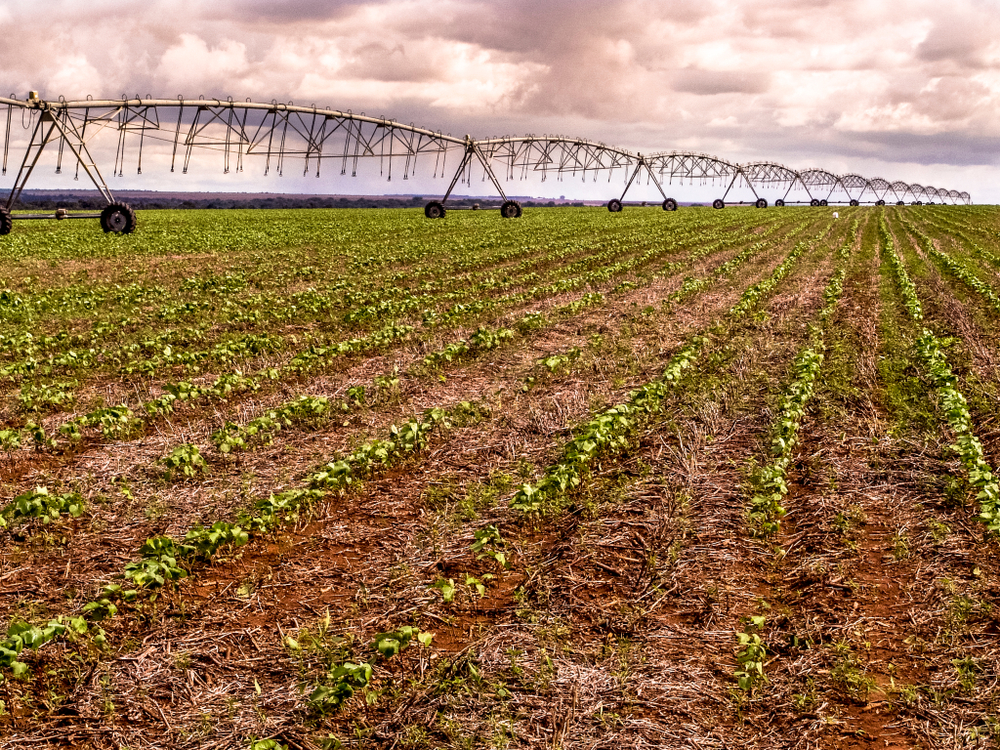
The draining began in earnest in 1909, when the first high-capacity irrigation well tapped into the aquifer. For decades, the extraction was modest, limited by the technology of the time, but everything changed after World War II, when industrial-scale pumping took hold to feed a fast-growing population. The arrival of the center-pivot irrigation system in 1952, those great rotating sprinkler arms that trace green circles across the Plains, accelerated the process dramatically and made large-scale irrigation possible across the region.
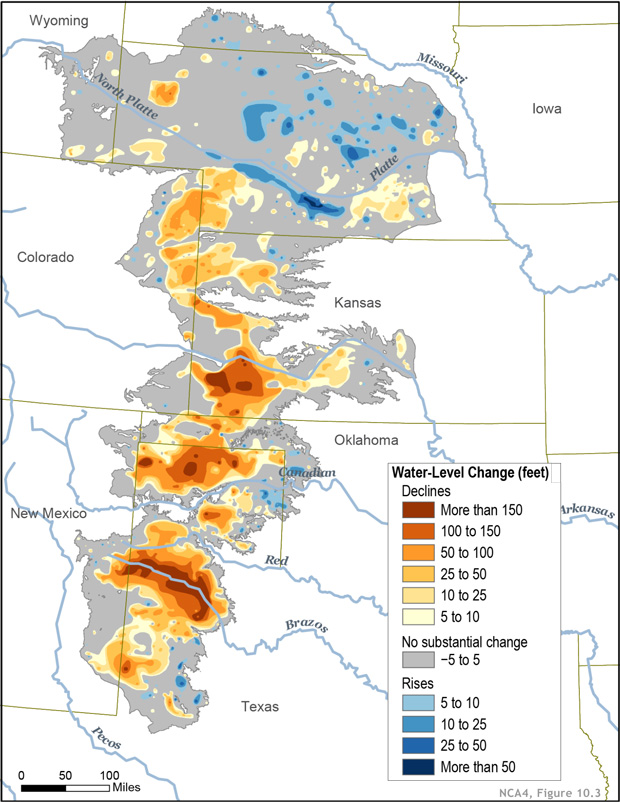
From there, the withdrawals piled up. Between 1900 and 2008, an estimated 89 trillion gallons were pumped from the Ogallala, the overwhelming majority of it, about 94%, going to agriculture. By 2010, roughly 30% of the aquifer’s water had already been removed, with total withdrawals having peaked back in 1974. The depletion has not been even, but its scale is unmistakable. In parts of the aquifer, water levels have dropped by anywhere from 40% to 75% since pumping began, and in Kansas, about 30% of the access points have already gone dry.
The Forces Driving Overuse
A natural question is why people kept draining the aquifer so aggressively even as the consequences became clear. Part of the answer lies in human nature and the slow pace of the damage. Dr. Robert Mace, a groundwater sustainability researcher at the University of Texas at Austin, traces the causes to a tangle of “economics, legal inertia, politics, and hydrogeology.”
“The impacts of unsustainable pumping take decades to centuries to be felt, luring users into complacency,” he explains, capturing the central trap of the whole situation. Because the well does not run dry tomorrow, there is little immediate pressure to change course today. Layered on top of that psychology are powerful economic forces. Government subsidies have long encouraged farmers to buy more land and plant more crops, which in turn demands larger and costlier irrigation equipment. To break even, farmers lean on cheap, fast, reliable irrigation, and federal policy has pushed in the same direction, with incentives such as the 2005 ethanol mandate driving a shift toward thirsty crops like corn. The result is a self-reinforcing cycle that has steadily run the aquifer down, a textbook example of what researchers call a tragedy of the commons.
The Wasteful Way Most Water Is Used
Compounding the problem is the surprisingly wasteful way much of the water gets used once it is pumped. The most widely practiced irrigation method, known as flood or furrow irrigation, simply runs water through small trenches between rows of crops. It is cheap and straightforward, which is why farmers favor it, but it is also remarkably inefficient, losing roughly half of all the water to evaporation and runoff before it ever reaches the plants.
More modern techniques tell a different story. Center pivots, low-energy precision applicators, and subsurface irrigation can push water-use efficiency as high as 95%, dramatically reducing the waste. Yet there is a frustrating catch that researchers are quick to point out. Greater efficiency does not always translate into less water used overall, because the same amount of water can now stretch across a larger area of land. Farmers, able to irrigate more acres with the water they save, often simply expand their irrigated fields, and the net savings to the aquifer can end up close to zero.
A Looming Tipping Point
The projections for what comes next vary by region, but the trend lines point in a worrying direction. The Texas State Water Plan forecasts that Ogallala water levels will fall by a staggering 52% before 2060. Much of the most productive farmland, stretching from Texas north through Kansas, is at risk of depletion by the year 2100, which in the life of a region is no distant abstraction but a horizon today’s children may well live to see.
It is important, though, not to flatten this into a single doomsday date. The northern portion of the aquifer, centered in Nebraska, sits in a far more comfortable position, with depletion estimated to be centuries away. It is the central and southern High Plains, including Texas cities like Lubbock and Amarillo, that face the gravest and most immediate risk. Dr. Seth Darling, who directs a water-systems research center at Argonne National Laboratory, frames the underlying dilemma starkly.
“With groundwater, there is obvious short-term gain to be had by pumping lots of it for productive use now,” he says. “That action will just as obviously result in massive long-term consequences, some of which rise to the level of being potential existential threats, but we do it anyway.”
Farmers On The Front Line Are Already Adapting
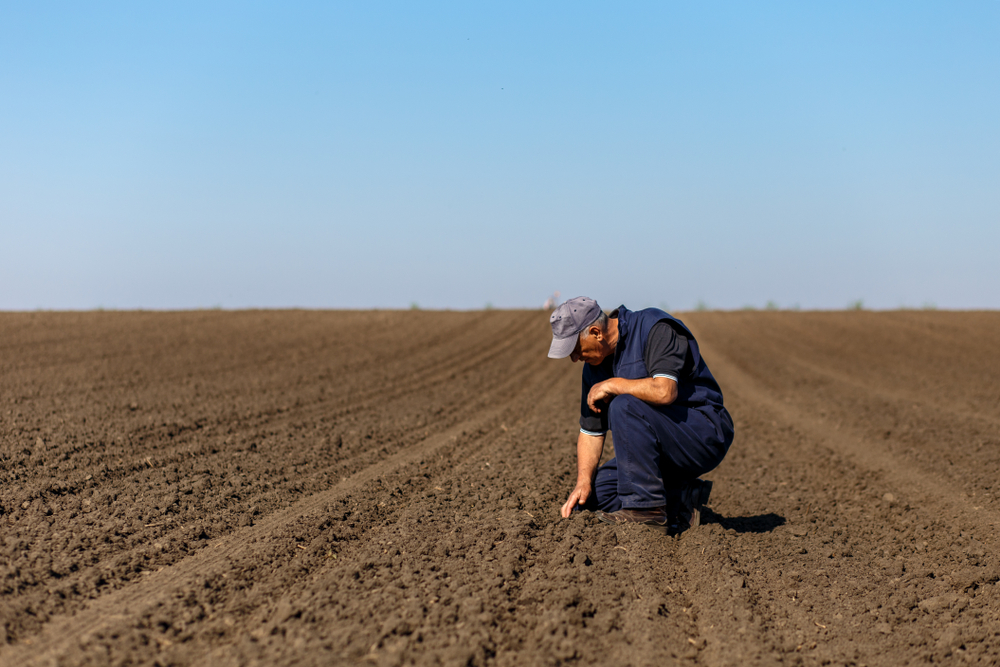
For the people who farm the Plains, none of this is theoretical. In southwest Kansas, a young farmer named Alex Millershaski has watched his water supplies collapse within his own lifetime. He used to have more than twenty wells on his farm; today he is pumping just four. Stories like his are becoming common across the region, and they are pushing a new generation of farmers to rethink what they grow.
Increasingly, the answer is to plant crops that simply need less water. Kansas State University runs an alternative-crop school promoting options like canola, black-eyed peas, and cotton, crops better suited to a drier future. One southwest Kansas farmer, Heath Koehn, decided to grow canola for the first time after a stretch of poor wheat prices and limited irrigation left him wanting to diversify rather than keep all his eggs in one basket. The appeal is practical: canola requires roughly 40% less water than corn, and new biofuel markets have recently made it a more viable choice. The shift is slow, but it is real, and it is being driven by farmers who can see the water disappearing beneath their own land.
Why More Farmers Don’t Just Switch
If alternative crops solve so many problems, it is fair to ask why every farmer doesn’t simply make the switch. The obstacle, it turns out, is less about water than about money and the entire system built around traditional crops. Chad Hart, an agricultural economist at Iowa State University, explains that commodity crops like corn and soybeans remain the most economically efficient choices despite their heavy water demands, because the financial scaffolding of American farming is constructed around them.
Crop insurance, government subsidies, and bank loans are all designed for conventional crops, and together they can account for nearly a quarter of a farmer’s income, money that is far harder to secure when planting something unconventional. The physical infrastructure compounds the problem, since the grain elevators and feedlots that dot the region are built for corn and soybeans, not canola or black-eyed peas. Switching means accepting more risk while giving up the safety nets that make farming financially survivable, a trade-off many farmers understandably hesitate to make.
The Search For Solutions
There is no shortage of proposed remedies, though no single one promises to fix everything. On the policy side, ideas range from subsidizing less water-intensive crops to capping the expansion of irrigated cropland, and reformers have suggested replacing the tax write-offs farmers currently claim for declining groundwater with tax credits that reward conservation instead. On the farm itself, practices like no-till planting and cover crops can cut evaporation and soil erosion, while integrated systems that combine crops and livestock offer another path toward resilience.
Technology adds still more options. In laboratories, scientists are engineering crops like corn to survive on less water, while in the field, wireless infrared sensors can read the temperature of a plant’s leaves to reveal exactly how thirsty it is. A growing discipline known as precision agriculture uses probes that measure soil moisture in real time, showing farmers precisely where they are watering too much or too little. As to which of these approaches matters most, Darling offers a clear-eyed assessment, noting that there is no cure-all here, but rather a collection of incremental solutions that can come together to reach a sustainable place.
Life After The Aquifer
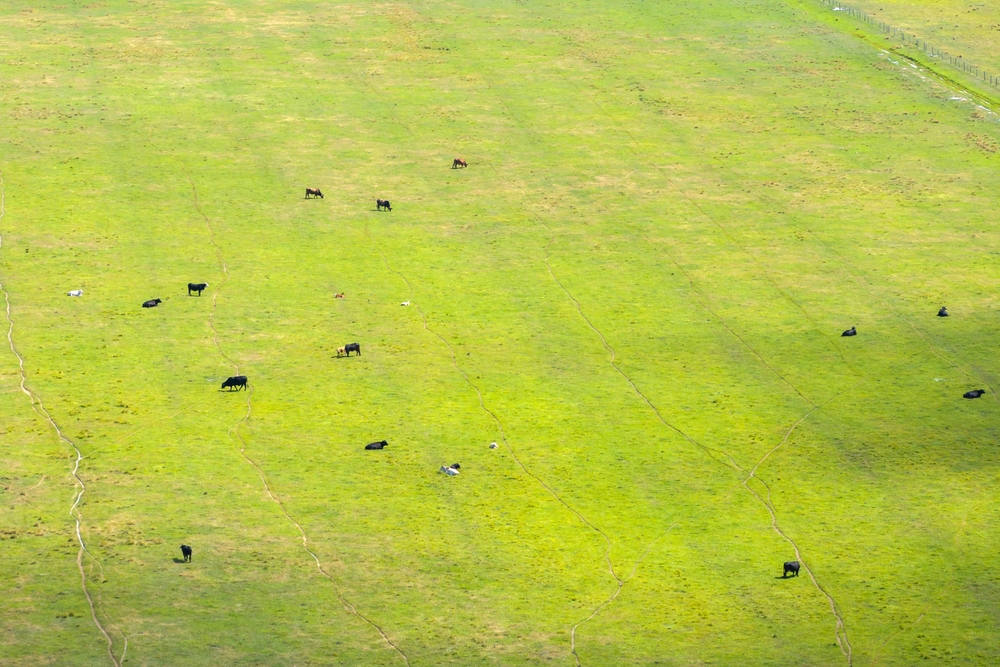
Looking further ahead, some researchers are asking a harder question: what happens to this land when the water finally runs out? For years the comfortable assumption was that irrigated fields would simply revert to dryland farming, growing crops on rainfall alone. But the soils across much of the region are marginal, and roughly a quarter of them, including a good deal of land currently under irrigation, may not support farming at all without the water that has propped them up.
That has led some scientists to propose a different future, one in which large stretches of exhausted cropland are returned to the grasslands and rangeland that covered the Plains before the plow arrived. Far from being a defeat, this kind of managed transition could deliver real benefits, storing carbon in the soil, restoring wildlife habitat, filtering water, and still producing food and fiber through grazing livestock. Hanging over all of it is the memory of the Dust Bowl of the 1930s, the last time the region stripped away its protective grasses and paid a catastrophic price, a warning that how this transition is handled will matter enormously.
The End of Easy Water
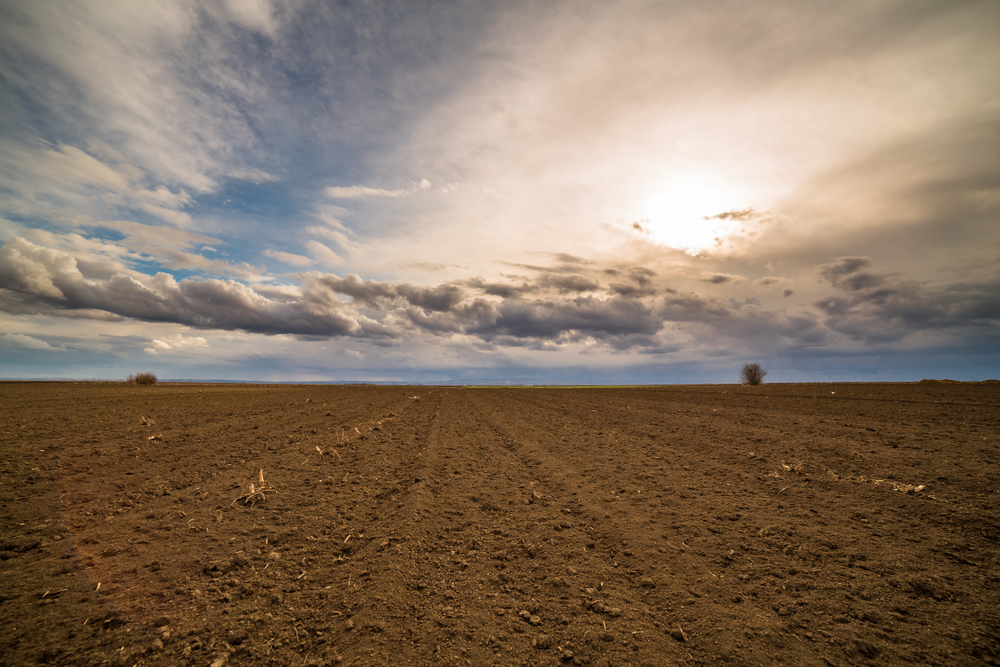
The Ogallala sustains a region responsible for feeding much of the country and a good part of the world, and its depletion will ripple outward through American agriculture, rural towns, and the global food supply over the course of this century. The reservoir that made the modern Plains possible is being spent faster than it can ever be replaced, and the central question now is not whether the reckoning comes, but how the people above it choose to meet it.
Dr. Mace, for his part, offers an observation that strips the problem down to its essence and leaves little room for wishful thinking. In the end, he warns, an aquifer can only produce what it can produce, which means that at some point the Ogallala will be managed sustainably, whether anyone likes it or not. The choice that remains is whether that reckoning arrives on the region’s own terms, through conservation and careful adaptation begun now, or whether it arrives later and far harder, when the water is simply gone.
Source: Rhodes, E. C., Perotto-Baldivieso, H. L., Tanner, E. P., Angerer, J. P., & Fox, W. E. (2023). The declining Ogallala aquifer and the future role of rangeland science on the North American High Plains. Rangeland Ecology & Management, 87, 83–96. https://doi.org/10.1016/j.rama.2022.12.002
American agriculture, center pivot irrigation, climate change, crop diversification, drought, dryland farming, Dust Bowl, food supply, fossil water, Great Plains, groundwater depletion, High Plains, irrigation, Kansas farming, Ogallala Aquifer, Sustainable farming, Texas Panhandle, U.S. water supply, water conservation, Water Crisis