
Your cart is currently empty!
Why Iowa City Has Become a Haven for Writers
Some cities are known for music. Others are known for food, technology, or sports. Then there is one Midwestern city where the most common answer to “What are you working on?” is a novel.
Contents
show
Walk into a bookstore, settle into a neighborhood café, or strike up a conversation with a taxi driver, and chances are you’ll meet someone polishing a manuscript, editing poetry, or preparing for a reading. In Iowa City, writing is not a niche hobby. It has become part of everyday life, transforming an unassuming college town into one of America’s most remarkable creative communities.
A City Where Stories Are Part of Everyday Life
The experience begins almost as soon as visitors arrive. Prairie Lights Books, one of the country’s best-known independent bookstores, regularly fills its upstairs event space with readers eager to hear authors discuss their latest work.
One recent evening offered a glimpse into what makes Iowa City different. Novelist Candice Wuehle read passages from her latest novel, Ultranatural, before taking questions from the audience.
Instead of asking predictable questions about inspiration or writer’s block, audience members wanted to know about narrative voice, editing choices, and literary influences.
Many of them were aspiring authors themselves.
That level of engagement surprises visiting writers, but locals hardly notice anything unusual. For them, conversations about character development or publishing contracts are as common as discussing last night’s football game.
It is a culture that has evolved over generations and continues to shape nearly every corner of the city.
Where Even the Taxi Drivers Are Writing Books

Perhaps no quote captures Iowa City’s personality better than the observation from Haunted Bookshop owner Nialle Sylvan.
“Pretty much everyone in this town is working on a book of some sort or other, and you can feel it,” Sylvan said.
She added that she even knows “at least one taxi driver who always has ink-stained fingers.”
That image perfectly summarizes Iowa City’s reputation. Writers are not hidden away inside university offices or publishing houses. They are bartenders, booksellers, students, retirees, musicians, and service workers who happen to spend evenings crafting stories.
The city’s bookstores become gathering places where strangers quickly discover they share an interest in fiction, memoirs, essays, or poetry.
Instead of treating writing as an elite profession, Iowa City embraces it as something almost anyone can pursue.
That openness has helped create a literary culture unlike anywhere else in America.
The University That Changed American Literature

Iowa City’s reputation did not emerge by accident.
Its literary identity traces back to 1936, when the University of Iowa established the Iowa Writers’ Workshop, widely recognized as the first graduate creative writing program in the United States.
The program helped transform creative writing from a casual pursuit into an academic discipline. Over the decades, it attracted extraordinary talent, producing generations of novelists, poets, essayists, and journalists whose work would influence American literature.
Its alumni and faculty include literary giants such as Kurt Vonnegut, Philip Roth, Raymond Carver, Flannery O’Connor, and Curtis Sittenfeld. Pulitzer Prizes and National Book Awards have become regular achievements among graduates.
The university’s influence extends far beyond a single program.
Today it also hosts internationally respected nonfiction writing, literary translation, playwriting, and international writing programs. Undergraduate students can major in creative writing, while numerous literary journals provide opportunities to publish original work before graduation.
John Kenyon, executive director of Iowa City UNESCO City of Literature, believes the university remains the foundation of everything that followed.
“Iowa City would not be a city of literature without the University of Iowa,” he said.
America’s First UNESCO City of Literature

The city’s literary achievements eventually earned global recognition.
In 2008, Iowa City became the first community in the United States to receive UNESCO’s prestigious City of Literature designation.
According to Kenyon, the honor surprised outsiders far more than those inside the literary world.
When Christopher Merrill, director of the university’s International Writing Program, contacted UNESCO to ask whether Iowa City should even apply, the response came almost immediately.
“We’ve been waiting for Iowa City to apply.”
The designation acknowledged something writers had recognized for decades.
Long before UNESCO arrived, Iowa City had become an international destination for people serious about literature. Writers from around the world traveled there to study, teach, collaborate, and share ideas.
The recognition simply gave an official title to a reputation the city had already earned.
Bookstores That Function Like Cultural Landmarks

Many cities have independent bookstores.
Few treat them as cultural institutions in quite the same way Iowa City does.
Prairie Lights is more than a retail store. Its upstairs reading room has hosted generations of celebrated authors, from established literary icons to first-time novelists launching their careers.
Co-owner Jan Weissmiller has watched countless young writers evolve from nervous graduate students into published authors returning for hometown readings.
She remembers a time when literary events regularly drew audiences that rivaled concerts.
“When Seamus Heaney read here, they had to move it to a bigger venue so that 800 people could get in,” she recalled.
Attendance has changed over the years as audiences juggle more entertainment options, but Prairie Lights remains one of the country’s most respected venues for literary conversation.
Unlike many book events elsewhere, readings in Iowa City often attract audiences filled with fellow writers.
That changes the entire atmosphere.
Questions become thoughtful discussions about craft rather than simple requests for writing advice.
For authors, it can be both rewarding and intimidating.
Candice Wuehle admitted that speaking before such knowledgeable audiences creates a unique kind of pressure.
“The questions here are so smart,” she said. “Everyone is so educated in terms of craft and references.”
A Literary Culture That Spreads Beyond Campus

Although the university remains the city’s creative engine, writing extends well beyond academic buildings.
Quotes from famous authors are permanently engraved into downtown sidewalks as part of the Literary Walk, celebrating writers connected to Iowa City across generations.
Coffee shops become informal workspaces where manuscripts quietly take shape.
Libraries host readings and workshops.
Neighborhood bars transform into poetry venues after dark.
Even longtime residents who are not writers often attend literary events simply because they have become part of community life.
Pulitzer Prize finalist and University of Iowa professor Inara Verzemnieks believes that constant exposure shapes everyone living in the city.
“You wander around and you continually are bumping into people who are your heroes,” she said.
She also noted that students regularly watch former graduates return to Prairie Lights carrying published books that first began as classroom assignments.
For aspiring authors, those moments make publishing seem less like an impossible dream and more like the next logical step.
The result is a city where writing feels surprisingly attainable.
Rather than existing behind closed doors, creativity unfolds in full view of the community, inviting others to believe they might someday join it themselves.
Festivals, Book Clubs, and a Community That Keeps Reading Alive

The literary energy in Iowa City does not stop at classrooms or bookstores. Throughout the year, the city hosts festivals, workshops, and book clubs that welcome everyone from established authors to first-time readers.
The Iowa City Book Festival has grown into one of the community’s signature events, stretching across multiple days with author talks, readings, and discussions. Other annual gatherings, including Mission Creek Festival and Witching Hour, blend literature with music, theater, and visual arts, creating events that appeal to audiences well beyond devoted book lovers.
Book clubs have also evolved far beyond the traditional format.
At the Old Capitol Museum, members gather beneath one of Iowa City’s most recognizable landmarks to discuss novels surrounded by history. Education and Engagement Coordinator Amanda Stout believes the setting encourages readers to slow down and engage more thoughtfully with the books they choose.
“Being immersed in a historic building with architectural details, atmosphere, and a connection to the past creates a sense of curiosity that pairs beautifully with reading and discussion,” she said.
Elsewhere, the Silent Book Club has built a following among readers who enjoy companionship without the pressure of discussion. Participants simply bring whatever they are currently reading, settle into a local café, and spend time reading together before chatting if they choose.
For romance fans, the monthly Bitchin’ Book Club has become another popular gathering, reflecting the growing appetite for community spaces built around shared interests rather than academic study alone.
Together, these groups show that Iowa City’s literary identity belongs to everyone, regardless of whether they have published a novel or simply enjoy reading one.
Beyond Books, Iowa City Has Plenty More to Discover

Visitors quickly learn that Iowa City offers much more than shelves filled with novels.
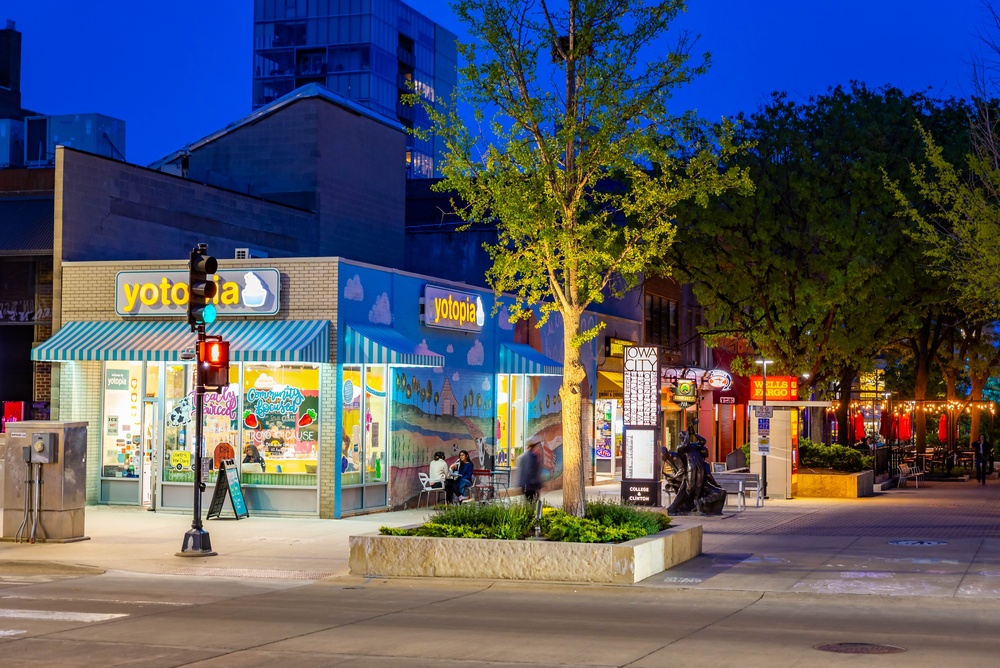
Its downtown Pedestrian Mall serves as the city’s social center, lined with cafés, restaurants, music venues, and independent businesses that create a lively atmosphere throughout the year. Students from the University of Iowa bring constant energy, while local entrepreneurs have worked for decades to ensure the district remains active from morning until late evening instead of becoming just another nightlife destination.
Karen Kubby, a longtime downtown advocate and co-owner of Beadology, believes that careful planning has preserved something many cities have lost.
“It’s not just a place for the lunch crowd,” she said.
That balance gives downtown a welcoming rhythm. Office workers, artists, professors, students, and tourists often find themselves sharing the same sidewalks, coffee shops, and outdoor patios.
Local favorites reflect the city’s personality just as much as its bookstores.
Hamburg Inn No. 2 has earned national attention for its famous pie shakes, combining slices of pie directly into thick milkshakes. Presidents including Ronald Reagan, Bill Clinton, and Barack Obama have all stopped by over the years, adding another layer to the restaurant’s long history.
Nearby, George’s Buffet continues serving classic American comfort food in an old-fashioned tavern atmosphere that has changed little over the decades.
The city’s cultural life extends into the evening with venues such as Gabe’s, the Englert Theatre, Riverside Theatre, and James Theater hosting concerts, plays, and performances throughout the year.
Small-Town Iowa Holds Some Unexpected Surprises
A short drive outside Iowa City reveals another side of eastern Iowa.
Rolling farmland gives way to Amish communities where horse-drawn buggies still travel quiet country roads. Visitors often make the trip to Golden Delight Bakery near Kalona, an Amish-run bakery known for fresh apple fritters, doughnuts, and homemade pies.
Millie Colper, one regular visitor, summed up the bakery’s reputation simply.
“We tell everyone they’re the best,” she said.
Not far away sits Riverside, a small town that has embraced one of science fiction’s most unusual claims to fame.
According to the Star Trek universe, Captain James T. Kirk will be born there in the year 2228.
Rather than treating the connection as a novelty, Riverside has woven it into the town’s identity. Street banners feature Star Trek imagery, crosswalks incorporate the famous logo, and the Voyage Home Riverside History Center houses an impressive collection of memorabilia, complete with automatic doors that recreate the familiar sound from the television series.
For visitors like Alejandro Navarro, the connection goes beyond entertainment.
After losing his mother, Navarro says watching Star Trek: Deep Space Nine helped him through one of the darkest periods of his life.
“It slapped me in the face with a message of forgiveness and acceptance,” he said. “If I hadn’t seen that, I would still be living in misery. ‘Star Trek’ saved me.”

A Place Where Creativity Still Finds Room to Grow
Like many communities built around the arts, Iowa City has changed over time.
Independent bookstores have become fewer, audiences are divided among countless entertainment options, and author events no longer draw the massive crowds they once did.
Jan Weissmiller has witnessed those changes firsthand during decades at Prairie Lights.
She remembers an era when nationally celebrated poets filled auditoriums with hundreds of eager readers. Today, even famous authors compete with streaming services, social media, podcasts, and countless other distractions.
Yet she does not necessarily see that shift as a loss.
Smaller audiences often create more meaningful conversations between writers and readers, preserving the thoughtful atmosphere that has long defined Iowa City’s literary culture.
The city itself continues evolving while holding onto the qualities that made it famous in the first place. New writers arrive every year, fresh graduates publish their first books, and longtime residents continue supporting local bookstores, libraries, and literary organizations.
For aspiring authors, there are few places where publishing feels so tangible.
Here, reading a debut novel at Prairie Lights is not an impossible fantasy. It is something students regularly watch happen to people who once sat exactly where they are sitting now.
Why Iowa City Continues to Stand Apart
Cities often build their identities around industries, landmarks, or sports teams. Iowa City built its identity around ideas.
Writing has become woven into daily life, shaping conversations in bookstores, cafés, classrooms, libraries, and neighborhood bars. Visitors arrive expecting a quiet college town and leave having discovered a place where literature remains part of the community rather than confined to university campuses.
That is what makes Iowa City remarkable. It proves that even in an age dominated by screens and endless digital distractions, there is still a place where stories matter enough that nearly everyone seems to be writing one.