
Your cart is currently empty!
NASA Watches a Hidden Black Hole Rip a Star Apart in Rare Cosmic Event
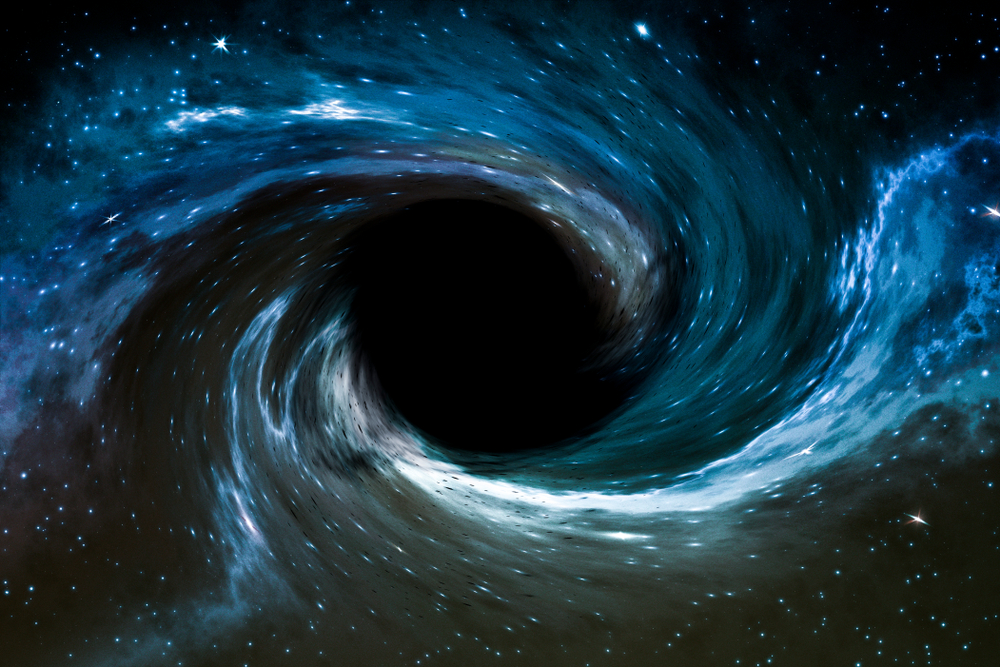
For decades, astronomers believed the universe’s most powerful black holes stayed anchored at the centers of galaxies, quietly shaping the stars and gas that surrounded them. That assumption has now been challenged after NASA and an international team of researchers captured one of the rarest cosmic events ever observed: a massive black hole lurking far from its galaxy’s core violently tearing a passing star apart. The extraordinary discovery not only revealed an invisible giant hiding in plain sight but also opened a completely new way of searching for these mysterious objects across the universe.
Contents
show
The dramatic event unfolded roughly 750 million light-years from Earth, where an “orphan” black hole weighing around one million times the mass of the Sun shredded an unfortunate star that ventured too close. The explosion produced an intense flash of light that temporarily outshone its entire host galaxy in ultraviolet wavelengths, allowing astronomers to detect what would otherwise have remained invisible. The findings, published in The Astrophysical Journal Letters, could reshape how scientists hunt for wandering supermassive black holes that have escaped the galactic centers where researchers traditionally expect to find them.
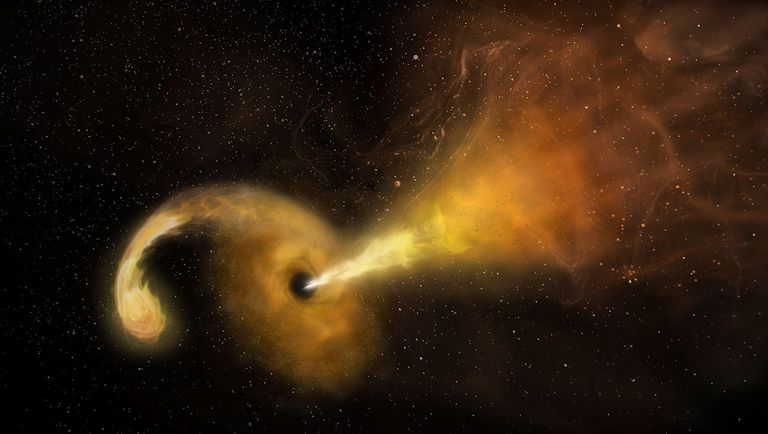
Image via NASA
A Rare Flash Revealed an Invisible Monster
Astronomers first noticed something unusual in November 2025 when the Zwicky Transient Facility, an advanced sky survey operating at California’s Palomar Observatory, detected an unusually bright flash of light. The facility scans enormous portions of the night sky every evening, recording around 500,000 separate flashes from exploding stars, variable objects, and other energetic cosmic events. Most of these signals turn out to be familiar astronomical phenomena, but this one immediately stood apart.
Instead of matching the characteristics of a supernova or another common stellar explosion, the flare displayed features that suggested something much more unusual was taking place. An artificial intelligence system developed to examine the observatory’s massive stream of data automatically flagged the event because its brightness and behavior closely resembled the signature of a tidal disruption event, often abbreviated as TDE. Without automated analysis, researchers say this remarkable discovery might easily have been overlooked among the countless flashes detected every night.
The discovery quickly triggered a worldwide effort to investigate the mysterious signal. Researchers turned to the Southern Astrophysical Research (SOAR) Telescope in Chile as well as NASA’s Neil Gehrels Swift Observatory, collecting observations across multiple wavelengths to determine exactly what had produced the brilliant flare. Combining evidence from several observatories allowed astronomers to eliminate competing explanations and confirm that they were witnessing one of the universe’s rarest phenomena.
Jonathan Carney, a doctoral student at the University of North Carolina at Chapel Hill who obtained some of the first confirming observations, explained the importance of gathering data from multiple instruments. He said, “The combination of all this data helped us rule out other explanations and confidently say it’s a tidal disruption event, despite its strange location.” That unusual location would soon become the most surprising part of the entire discovery.
What Happens When a Black Hole Devours a Star?
A tidal disruption event occurs when a star drifts dangerously close to a supermassive black hole. Although black holes themselves emit no visible light, the immense gravitational forces they generate can produce spectacular displays when nearby material becomes trapped. As the star approaches, the difference in gravitational pull between its near and far sides becomes so extreme that the star can no longer hold itself together.
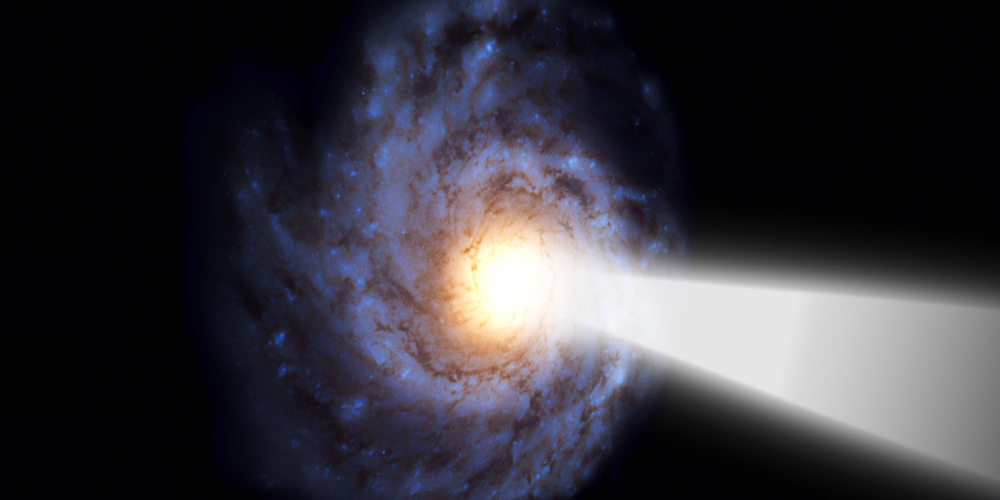
The star begins to stretch dramatically before ultimately being ripped apart in a process astronomers sometimes compare to pulling apart a piece of soft taffy. Some of the stellar material is thrown back into space, while the remaining gas spirals rapidly toward the black hole, heating to extraordinary temperatures as it forms a swirling disk. This process releases enormous amounts of radiation across the electromagnetic spectrum, producing a brilliant flare that can briefly outshine billions of stars.
NASA said this particular tidal disruption event became so luminous that it radiated with the light of approximately 10 billion Suns in ultraviolet wavelengths for several months. Even though the black hole itself remained invisible, the destruction surrounding it created one of the brightest astronomical events scientists can observe. That intense burst of energy gave researchers the evidence they needed to identify the hidden giant responsible.
These events remain exceptionally uncommon. According to NASA, a star wanders close enough to be destroyed by a supermassive black hole only about once every 100,000 years within a typical galaxy. Capturing one in progress is already a remarkable achievement. Witnessing it occur so far from a galaxy’s center makes the discovery even more extraordinary.
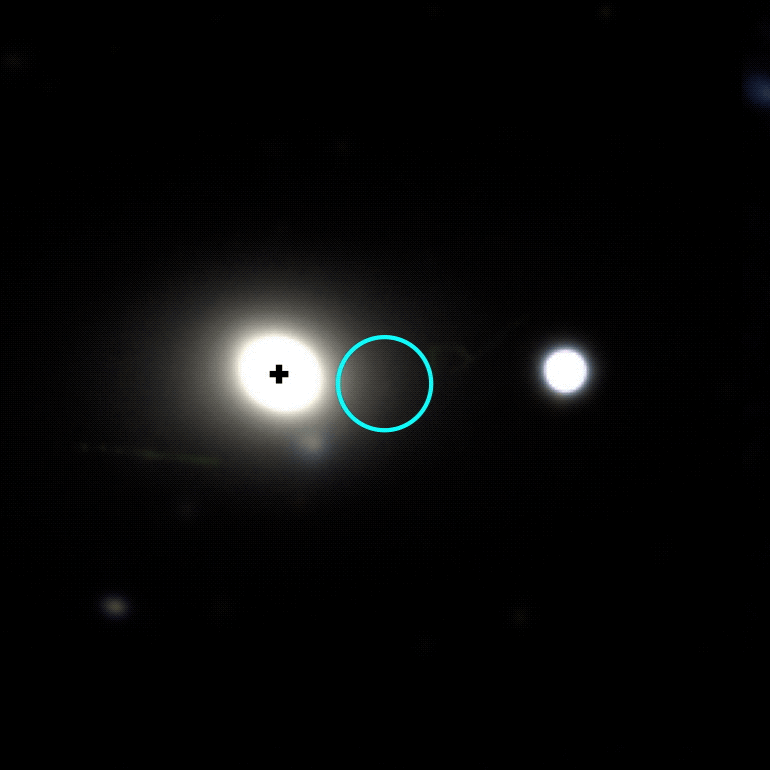
Image via NASA
The Black Hole Was Hiding Where Nobody Expected
The most surprising aspect of this discovery was not simply that astronomers observed a tidal disruption event, but where it happened. Nearly every known supermassive black hole resides at the center of its host galaxy, where gravity naturally pulls enormous amounts of matter over billions of years. Because of that expectation, astronomers have traditionally focused their searches almost exclusively on galactic cores.
This newly discovered black hole broke that pattern completely. Instead of occupying the galaxy’s center, researchers found it roughly 2,600 light-years away from the core, making it the first optical tidal disruption event ever confirmed in such an unexpected location. Scientists describe these unusual objects as “orphan” or “wandering” black holes because they appear to roam the outskirts of galaxies rather than remaining fixed at their centers.
Researchers believe there are two possible explanations for how the black hole ended up so far from where it should be. One theory suggests that several galaxies merged long ago, causing their central supermassive black holes to engage in a powerful gravitational struggle that ultimately flung the lightest black hole toward the galaxy’s outer regions. The second possibility is that a much smaller dwarf galaxy is still merging with the larger host galaxy, carrying its own central black hole along with it as the galaxies slowly combine.
Either explanation points to an active and constantly changing universe where galaxies continue to collide, merge, and reshape themselves over billions of years. More importantly, it suggests that many more wandering supermassive black holes may be waiting to be discovered far beyond the places astronomers have traditionally searched.
Why This Discovery Could Change Black Hole Research
Finding a tidal disruption event outside a galaxy’s core does more than add another rare observation to astronomy’s growing catalog. It provides researchers with an entirely new strategy for locating black holes that have remained invisible for decades. Because black holes emit no light of their own, astronomers have historically relied on indirect clues, such as the movement of nearby stars or hot gas orbiting around them. Those methods work well near galactic centers but become far less effective when black holes wander into less crowded regions.

This newly observed event demonstrated that a wandering black hole can reveal itself in spectacular fashion if a star happens to pass close enough to be torn apart. Instead of searching directly for invisible objects, scientists can now monitor the sky for these brilliant flares and work backward to identify the hidden black holes responsible. Robert Stein, lead author of the study and a research fellow at the University of Maryland and NASA’s Goddard Space Flight Center, believes this approach could dramatically expand the number of known wandering supermassive black holes.
“We were looking for these star-shredding events as a way to find otherwise invisible supermassive black holes wandering away from the galactic cores where they usually reside,” Stein said. “With this discovery, which is one of just a couple that have been confirmed so far, we’ve validated a new technique and can use it to hunt for more.”
The discovery also raises an intriguing possibility that astronomers may have missed similar events in the past simply because they were looking in the wrong places. For years, surveys concentrated almost entirely on galaxy centers under the assumption that every supermassive black hole would be located there. Now researchers have reason to cast a much wider net, increasing the chances of uncovering many more hidden giants scattered throughout the universe.
Artificial Intelligence Played a Crucial Role
The sheer volume of information collected by modern observatories has transformed astronomy into a data-intensive science. Every night, facilities like the Zwicky Transient Facility capture hundreds of thousands of flashes from distant galaxies, exploding stars, asteroids, and countless other cosmic phenomena. Sorting through such an enormous amount of data manually would be impossible, making advanced computer algorithms an essential part of modern discovery.
In this case, an artificial intelligence system examined the incoming observations and recognized that one particular flare matched the expected characteristics of a tidal disruption event. Rather than simply measuring brightness, the algorithm analyzed how the light evolved over time and compared it with known astronomical events. That allowed researchers to identify a candidate worthy of immediate follow-up observations before the signal faded.
The discovery highlights how AI is becoming an increasingly valuable tool for scientific research rather than replacing astronomers themselves. The algorithm identified the unusual event, but confirming its nature required detailed observations from multiple telescopes and careful analysis by researchers around the world. Human expertise remained essential for interpreting the evidence and ruling out alternative explanations.
As observatories become even more powerful over the coming years, astronomers expect artificial intelligence to play an even larger role in discovering rare cosmic events. Facilities such as the upcoming Vera C. Rubin Observatory are expected to generate unprecedented amounts of astronomical data, making automated systems critical for ensuring extraordinary discoveries do not disappear unnoticed among millions of ordinary observations.
The Universe May Be Filled With Wandering Giants
Although this black hole grabbed headlines because of the dramatic way it destroyed a passing star, astronomers suspect it may represent only a tiny fraction of a much larger hidden population. If galaxy mergers frequently eject supermassive black holes into their outskirts, then countless wandering giants could be drifting silently through the universe without producing any detectable light.
Researchers have spent years searching for evidence of these elusive objects. Before 2024, nearly every confirmed supermassive black hole had been identified at the center of its galaxy, largely because that was where scientists expected to find them. The discovery of unusual star-shredding events occurring away from galactic cores has begun to challenge that assumption, suggesting many invisible black holes have escaped detection simply because nobody was looking in the right locations.
Every newly discovered tidal disruption event offers astronomers another opportunity to map these hidden monsters and better understand the violent history of galaxy collisions. Since galaxies merge repeatedly over billions of years, finding wandering black holes could reveal important clues about how these enormous cosmic structures evolved into the forms we observe today.
The research may also improve scientists’ understanding of how supermassive black holes influence star formation, galactic evolution, and the distribution of matter across the universe. Each discovery helps piece together another part of a puzzle that has fascinated astronomers for generations.
One Brilliant Flash Opened a New Window on the Cosmos
The destruction of a single distant star has provided scientists with far more than another dramatic image of the universe. It has revealed a hidden black hole where none was expected, demonstrated a powerful new way to detect invisible cosmic giants, and challenged long-standing assumptions about where these enormous objects can exist.
As telescopes continue scanning millions of galaxies each night, astronomers will now be watching far beyond galactic centers for the next brilliant flash. Somewhere in the darkness, another wandering black hole may already be waiting for an unlucky star to drift just a little too close.
Sources:
- Stein, R., Carney, J., Ward, C., Margutti, R., Hall, X. J., Sfaradi, I., Andreoni, I., Charalampopoulos, P., Chornock, R., Gezari, S., Mo, G., Yao, Y., Anumarlapudi, A., Bellm, E. C., Bloom, J. S., Busmann, M., Caiazzo, I., Cenko, S. B., Graham, M. J., . . . Veilleux, S. (2026). TDE 2025ABCR: A tidal disruption event in the outskirts of a massive galaxy. The Astrophysical Journal Letters, 1006(2), L57. https://doi.org/10.3847/2041-8213/ae77f3