
Your cart is currently empty!
A High School Student Made A Remarkable Discovery At NASA

Most teenagers would probably spend their first few days at NASA trying to understand where everything is and how not to look completely lost. Wolf Cukier had a very different introduction to the space agency.
Contents
show
Just three days into his internship, the 17-year-old high school student noticed an unusual signal buried in telescope data. What initially looked like an ordinary stellar eclipse turned out to be evidence of a planet orbiting two stars, around 1,300 light-years from Earth.
A Strange Signal Caught His Attention
Cukier was spending the summer at NASA’s Goddard Space Flight Center in Maryland, working with data collected by NASA’s Transiting Exoplanet Survey Satellite, better known as TESS. The spacecraft searches for planets outside our solar system by monitoring stars and looking for tiny changes in their brightness.
When a planet passes between its star and a telescope observing from Earth, it can block a small amount of the star’s light. That creates a temporary dip in the data, which astronomers can study for evidence of an exoplanet.
Cukier had been assigned to examine systems that volunteers with the Planet Hunters TESS citizen science project had already identified as possible eclipsing binaries. An eclipsing binary is a system containing two stars that pass in front of one another from our perspective on Earth.
That narrowed the search, but the data could still contain plenty of confusing signals. On the third day of his internship, Cukier came across a system known as TOI 1338 and noticed something that did not quite fit.
“I was looking through the data for everything the volunteers had flagged as an eclipsing binary,” Cukier told NASA. “About three days into my internship, I saw a signal from a system called TOI 1338.”
At first, he thought the unusual dip was caused by one of the stars passing in front of the other. However, the timing did not match what researchers would expect from a normal stellar eclipse.
“At first I thought it was a stellar eclipse, but the timing was wrong,” Cukier said. “It turned out to be a planet.”
The Discovery Became Clear After More Data
Cukier did not immediately know he had discovered a planet. Instead, the strange signal gave him a reason to investigate further with his mentor, Veselin Kostov, a research scientist at NASA’s Goddard Space Flight Center and the SETI Institute.
Cukier had been keeping track of potential targets in a spreadsheet, with around 100 different systems eventually making the list. The TOI 1338 signal stood out enough to receive several asterisks.
As Cukier and Kostov examined more complete versions of the data, they found additional dips in the light coming from the system. Those extra observations changed the situation because three separate transits provided enough evidence to justify serious investigation.
The planet was especially difficult to identify because it was orbiting two stars. The stars themselves were moving around each other, which affected the timing and appearance of the planet’s transits.
Researchers later confirmed that the unusual signal was genuine rather than an artifact created by the telescope or its instruments. The discovery was then analyzed using additional software and observations before the planet was formally announced.
The world was named TOI 1338 b, and it became the first circumbinary planet discovered using TESS data.
Kostov explained why a human observer had been so useful in this particular case. “These are the types of signals that algorithms really struggle with,” he said. “The human eye is extremely good at finding patterns in data, especially non-periodic patterns like those we see in transits from these systems.”
That made Cukier’s role more significant than simply being in the right place at the right time. He noticed that something in the data did not behave as expected, then kept investigating until the pattern made sense.
The Planet Has Two Stars In Its Sky

TOI 1338 b is a circumbinary planet, which means it orbits two stars instead of following an orbit around a single star like Earth does around the Sun.
The two stars in the system orbit each other approximately every 15 days. One is about 10% more massive than the Sun, while the other is cooler and dimmer, with roughly one-third of the Sun’s mass.
The planet itself is around 6.9 times larger than Earth. That puts it between the size of Neptune and Saturn, making it a very different kind of world from our own.
It is located in the constellation Pictor, roughly 1,300 light-years away.
The double-star setup immediately reminded people of one of the most famous fictional planets in popular culture. In Star Wars, Luke Skywalker’s home world of Tatooine orbits two suns and is known for its distinctive double sunsets.
Cukier was already a Star Wars fan, so the comparison was particularly fitting.
“It’s very much like Tatooine, at least how the stars would appear in the sky,” Cukier told BBC Radio 1 Newsbeat. “So, it would also have a double sunset.”
There is an important difference between the fictional world and the real one, however. TOI 1338 b is believed to be a gas planet and is not considered habitable.
Nobody should expect to find a desert settlement or a young space farmer living beneath those two stars. The Tatooine comparison refers specifically to the planet’s two-star system and the view its sky could offer.
Even so, the resemblance was enough to give an already unusual discovery an unmistakable science-fiction quality.
Why Two-Star Planets Are Hard To Spot
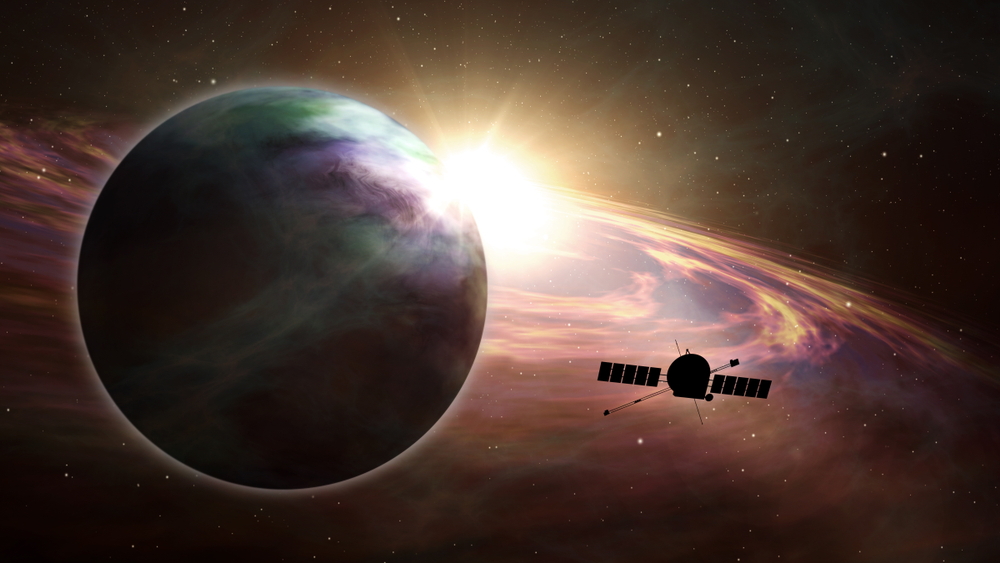
The discovery also demonstrated why circumbinary planets can be so difficult for astronomers to identify.
With a planet orbiting one star, researchers can look for recurring changes in brightness as the planet crosses in front of its host star. The timing of those events can provide important clues about the planet’s orbit.
A circumbinary planet creates a much messier pattern because the two stars are moving around one another while the planet is also following its own orbit.
TOI 1338 b’s transits occur roughly every 93 to 95 days, but their depth and duration vary because of the movement of the two stars. TESS can detect the planet crossing the larger star, while transits across the smaller star are too faint to identify.
That irregular pattern is precisely the kind of signal that can confuse automated systems.
The planet’s discovery therefore relied on several stages of analysis rather than one dramatic moment in which a computer announced a new world.
The basic process involved:
- TESS monitored the brightness of millions of stars and recorded changes over time.
- Citizen scientists identified systems that appeared to contain eclipsing binary stars.
- Cukier examined those systems and noticed an unusual signal in TOI 1338.
- He and his mentor found additional transits when they examined more complete data.
- Researchers used further analysis to confirm that the signal came from a planet.
The research team also used a software package called eleanor to analyze and visualize TESS data. Additional observations from another project provided complementary information that helped researchers better characterize the system.
The discovery was eventually presented at the 235th meeting of the American Astronomical Society, while a scientific paper co-authored by Cukier and established researchers was submitted for review.
Cukier Had Already Been Chasing Astronomy
The discovery may sound like pure luck, but Cukier had been developing an interest in science for years before arriving at NASA.
His mother was trained as a geologist, and Cukier said she helped pass her interest in science on to him. During family trips, she would give him science magazines to read, which helped strengthen his interest in astronomy.
By high school, that interest had become much more focused. Cukier joined a school science research program that helped students find mentors and develop independent research projects.
Finding a mentor was not automatic. Students were expected to reach out to researchers themselves, and Cukier began contacting scientists around the country.
Some researchers declined. Others never responded.
He kept trying.
Eventually, his search led him to Ravi Kopparapu, a research scientist at NASA Goddard. Kopparapu became Cukier’s mentor during his 2018 internship, where Cukier worked on theoretical astronomy and helped update a climate model for calculating habitable zones around planets orbiting two stars.
That earlier work gave him experience with the very kind of system he would later encounter in the TESS data.
For his next internship, Cukier worked with Kostov, whose research involved finding circumbinary planets. The goal was to identify one of these unusual worlds.
The teenager did not have to wait long.
“I was looking for a circumbinary planet,” Cukier explained in his interview with Space.com. “So going through this has the benefit of it narrowing down my field of search to only two-star systems.”
That focused search eventually placed the TOI 1338 signal directly in front of him.
Suddenly Everyone Wanted To Know Who He Was
The discovery brought something Cukier had not anticipated: widespread media attention.
The teenager went from studying astronomy in a NASA internship to appearing in interviews and being recognized by strangers. For someone still in high school, the sudden attention was difficult to process.
“It’s a bit intimidating. And overwhelming,” Cukier told Space.com.
He even described an unexpected encounter at a store when a cashier recognized him from the news.
Cukier said the attention had surprised both him and his family, but he also understood that the publicity could help introduce more young people to science.
“We’re all kind of surprised and overwhelmed at how much this has been taking off,” he said. “But it is good for science outreach and education to continue doing this.”
The attention also arrived while Cukier was thinking about college.
At the time, he said his preferred choices included Princeton, Stanford and MIT. He was considering physics and astrophysics and said a future in research was a significant possibility.
The planet discovery had given him a remarkable story to take into that next chapter, but Cukier was still approaching the process like any other student.
He still had to get accepted first.
He Could Not Even Name The Planet Himself
One of the less glamorous realities of discovering a planet is that the person who finds it does not necessarily get to give it a dramatic name.
Cukier’s discovery was officially designated TOI 1338 b, following the scientific naming system used for exoplanets.
His brother apparently had a more personal suggestion.
“Wolftopia” was floated as a possible name, although Cukier seemed perfectly happy with the official designation.
“I don’t get to name the planet,” he told BBC Radio 1 Newsbeat. “My brother had the idea of calling it Wolftopia but I think TOI 1338 b is sufficient.”
The official name may not have the same ring as Tatooine, but TOI 1338 b already has a place in astronomy history.
It was the first circumbinary planet identified through TESS data, and its discovery showed how unusual signals can sometimes be found by simply paying close attention.
His Advice To Other Teenagers Was Surprisingly Simple
For all the excitement surrounding the discovery, Cukier’s advice to other young people interested in science was not complicated.
He encouraged students to contact researchers, ask for opportunities and accept that rejection is part of the process.
“I would tell people to ask,” Cukier told Space.com. “The worst thing that can happen is you get a ‘no.’”
He knew that from experience. Some of the researchers he contacted did not respond, while others rejected his request for an internship or research opportunity.
Cukier also knew students who had received dozens of rejections before finding someone willing to work with them.
“I would just tell people to reach out and don’t be afraid of people saying ‘no,’” he said. “People will say ‘no,’ but all you need is one ‘yes.’”
For Cukier, that yes eventually led to NASA.
Then, on the third day of his internship, it led to something much bigger.
A Tiny Dip In Starlight Changed Everything
There was no giant telescope image showing TOI 1338 b in glorious detail when Cukier first encountered the planet. He saw something far less dramatic: a small dip in a graph.
The important part was that the dip appeared at the wrong time.
That inconsistency could have been dismissed as noise or an ordinary anomaly. Instead, Cukier investigated it, showed it to his mentor and helped uncover a planet that had been orbiting two distant stars for millions of years.
The discovery is a striking reminder of how much information can be hidden inside seemingly ordinary data. Sometimes the difference between overlooking something and finding it comes down to whether someone stops long enough to ask why the pattern looks wrong.
For a 17-year-old intern, that question opened the door to a planet 1,300 light-years away.