
Your cart is currently empty!
Soft Food May Have Helped Humans Learn to Say F and V
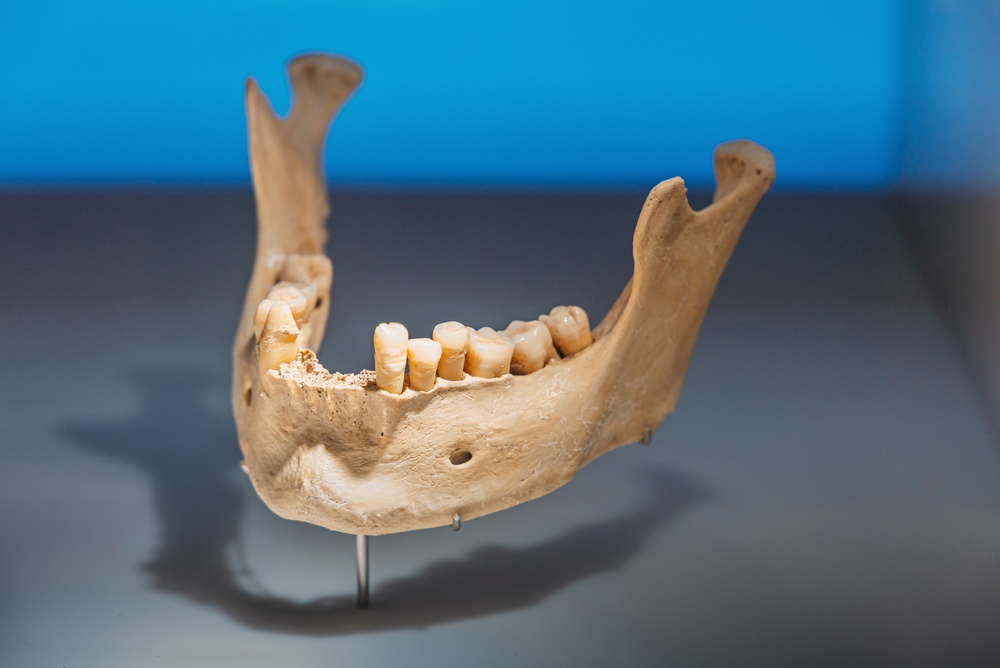
An overbite might seem like a modern dental problem, but researchers believe it could have quietly influenced the way humans speak. A shift toward softer food may have altered human jaws over thousands of years, making sounds like “f” and “v” easier to produce and leaving a possible mark on languages still spoken today.
Contents
show
For most people, placing the lower lip against the upper teeth to say words such as “fine” or “love” feels completely natural. Researchers argue, however, that the mouth shapes making those sounds easier were not always as common as they are today.
Humans Did Not Always Have Modern Overbites
For much of human history, adults ate tough and gritty foods that placed enormous strain on their teeth. Their front teeth gradually wore down until the upper and lower incisors met edge to edge, rather than with the upper teeth resting slightly in front.
That pattern began changing as human diets changed. Farming, food processing, milled grains, and dairy reduced some of the physical work involved in eating, potentially allowing more adults to retain an overbite.
A team at the University of Zurich spent years examining an unusual question: if changes in diet altered the human mouth, could they also have influenced the sounds people were more likely to make?
Their 2019 study, published in Science, argued that the answer may be yes. The researchers suggested that even small changes in speech mechanics could influence language over thousands of years.
Producing “F” May Have Required Less Effort

Say the word “off,” and the movement becomes obvious. The lower lip rises to touch the upper teeth, producing a type of sound linguists call a labiodental.
English relies heavily on labiodentals, which appear in everyday words including “fine,” “off,” “leave,” “love,” and “life.” The Zurich researchers created biomechanical models to compare an overbite with an edge-to-edge bite.
Their results suggested that producing a labiodental required 29% less muscular effort with an overbite. That does not mean people with edge-to-edge teeth cannot pronounce “f” or “v,” but researchers argued that easier articulation could create a small advantage repeated across generations.
Balthasar Bickel, the University of Zurich linguist who led the project, described speech as a process shaped by countless repetitions. “Every utterance that you make is a single trial,” he said.
He also explained the wider implication of the research, saying, “One of the take home messages is really that the landscape of sounds that we have is fundamentally affected by the biology of our speech apparatus.”
Thousands of Languages Revealed a Pattern

The researchers then searched for evidence beyond computer models. They examined thousands of languages and compared the sounds used by societies with different ways of obtaining food.
Languages spoken by hunter-gatherer groups appeared to use roughly one labiodental sound for every four used by food-producing societies. The result was striking enough that the researchers initially tried to find another explanation.
Steven Moran, a co-author of the paper, admitted that the team spent months attempting to disprove the pattern. “We tried for months to show that this correlation didn’t exist … and then we thought, maybe there’s actually something there,” he said.
Damián Blasi, another researcher involved in the study, warned that language research can produce misleading patterns. “But there are dozens of superficial correlations involving language which are spurious, and linguistic behavior, such as pronunciation, doesn’t fossilize,” he said.
Ancient bones and teeth can survive for thousands of years, but the sound of a spoken word disappears immediately. Researchers must reconstruct linguistic history through modern languages, physical evidence, and statistical models.
Indo-European Languages Offered Another Clue
The researchers found some of their strongest evidence in the Indo-European language family, which includes English, Spanish, French, German, Hindi, Russian, and many other languages.
Working backward through linguistic history, they estimated there was only a 3% probability that the ancient proto-language spoken roughly 6,000 to 8,000 years ago contained labiodental sounds. Today, around 76% of Indo-European languages contain them.
The timing appeared to overlap with major dietary changes. Archaeological evidence from Pakistan dating to around 4,300 years ago includes adult skulls showing evidence of overbites after diets increasingly involved milled grain and dairy.
Moran said, “In Europe, our data suggests that the use of labiodentals has increased dramatically only in the last couple of millennia, correlated with the rise of food processing technology such as industrial milling.”
How Food Processing May Have Changed Eating
Several developments could have gradually reduced the physical demands placed on human teeth:
- Milled grains: Grinding food made many staples easier to chew.
- Dairy products: Dietary changes reduced some of the constant grinding associated with tougher foods.
- Food processing: Cooking and preparation techniques softened diets over long periods.
- Industrial milling: More recent technology may have further reduced the force required to eat.
None of these developments automatically created new language sounds. The theory is that physical changes may have made certain sounds easier, slightly increasing the chance that they became common.
The Idea Had Been Around for Decades
The connection between teeth and speech was not completely new. Linguist Charles Hockett proposed a similar theory in 1985, suggesting that people who used their front teeth heavily and ate tougher food might find labiodental sounds less convenient.
The idea remained difficult to test because speech does not leave fossils. Researchers could study ancient skulls, but they could not directly hear how people spoke thousands of years ago.
Modern computing and larger linguistic databases changed that. Researchers could compare bite mechanics, examine sound distributions across thousands of languages, and reconstruct parts of linguistic history using methods unavailable to earlier generations.
Bickel said the findings “challenge the common assumption that, when it comes to language, the past sounds just like the present.” The possibility that everyday eating habits influenced speech adds another layer to the history of human communication.
A Second Study Found Similar Results
The original study did not settle the debate, but later research found a similar pattern. In 2021, Caleb Everett and Sihan Chen examined 2,729 language varieties and again found a divide between hunter-gatherer and non-hunter-gatherer populations.
All seven hunter-gatherer lineages in their sample had zero labiodental sounds, while 18 of the 30 non-hunter-gatherer lineages included them. The researchers also examined ten English speakers under the same laboratory conditions.
The speakers with an overbite produced labiodental sounds more than three times as often as those without one. Among 10,274 consonants analyzed, speakers with an overbite produced 365 labiodentals out of 5,629 consonants, compared with 88 out of 4,645 among speakers without an overbite.
The results added weight to the argument that the shape of the mouth can influence speech. However, critics have repeatedly challenged the idea that anatomy can explain major changes in language.
Critics Say Culture Can Override Biology

USC linguist Khalil Iskarous pointed to click languages as an important counterexample. Click sounds can require demanding physical movements, yet they have survived and spread because cultural forces supported their use.
“These are extremely effortful, but it doesn’t matter: There are cultural forces that decided that clicks would spread,” Iskarous told National Geographic.
Brown University linguist Philip Lieberman made a simpler objection, saying, “We can produce these sounds whether we have overbite or not.” Culture, migration, identity, history, and social contact can all shape how languages develop.
In 2020, Sergei Tarasov and Josef Uyeda reanalyzed the original data and argued that the connection between diet and labiodentals could disappear under different models. Blasi and his colleagues later published a rebuttal disputing that conclusion.
Moran and Bickel have also been careful about what their research actually claims. An overbite may make labiodentals easier, but it “does not mandate it.”
Half the World’s Languages Went Another Way
There are roughly 7,000 languages spoken around the world today, and about half do not regularly use “f” and “v” sounds. That number shows how little human speech can be explained by anatomy alone.
The evidence suggests that changes in diet may have altered the physical conditions under which language developed. Softer food could have changed human jaws, and those changes may have made certain sounds easier to produce.
Biology may quietly tilt the odds, while culture determines which sounds become part of a language. The food eaten by distant ancestors may have helped shape the mouths people inherited, and those mouths may have subtly influenced the sounds that still fill everyday conversation.