
Your cart is currently empty!
A Mathematician Predicted Humanity Would Hit ‘Doomsday’ on November 13, 2026

There is a date sitting in a 66-year-old mathematical paper that is about to become impossible to ignore .Friday, November 13, 2026 was identified as the point when human population growth would reach a mathematical breaking point.
Contents
show
The prediction was never meant to mean the Earth would suddenly explode, but the paper’s title gave the idea a name that has stuck ever since: “Doomsday.”

Twenty-Four Numbers Led to One Strange Date
In 1960, Heinz von Foerster and his colleagues Patricia M. Mora and Lawrence W. Amiot examined a surprisingly simple collection of data: 24 estimates of the world’s population stretching from the year zero to 1958. They wanted to understand how the human population had changed over two millennia and whether a mathematical pattern could explain its rapid acceleration.
The numbers produced a curve that kept getting steeper. Humanity was not merely growing. According to the pattern they observed, the rate of growth itself had been accelerating. Their equation pushed that trend forward until it reached a singular point on Friday, November 13, 2026, when the model suggested the population would approach infinity if the same historical pattern continued.
The paper appeared in Science under the deliberately provocative title “Doomsday: Friday, 13 November, A.D. 2026.” Its central argument depended on one crucial assumption: human population would continue growing as it had during the previous two thousand years.
That assumption is the reason the prediction became famous and the reason it eventually fell apart.
The Population Curve Started Looking Like A Wall
The growth pattern that caught von Foerster’s attention was more extreme than ordinary exponential growth. Under steady exponential growth, a population doubles at roughly regular intervals. Human history appeared to show something different because the time required for the population to double had been shrinking.
Humanity took roughly 1,024 years to grow from 250 million people to 500 million. Much later, the global population rose from 2.5 billion to 5 billion in only 36 years. Those shrinking intervals created a curve that became increasingly steep as the years passed.
Their mathematical formula effectively treated the remaining time before a fixed point as a denominator. As the calendar approached that point, the amount of time left shrank toward zero. The population figure then rose so sharply that the equation stopped producing anything resembling a realistic population forecast.
The model matched much of the historical data available in 1960 with striking accuracy. That was the part that made the prediction so unsettling. Looking backward, the curve appeared to fit. Looking forward, it produced a date that sounded like something from a disaster movie.
The prediction rested on several assumptions:
- Population growth would continue accelerating: The model assumed the long-term historical trend would remain intact.
- Families would keep having large numbers of children: It could not account for a major worldwide fall in fertility.
- The demographic transition would not disrupt the pattern: Changes in education, income, healthcare, and family planning were not built into the equation.
- Past population trends would predict the future: The model extended a historical curve beyond the conditions that created it.
The equation had found a pattern in the past. It could not know that human behaviour was about to change.
The Date Had A Personal Connection
One detail often disappears when the story resurfaces online. Heinz von Foerster was born in Vienna on November 13, 1911. The date produced by his own equation was his 115th birthday.
That coincidence gave the prediction an almost absurd edge. The paper’s precise date was partly intended to be provocative, and the title carried a sense of dark humour alongside its serious warning about population growth.
Von Foerster was not casually dismissing the consequences of unchecked population growth, however. He believed the pressure created by rising numbers could eventually become catastrophic.
His concern was less about humanity suddenly disappearing and more about what happens when a rapidly expanding population is forced onto a planet with finite land and resources.

His Warning Was About Being ‘Squeezed To Death’
Von Foerster described his fears in stark terms. He warned that future generations would face extreme population density, saying, “They will be squeezed to death.”
The phrase captured the concern behind the mathematics. If population growth continued accelerating forever, there would eventually be too many people for the available space and resources. The equation transformed that fear into a theoretical endpoint.
Von Foerster even proposed what he called a “peoplo-stat,” a deliberate mechanism for slowing population growth. His suggested solutions included strong measures designed to discourage families from having more than two children.
There was an obvious irony attached to that proposal: von Foerster himself was the father of three.
The idea of governments directly controlling family size never became the global solution his mathematical warning imagined. Instead, something far less dramatic happened over the following decades.Families began having fewer children.
The Equation Missed A Major Turning Point
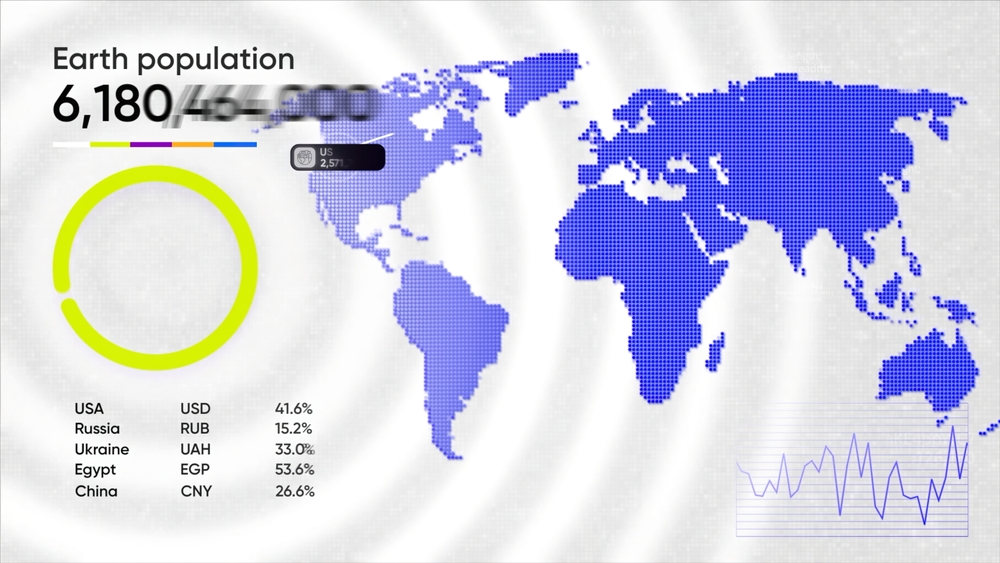
Only three years after von Foerster’s paper was published, global population growth reached its historical peak. The annual growth rate peaked around 1963 at approximately 2.3%. After that, the rate began declining. The world’s population continued increasing, but the acceleration that had driven the mathematical curve toward its 2026 singularity started to disappear.By 2023, the global population growth rate had fallen to around 0.9%. Estimates for 2026 place it near 0.84%.
That difference is crucial.The population itself kept climbing because there were still more births than deaths globally. Yet the speed of growth changed direction. Humanity was adding people, but it was no longer accelerating according to the same pattern von Foerster had observed in the historical data.
His equation had no room for that reversal. A model can describe the past with impressive accuracy and still fail when the forces shaping the future change.
Why Families Began Having Fewer Children
The biggest reason the mathematical wall never arrived was not a single government policy or worldwide agreement. It was a gradual shift that took place across hundreds of millions of households.
During the demographic transition, birth rates began falling as societies changed. Greater access to education, urbanisation, healthcare, contraception, and changing economic expectations all played a role. Parents increasingly chose to have smaller families.
The shift did not happen everywhere at the same speed, and fertility rates still vary sharply between countries. Yet the broad global trend was powerful enough to change the trajectory of human population growth.
Several factors helped reshape family size:
- Education expanded: More years spent in education often delayed parenthood and changed family planning decisions.
- Child survival improved: Parents no longer needed to have as many children to expect some would survive into adulthood.
- Cities changed the economics of family life: Raising children became more expensive in urban environments.
- Women gained greater control over reproductive choices: Access to contraception and wider social opportunities affected fertility rates.
- Family expectations shifted: Smaller families became increasingly common across many parts of the world.
The historical feedback loop that von Foerster’s equation captured had started to weaken. More people had once contributed to more labour, innovation, production, and further population growth. As family sizes declined, that relationship no longer produced the same runaway acceleration.
No global “peoplo-stat” was required. Individual decisions, repeated across generations and societies, changed the curve.
Scientists Still Disagree About The Future Peak
The failure of the 2026 singularity does not mean population forecasting has become simple. Major demographic projections still differ on when the global population will reach its highest point. United Nations projections suggest the world population could peak at around 10.3 billion during the mid-2080s before beginning to decline.
Other researchers have examined the mathematical patterns behind population growth and produced different estimates. A 2025 re-examination of von Foerster’s curve by physicist Victor Yakovenko proposed replacing the original singularity with a smoother population peak around 2030.
That work should not be treated as a standard demographic forecast. It was presented as a mathematical re-examination and was posted as a preprint rather than a peer-reviewed demographic projection.
The competing estimates reveal a major problem with predicting humanity’s future: people are not particles following a fixed physical law.
Birth rates change. Economies change. Governments change. Medical advances alter life expectancy, while migration and cultural shifts reshape entire societies. A curve that looks convincing across centuries can still change direction when human behaviour changes.
The one point that has become increasingly clear is that the vertical wall predicted in 1960 is not arriving as the original equation suggested.
November 13 Will Arrive Without A Mathematical Apocalypse
Friday, November 13, 2026 will still arrive.The world will not contain an infinite number of people, and humanity will not suddenly run out of space because of von Foerster’s equation. Roughly 8.3 billion people are expected to be alive around that time, with global population growth running far below its 1963 peak.
That does not mean population challenges have disappeared. Different countries face very different problems. Some continue growing rapidly, while others are confronting shrinking populations and ageing societies.
The strange part of the story is how quickly a mathematical certainty can become a historical curiosity. Von Foerster examined 2,000 years of accelerating population growth and found a pattern that seemed to point directly toward a date in 2026.
Humanity changed the pattern before the calendar got there.
On November 13, millions of ordinary lives will continue as usual. Babies will be born, families will make decisions about the future, and the number that once appeared to be racing toward infinity will remain firmly attached to the real world.