
Your cart is currently empty!
Sister Of The Falling Man Shares Their Final Holiday Memory
For 25 years, one photograph has remained impossible to separate from the human cost of September 11, 2001. Now, the sister of the man widely believed to be pictured in that frame has opened up about the image, the pain it caused her family, and the final holiday she shared with her brother just days before the attacks.
Contents
show
Gwen Briley-Strand, now 72, has never been able to definitively confirm that the man captured by photographer Richard Drew was her brother Jonathan Briley. Yet after decades of grief, she says the identity has become less important than what the photograph came to represent for thousands of people who never had the chance to say goodbye.
The Photograph Captured One Of 9/11’s Most Horrific Moments
Richard Drew was working as an Associated Press photographer in New York when news broke that a plane had struck the World Trade Center. He had been sent to photograph a maternity fashion show at Bryant Park, but his assignment changed immediately when his editor told him to leave and head downtown.
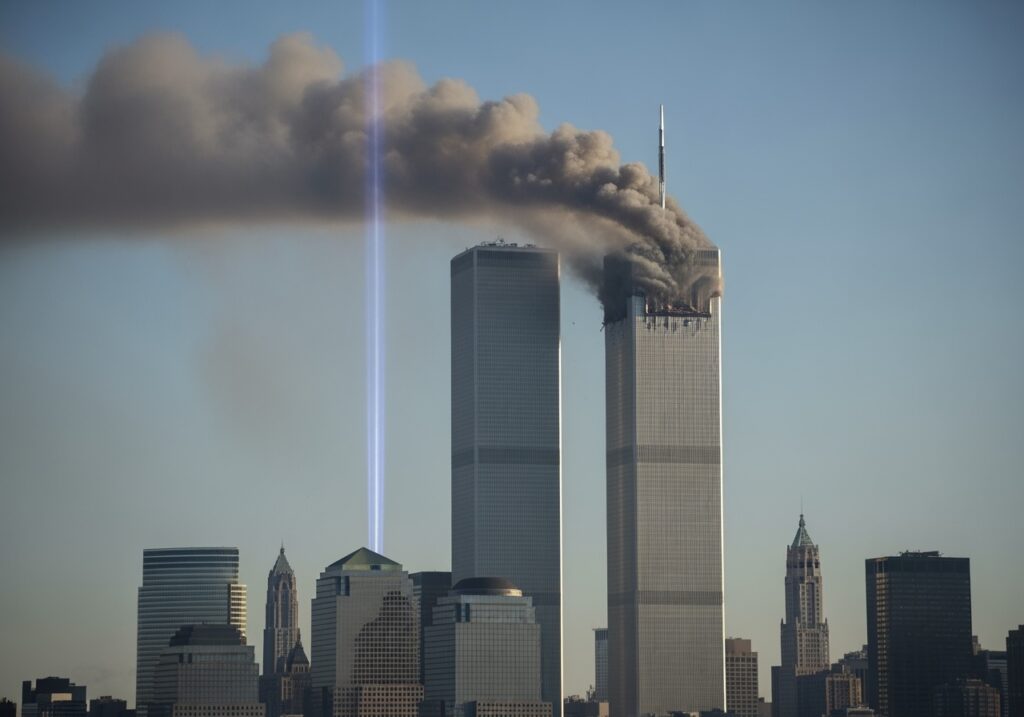
By the time Drew reached the area around the towers, both buildings were burning and the streets were filling with smoke, sirens and terrified crowds. People trapped on the upper floors had gathered around windows as fire and smoke cut off their escape routes, while people below could only watch as some victims fell from the buildings.
Drew later recalled that he could see people falling but could not see where they landed. He could hear the impacts from the street, a detail that would remain with him long after the attacks were over.
At 9:41 a.m., Drew raised his 200mm zoom lens toward one of the falling figures and began photographing. His camera captured a series of frames in rapid succession, but one image stood apart from the others.
The photograph showed a man falling vertically between the towers, his body aligned almost perfectly with the buildings behind him. There was no visible explosion or crowd in the frame, leaving the viewer with an intensely direct image of one person’s final moments.
Drew did not realize immediately that he had captured the photograph that would become known as the “Falling Man.” He later explained that he only noticed the particular frame after returning to the Associated Press office and reviewing his photographs.
In a 2021 interview with CBS News, Drew said, “I didn’t see that picture really until I got back to the office and then started looking at my stuff on my laptop.” The image would soon take on a life far beyond the photographer’s original assignment.
Why The Falling Man Image Caused Such Anger
The photograph was published soon after the attacks, but newspapers quickly discovered that many readers did not want to see it. Some regarded it as an important record of what had happened, while others believed publishing someone’s final moments crossed an ethical line.
At the Morning Call newspaper in Pennsylvania, editors reportedly debated whether Drew’s photograph should appear alongside other images from September 11. Some saw stillness and dignity in the frame, while others felt uncomfortable with the idea of placing such an intimate moment before the public.
The criticism was not limited to questions about taste. For many people, the photograph forced them to confront something they were struggling to process: ordinary people had been trapped inside the towers with nowhere safe to go.
The image also created a difficult argument over the word “jump.” Describing someone as a person who had chosen to jump could suggest suicide, but the circumstances inside the towers were far more complicated than that wording implied.
The New York medical examiner’s office classified the deaths as homicides rather than suicides. A spokeswoman explained at the time that the victims were forced out by smoke and flames or blown from the buildings, rather than fitting the conventional definition of a person who deliberately commits suicide.
That distinction became especially painful for families whose religious beliefs made suicide a source of additional grief. Gwen Briley-Strand remembers hearing about a deeply religious family who struggled with the idea that their loved one might have deliberately chosen death.
For Gwen, however, faith offered a different way of understanding what happened. She said she does not believe there is an unforgivable sin and believes that those who fell were ultimately received by God.
The Search For The Man Behind The Photograph
The identity of the man in the photograph remained uncertain for years, even as the image became increasingly famous. One early theory identified him as Norberto Hernandez, a pastry chef who worked at Windows on the World, the restaurant located near the top of the North Tower.
Hernandez’s relatives disagreed about the identification, and his family found the idea deeply painful. His wife reportedly rejected the suggestion that he would have chosen to leap from the building, insisting that he would have done everything possible to return to his family.
The mystery was later investigated by Esquire writer Tom Junod, who became fascinated by the photograph after seeing it in a newspaper the day after the attacks. Junod set out to discover who the man was, but his investigation soon revealed how difficult and sensitive the search would become.
The key breakthrough came from Drew’s additional photographs. His camera had captured several frames of the same man as he fell, and one of those images showed the man’s shirt opening to reveal an orange shirt underneath.
That detail helped investigators move away from the Hernandez theory and toward Jonathan Briley. Briley worked as a sound engineer at Windows on the World, where he was responsible for audio equipment at the restaurant.
Jonathan was 43 years old and stood around 6 feet 5 inches tall, matching the general build of the person in Drew’s photograph. His family also remembered him wearing black high-top shoes and orange shirts, details that appeared to correspond with the available photographic evidence.
None of those clues produced absolute proof, however. The identity of the man in the photograph has never been officially established as Jonathan Briley.
The Clues That Pointed Toward Jonathan
The evidence surrounding Jonathan went beyond his job and physical appearance. His family knew that he had severe asthma, which could have made the smoke-filled conditions inside the upper floors particularly dangerous.
After the attacks, Gwen and other members of the family searched desperately for Jonathan and put up missing-person flyers. Eleven days later, they received confirmation that his remains had been identified.
The family recovered several personal belongings, including his wedding ring, identification and pager. One of his black tennis shoes was also recovered, adding another detail that appeared to resemble the footwear seen in photographs of the falling man.
Jonathan’s widow had already packed away his clothes after his death, meaning there was never a complete record of exactly what he had been wearing that morning. The orange shirt therefore remained an intriguing clue rather than definitive evidence.
Junod’s investigation eventually concluded that Jonathan was the most likely candidate, but even his reporting acknowledged the uncertainty. His wider argument was that the man’s identity mattered less than what the photograph had come to represent.
The image became a symbol for people whose final moments were never photographed or identified. In that sense, Jonathan could be the man in the photograph while also being part of a much larger story about the thousands of people who died that day.
Gwen’s Family Was Deeply Hurt By The Photograph
For Gwen, discovering that her brother had become linked to such a disturbing image was painful. She told the Daily Mail that her family had been “very hurt” by the speculation, even though she never became fixated on proving whether Jonathan was the person captured by Drew.
She also said she no longer looks at the photograph. The image carries too much pain for her, particularly because of the effect it had on families who were already trying to understand the circumstances of their loved ones’ deaths.
“The photograph brought so much pain to so many people when they were trying to figure out who this person was,” Gwen said. Her concern was not simply whether the photograph showed Jonathan, but what the image meant for families forced to confront the possibility that their loved one had been portrayed in his final seconds.
Gwen’s faith also shaped how she viewed the victims who fell from the towers. She rejected the idea that their final actions should automatically be interpreted as an unforgivable religious offense.
“I believe that all those individuals that jumped were caught. Their spirits were caught,” she said. Her words reflect a deeply personal belief that those victims should be remembered with compassion rather than judged for an impossible decision made during a catastrophe.
That perspective also changes the way the photograph can be viewed. Instead of focusing exclusively on what the person may have chosen to do, it draws attention to the conditions that left people facing an impossible situation.

One of the most poignant details in Gwen’s account happened just one week before September 11. She had travelled to Florida with her husband, and Jonathan decided to join them at the last minute.
The trip gave the siblings an ordinary stretch of time together before their lives were changed forever. They stayed near the ocean and got up early to watch the sunrise, enjoying quiet mornings away from the pressures of everyday life.
“We were right there on the ocean and we would get up and have Kahlua and coffee and watch the sunrise,” Gwen recalled. She described the trip as “a gift of God” because Jonathan had not originally been expected to join them.
At the time, there was nothing remarkable about the decision. A brother joined his sister on holiday, they watched the sunrise together and shared a few peaceful mornings by the water.
That ordinary memory has become far more significant because of what happened the following week. The final time Gwen saw Jonathan was not at the World Trade Center or in the aftermath of the attacks, but beside the ocean in Florida.
For families affected by sudden loss, memories like this can become more important than photographs of the tragedy itself. Gwen’s clearest connection to her brother is tied to a morning when he was simply there with his family, rather than to an image that has been viewed by millions of strangers.
Richard Drew Says The Photograph Was About A Life
Drew has repeatedly addressed the controversy surrounding his photograph and the criticism that followed its publication. He has explained that his role that morning was to document what was happening, even when the events unfolding in front of him were almost impossible to process.
The photographer later emphasized that he did not deliberately compose the famous frame in the way viewers might imagine. He was following the falling man with his camera as the sequence of photographs was automatically captured.
Drew told CBS News that he would hold the camera toward the falling figures and follow them downward while the camera continued taking photographs. He said he had around eight or nine frames of the particular man falling.
The famous image appeared because the camera happened to capture him completely vertical at that instant. Drew did not see the composition while standing in the street and did not know what he had recorded until later.
In a 2023 interview with Quill, Drew offered another explanation for why the photograph caused such a strong reaction. “But it wasn’t his death. It was the last moments of his life,” he said.
Drew argued that photojournalism records people’s lives, and the final moments of this man’s life were part of that record. He also believed the public reaction was partly driven by how quiet the photograph appeared compared with other images of violence.
The picture showed almost no visible destruction. Instead, the viewer was left alone with one human figure suspended against the enormous architecture of the towers.
The Image Became A Symbol For Thousands Of Victims
The “Falling Man” eventually came to represent far more than the identity of the person shown in the frame. The majority of those who died inside the towers left behind no comparable visual record of their final moments.
Some victims were never identified, while others were identified only after painstaking work by investigators and grieving relatives. The photograph therefore became a visual representation of the uncertainty surrounding many families’ final memories of September 11.
Junod described the man as an “unknown soldier” of the attacks. His reporting gave readers possible clues about Jonathan, but it also deliberately left room for the family to reject the identification if they could not accept it.
That uncertainty has remained central to the photograph’s meaning. The man could be Jonathan, but he could also represent the many people whose individual stories became impossible to reconstruct.
The image’s endurance also reflects an uncomfortable truth about historical photographs. Sometimes the most powerful image of an event is not the one that explains what happened, but the one that leaves viewers confronting what they cannot know.
The Photograph Still Has A Place At The 9/11 Museum
The controversy did not prevent the photograph from eventually becoming part of the historical record. At the 9/11 Memorial and Museum, images of people falling from the towers are displayed in a discreet section rather than being placed prominently among the museum’s most visible exhibits.
The decision followed extensive discussions about whether such images should be shown at all. Museum curator Jan Ramirez said the institution had to consider the feelings of families and visitors while also deciding how to represent an aspect of the attacks that had been witnessed by people across New York.
The museum ultimately included the images because they documented what Ramirez described as a “choiceless choice.” The victims trapped above the fires faced circumstances that most people can scarcely imagine.
The display allows the photographs to be acknowledged without turning them into spectacle. That balance remains difficult because the images document real people rather than fictional scenes or anonymous historical events.
Drew has continued working as a photographer for the Associated Press, and the attacks remain personally significant to him. He has written about the psychological impact of spending so much time documenting Ground Zero and the years of trauma that followed.
His photograph also helped at least one family find a form of closure. Drew has recalled meeting a man searching for his missing fiancée, a Cantor Fitzgerald employee, and going through photographs of falling victims with him until the man recognized her.
For Drew, that experience offered another reason for the photograph’s existence. It could cause pain, but photographs could also provide information that families desperately needed.
Gwen Watches The Anniversary Coverage Every Year

Twenty-five years have now passed since Jonathan disappeared into the history of September 11. Gwen still watches the anniversary coverage each year, even though the passage of time has not made the loss feel straightforward.
“There are times when it feels like 25 years but, then again, there are times when it feels like yesterday,” she said. She described grief as a wave, with some years feeling easier than others.
Her view of the “Falling Man” has also changed with time. Rather than spending her energy trying to establish whether the photograph definitely shows Jonathan, she sees the anonymous figure as a representative of everyone who endured that day.
Gwen believes the identity ultimately matters less than the people behind the statistics. Nearly 3,000 people died in the attacks, and every one of those victims had families, memories and ordinary moments that existed before September 11.
For her, Jonathan’s story includes much more than the final photograph. It includes his work at Windows on the World, his role as a church deacon, his love of gospel piano and the Florida trip that brought him together with his sister one last time.
The photograph may have preserved one terrible moment, but Gwen’s memories preserve the person who existed before it.
The Most Important Part Of Jonathan’s Story Happened Before 9/11
The question of whether Jonathan Briley was the “Falling Man” may never receive a definitive answer. What has become clearer over the years is that the photograph cannot contain an entire human life, no matter how famous the image becomes.
Gwen’s story shifts attention away from the anonymous figure in the sky and toward the brother she remembers beside the ocean. Her final holiday with Jonathan, complete with sunrise and coffee, is a reminder that every victim represented a complete life that existed long before the cameras arrived.
The photograph remains part of the history of September 11, but it does not have to become the final word on Jonathan Briley. For his family, the man worth remembering is the brother who joined them for one last Florida sunrise.