
Your cart is currently empty!
The Big Bang May Have Been A Cosmic Bounce After All
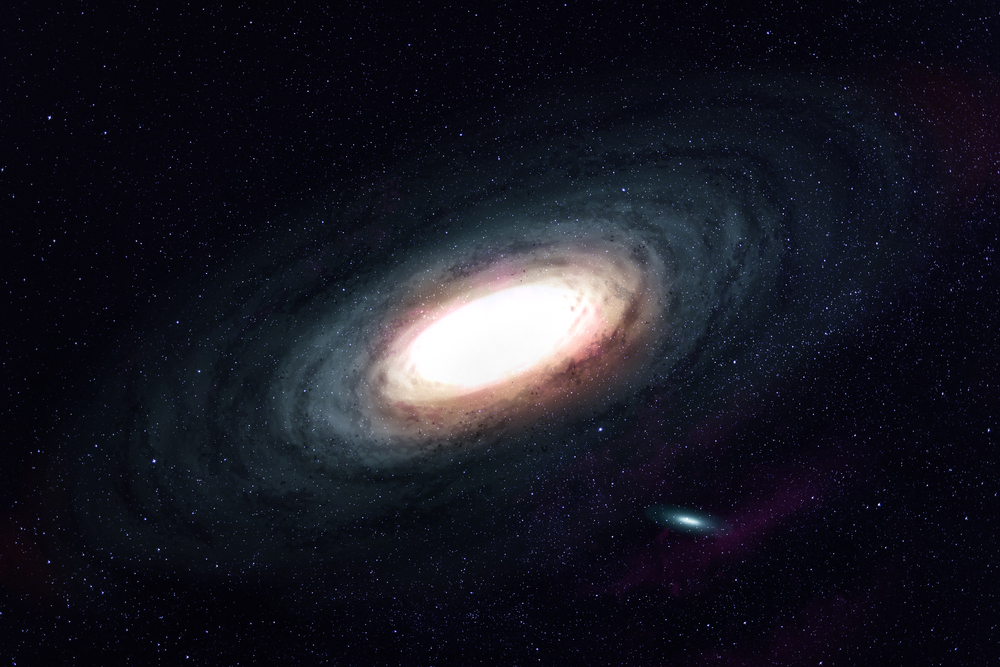
The universe may have had a beginning. Or it may have had a previous life that ended in a colossal collapse before bouncing back into the expanding cosmos we see today.
Contents
show
A team of physicists has proposed a strange alternative to the standard picture of cosmic history: the event we call the Big Bang may have been a rebound from a universe collapsing inside a black hole. The idea sounds like science fiction, but the mathematics behind it is being explored seriously.
The Big Bang May Not Have Been The Beginning
The familiar story of the universe starts roughly 13.8 billion years ago with an extremely hot, dense state that began expanding. Wind the equations backward far enough, however, and the standard model runs into a major problem because everything appears to converge toward a singularity, where density becomes infinite and known physics stops providing a meaningful description.
Enrique Gaztanaga, a professor at the University of Portsmouth’s Institute of Cosmology and Gravitation, has argued that this may be telling physicists something important. “The Big Bang model begins with a point of infinite density where the laws of physics break down,” Gaztanaga said. “This is a deep theoretical problem that suggests the beginning of the Universe is not fully understood.”
His team’s alternative was published in Physical Review D in June 2025. Rather than starting with an expanding universe and running the clock backward, the researchers considered the opposite process: matter collapsing under gravity until it reaches an extremely dense state.
A Cosmic Collapse Could End In A Bounce
The proposed answer involves one of the strangest rules in quantum mechanics. Matter is made from particles, and some of those particles are fermions, including electrons, protons and neutrons, which obey the Pauli exclusion principle.
That principle prevents identical fermions from occupying the same quantum state. Under enormous gravitational pressure, the researchers argue, this creates resistance against further compression and could prevent a collapsing cloud from reaching a singularity.
“We’ve shown that gravitational collapse does not have to end in a singularity and found that a collapsing cloud of matter can reach a high-density state and then bounce, rebounding outward into a new expanding phase,” Gaztanaga said.
The proposed rebound could produce a universe resembling the one we observe today. The researchers also argue that the model can account for both the extremely rapid expansion associated with the early universe and the accelerated expansion happening today, without requiring separate additions to explain each phenomenon.
The Black Hole Would Become A Cosmic Doorway
This is where the theory becomes particularly strange. If our universe emerged from matter collapsing inside a black hole, then the black hole would not simply mark the end of a cosmic structure. It could instead connect one cosmic phase to another.
The proposal does not mean scientists have discovered another universe or proved that ours came from a black hole. It is a theoretical model describing one possible way a universe could emerge from gravitational collapse.
The Idea Goes Back To 1972
Gaztanaga’s proposal did not appear from nowhere. In 1972, physicist Raj Kumar Pathria published a short paper in Nature titled “The Universe as a Black Hole,” examining the possibility that a closed universe could exist inside a Schwarzschild black hole.
The concept remained on the edge of cosmological research for decades because one major question remained unanswered: what would stop the collapse? Without a mechanism preventing the material from reaching a singularity, the idea lacked an obvious physical route from collapse to expansion.
Gaztanaga’s work proposes a possible answer through quantum mechanics. The exclusion principle could provide the resistance needed to halt the collapse and produce a rebound, giving the old black-hole cosmology idea a mechanism worth investigating.
Webb Telescope Data Adds Another Mystery
Another intriguing clue comes from the rotation of distant galaxies. Lior Shamir analyzed 263 early galaxies observed by the James Webb Space Telescope in the JADES deep field and found that roughly two-thirds appeared to rotate clockwise, while the rest rotated in the opposite direction.
If the universe has no preferred direction, researchers would generally expect a more even split. Shamir described the difference as quantitative and said the imbalance was also visible when looking at the images themselves.
One possible interpretation is that the universe itself has a preferred rotational direction. If our universe inherited an axis from a rotating parent black hole, that could potentially fit the black-hole cosmology picture.
There is another explanation, however, and it is far less exotic. The apparent imbalance could be affected by the Milky Way’s own rotation because galaxies rotating in different directions relative to our galaxy can have slightly different observed brightness through the Doppler effect.
That means the galaxy data do not prove that our universe came from a black hole. They give researchers another unresolved question to investigate.
Another Team Is Rethinking The Early Universe
Gaztanaga’s proposal is not the only recent attempt to rethink what happened during the universe’s earliest moments. Researchers at the University of Waterloo and the Perimeter Institute have been working with a framework called quadratic gravity.
Their work, published in Physical Review Letters in March 2026, explores whether the rapid expansion of the early universe could emerge directly from a deeper description of gravity. Instead of adding inflation separately, the model produces the early expansion from the gravity equations themselves.
“This work shows that the universe’s explosive early growth can come directly from a deeper theory of gravity itself,” researcher Niayesh Afshordi said.
The model also predicts a minimum level of primordial gravitational waves, which are faint ripples in spacetime that could have been produced during the universe’s earliest moments. That gives future experiments something specific to search for rather than leaving the theory entirely in the realm of mathematical speculation.
Physicists Don’t Fully Agree On The Big Bang
Perhaps the most revealing development is a survey of physicists themselves. Afshordi and colleagues surveyed 1,675 physicists through the American Physical Society’s Physics Magazine Big Mysteries Survey to find out how researchers actually view some of cosmology’s biggest unresolved questions.
The responses showed that several ideas commonly presented to the public as settled positions do not command overwhelming agreement among researchers.
- 68.4% said the Big Bang describes a universe evolving from a hot, dense state rather than necessarily representing the literal beginning of time.
- 50.8% supported cosmic inflation.
- 20.6% was the highest share attached to any single position on dark matter.
- 18.9% selected string theory as their preferred approach to quantum gravity.
- 17.7% said gravity may not be quantum at all.
The survey does not determine which theory is correct. Instead, it shows where physicists disagree and where major questions remain open.
“In this sense, lack of consensus can be a clue,” Afshordi said. “It marks places where better data, sharper theory, or new connections between subfields may be needed.”
The New Theory Still Has Major Gaps
The black-hole bounce proposal is intriguing, but there is a large difference between a mathematical model and an established description of reality. Gaztanaga’s model has not been confirmed by an observation showing that our universe actually emerged from a black hole.
There are other unresolved problems as well. The model does not explain dark matter, the galaxy rotation finding has an alternative interpretation, and the quadratic gravity model’s predicted gravitational-wave signal has not been detected as confirmation.
Even the physicists’ survey tells us about scientific opinion rather than the actual history of the cosmos. The evidence therefore does not show that scientists have disproved the Big Bang.
What it does show is narrower and more interesting: the singularity remains a serious theoretical problem, alternative models exist, and physicists are still debating what happened at the earliest stage of cosmic history.
Euclid Could Put The Bounce To The Test
The most important feature of the bounce proposal may be that it makes a prediction that can be tested. Gaztanaga’s model predicts that the universe should have a small amount of positive spatial curvature rather than being perfectly flat.
The European Space Agency’s Euclid mission is already mapping enormous portions of the cosmos to study dark matter, dark energy and the geometry of the universe. Its observations could therefore provide an important test of models that make different predictions about cosmic curvature.
If Euclid continues to find a universe consistent with being extremely flat, the prediction made by the bounce model would face a serious problem. If the observations reveal the type of positive curvature the model predicts, an idea that has spent decades on the fringe would suddenly deserve much closer attention.
For now, the Big Bang remains the central framework for describing the hot, dense early universe. But the deeper physicists look into the first moments, the clearer it becomes that the origin of everything is still one of science’s hardest unanswered questions.
A universe reborn from the collapse of a black hole would be an extraordinary possibility, but it remains a possibility. The next chapter will be written by observations capable of telling physicists whether the mathematics describes our universe or merely one universe that could exist.