
Your cart is currently empty!
Scientists Explain Why Earth Days Are Not Always Exactly 24 Hours

Earth’s clock is not as reliable as it appears. Although we measure a day as 24 hours, our planet’s rotation constantly fluctuates, making some days fractionally longer or shorter than others. Scientists have now uncovered new evidence suggesting that a hidden struggle between forces deep inside Earth helps control these changes, revealing a surprising connection between the planet’s innermost regions and the time we measure on its surface.
Contents
show
The differences are too small for anyone to notice during an ordinary day, but they carry important clues about what is happening thousands of kilometres underground. Researchers believe their findings could help explain a decades-old mystery surrounding Earth’s rotation and the strange behaviour of its deepest layers.
Earth’s Rotation Is Not As Steady As Most People Think
For practical purposes, a day lasts 24 hours. It is the measurement around which modern life revolves, determining everything from work schedules and sleep patterns to the timing of scientific observations. Yet the planet itself does not maintain a perfectly constant rotational speed, meaning the actual length of a day can shift by a few milliseconds.
These variations are far too small to affect daily routines, but scientists can detect them using highly precise measurements. Over time, Earth can rotate slightly faster or slower, changing the interval required to complete one full turn on its axis.
Several processes contribute to these fluctuations. Powerful earthquakes redistribute mass across the planet, while melting glaciers alter the distribution of water between land and oceans. Atmospheric circulation, including powerful winds associated with storms, can also influence rotation. Ocean currents and tides introduce further changes through the movement of enormous quantities of water.

These processes help explain why Earth’s rotation is never perfectly uniform. However, they do not account for every observed fluctuation, particularly changes that develop over periods of several decades.
That gap has encouraged researchers to investigate the planet’s interior. Beneath the crust and mantle lies a constantly moving metallic outer core surrounding a solid inner core. Interactions between these regions can transfer rotational momentum, creating changes that eventually affect the speed at which Earth turns.
A study by University of Alberta researchers Huifeng Zhang and Mathieu Dumberry, published in Nature, examines how these deep interactions influence variations in day length over longer timescales. Their work suggests that gravitational forces involving the inner core play a particularly important role.
A Hidden Struggle Between Earth’s Deepest Layers

Earth is often depicted as a solid sphere, but its interior contains several layers with different physical properties and movements. The crust forms the thin outer shell, beneath which lies the mantle, an enormous region of hot rock extending roughly 2,900 kilometres towards the core. Below it, the liquid outer core surrounds the solid inner core at the planet’s centre.
Although these layers belong to the same planet, they do not always rotate at precisely the same rate. Their relative movements change over time, allowing angular momentum to pass between them.
Angular momentum describes the rotational motion of an object or system. When interacting parts exchange this quantity, changes in one region can be accompanied by changes elsewhere. Earth’s total angular momentum remains conserved when the planet is considered as a whole, although exchanges with the Moon and other external influences also affect its long-term rotation.
The relationship between the core and mantle is particularly important because changes in the mantle’s rotational speed influence the length of a day. If the mantle rotates slightly faster, Earth completes a turn in less time. If it slows down, the rotation takes longer.
Scientists have known for roughly three decades that interactions between Earth’s core and mantle are connected to changes in day length over periods of years and decades. The challenge has been identifying how the different forces involved combine to produce the variations seen in observational data.
Zhang and Dumberry examined this problem by investigating several mechanisms that transfer torque between the inner core, outer core and mantle. Their findings offer a more detailed explanation of how processes hidden deep underground can influence the planet’s rotation.
Gravity Could Be The Biggest Influence On Earth’s Rotation
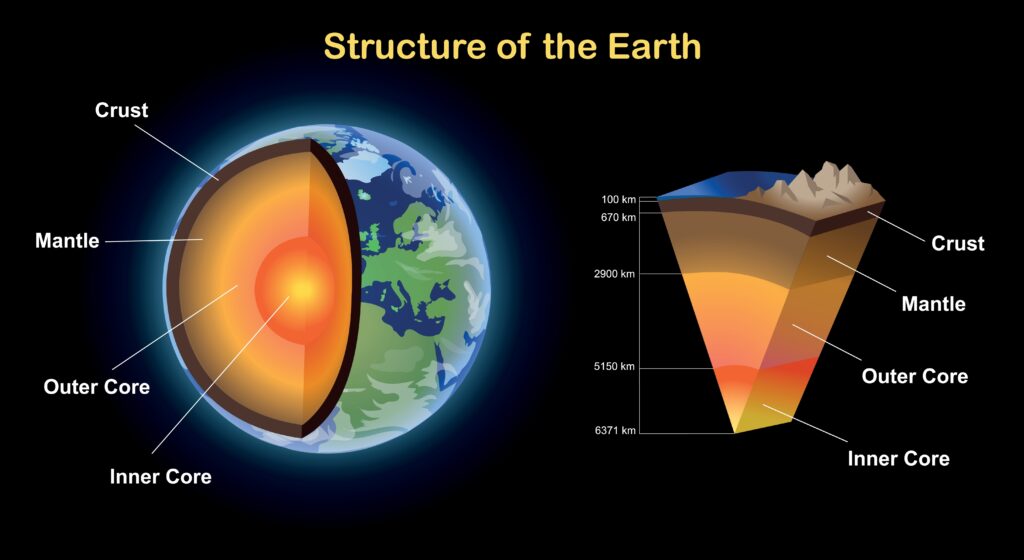
One of the study’s central findings concerns a mechanism known as gravitational coupling. This describes how gravity links the inner core with uneven distributions of mass in the mantle, allowing changes in the core’s movement to influence the rotation of surrounding layers.
The inner core is solid, but it is not a perfectly spherical object. Its shape and the distribution of mass inside Earth create conditions in which gravitational interactions can produce a turning force, known as torque.
When the inner core’s rotational speed changes, its gravitational relationship with irregularities in the mantle can also change. The resulting torque affects the rotational motion of the surrounding layers, potentially altering the length of a day by a few milliseconds.
The researchers compared models of these forces with observations of Earth’s rotation and estimates of inner-core movement. Their analysis indicated that gravitational coupling exerted the strongest influence among the three mechanisms they investigated.
This finding helps clarify a longstanding scientific question. Researchers had observed variations in Earth’s rotation for decades, but accurately predicting those changes from the forces acting inside the planet remained difficult.
Gravitational coupling appears to provide a significant part of the missing explanation. However, the other mechanisms still matter because they can resist the gravitational influence and change the overall balance of forces acting on the mantle.
The result is a complicated interaction in which small shifts in the movement of Earth’s deepest layers can influence the speed of rotation measured at the surface.
Two Other Forces Help Keep Earth’s Rotation In Check

Gravity is only one part of the mechanism. Zhang and Dumberry also investigated electromagnetic coupling and topographic coupling, which can affect the exchange of rotational momentum between the core and mantle.
These processes operate at the boundary separating the liquid outer core from the solid mantle. Their influence helps determine how strongly the layers interact and how much the gravitational torque can alter Earth’s rotation.
Electromagnetic Forces Connect The Core And Mantle
The outer core contains electrically conducting liquid metal. As this material moves, it generates Earth’s magnetic field and creates electromagnetic interactions that can transmit forces between different regions of the planet’s interior.
The electrical conductivity of the lowermost mantle is particularly relevant. If this region can conduct electricity sufficiently well, the movement of liquid metal in the outer core can exert electromagnetic stress across the core-mantle boundary.
This process creates a coupling between the two layers, allowing changes in the outer core’s movement to influence the mantle’s rotation. Electromagnetic forces can therefore oppose some of the gravitational torque acting on the mantle.
Scientists still have uncertainties about the physical properties that control this process, including the conductivity and structure of the deepest mantle. Better measurements and improved models could help establish more precisely how strongly electromagnetic coupling affects Earth’s rotation.

Irregularities Along The Boundary Add Another Force
The boundary between the liquid outer core and the solid mantle is not perfectly smooth. Variations in its topography can influence how the two regions interact as liquid metal flows beneath the mantle.
These irregularities can generate another form of torque, known as topographic coupling. Like electromagnetic coupling, this mechanism can resist changes driven by gravitational interactions between the inner core and mantle.
The researchers found that gravitational, electromagnetic and topographic coupling must be considered together to understand the observed changes in day length. Their models suggest that the latter two mechanisms help limit the influence of gravitational torque.
The balance between these competing forces offers a possible explanation for why Earth’s rotation changes over decades without producing much larger variations.
How Researchers Investigated A Mystery Thousands Of Kilometres Underground

Scientists cannot directly observe the inner core in the way they study Earth’s surface. Instead, they use seismic measurements, models of material movement and precise observations of planetary rotation to reconstruct what may be happening deep inside the planet.
Zhang and Dumberry combined seismic estimates of inner-core rotation with models describing the flow of material in the outer core. They examined changes between 1964 and 2019, assessing how different combinations of forces compared with observed variations in day length.
Their analysis considered three main mechanisms: gravitational coupling between the inner core and mantle, electromagnetic coupling across the core-mantle boundary, and topographic coupling associated with irregularities along that boundary.
By comparing the model results with observations, the researchers investigated which combinations of forces could best explain the rotational changes recorded over several decades.
The analysis pointed towards gravitational coupling as the dominant influence among the mechanisms studied. Electromagnetic and topographic effects appeared to act as a buffer against some of those changes.
This modelling approach is particularly valuable because Earth’s deep interior remains inaccessible to direct investigation. Scientists must test their explanations against measurable evidence and determine whether their models reproduce the behaviour observed at the surface.
However, the findings depend partly on how accurately the models represent the physical properties and movements of Earth’s interior. Limitations in those models mean that the results cannot yet explain every variation in the planet’s rotation.
Earth’s Solid Inner Core May Also Change Shape
The research offers another intriguing insight into the behaviour of Earth’s inner core. Although this central region is solid, the researchers suggest it can deform gradually under sustained forces, with changes occurring over a timescale of about 10 years.
This process is described as viscous deformation. Rather than behaving like an entirely rigid object under every circumstance, the inner core may slowly adjust its shape as forces act upon it over time.
The possibility matters because the inner core’s shape influences its gravitational relationship with the mantle. If the distribution of mass changes as the core deforms, the resulting torque can also change, influencing how rotational momentum passes between Earth’s layers.
The finding adds to scientific understanding of how the deepest parts of the planet respond to their surroundings. It also illustrates why researchers cannot fully explain Earth’s rotation by examining its surface alone.
The inner core’s movement, shape and interaction with the surrounding liquid metal all contribute to a complex system. Even small changes within that system can leave measurable traces in the length of a day.
Further research will be needed to establish exactly how these processes interact and whether other changes in the inner core’s behaviour can explain additional patterns in Earth’s rotation.

Scientists Still Cannot Explain Every Change In Day Length
Although the study provides new evidence about long-term rotational changes, it does not solve every mystery surrounding Earth’s inconsistent rotation. The research focuses on variations unfolding over several decades, while other processes operate over much shorter or longer periods.
Atmospheric circulation and ocean movements can influence rotation over shorter timescales. Tidal interactions with the Moon affect Earth’s rotation over much longer periods, gradually slowing the planet over geological time.
Researchers have also observed fluctuations that occur over periods of only a few years. The models examined by Zhang and Dumberry cannot yet establish precisely how the mechanisms they studied contribute to every shorter-term variation.
One limitation is the accuracy of existing seismic estimates of inner-core rotation. These measurements provide valuable information, but their precision is insufficient to resolve every change across shorter intervals.
The models also rely on estimates of physical properties deep inside Earth that remain uncertain. Some forces influencing day length may not be fully represented in the calculations, leaving room for further discoveries.
Zhang has highlighted the value of bringing different forms of evidence together to build a clearer picture of Earth’s interior. In comments reported by Gizmodo, she said, “What I find particularly exciting is that these different pieces of information can come together to provide a more coherent picture of Earth’s deep interior, a region that is extremely difficult to observe directly.”
The research therefore offers a stronger explanation for one part of the puzzle while leaving other questions open for investigation.
Why A Few Milliseconds Can Reveal So Much About Earth
A change of a few milliseconds may seem insignificant compared with the 86,400 seconds in a standard 24-hour day. Yet precise measurements of Earth’s rotation give scientists a way to investigate processes that cannot be observed directly.
When researchers compare changes in day length with seismic observations and models of the core, they gain clues about how material moves inside the planet. These measurements can help test theories about the structure of the mantle, the properties of the core and the forces connecting different layers.
The findings may also improve understanding of the inner core’s behaviour, including how it rotates and responds to sustained forces. Better models could eventually help scientists make more reliable predictions of rotational variations over decades.
There is still considerable work ahead. Earth’s interior contains interacting processes that operate at different speeds, and no single mechanism explains every fluctuation. Continued observations and improved modelling will be necessary to determine how these forces work together.
For now, the research offers a striking insight into the planet beneath our feet. The ground may feel stable, and the clock may keep ticking, but Earth is constantly adjusting its motion in ways that precise instruments can detect.
The next time a clock measures another 24-hour day, remember that the planet underneath it is still moving to a rhythm that scientists are only beginning to understand.