
Your cart is currently empty!
Scientists Invent a Knitting Stitch That Could Prevent Fabric From Unraveling
A single dropped stitch can ruin hours of knitting, turning a tiny mistake into a long, unraveling column of damaged fabric. Now, mathematicians have designed a new type of stitch that could stop this familiar problem from spreading indefinitely.
Contents
show
Called a “robust knit,” the design uses knot theory to change how loops interact and how defects travel through knitted material. The research offers a surprising example of how advanced mathematics could help solve a practical problem that has challenged knitters for generations.
How One Small Mistake Can Unravel an Entire Piece of Fabric
Knitting may appear straightforward, but its structure creates a particular vulnerability. The fabric is formed by pulling loops of yarn through other loops, allowing the material to stretch while holding together through its repeating pattern. Unlike woven textiles, knitted fabric depends on these interconnected loops to maintain its structure.
That arrangement makes knitting flexible and convenient, but it also means that one failed loop can affect the stitches around it. When a loop slips out of position, the surrounding structure can become vulnerable, allowing the defect to spread through successive rows.
This process is known as defect propagation, and one of its most recognizable forms is called laddering. A dropped stitch can unravel down a column of fabric, leaving a visible line of loose loops that may extend much farther than the original mistake.
For someone knitting a scarf, sweater, or blanket, this can mean spending valuable time repairing damage that began with a single missed loop. The problem is particularly frustrating because the defect can continue spreading even after the knitter has moved on to another section.
Researchers led by physicist Daisuke S. Shimamoto of Ritsumeikan University in Japan wanted to understand why these failures spread and whether the underlying stitch structure could be redesigned to stop them. Their answer came from investigating the mathematical relationships between loops rather than treating each stitch as an isolated piece of yarn.
Why Scientists Turned a Knitting Pattern Into a Mathematical Knot
To investigate the problem, Shimamoto and his colleagues created a three-dimensional model of a single jersey knit stitch. This is a common knitting pattern in which loops form a repeating structure, making it a useful starting point for examining how defects develop.
The team then wrapped the model around a mathematical shape known as a torus. A torus resembles a doughnut, with a continuous surface that has no conventional top or bottom edges. Using this shape allowed the researchers to examine the repeating knit pattern without introducing boundaries that could complicate the analysis.
The approach transformed the knitted structure into a form that could be investigated using knot theory, a branch of mathematics that studies how loops and strands connect and intertwine. Although knot theory may sound far removed from an everyday craft, it provides a useful framework for understanding structures built from connected strands.
By projecting multiple rows of knitted stitches onto the torus, the researchers could examine how defects in one row affected the rows around it. Instead of looking only at the location of a dropped stitch, they could study how the resulting damage moved through the fabric.
This dynamic approach helped reveal the mechanism behind laddering. It also gave the team a mathematical foundation for exploring whether changes to the arrangement of loops could prevent a defect from continuing indefinitely.
What Makes Conventional Knitting Vulnerable to Laddering
In a standard single jersey knit, each loop interacts with neighboring loops in a repeating arrangement. This structure makes the fabric flexible and relatively easy to produce, but it also allows certain failures to trigger a chain reaction.
When a loop becomes disentangled, the loop immediately below it can become vulnerable to the same problem. If that loop slips, the defect can continue downward through the column, creating the familiar ladder-like pattern.
Shimamoto described the process in the source coverage, saying, “If one unit cell is disentangled, the cell just below that cell is disentangled, and it is repeated, and it propagates endlessly.”
The explanation captures the central weakness the researchers were trying to address. A dropped stitch can create conditions that encourage further failures, allowing damage to spread through the structure rather than remaining confined to its original location.
Previous mathematical research had examined defects in knitted materials, but the researchers sought to understand how those defects moved over time. Applied mathematician Alexander Omelchenko of Constructor University in Germany, who was not involved in the study, described the new approach as “a very original approach.”
Omelchenko originated the topological analysis method used in the work. His comments helped distinguish the study from earlier efforts that examined defects as static objects rather than investigating their movement through successive rows of fabric.
Understanding that movement was essential to the next stage of the research. If the researchers could identify how the structure allowed a defect to spread, they could investigate whether a different arrangement of loops might interrupt the process.
How the New Robust Knit Limits the Spread of Damage

After analyzing the conventional jersey stitch, Shimamoto used basic moves from knot theory to design a different knitted structure. The resulting robust knit changes how loops cross and interact, creating a pattern that behaves differently when a stitch becomes defective.
The new design uses more complex, sweeping loops that cross over two stitches rather than one. This alteration changes the relationships between neighboring loops and limits the way a defect can propagate through successive rows.
In the conventional pattern examined by the researchers, a dropped loop can trigger an ongoing chain reaction. In the robust knit, the effect of a defect diminishes as it moves through the structure, eventually reaching a point where the propagation stops.
The distinction is significant because the new design does not depend on preventing every possible stitch from slipping. Instead, it changes the structure so that a single defect has less capacity to trigger an extended sequence of failures.
The researchers found that defects could still expand when more than one stitch was slipped in the same row. The robust knit therefore offers a specific solution to defect propagation rather than a universal guarantee against every form of unraveling.
Its main characteristics include:
- A different loop arrangement: The robust knit uses sweeping loops that cross over two stitches instead of one, changing the structure of the fabric.
- Reduced defect propagation: A defect can initially spread, but its effect becomes smaller across successive rows.
- A stopping point: The chain reaction eventually ends instead of continuing indefinitely through the knitted structure.
- A defined limitation: Multiple slipped stitches in the same row can still allow defects to expand, meaning the design does not eliminate every possible failure.
The findings suggest that the arrangement of loops plays a central role in determining whether damage remains limited or spreads through knitted material. By changing that arrangement, the researchers demonstrated a way to control a problem that conventional stitches can struggle to contain.
Could the Discovery Lead to Stronger Textiles?

The study, published in Physical Review X, connects mathematical research with a practical challenge in textile design. Its findings could eventually help researchers investigate new knitted structures that are more resistant to certain types of damage.
Industrial textiles could be one area of interest, particularly where manufacturers want knitted materials to maintain their structure during repeated use. Athletic wear and other performance garments might also offer opportunities for future investigation, although the research has not yet established that the robust knit is suitable for these applications.
A better understanding of defect propagation could help textile designers evaluate how different stitch structures respond to individual failures. Rather than relying entirely on trial and error, researchers may be able to use mathematical models to identify patterns worth testing.
The potential benefits could extend to reducing fabric damage and waste if future manufacturing research establishes practical ways to use more resilient stitches. However, those outcomes remain possibilities rather than demonstrated results of the current study.
The researchers have established a proof of concept showing that a carefully designed stitch can limit the spread of certain defects. Turning that result into a commercially useful textile would require further work to evaluate the design under practical conditions.
For manufacturers, the next questions include how the stitch could be produced, how it would perform during ordinary wear, and whether its structural advantages could be achieved without creating other difficulties. Those questions will help determine whether the mathematical discovery can become a practical option for textile production.
Why Testing Every Possible Stitch Could Be Difficult
Although the researchers demonstrated how knot theory can guide stitch design, the method also presents a computational challenge. Evaluating every possible knitted structure using torus diagrams could become impractically expensive, according to Omelchenko.
The challenge is significant because knitted fabrics can contain complex arrangements of interconnected loops. Exploring a wide range of possible structures would require researchers to analyze how different patterns behave and how defects might move through them.
The robust knit provides an example of how mathematical analysis can identify a structure with a useful property. It does not mean that every potential design can be evaluated easily or that the best possible stitch has already been found.
Shimamoto hopes the work will inspire stronger fabric designs in the future. The research establishes a starting point for investigating the relationship between stitch geometry and the spread of defects, giving future studies a way to build on the initial findings.
Further research will be needed to explore the full range of possible designs and assess their practical usefulness. The immediate achievement is a mathematical demonstration that changing the arrangement of loops can alter how a defect travels through a knitted structure.
The Research Also Had Help From an Unexpected Source
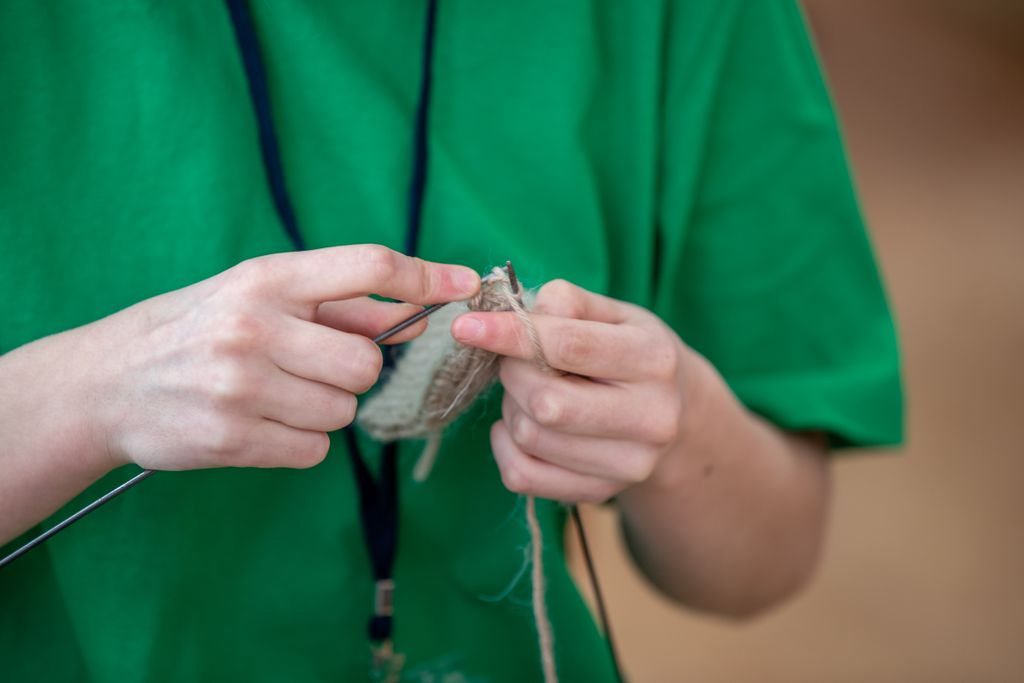
Behind the mathematical analysis is a personal detail that connects the research to the craft it examines. Both Shimamoto and Omelchenko consulted their mothers for knitting advice while working on their research.
Shimamoto even gave his mother an author credit in recognition of her role in teaching him how to knit. The detail offers a glimpse of how practical experience and mathematical analysis came together during the project.
Omelchenko described the value of that advice, saying, “It sometimes was a little bit more useful to talk with her rather than textile researchers.”
The comment reflects the practical knowledge that can accompany an everyday skill. Mathematical models helped the researchers investigate the behavior of knitted loops, while familiarity with knitting provided another way to understand the structures they were studying.
It is an especially fitting detail for a project that connects an ordinary household craft with an advanced mathematical field. The researchers approached a familiar problem using formal analysis, but they also drew on advice from people who knew the craft through experience.
What the Robust Knit Actually Proves
The new stitch remains a research concept, and its suitability for widespread manufacturing has yet to be established. The study does not show that conventional knitting will immediately be replaced or that the robust knit can prevent every kind of unraveling.
What it does demonstrate is more specific. By changing how loops cross and connect, researchers created a knitted structure in which certain defects shrink across successive rows and eventually stop propagating.
That result gives textile researchers a new way to think about fabric reliability. It also illustrates how mathematics can help explain why familiar materials fail and identify structural changes that could make them more resilient.
For knitters, a dropped stitch can still mean an unwelcome repair. For researchers, it now offers a precise question about how loops interact and how a small failure moves through a larger structure.
The robust knit provides one answer, showing that a defect’s path can depend on the design of the stitches themselves. If future research can turn that mathematical insight into a practical manufacturing technique, a small change in how yarn loops cross could help prevent a minor mistake from becoming a much larger problem.