
Your cart is currently empty!
Scientists Spot a Bizarre Particle Pattern That Could Change Everything We Know About the Universe

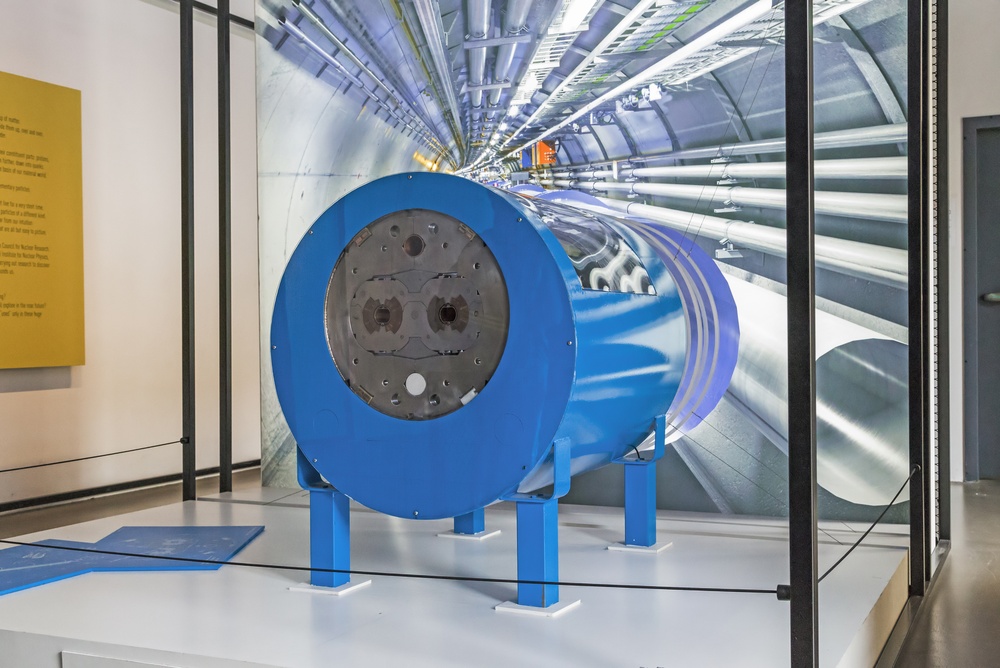
The Large Hadron Collider has uncovered a strange pattern that could point toward something physicists have spent decades searching for: evidence that our understanding of the Universe is incomplete. Scientists studying tiny particles known as B mesons have spotted unexpected behaviour involving processes nicknamed “penguin decays,” raising questions about one of the most successful theories in modern physics. The findings are particularly intriguing because they emerged from an analysis involving approximately 650 billion particle decays, yet the results still fall short of the evidence required to confirm a discovery.
Contents
show
For more than 50 years, the Standard Model has helped scientists explain the fundamental particles that make up our world and how they interact. It successfully predicted the Higgs boson, which researchers discovered in 2012, but it cannot explain gravity or identify the particles responsible for dark matter. Now, the unusual penguin decay measurements have added another potential problem to the list. If future experiments confirm the discrepancy, physicists could be looking at clues to an entirely new framework for understanding reality.
The Large Hadron Collider Has Found a Curious Anomaly
The Standard Model has survived decades of experiments because its predictions have repeatedly matched what scientists observe. However, researchers are now investigating a discrepancy involving B mesons, short-lived particles that contain a bottom quark alongside another quark. Scientists studying how these particles decay have found that a particular process appears to occur less frequently than the Standard Model predicts. They have also observed an unexpected pattern in the directions of the particles produced during these decays, giving researchers another reason to investigate whether something is missing from their current understanding.
The measurements do not prove that the Standard Model is wrong, and the anomaly could still have an explanation within known physics. Nevertheless, the sheer number of observations makes the result worth examining closely. When researchers analyse hundreds of billions of particle decays, they can search for subtle patterns that might be difficult to distinguish from random fluctuations in a smaller dataset. If the same discrepancy persists as more evidence becomes available, it could indicate that an unknown particle or interaction is influencing the process. For now, scientists are investigating several possible explanations before reaching any conclusions.
Why Scientists Are Talking About Particle Penguins
The unusual nickname has a surprisingly playful origin. Penguin decays are associated with diagrams physicists use to represent certain particle interactions, and the name reportedly emerged after physicist John Ellis lost a game of darts and was challenged to include the word “penguin” in a scientific paper. He redrew his diagrams to resemble the flightless birds, and the name became part of particle physics terminology. Despite the amusing label, the process is scientifically significant because it allows researchers to investigate the possible influence of heavy particles that cannot easily be observed directly.
Scientists typically use particle accelerators to smash smaller particles together at extremely high speeds, producing heavier particles that can then be studied. Penguin decays offer another route to investigating the unknown. Even when a hypothetical heavy particle never appears directly in a detector, its influence could alter the probability of a known particle decaying in a particular way. Researchers can compare those measurements with theoretical predictions and search for discrepancies. If the observed behaviour consistently differs from what the Standard Model expects, it could provide an indirect clue that new physics is involved.
Hundreds of Billions of Observations Revealed the Problem
Researchers analysed approximately 650 billion B meson decays and found fewer penguin decays than the Standard Model predicts. The analysis also revealed an anomaly involving the directions of the resulting particles, adding another layer to the puzzle. Individual measurements can be affected by statistical fluctuations, experimental limitations or difficulties in calculating complex particle interactions. However, scientists can use enormous datasets to investigate whether an apparent discrepancy remains when the number of observations increases. The latest findings have attracted attention because they suggest a pattern that deserves further investigation, although they have not established what is causing it.
Particle physicists generally require a result to reach a five-sigma level of statistical significance before treating it as a discovery. This standard corresponds to roughly a one-in-1.7-million probability of obtaining an equally extreme result from random statistical fluctuations under the relevant assumptions. The penguin decay measurements have not reached that threshold, meaning the findings cannot yet establish the existence of a new particle or force. Researchers need additional observations and further analysis to determine whether the anomaly becomes more convincing. Until then, the results remain an intriguing possibility rather than proof that the laws of physics need rewriting.

Another Detector Could Help Confirm the Findings
The investigation has gained another potential lead from the Compact Muon Solenoid, known as CMS, one of the major detectors operating at the Large Hadron Collider. The CMS experiment has also examined penguin decay, using different hardware and methodology and involving a separate research team. Independent measurements can help scientists determine whether an unusual result reflects genuine particle behaviour or an issue associated with a particular experiment. If researchers repeatedly observe a similar discrepancy through different approaches, confidence in the finding can increase, although the evidence must still withstand careful statistical and theoretical scrutiny.
The CMS detector measures the tracks of particles emerging from high-energy collisions, allowing researchers to reconstruct their properties and investigate how they behave. Its measurements provide another opportunity to test the predictions of the Standard Model against experimental results. However, independent findings do not automatically settle the question, particularly when the underlying processes are difficult to calculate. Scientists must still consider whether known interactions, measurement uncertainties or other factors could account for the apparent mismatch. The supporting results have strengthened the case for further investigation, but a confirmed discovery remains out of reach.

Charming Penguins Could Complicate the Explanation
One possible complication involves a process known as charming penguins, which includes interactions involving a charm quark. These processes can be difficult to predict precisely, creating uncertainty when scientists compare theoretical calculations with observed decay rates. If researchers have underestimated their contribution, the apparent discrepancy could be partly explained without requiring an entirely new particle or force. This possibility demonstrates why physicists must investigate conventional explanations before concluding that an unexpected result signals a major change to existing theory.
The researchers therefore face two central questions: whether the anomaly persists as more data becomes available and whether known physics can explain the measurements. If the discrepancy becomes statistically stronger and conventional explanations prove insufficient, scientists could begin exploring models involving previously unknown particles or interactions. If the pattern disappears or can be accounted for by existing processes, the results may instead help researchers refine their understanding of particle decays. Either outcome would provide valuable information about how well the Standard Model describes the physical world.
The Standard Model Still Cannot Explain Gravity
The penguin decay anomaly is particularly interesting because physicists already know that the Standard Model cannot answer every major question about the Universe. Although it successfully describes elementary particles and three fundamental forces, gravity remains outside its framework. Dark matter presents another unresolved mystery because scientists have not identified the particle responsible for it. These longstanding problems have led researchers to expect that a more complete theory will eventually be needed, even though they do not yet know exactly what that theory will contain.
Dr Mark Smith of Imperial College London, who is investigating the topic, described the emerging discrepancies by saying, “We’re starting to see cracks from these kinds of measurements.” He also acknowledged the uncertainty surrounding what comes next, explaining, “We’ve always known there should be new physics beyond the Standard Model. The problem is we just don’t know what.” His comments reflect a central challenge in modern particle physics: researchers have evidence that their current framework is incomplete, but no confirmed replacement has emerged. A new particle that explains one discrepancy would also need to fit consistently with other measurements and established physical principles.
One New Particle Could Lead to Many More
Finding a particle that explains dark matter or the penguin decay anomaly might sound like a straightforward solution, but new discoveries can have consequences throughout physics. As Smith explained, “One of the exciting things about particle physics is that nothing exists in isolation.” A new particle would need to fit into a wider framework that accounts for its interactions and explains how it relates to other particles. The discovery could therefore lead scientists to predict additional particles or interactions that have not yet been observed.
Researchers are particularly interested in whether the explanation for penguin decay could also help address other unresolved problems. Smith suggested that the same underlying physics might provide an explanation for dark matter or identify possible dark matter candidates. Such a connection would be significant, but it remains speculative because the current measurements have not established a link between these phenomena. Scientists will need stronger evidence and a coherent theoretical explanation before concluding that a single discovery could resolve several outstanding mysteries.
More Data Could Decide the Future of the Discovery
Researchers have more evidence to examine, with the existing dataset reportedly containing around five times more data than was available for the latest paper. Further results from CMS and other particle physics experiments could also help establish whether the anomaly survives additional scrutiny. Scientists will analyse the larger datasets to test the statistical significance of the discrepancy and improve their understanding of the processes involved. The report estimates that the penguin decay question could be settled within five to 10 years, although the actual timeline will depend on the results and progress of the research.
Experiments investigating dark matter, neutrinos and other unresolved questions will also contribute to the search for physics beyond the Standard Model. Previous discoveries often followed a clear theoretical prediction, as happened with the Higgs boson, which scientists had anticipated decades before its detection. The search for new physics is different because researchers have far less certainty about what the next discovery should look like or where it might appear. As Smith put it, “We’re in the region where, for the first time, we don’t know what’s next.” The penguin decay findings have not overturned modern physics, but they have given scientists another reason to keep looking. The next decisive discovery could emerge from a pattern that initially seemed far too small to change our understanding of the Universe.
Sources:
- Aaij, R., Abdelmotteleb, A. S. W., Beteta, C. A., Abudinén, F., Ackernley, T., Adefisoye, A. A., Adeva, B., Adinolfi, M., Adlarson, P., Agapopoulou, C., Aidala, C. A., Ajaltouni, Z., Akar, S., Akiba, K., Akthar, M., Albicocco, P., Albrecht, J., Aleksiejunas, R., Alessio, F., . . . Zunica, G. (2026). Comprehensive Analysis of the B 0 → K * 0 μ + μ − Decay. Physical Review Letters, 137(2), 021802. https://doi.org/10.1103/24g9-yn9d
- Shaking the box for new physics – Home | CERN. (2024, June 12). https://home.cern/shaking-box-new-physics/?