
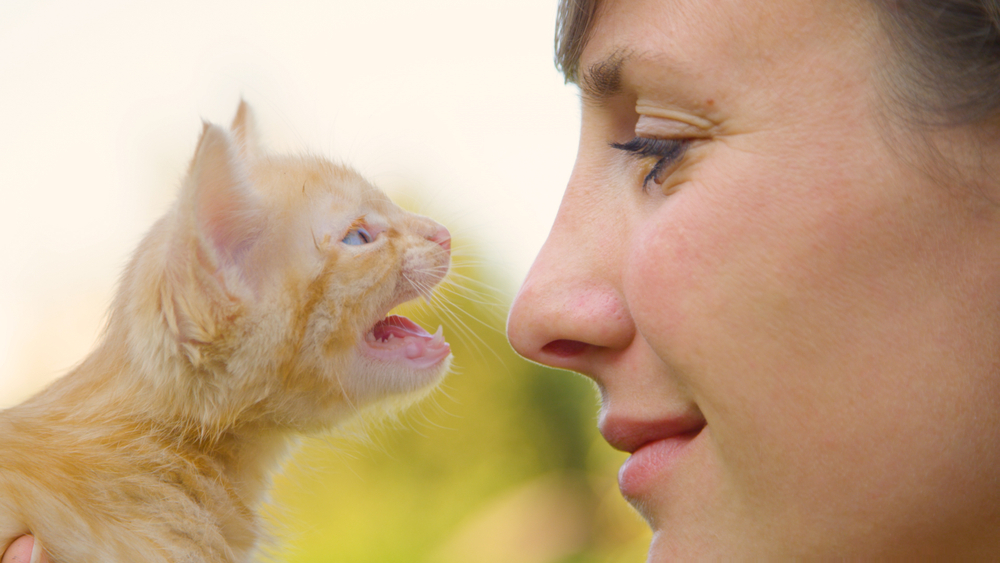
Your cat might be trying to tell you something every time it starts meowing loudly, and scientists have now found evidence that those familiar complaints could be more deliberate than owners realize. According to a new study, cats become significantly more vocal when humans are nearby and potentially able to solve whatever problem they are facing. So, the next time your feline starts shouting at you, there might be a very specific reason behind the performance.
Researchers at the University of São Paulo in Brazil conducted an experiment involving 38 domestic cats to investigate how they communicate when they need human assistance. The results were striking: cats produced 86 meows when a human was present, compared with just 20 when they were alone. Their behavior also suggested they were directing their attention toward the person who could potentially help them. The findings offer fascinating insight into why cats may have developed such an effective way of getting their owners’ attention.
Scientists Put 38 Cats In A Surprisingly Difficult Situation
Researchers wanted to understand whether cats deliberately use meowing to communicate problems to humans. Although domestic cats frequently vocalize around their owners, scientists have spent years investigating whether these sounds serve specific purposes beyond expressing excitement, discomfort, or frustration. To examine the behavior more closely, the team recruited 38 pet cats whose owners reported frequent meowing, particularly when food was involved.
Each cat was presented with a favorite food treat inside a small plastic box containing holes. The animals could smell the food and recognize that something desirable was inside, but they couldn’t retrieve it themselves. Getting the treat required an ability they didn’t possess: using human hands to open or manipulate the container.
The researchers then observed each cat under two different conditions. During one session, a human was present and paying attention. During the other, the cat was left alone without a person in the room. Each observation lasted one minute, allowing researchers to compare how frequently the animals vocalized when someone capable of helping was nearby.
The experiment created a situation in which the cats had a clear problem and a potential source of assistance. Their responses gave researchers an opportunity to examine whether the animals changed their communication depending on the availability of a human.

Cats Meowed Four Times More When Humans Were Around
The results revealed a considerable difference between the two conditions. Researchers recorded 86 meows when a human was present, compared with only 20 when the cats were alone. Statistical analysis also showed that the odds of meowing were more than 16 times higher when a person was in the room.
These findings suggest that cats adjust their vocal behavior depending on whether someone is available to hear them. The researchers concluded that their observations were consistent with meowing playing a communicative role in interactions between cats and humans.
“These results are consistent with meowing playing a communicative role in cat-human interactions,” the researchers wrote in their paper, published in the journal Animal Behaviour.
The difference was particularly interesting because the cats weren’t simply making noises throughout the experiment. Their vocalizations became much more frequent when a human was present. This suggests that the presence of someone who could potentially resolve their problem influenced how they communicated.

Your Cat May Be Directing Its Complaints Straight At You
The number of meows wasn’t the only behavior researchers examined. They also paid attention to where the cats looked while vocalizing and how they interacted with the person and the inaccessible food container. Several animals alternated their gaze between the human and the box, suggesting their attention was connected to both the problem and the potential helper.
This behavior offered another clue about feline communication. The cats appeared to direct their vocalizations toward a particular audience rather than simply making sounds into their surroundings. Researchers described this as recipient-directed signaling, meaning the communication appeared to be aimed at someone who could potentially respond.
“The recipient-directed nature of the majority of meows recorded in our study indicates that cats were not simply vocalizing into the environment but targeting a specific audience, consistent with recipient-specific signaling,” the researchers explained.
However, the experiment cannot establish exactly what the cats consciously understood. It doesn’t prove that every animal recognized the human’s ability to open the container or deliberately planned each meow. What it does show is that their vocal behavior changed considerably depending on whether a person was available.
Cats Have A Very Different Way Of Communicating With Humans
Domestic cats have a surprisingly varied communication system, and meowing is one of the most recognizable parts of it. Interestingly, cats tend to meow frequently around humans but do so much less often when interacting with other cats. This difference has attracted scientific attention because it suggests that their vocal behavior may have developed in response to living alongside people.
Feral cats also generally meow less frequently than domestic cats. That observation has strengthened interest in the relationship between human contact and feline vocalizations. Researchers have suspected that domestic cats use meows to encourage people to provide food, affection, attention, or access to places they cannot reach themselves.
Some familiar situations may include:
- Food requests: Cats frequently vocalize around feeding times or when they want their food bowls replenished.
- Closed doors: A cat may meow when it wants access to a room or another part of the house.
- Attention seeking: Some cats use vocalizations when they want their owners to interact with them.
- Unreachable objects: An inaccessible treat or toy may encourage a cat to seek human assistance.
- General interaction: Cats may vocalize simply because they have learned that humans respond to their sounds.
The latest experiment adds evidence to the idea that meowing plays an important role in communication between domestic cats and their owners. It also suggests that the behavior can change depending on the circumstances and the person available to respond.
Cats Behaved Differently When Nobody Was Available To Help
Another observation from the experiment involved what the animals did when humans weren’t present. Rather than producing as many vocalizations, the cats spent more time standing still and looking toward the door. Their behavior differed from what researchers observed when someone was available inside the room.
This contrast suggests that cats may adjust their responses according to their immediate social environment. When a person was present, they became considerably more vocal. When nobody was available, their behavior shifted toward looking at the door and remaining relatively still.
The researchers interpreted these differences as further evidence that meowing could have a communicative purpose during interactions with humans. The cats appeared to respond differently depending on whether someone was available to receive their signals.
Still, there are questions the experiment cannot answer. Researchers haven’t established whether cats consciously recognize that their owners can solve particular problems or whether their behavior develops through repeated experiences of humans responding to their vocalizations.
Scientists Admit The Cat Study Has Some Limitations
Although the results are fascinating, the researchers acknowledged that their experiment involved a relatively small group of animals. Only 38 cats participated, meaning the findings cannot automatically be applied to every domestic cat.
There was also another important consideration: the researchers deliberately recruited cats whose owners already reported frequent meowing, particularly around food. This means the animals were selected partly because they were known to be vocal. Cats that rarely meow might respond differently under the same experimental conditions.
The study also focused on one particular situation involving inaccessible food. Cats communicate in many different circumstances, and their vocal behavior could vary depending on whether they want attention, food, affection, or something else entirely.
These limitations don’t erase the findings, but they show why additional research will be necessary before scientists can fully explain the purpose behind different feline vocalizations.
Future Research Could Reveal What Different Cat Meows Mean
The researchers believe future investigations could examine the actual sounds cats produce in different situations. By recording and comparing their vocalizations, scientists may be able to identify whether particular meows are associated with specific requests or circumstances.
For example, researchers could investigate whether the sounds cats make when seeking food differ from those produced when they want attention or access to a closed room. Such comparisons could provide a clearer understanding of how cats communicate their needs.
Further studies could also investigate whether cats with different levels of vocal behavior respond similarly when humans are present. This would help determine whether the findings apply to a wider population of domestic cats.
For now, the research provides evidence that meowing is closely connected to cat-human interactions. It also gives scientists another reason to investigate how domestic animals adapt their communication when living alongside people.
Your Cat Might Have Been Trying To Tell You Something All Along
The next time your cat starts meowing beside an inaccessible snack, a closed door, or something it cannot reach, paying attention might be worthwhile. Its vocalizations could be an attempt to get you involved in solving a problem, particularly if it knows you are nearby.
Cats may never develop the ability to open every container or operate every door themselves, but their communication skills appear to give them another way of getting human assistance. And if this experiment is anything to go by, your cat may have already figured out that making enough noise is a pretty effective way to get the household manager’s attention.