

Margaret Atwood created one of the most unsettling fictional societies ever put on paper, but the truth behind her writing process is even more disturbing. The author behind The Handmaid’s Tale revealed that she followed one strict rule while writing the novel: nothing could happen in her fictional world unless something similar had already happened somewhere in real life. Every horrifying detail needed a historical precedent, and she was determined to make sure readers could never dismiss her story as the product of an overactive imagination.
“When I wrote The Handmaid’s Tale, nothing went into it that had not happened in real life somewhere at some time,” Atwood explained in a promotional video for her creative writing MasterClass. She wanted to avoid accusations that she had simply invented terrible things to make her dystopian society frightening. Her explanation was remarkably direct: “I didn’t make them up.” For a novel about a government that takes control of women’s bodies and reproductive freedom, that statement gives its fictional horrors an uncomfortable historical foundation.

Margaret Atwood Had One Rule When Writing Her Most Disturbing Novel
When Margaret Atwood began developing The Handmaid’s Tale, she knew the story would push readers into an uncomfortable place. Published in 1985, the novel introduced Gilead, a totalitarian society where women lose their legal rights and fertile women are forced into reproductive servitude. The fictional government uses religious ideology to justify its control, creating a society where personal freedom becomes almost impossible for women who live under its authority.
Atwood understood that readers might question how someone could imagine such an extreme political and social system. She therefore established a rule that governed what could enter the story. Every disturbing practice needed to have happened somewhere in the real world, even if it had occurred in a different country or historical period. She explained that she did not want anyone accusing her of having invented the atrocities simply because she possessed an evil imagination.
The author repeated this point while promoting her MasterClass writing sessions, where she discussed her approach to speculative and historical fiction. Her statement was short, but it explained the thinking behind one of modern literature’s most unsettling dystopian worlds. The fictional country of Gilead may never have existed, yet many of the practices used to control its population have appeared throughout human history.
The Real Historical Events Behind Gilead Are Disturbing
Atwood’s research included newspaper clippings and historical documents covering political oppression, reproductive restrictions and religious extremism. She collected material from different places and periods because she wanted the society in her novel to have a believable foundation. Some of the most revealing examples came from countries where governments attempted to control reproduction through strict laws and intrusive policies.
Romania’s Forced Birth Policies
One particularly disturbing example came from Romania under Communist leader Nicolae Ceaușescu. His government introduced policies intended to increase the country’s birth rate, including restrictions on abortion and contraception. Women faced intrusive reproductive monitoring, while those who did not meet the government’s expectations could face questioning. The policies contributed to widespread hardship and a devastating crisis involving children placed in overcrowded institutions.
The connection to Gilead is difficult to overlook. Atwood’s fictional government also treats reproduction as a matter controlled by political authorities rather than an individual’s personal choice. Women are assigned roles according to their fertility, and their bodies become instruments of the state’s ambitions. Romania’s historical policies provided a real example of how far a government could go when it treated childbirth as a political objective.
Nazi Germany’s Reproductive Ideology
Atwood also examined Nazi Germany’s Lebensborn programme, which was connected to the regime’s racial ideology and efforts to increase births among people considered desirable under its racist beliefs. The programme demonstrated how political authorities could interfere with reproduction while presenting their actions as part of a larger national mission. Its historical context helped Atwood examine the relationship between authoritarian power and control over family life.
These examples came from different political systems and historical periods, but they shared a disturbing pattern. Governments attempted to influence who could reproduce, under what circumstances and for whose benefit. Atwood brought historical precedents together when constructing Gilead, giving her fictional society a foundation that readers could trace back to documented human behaviour.
Atwood Collected Newspaper Clippings To Build Her Fictional World
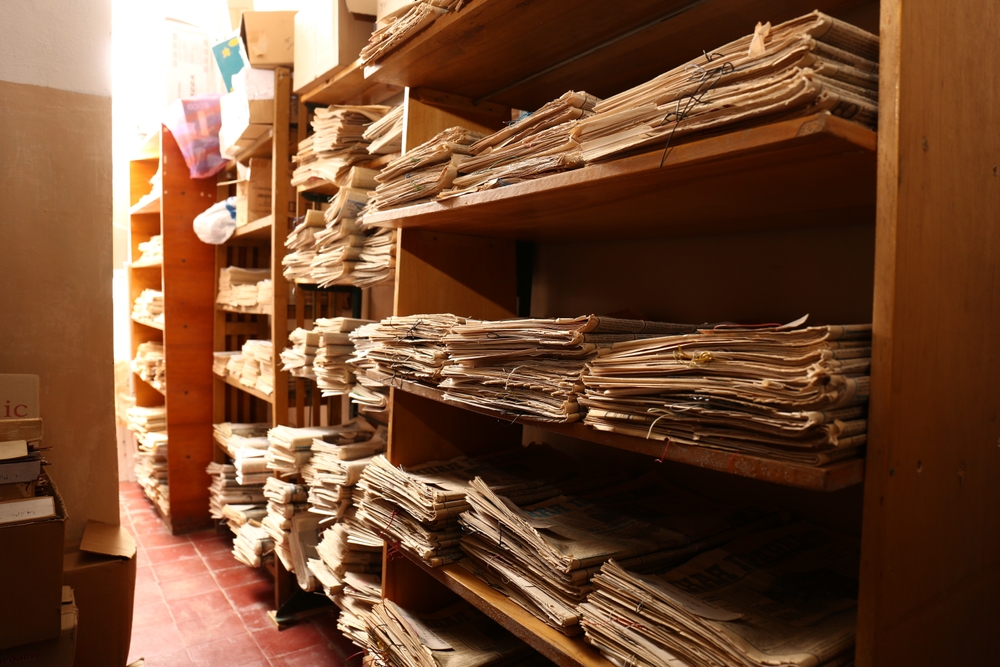
One of the most fascinating details about Atwood’s writing process is how she gathered the material behind the novel. Rather than relying entirely on imagination, she kept newspaper and magazine clippings that documented events connected to the themes she wanted to explore. The collection included reports about reproductive restrictions, religious movements, infertility, missing children and political extremism. Each item offered another example of something that had already happened outside the pages of fiction.
Atwood explained that she began collecting this material long before the internet made research instantly accessible. In her words, “I didn’t even research it. There was no Internet then, you couldn’t just go online and put in a topic.” She gathered information as she encountered it, gradually building an archive that would help support the fictional world she was creating. The documents gave her a way to examine historical events without having to invent an entirely new set of human behaviours.
Her collection also included reports about attempts to restrict birth control and voluntary sterilization, alongside accounts of religious groups with strict expectations for women. Other material covered human exploitation and political movements that challenged individual freedoms. These were not all examples of the same event, and they did not happen under one government. Atwood used them as separate historical references when developing the different parts of Gilead.
Why Readers Once Thought The Handmaid’s Tale Was Impossible
When The Handmaid’s Tale appeared in 1985, its fictional society seemed extreme to many readers. The idea of a government systematically stripping women of their rights and turning reproduction into a state-controlled responsibility was difficult to accept as a realistic possibility. Atwood later discussed how people often assumed societies would continue becoming more progressive, making a return to older forms of authoritarian control seem unlikely.
She challenged that assumption by pointing to the speed at which political and social conditions can change. Historical events had already shown that rights and freedoms could be restricted when governments gained enough power. Her interest in dystopian fiction came partly from examining failed attempts to create supposedly ideal societies, including political systems that produced repression and widespread suffering instead.
Atwood’s approach also helps explain why she avoided presenting Gilead as a prediction of one specific future. The novel combines different historical precedents into a fictional political system. Its details come from separate events, but the overall warning concerns the vulnerability of human rights when political authorities gain control over people’s private lives. The story asks readers to examine what has happened before rather than assuming history can never repeat itself.
The Television Adaptation Brought Gilead To A New Generation
The novel received renewed attention when Hulu adapted The Handmaid’s Tale into a television series starring Elisabeth Moss. Premiering in 2017, the show introduced Atwood’s fictional society to a much larger audience. Its visual presentation of Gilead, particularly the red clothing and white bonnets worn by the Handmaids, became instantly recognisable and helped turn the story into a major cultural talking point.
The show’s imagery also appeared beyond television screens. During the 2017 Women’s March, protesters wore outfits resembling the Handmaids’ uniforms as a form of political expression. The costumes referenced the fictional society’s restrictions on women and connected the novel’s themes with contemporary debates about reproductive freedom and civil liberties. The series helped bring renewed attention to questions that Atwood had been exploring since the 1980s.
Book sales also increased following Donald Trump’s 2016 election victory, reflecting renewed interest in the novel’s political themes. Atwood has nevertheless resisted being treated as someone who can predict the future. She has explained that the number of variables involved makes accurate predictions impossible. Her focus has remained on examining historical patterns and showing how quickly political conditions can change.
Atwood Had A Surprisingly Dark Idea For Little Red Riding Hood
The MasterClass promotional video offered another glimpse into Atwood’s creative imagination. While discussing her approach to storytelling, she suggested a new opening line for the classic fairy tale Little Red Riding Hood. Her proposed sentence was simple: “It was dark inside the wolf.” The line immediately changes the perspective of a familiar children’s story, introducing an unsettling image without needing a lengthy explanation.
The suggestion also showed how Atwood approaches storytelling through perspective and atmosphere. A familiar character or situation can feel completely different when the writer changes the way readers encounter it. The wolf becomes more than a character waiting in the forest, while the opening sentence introduces a darker possibility that invites the reader to imagine what comes next.
Her creative writing MasterClass was designed to share the methods behind her fiction, including speculative writing, historical storytelling and dystopian societies. Students were also offered access to materials connected to her writing process, including a handwritten draft of The Handmaid’s Tale and manuscript materials from her 1996 novel Alias Grace. The original announcement listed prices of $90 and $180 for the available access options.
Atwood’s Writing Rule Gives Historical Fiction A Different Purpose
Atwood’s approach offers a striking example of how historical research can strengthen a fictional story. She examined real events and used them to build a society that could feel frighteningly believable without claiming that Gilead existed as one complete historical system. Her method required her to separate imaginative storytelling from unsupported invention, giving the novel a foundation rooted in documented events.
Her work also shows why historical records deserve attention beyond classrooms and academic discussions. Newspaper reports and government records can preserve evidence of policies and practices that later generations might struggle to imagine. Atwood used those records to construct a fictional warning, allowing readers to encounter familiar historical patterns through the lives of imagined characters.
The most unsettling part of The Handmaid’s Tale remains the rule that shaped it. Atwood did not need to invent every horror in Gilead because human history had already provided the evidence. The fictional world was hers, but the events that helped inspire it belonged to the real one.