
Your cart is currently empty!
An American Student Visited a Taiwanese ER Without Insurance and Paid Just $80
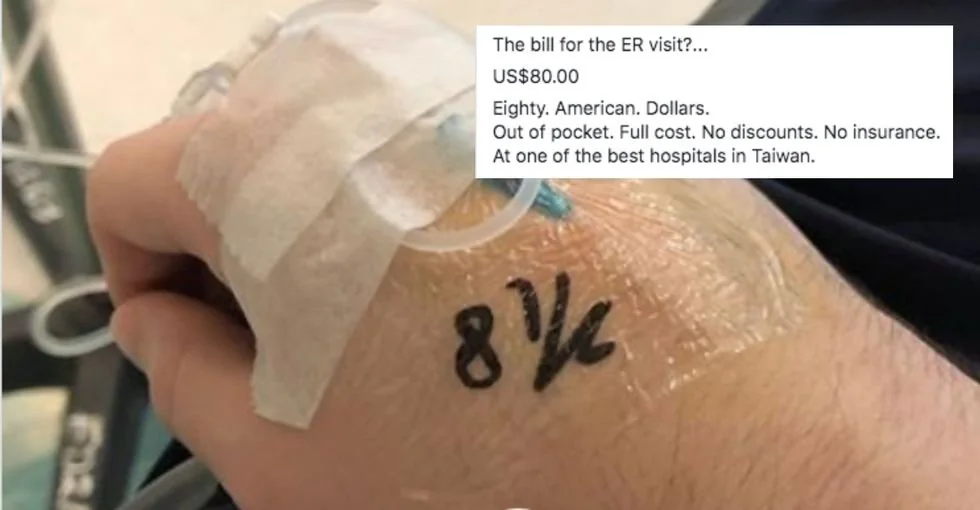
Kevin Bozeat knew something was wrong. What started as a dull ache in his stomach had turned into something far worse, and he found himself hunched over, unable to keep even water down. At 25, studying abroad in Taiwan, he faced a decision no uninsured American wants to make. Go to a hospital in a foreign country with no coverage, no idea what it would cost, and no guarantee anyone would speak his language? Or wait it out and hope for the best?
Contents
show
He chose the hospital. What happened next became one of the most widely shared stories about healthcare to ever circulate on social media. But before we get to the bill and the viral firestorm it ignited, it helps to understand just how anxious Bozeat was walking through those ER doors.
No Insurance, No Safety Net, No Choice
Bozeat had been living in Taiwan as a student, but he hadn’t been there long enough to qualify for the country’s National Health Insurance program. His American coverage had lapsed. He was, by every measure, on his own financially if anything went wrong. And something had gone very wrong.
His vomiting grew relentless. Hours passed, and his symptoms refused to let up. He couldn’t hydrate. He couldn’t rest. His body was shutting down its ability to function in the most basic way, and he recognized that riding it out at home was no longer an option.
“I wanted to avoid it,” Bozeat later wrote in a Facebook post that would eventually reach millions. He worried about language barriers and unfamiliar medical protocols. Most of all, he worried about money. Every American who has ever delayed calling an ambulance or driven themselves to an ER instead knows that fear intimately. It is baked into the American healthcare experience, a quiet dread that sits beside every symptom and every sharp pain.
His Taiwanese roommate called a taxi, and together they headed to the emergency room at National Taiwan University Hospital, one of the most respected medical institutions in the country.
Fast, Thorough, and Professional
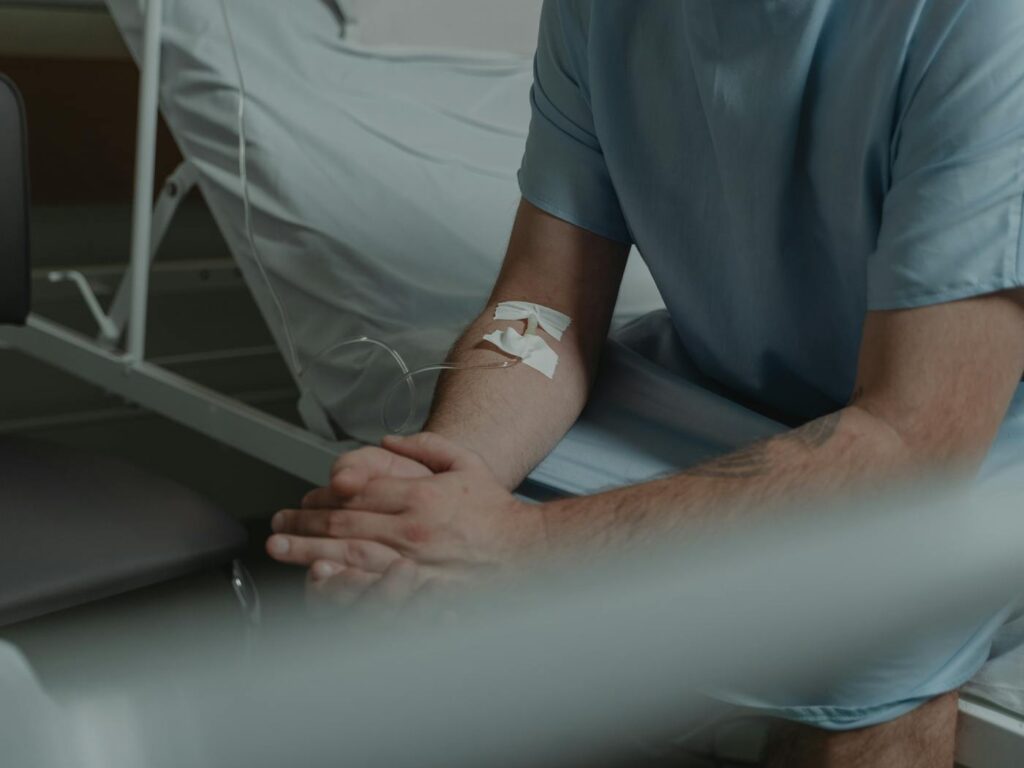
What Bozeat encountered at NTU Hospital defied his expectations. An English-speaking nurse checked him in right away. Within 20 minutes, medical staff had started him on IV fluids and administered antiemetics to control his nausea. Doctors ordered blood work and an ultrasound to rule out gallstones and appendicitis, two conditions that could have turned a bad night into a life-threatening one.
After roughly three hours on an IV drip, Bozeat began to stabilize. His nausea faded. His stomach calmed. Doctors gave him a diagnosis of acute viral gastroenteritis, a severe case of the stomach flu, and sent him home with prescriptions for anti-nausea and pain medication. Within a few days, he had recovered fully.
By any standard, the care he received matched what a well-regarded American hospital would provide for the same condition. Speed, diagnostic rigor, attentive staff, and a clear treatment plan. Nothing about it felt like a lesser version of medicine. And then came the bill.
Eighty Dollars
Bozeat paid $80. Not a copay. Not a discounted rate. Not a partial bill with more invoices to follow. Eighty U.S. dollars covered his entire emergency room visit, out of pocket, with zero insurance, at one of Taiwan’s best hospitals.
He titled his now-famous Facebook post “Horrors of Socialized Medicine” with obvious, biting irony. Americans spend years hearing politicians warn about the dangers of government-run healthcare. Bozeat had just lived through it, and the horror amounted to a bill most people would spend on a decent dinner for two.
Consider what that same visit might have cost in the United States. Emergency room charges for uninsured patients in America routinely climb into the thousands, even for conditions far less involved than what Bozeat experienced. A simple bee sting, requiring little more than observation and an antihistamine, has been known to generate ER bills north of $12,000. An IV drip, blood panels, an ultrasound, anti-emetics, and a three-hour stay? In many American hospitals, that could easily produce a bill in the mid-four figures or higher, leaving an uninsured 25-year-old student staring at debt that might follow him for years.
Taiwan’s cost of living runs roughly half of what Americans pay on average. Even adjusting for that difference, no hospital in the United States comes close to $160 for a comparable visit. Not even in the same universe.
A System Built on a Simple Idea
So how does Taiwan manage it? NHI, the country’s National Health Insurance program, operates as a single-payer system. Every Taiwanese citizen and permanent foreign resident must enroll. Coverage begins at birth and never lapses due to employment status. No one in Taiwan faces the American nightmare of losing health insurance because they lost a job or aged out of a parent’s plan.
Foreigners living in Taiwan qualify for NHI after six months of residency or immediately upon receiving a work permit. Bozeat, as a newer student, had not yet crossed that threshold. He paid full freight, out of pocket, with no government subsidy, and still walked away paying less than most insured Americans pay in copays and deductibles for emergency care.
For those enrolled in NHI, the numbers are even more staggering. Bozeat broke down the premium formula in his post. A single employed adult pays 4.69% of their monthly income, and the individual’s share comes to 30% of that figure. For someone earning $60,000 a year, the monthly premium lands at roughly $70.53. Seventy dollars a month. Full medical coverage. No network restrictions. No surprise bills. No prior authorizations.
Compare that to the average American employer-sponsored health insurance premium, which runs well over $600 per month for family coverage, with deductibles often exceeding $1,500 before insurance begins to pay anything at all. And even then, the bills keep coming.
Honest About the Flaws
Bozeat did not frame Taiwan’s system as a utopia. His post carried a clear-eyed honesty that likely helped it spread as far as it did. He openly noted that NHI does not cover everything. Some treatments and procedures still carry out-of-pocket costs. He acknowledged that people in Taiwan have had difficult medical experiences unrelated to finances, because no healthcare system anywhere eliminates human error or guarantees perfect outcomes.
But he drew a firm line between imperfection and injustice. A system can have flaws and still treat healthcare as a fundamental right rather than a commodity. Taiwan’s Ministry of Health says exactly that in its own literature. Healthcare, in Taiwan’s view, belongs to every citizen. It is not a privilege reserved for those with the means to afford it.
And that philosophical difference produces real, measurable results. No Taiwanese citizen goes uninsured. Medical bankruptcy, a phenomenon that devastates hundreds of thousands of American families every year, does not exist within the system. People in Taiwan seek care when they need it, not when they can afford it, and the distinction between those two realities separates a functional healthcare system from a broken one.
Pride in a Public Good
Perhaps the most telling detail in Bozeat’s account had nothing to do with money. He wrote that he had never met a single Taiwanese person who expressed dissatisfaction with their healthcare system. Many spoke about it with genuine pride. Even expats from other countries with universal coverage, people who had experienced government healthcare in Europe, Canada, and elsewhere, praised Taiwan’s version as efficient and well-run.
Satisfaction with a public institution at that level is almost unheard of in American civic life. Americans have grown accustomed to treating government programs with suspicion, assuming that public management equals inefficiency. Taiwan’s NHI stands as a direct challenge to that assumption, and the lived experiences of its citizens and foreign residents back it up.
Why an $80 Bill Still Goes Viral
Bozeat wrote his Facebook post years ago, yet it continues to circulate. New waves of readers discover it, share it, and argue about it in comment sections across every platform. Its longevity says something uncomfortable about where American healthcare still stands.
Every year, polls show that healthcare costs rank among the top concerns for American voters. Medical debt remains the leading cause of personal bankruptcy in the United States. Families ration insulin. Parents drive past the nearest emergency room to reach one that might be in-network. Young adults avoid the doctor entirely because they cannot afford the visit, let alone the follow-up.
Against that backdrop, an uninsured American student paying $80 for emergency care in a foreign country reads less like an anecdote and more like an indictment. Bozeat did not set out to write a policy paper. He simply told the truth about what happened to him, and the truth did the rest.
His story does not answer every question about how to fix American healthcare. But it does something equally powerful. It shows millions of readers, in plain and undeniable terms, that another way exists. Other countries have built systems that treat illness without inflicting financial ruin, and their citizens are not just surviving those systems. By all accounts, they are proud of them.
American healthcare, cost of healthcare in America, emergency room visit, ER costs, healthcare comparison, healthcare costs, healthcare debate, healthcare reform, Kevin Bozeat, medical bills, National Health Insurance Taiwan, NHI, single-payer healthcare, studying abroad, Taiwan healthcare, Taiwan NHI system, uninsured hospital visit, universal healthcare, viral Facebook post