
Your cart is currently empty!
China Just Set a New World Record After Their Artificial Sun Sustained 100,000,000 Degrees of Heat on Earth for 17 Minutes

For years, scientists have been chasing the ultimate energy breakthrough—one that could power the world without pollution or limits. Now, China has taken a bold leap forward.
Their artificial sun just hit a staggering 100 million degrees Celsius and sustained it for 1,066 seconds, setting a new world record. This isn’t just a scientific milestone—it’s a glimpse into a future where clean, limitless energy might become reality. But how close are we to harnessing fusion power? And what challenges stistand in the way?
China’s Artificial Sun Sets a New World Record
China has taken a major step forward in nuclear fusion research, achieving a record-breaking milestone that could bring the world closer to clean, limitless energy. The Experimental Advanced Superconducting Tokamak (EAST), often referred to as China’s “artificial sun”, has set a new world record by maintaining a steady-state high-confinement plasma operation for 1,066 seconds—just over 17 minutes. This achievement significantly surpasses the previous record of 403 seconds, also set by EAST in 2023.
China's experimental advanced superconducting tokamak (EAST), or "Chinese artificial sun," on Thur saw a 1,056-sec long-pulse high-parameter plasma operation, the world's longest recorded.
— China Science (@ChinaScience) December 31, 2021
EAST's goal is to create nuclear fusion like Sun&provide a steady stream of clean energy. pic.twitter.com/puBVtSgaBy
According to the Chinese Academy of Sciences (CAS), EAST’s breakthrough marks a crucial step toward the long-term goal of fusion energy, a process that mimics the Sun’s power by merging atomic nuclei to generate massive amounts of energy. Unlike nuclear fission, which produces hazardous radioactive waste, fusion offers a cleaner and potentially limitless source of power.
In an official statement, CAS emphasized, “The duration of 1,066 seconds is a critical advancement in fusion research.” The experiment was made possible by significant upgrades to EAST, including a doubling of the power output in its heating system.
According to Song Yuntao, director of the Institute of Plasma Physics at CAS (ASIPP), “A fusion device must achieve stable operation at high efficiency for thousands of seconds to enable the self-sustaining circulation of plasma, which is critical for the continuous power generation of future fusion plants.” He described the latest record as “monumental,” representing a key step toward the development of a commercial fusion reactor.
Scientists have been working for over 70 years to harness fusion energy, but achieving a sustainable and controlled fusion reaction has remained an enormous challenge. Only after reaching temperatures over 100 million degrees Celsius, ensuring long-term stability, and achieving precise control over the plasma, can a fusion reactor successfully generate electricity.
How EAST Achieved This Milestone
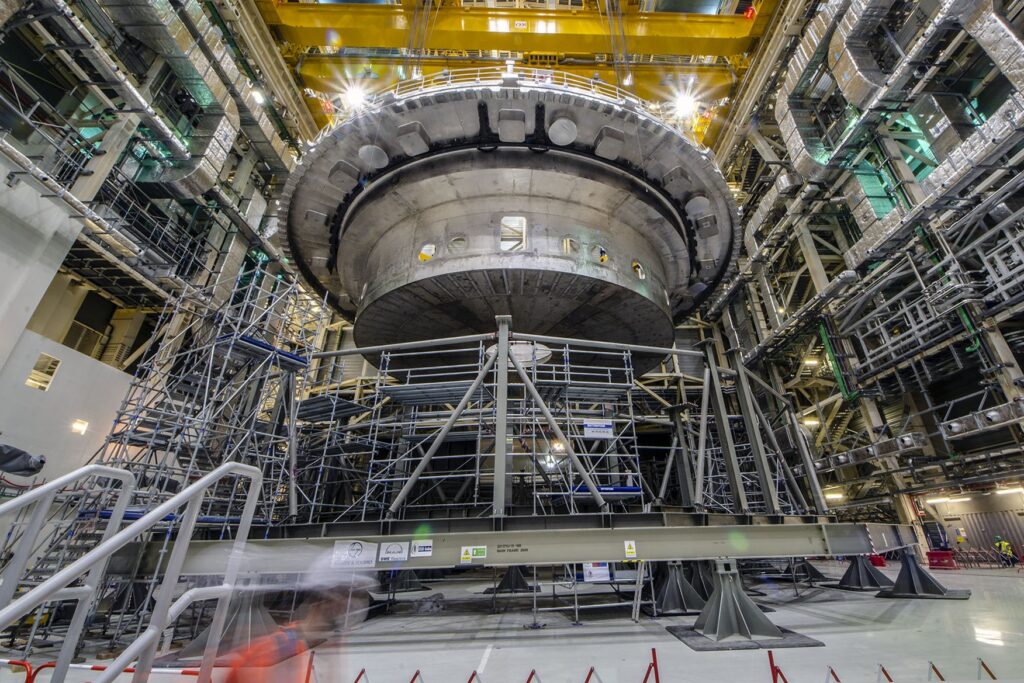
The EAST reactor, located in Hefei, Anhui Province, operates on the tokamak principle, using magnetic confinement to control plasma at extreme temperatures. Since its launch in 2006, it has served as an open platform for both Chinese and international scientists to conduct fusion-related experiments. EAST is part of China’s broader mission to accelerate fusion energy research, contributing key advancements to international projects like the International Thermonuclear Experimental Reactor (ITER), currently under construction in France.
China sets a new record in fusion 🌍⚡
— Fusion For Energy (@fusionforenergy) January 27, 2025
The Experimental Advanced Superconducting Tokamak (EAST) by @CAS__Science sustained a plasma for over 17 minutes. Congratulations! 🇨🇳
We look forward to gaining more knowledge for ITER☀️
Read more: https://t.co/u62N3zQfeh pic.twitter.com/1ZrZHbxT0x
According to Gong Xianzu, head of the division of EAST Physics and Experimental Operations, one of the key improvements leading to EAST’s latest achievement was an upgraded heating system. “The heating system, which previously operated at the equivalent of nearly 70,000 household microwave ovens, has now doubled its power output while also maintaining stability and continuity,” he explained. This increased efficiency allowed EAST to sustain the extreme plasma conditions required for fusion.
China officially became the seventh member of the ITER program in 2006, committing to 9 percent of the project’s construction and operation. ITER, once completed, will be the largest experimental tokamak nuclear fusion reactor in the world, aiming to provide critical insights into large-scale fusion energy production.
Beyond EAST, China is also developing the China Fusion Engineering Test Reactor (CFETR), a next-generation facility designed to further accelerate fusion research. As part of its long-term vision, China aims to integrate international collaboration into its fusion energy program, ensuring that breakthroughs in EAST contribute to the global development of practical fusion power.
"In the 2030s, before ITER will have begun its main experiments, the country aims to build the China Fusion Engineering Test Reactor (CFETR), with the goal of producing up to 1 gigawatt of fusion power" #fusion #ITER #China @Nature https://t.co/QRDjHwznkV
— Michel Claessens (@M_Claessens) August 29, 2024
“We hope to expand international collaboration via EAST and bring fusion energy into practical use for humanity,” Song Yuntao added.
This record-breaking experiment has reinforced China’s position as a leader in fusion energy development, providing valuable references for the construction of future fusion reactors worldwide. However, despite these advances, significant challenges remain before fusion power becomes commercially viable. Scientists must continue refining their methods for plasma confinement, energy efficiency, and long-term stability—key elements that will determine whether fusion energy can transition from experimental success to a reliable power source for the world.
Understanding Nuclear Fusion: How It Works and Its Global Significance
Nuclear fusion is widely regarded as the “holy grail” of clean energy, offering the potential for unlimited power with minimal environmental impact. Unlike nuclear fission, which splits atoms to generate energy, fusion works by merging atomic nuclei to produce helium and enormous amounts of energy, with no carbon emissions or long-lived radioactive waste. Scientists have been working for more than 70 years to replicate the Sun’s fusion process on Earth, but the challenge remains in sustaining high temperatures, stabilizing plasma, and achieving continuous energy output.
China’s Experimental Advanced Superconducting Tokamak (EAST), which recently set a world record for maintaining high-confinement plasma for 1,066 seconds. Unlike conventional nuclear power plants, which rely on fission, tokamaks use magnetic confinement to control superheated plasma, preventing it from touching reactor walls while maintaining the extreme conditions needed for fusion reactions.
According to Live Science, EAST’s success is a pivotal moment in plasma confinement research, proving that long-duration fusion reactions are possible with the right stability and heating improvements. While EAST has made history, fusion research is advancing on multiple fronts worldwide. The International Thermonuclear Experimental Reactor (ITER), currently under construction in France, is set to become the largest experimental tokamak reactor in the world. China, which joined ITER in 2006, is responsible for 9% of its construction and operation, reinforcing its commitment to the global push for fusion energy. Beyond EAST, China is also developing the China Fusion Engineering Test Reactor (CFETR), a next-generation facility aimed at bridging the gap between ITER’s research phase and the commercial viability of fusion power.
The Promise and Challenges of Nuclear Fusion
Nuclear fusion is often described as the ultimate energy source, capable of providing near-limitless power with minimal environmental impact. Recent breakthroughs have moved fusion research forward, but significant challenges remain. Understanding both the potential benefits and the technical hurdles is essential in assessing its future as a commercial energy solution.
Why Fusion Energy Matters
One of the most significant advantages of fusion is its environmental sustainability. Unlike fossil fuels, fusion reactions produce no greenhouse gas emissions, and the primary byproduct is helium, an inert gas with no harmful environmental effects. According to the International Atomic Energy Agency (IAEA), fusion could play a key role in reducing global carbon emissions while providing long-term energy security.
Fusion fuel is also abundant and widely available. Deuterium, one of the primary fuels, can be extracted from seawater, while tritium can be generated from lithium, a resource found in both the Earth’s crust and the ocean. These elements are far more sustainable than fossil fuels, making fusion a long-term energy solution.
A key safety advantage of fusion is that it does not rely on a chain reaction, eliminating the risk of a runaway reaction or nuclear meltdown. Additionally, fusion produces no long-lived radioactive waste, significantly reducing nuclear waste management challenges. According to the UKAEA, fusion plants will generate far less radioactive material than nuclear fission plants, making them easier to decommission.
The Remaining Challenges
Despite its potential, fusion energy is not yet commercially viable due to several key challenges. The most pressing is achieving net energy gain—where a reactor generates more energy than it consumes. While the U.S. National Ignition Facility (NIF) achieved scientific breakeven in 2022, commercial fusion reactors must sustain continuous energy production for extended periods, something no experiment has yet accomplished.
Engineering challenges also remain a major concern. Fusion reactors must withstand extreme temperatures and neutron bombardment for prolonged periods. Scientists are working on advanced materials and superconducting magnets to improve reactor durability, but these solutions are still in development. The U.S. Government Accountability Office (GAO) has cited material degradation as one of the biggest barriers to commercial fusion energy.
Economic feasibility is another major hurdle. Fusion reactors require massive initial investment, with ITER alone projected to cost over $22 billion. While many governments and private companies are funding fusion research, making it cost-competitive with existing renewables is crucial for widespread adoption.
Recent Developments in Nuclear Fusion Research
The global pursuit of nuclear fusion as a viable energy source has accelerated, with major breakthroughs in public and private sectors. From China’s expanding research infrastructure to private sector investments and international collaborations, fusion energy is moving closer to reality.
Private Sector Investment in Fusion
Private companies are accelerating fusion technology. Helion, a U.S. startup, secured $425 million from SoftBank, reaching a $5.4 billion valuation. The company plans to deliver fusion-generated electricity by 2028, using a direct energy capture system instead of conventional turbines. Several other private firms are preparing to debut functional fusion reactors in 2025, marking a shift toward commercialization.
Advancements in Cold Fusion
Although cold fusion (low-energy nuclear reactions, LENR) was once dismissed, recent progress suggests its viability. Companies have reportedly achieved reliable LENR reactions, with some powering small devices. The U.S. ARPA-E and EU Horizon 2020 programs are funding research to determine whether cold fusion could be a game-changer in energy production.
International Collaborations & Future Outlook
Global projects like ITER remain central to fusion research. However, delays have pushed major experimental phases to 2039, highlighting the technical and logistical hurdles of large-scale fusion. Despite this, ongoing research, international cooperation, and private investment are accelerating fusion’s path toward becoming a practical and sustainable energy source.
The Future of Fusion Energy
For decades, nuclear fusion has been the ultimate energy dream—clean, limitless, and powerful. Now, with breakthroughs like EAST’s record-setting plasma, private sector investments, and global collaborations, that dream is closer than ever. But the road ahead remains long.
Scaling fusion to power cities requires major technological leaps, sustained investment, and time. While projects like ITER push forward and companies race to commercialize fusion, one truth remains: once humanity masters fusion, the energy game changes forever. The only question is—how soon can we get there?
Featured Image from Xinhua