
Your cart is currently empty!
How 175 Generations of Indigenous Painters Kept a Cosmic Secret Alive
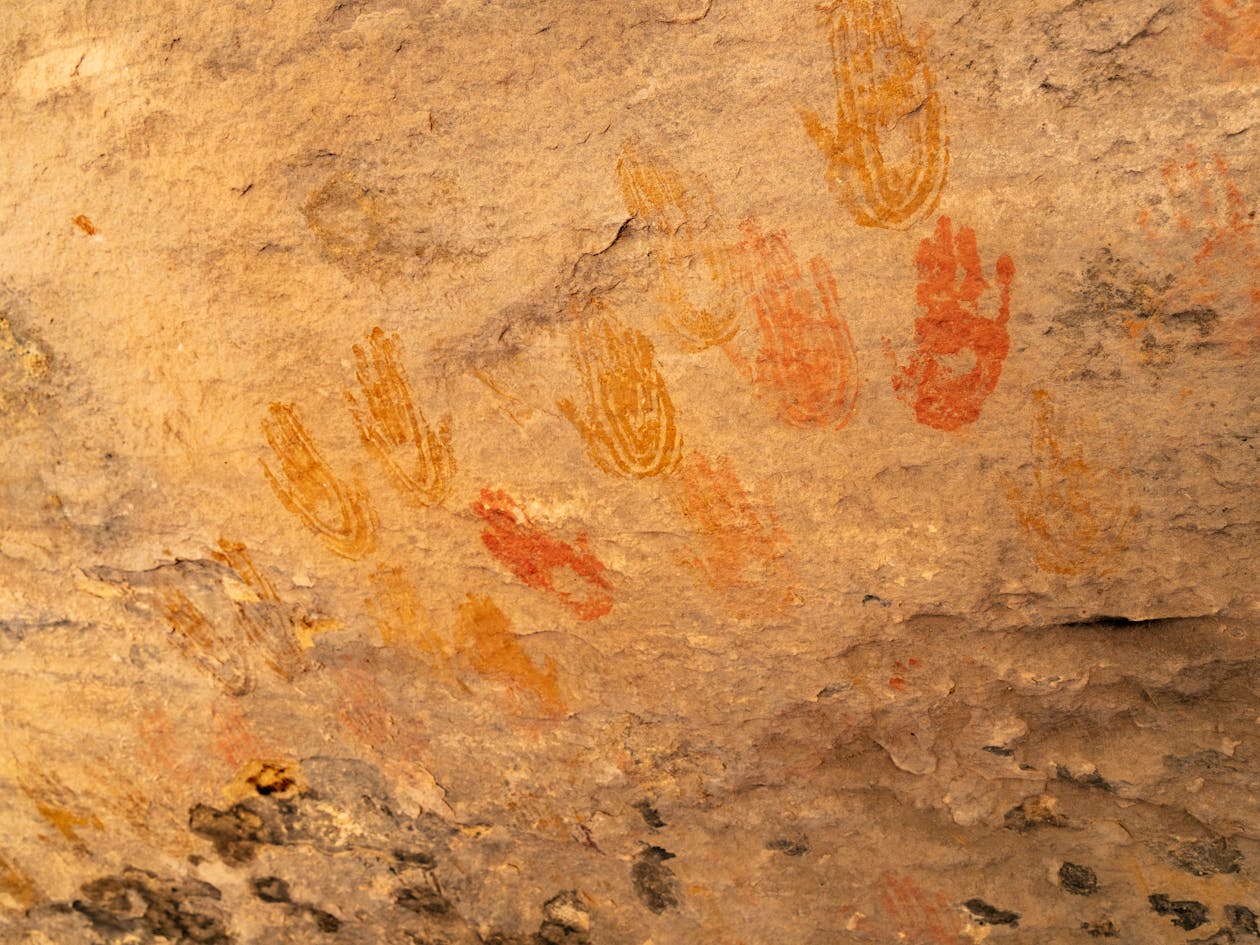
Somewhere in southern Texas, ancient hands pressed pigment against limestone walls. Black paint went down first. Red followed once it dried. Then yellow. Then white. Always in that order. Always.
Contents
show
What makes that sequence remarkable is not the colors themselves but the timespan across which painters followed it. For more than four thousand years, generation after generation of Indigenous artists returned to rock shelters in the Lower Pecos Canyonlands and created enormous murals while adhering to an unchanged set of rules. Roughly 175 successive generations participated in a tradition so consistent that researchers now consider it something far more sophisticated than cave paintings.
A new study published in Science Advances has radiocarbon dated these murals with unprecedented precision, revealing that Pecos River style rock art began between 5,760 and 5,385 years ago and continued until roughly 1,035 years ago. Nomadic foragers who hunted small game, fished rivers, and baked agave in pit ovens somehow maintained artistic conventions across millennia without written language, permanent settlements, or centralized authority.
A Painted Calendar of Beliefs
Walking into one of these rock shelters today means confronting compositions that stretch up to 100 feet in length. Human-like and animal-like figures crowd together in dense arrangements that reach 15 feet high on some walls. Artists would have needed ladders or scaffolding to paint the upper registers.
But size alone does not capture what makes these murals unusual. Pecos River style paintings depict metaphysical concepts that Indigenous cultures across the Americas still recognize. Circular time, where past and future fold into each other rather than marching forward in a line. A universe separated into multiple layers, with portals connecting the underworld to the realm above. Anthropomorphic figures wearing elaborate headdresses and wielding spear-throwers called atlatls. Deer, felines, birds, and snakes mingle with human forms in ways that blur boundaries between species.
Dr. Karen Steelman, the study’s lead author, described one recurring motif as showing an arch with a portal, often depicting a human figure passing through it. Such images relate to the idea of a veil or surface separating different cosmic layers. Painters returned to these themes again and again across four millennia, selecting from the same inventory of symbols and arranging them according to consistent compositional rules.
Radiocarbon Dating Pinpoints a 4,000-Year Timeline

Previous attempts to date Pecos River style murals produced conflicting results and raised questions about methodology. Researchers in the current study developed a rigorous protocol to avoid those pitfalls.
Scientists collected 57 direct radiocarbon dates and 25 oxalate dates from 12 sites scattered across the region. Paint samples underwent plasma oxidation to extract organic carbon from binders and emulsifiers that ancient artists mixed with mineral pigments. Accelerator mass spectrometry then measured the carbon isotopes.
Bayesian modeling combined these radiocarbon dates with archaeological evidence from paint stratigraphy to generate probability estimates. Results indicated that Pecos River style painting spanned a duration of roughly 4,095 to 4,780 years. Control samples of unpainted rock adjacent to paintings showed negligible organic carbon, confirming that dateable material came from the paint itself rather than the limestone substrate.
Oxalate mineral accretions provided a second method to verify direct paint dates. Cream-colored mineral layers form both above and below the paint over time. In every instance, underlying oxalate layers proved older than paint dates while overlying accretions proved younger. Correctly ordered microstratigraphy across multiple sites supported the validity of both dating methods.
Color Sequence and Motif Consistency

Eight sites containing multiple intersecting figures underwent detailed stratigraphic analysis. Researchers captured 2,206 photomicrographs at 588 points where paint layers overlapped, documenting the sequence in which colors were applied.
Out of 535 successful determinations, only 10 deviated from the standard color application sequence. Black went down first. Red superimposed black. Yellow superimposed both red and black. White superimposed all colors. Painters at sites separated by 70 kilometers east to west followed identical procedures across thousands of years.
Because artists adhered to this organized layering of colors, many figures ended up sandwiched together. A paint layer of one figure was painted both over and under another figure. Polychromatic images across murals were woven together to form complex arrangements of intertwined imagery. Radiocarbon dates within individual murals proved statistically indistinguishable, suggesting each mural was painted during a single event rather than accumulated over centuries.
Such consistency points to formal training and knowledge transmission. Someone taught each generation of painters the proper sequence. Someone ensured fidelity to an established graphic vocabulary that allowed murals created five thousand years apart to speak the same visual language.
Power Bundles and Portal Arches
Certain motifs appear at both the earliest and latest dated sites, spanning the entire four-thousand-year production period. Power bundles rank among the most prevalent. More than 60 percent of documented sites incorporate anthropomorphs with power bundles extending from their nondominant arm. A plant-like, animal-like, or human-like shape appears at the distal end of long parallel lines connected perpendicularly to a staff or dart.
Crenellated arches with portals recur across sites and centuries. Single-pole ladders appear repeatedly. Anthropomorphs display rabbit-eared headdresses, antlers tipped with dots, wrist adornments on dominant hands, and elbow adornments on nondominant arms. Speech breath imagery shows dots emanating from the mouth. Winged anthropomorphs with antlers enter the repertoire during the Late Holocene mesic interval around 3,000 years ago but persist alongside older motifs.
Red antlers with black dots at the end of each tine appear at three sites dated to the second dry period. Each new motif enriched the visual vocabulary without replacing established symbols. Artists experimented while preserving core pictographic elements diagnostic of the style.
A Huichol Shaman Recognizes His Ancestors
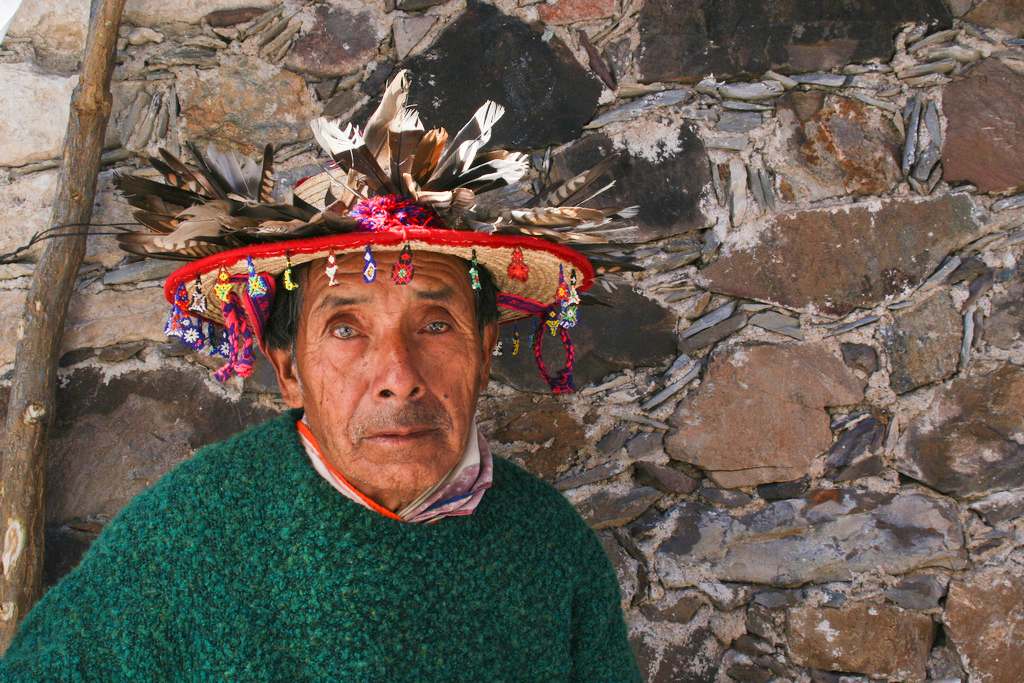
Questions naturally arise about who painted these murals. No tribal name survives for people who lived five to six thousand years ago. Yet modern Indigenous groups trace ancestry to these ancient artists, and the cosmology depicted in Pecos River style paintings remains recognizable today.
Steelman recounted how a Huichol shaman who visited the site in the early 2000s was able to “call the names of all the figures… [recognizing] that the people who painted the paintings and his ancestors had common beliefs.” A visitor from hundreds of kilometers away in Mexico looked at imagery created thousands of years before his birth and saw something familiar. He understood what the figures represented because his people had preserved the same cosmological framework through oral tradition.
Such recognition suggests these murals encode something deeper than artistic preference. Painters were recording a worldview that proved remarkably resistant to change across time, geography, and linguistic boundaries.
Why the Lower Pecos Canyonlands Became Sacred Ground

Pecos River style murals concentrate in a remarkably limited geographic area of roughly 8,000 square kilometers. Deep canyons cut through Cretaceous limestone tablelands. Rivers wind through narrow passages. Rock shelters, sinkholes, caves, and permanent springs dot the landscape. In Indigenous thought, such geomorphological features carry profound significance.
Ancestral places of emergence are imbued with power and agency. Caves and springs connect different cosmic layers. Once people establish a location’s efficacy through ritual activity, they return to acquire more knowledge and interact with forces dwelling there. Each subsequent human and supernatural interaction causes more power to accrue.
Rock art often concentrates in such sacred places. Painted onto or engraved into the living landscape, images are considered embodiments of supernatural entities and vehicles to transmit knowledge. From an Indigenous viewpoint, the paintings are not passive props but living entities directly communicating sacred ancestral knowledge. Roughly 175 generations of artists treating the Lower Pecos Canyonlands as a place of high cultural salience fit the definition of a cultural keystone place.
From Texas to Tenochtitlan

Researchers have noted parallels between metaphysical concepts in Pecos River style murals and myths of later Mesoamerican agriculturalists hundreds of kilometers to the south. In 1974, before advances in radiocarbon dating of pictographs, scholar David Kelley recognized similarities between the Pecos River style and Mesoamerican ceremonial art. More recent analyses have identified patterns equating in detail to creation myths and cosmological constructs of 14th to 16th-century Aztec peoples and present-day Huichol communities.
Mexican anthropologist Alfredo López Austin proposed that shared concepts across Mesoamerican peoples, including creation stories, cyclical time, quadripartite cosmovision, and complex calendrical systems, constituted “el núcleo duro” or the hard core. Such deeply rooted beliefs were highly resistant to change and virtually unchangeable. Some scholars suggest this substratum of beliefs dates back several thousand years and developed before people entered the region now called Mesoamerica.
Pecos River style pictographs offer material evidence for evaluating these ideas. “They show that complex religious and philosophical thought arose among foragers long before the rise of cities and states,” Boyd explained. Hunter-gatherers developed sophisticated metaphysical frameworks and transmitted them with high fidelity across millennia. Agricultural societies in Mexico may have inherited rather than invented the cosmological structures that defined their civilizations.
What 4,000 Years of Consistent Art Tells Us About Early Humans
With 134 documented Pecos River style sites, the 12 dated murals almost certainly do not represent the first or last painting events. Future radiocarbon dating will refine the chronological model. Advances in identifying organic paint ingredients will strengthen results. Additional stratigraphic studies will expand understanding of compositional murals across the region.
What already seems clear is that nomadic foragers achieved something remarkable in the Lower Pecos Canyonlands. Without cities, writing, or agriculture, they created monumental art encoding a sophisticated worldview and maintained that tradition for more than four thousand years. Climate shifted. Projectile point technology changed from broad-bladed darts to the bow and arrow. Bison populations expanded and contracted. Yet painters kept returning to the same rock shelters, applying colors in the same sequence, selecting motifs from the same vocabulary, and depicting the same cosmic architecture.
Such continuity challenges assumptions about what hunter-gatherer societies could accomplish. It suggests that the intellectual achievements often attributed to complex agricultural civilizations may have deeper roots than previously recognized. And it raises humbling questions about how ancient peoples transmitted knowledge with such precision across timescales that dwarf recorded human history.