
Your cart is currently empty!
I Died for 32 Seconds and Saw a Future Humanity Is Not Ready For

Thirty two seconds rarely holds any weight in the flow of daily life. It disappears between routine tasks, passing so quietly that most people never notice its beginning or end. For Angela Harris, those 32 seconds expanded into something she claims felt far longer than any measurable unit of time. During a brief period of clinical death in 2015, Harris says she remained conscious in a way that felt clearer and more structured than ordinary awareness. Rather than fading into darkness or slipping into unconsciousness, she describes stepping into a state where perception felt heightened and complete. According to her, this state carried an unusual sense of stability and coherence that made everyday reality seem distant and limited by comparison.
Contents
show
Harris insists that what unfolded during that brief medical crisis did not feel like a dream or a hallucination. She describes an experience that seemed to stretch across what felt like years of perception, filled with encounters, observations, and a deep sense of understanding. Most unsettling of all, she believes she witnessed a version of humanity’s future shaped by conflict, collapse, and forced adaptation. Harris does not present what she saw as an unavoidable prophecy. Instead, she frames it as a possible outcome that could emerge if current patterns of division and instability continue. This belief has become central to the message she now shares publicly, turning a personal medical emergency into a narrative about collective responsibility and the fragile direction of modern civilization.

A Routine Test That Became a Medical Crisis
In 2015, Harris was living a life that revolved around familiar responsibilities and practical concerns. As a schoolteacher and mother of two young children, her days were structured by work, family obligations, and the usual demands of maintaining a stable household. She was not searching for spiritual revelations or questioning the nature of consciousness. Instead, she was dealing with persistent health issues that had begun to interfere with her daily routine. Unexplained fainting spells and episodes of dizziness raised enough concern for doctors to recommend a tilt table test, a standard diagnostic procedure used to evaluate how the body responds to changes in posture and blood pressure. The recommendation seemed routine and medically straightforward, offering the promise of clear answers.
The tilt table test involves securing a patient to a specialized table that gradually shifts from a horizontal to an upright position while vital signs are carefully monitored. The goal is to safely reproduce fainting in a controlled environment so physicians can observe how the cardiovascular system responds to gravitational stress. Most patients complete the procedure without complications and return home the same day with useful diagnostic information. Harris entered the hospital expecting nothing more than another step toward understanding her symptoms. Instead, the test quickly escalated into a life threatening emergency. About eighteen minutes into the procedure, her blood pressure dropped dramatically and her body began to convulse with severe seizures.
Medical staff immediately recognized that something had gone seriously wrong. Alarms sounded as her heart rate collapsed and then stopped altogether. Doctors and nurses rushed to intervene, lowering the table and initiating emergency protocols to restart her heart and stabilize her condition. For thirty-two seconds, Harris had no measurable heartbeat, placing her in a state of clinical death. Such an interval carries significant risk, including potential brain injury or permanent neurological damage. Yet when Harris later described what she experienced during those seconds, her account did not reflect emptiness or oblivion. Instead, she claimed that those moments marked the beginning of an extended and deeply detailed sequence of experiences that felt more structured and real than ordinary life.
Awareness Beyond the Physical Body
According to Harris, the moment her heart stopped, she experienced a sudden separation from her physical body. She describes finding herself observing the hospital room from a position above the table, fully aware of everything unfolding below. In her account, perception did not rely on physical senses such as sight or hearing. Instead, she describes a form of awareness that allowed her to take in the entire environment at once, noticing movements, expressions, and details with unusual clarity. She recalls seeing the medical team react with urgency as they attempted to revive her, their actions unfolding in what she perceived as slow and deliberate motion.
Despite the intensity of the situation, Harris says she felt no fear or distress. The absence of pain and anxiety stood in sharp contrast to the emergency taking place around her physical body. She describes a calm detachment that made the scene feel distant and almost observational rather than personal. The body on the table did not feel like the center of her identity in that moment. Instead, she experienced a sense of curiosity and neutrality, as though she were watching events unfold without emotional attachment or urgency.
Harris has stated that the clarity of awareness in this state felt stronger and more stable than ordinary consciousness. She recalls that thoughts and perceptions seemed organized and immediate, without the usual distractions or confusion of everyday life. This heightened clarity contributed to her conviction that what she experienced was not a simple dreamlike state. As the hospital environment gradually faded from her perception, she says the transition felt smooth rather than abrupt. The physical world seemed to recede as her awareness shifted into what she describes as another level of existence defined by calm and structured perception.
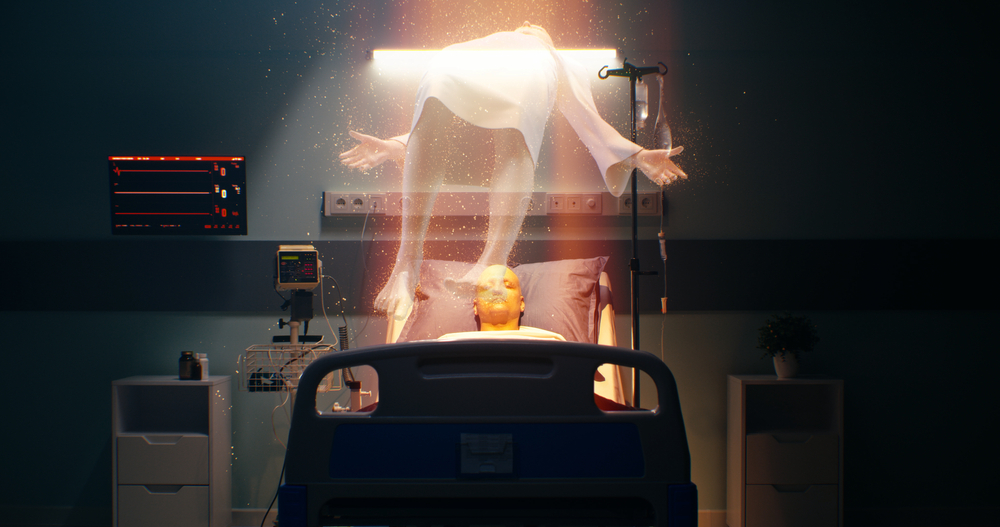
Encounters Beyond Earthly Life
Harris says she soon entered a vast dark space that felt calm and comforting rather than empty or frightening. She describes this environment as a peaceful void where physical sensations and emotional burdens disappeared completely. The darkness did not feel isolating or oppressive. Instead, it carried a sense of safety and acceptance that she found difficult to describe in ordinary language. Within this space, she claims to have encountered presences she recognized as deceased relatives and other connected souls. Recognition did not depend on physical appearance but on an immediate sense of familiarity and emotional connection that felt undeniable.
Communication in this state did not involve spoken words or physical gestures. Harris says understanding flowed instantly between beings, as if information and emotion were shared directly without the need for language. She describes this form of interaction as complete and efficient, allowing complex ideas and feelings to be conveyed in an instant. The experience created a sense of unity and connection that replaced all previous discomfort or fear. According to her account, this environment felt structured and purposeful rather than chaotic or random.
Her experience, as she describes it, then expanded beyond encounters with familiar souls. Harris claims she was transported to other worlds where life existed in forms unfamiliar to human perception. She insists she did not simply observe these environments but experienced existence within them, living full lives as different beings on distant planets. These lives felt continuous and detailed, complete with relationships, environments, and daily routines. To Harris, the realism of these experiences reinforced her belief that consciousness is not limited to a single body or one lifetime. She interprets these events as evidence that identity can extend across multiple forms and locations within the universe.

A Future Shaped by Conflict and Collapse
The most unsettling element of Harris’s account is the vision she says she saw of Earth’s future. According to her description, this vision did not appear symbolic or abstract. It felt structured and sequential, as though she were observing historical events unfolding over time. She recalls seeing rising tensions between nations that gradually escalated into open conflict. Diplomatic relationships deteriorated and alliances fractured as distrust deepened. Regional disputes expanded into larger confrontations that eventually drew multiple countries into sustained warfare.
In the timeline she describes, advanced military technology intensified the scale of destruction. Critical infrastructure became a primary target as power grids, communication systems, and transportation networks were disrupted or destroyed. Harris says the interconnected nature of modern civilization made societies especially vulnerable once these systems began to fail. Cities that depended on continuous delivery of food, fuel, and medical supplies struggled to function as supply chains collapsed. The complexity that once made global life efficient became a source of fragility under pressure.
She recalls witnessing a sharp decline in population caused not only by direct violence but also by famine, disease, and the breakdown of healthcare systems. According to her account, survivors reorganized into smaller communities focused on self sufficiency rather than technological expansion. Large urban centers lost their ability to sustain themselves and people migrated toward regions where basic resources could be produced locally. Harris describes a world where global connectivity had largely disappeared, replaced by isolated settlements and cautious interactions between groups. She emphasizes that this future felt possible rather than predetermined, shaped by human choices and the direction of collective decisions.

afterlife experience, Clinical Death, consciousness, died for 32 seconds, Future of Humanity, humanity warning, life after death, Near Death Experience, near death story, real life story, saw the future, soul journeys, spiritual experience, unexplained phenomena, war and collapse, warning for humanity