
Your cart is currently empty!
I Swam the Entire 29 Miles Around Manhattan in Handcuffs, Unaware of the Danger Lurking Beneath Me
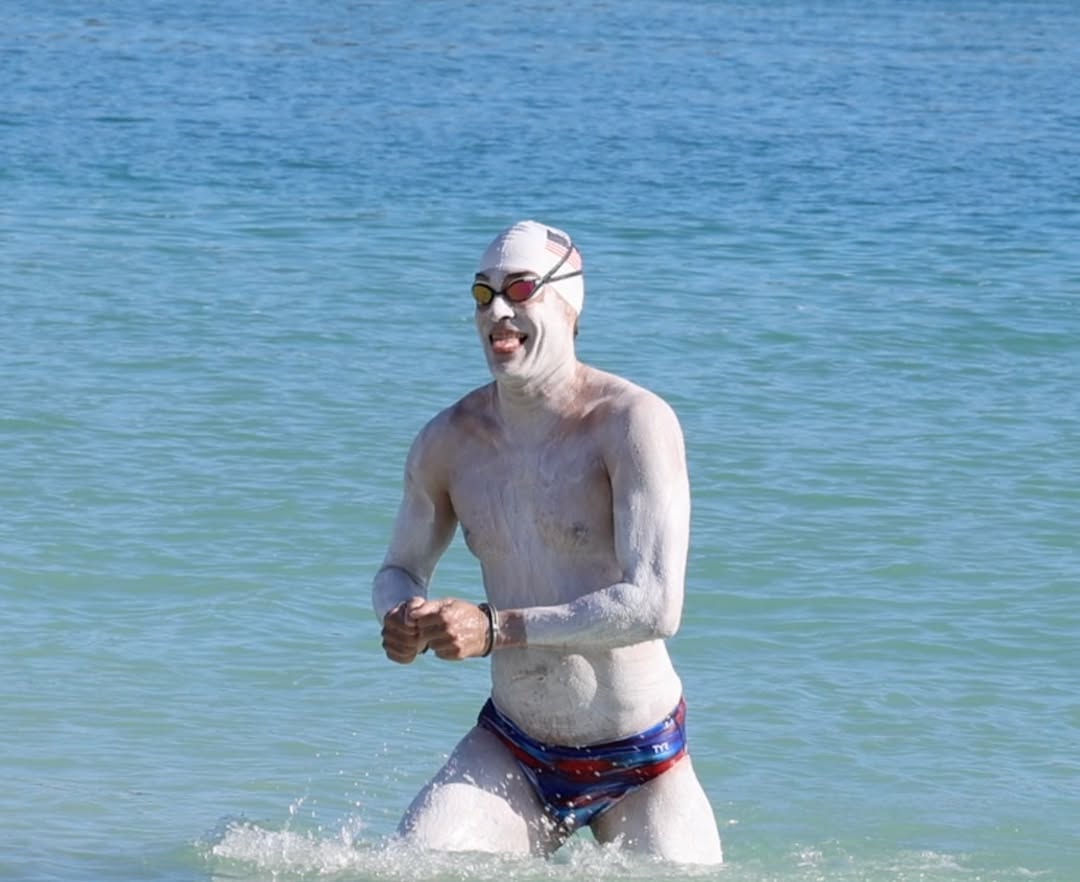
There are stories that feel unbelievable even when you read them twice, and Michael Moreau’s journey around Manhattan belongs firmly in that category. When he leapt into the water at the southern tip of the island in September, most people watching likely assumed he was attempting another ambitious open water marathon. What they did not know was that he had deliberately restrained his arms behind him with handcuffs before hitting the water, and that he would not reappear until he had completed the full 28.5 mile circuit up the East River, through the Harlem, and down the Hudson. The feat was already incredible by distance alone, but the added restriction pushed it into territory few people could even imagine attempting. By the time he emerged nearly ten hours later, he had secured two Guinness World Records and a story that shocked even experienced marathon swimmers.
Contents
show
What makes the achievement even more striking is that Moreau had no idea how close he came to being pulled beneath a barge during the Hudson stretch. Construction on the Lincoln Tunnel had created an unusually strong current that could have dragged him under at a moment when he had no use of his arms. His team chose not to warn him in real time, guiding him quietly out of danger while he continued kicking toward the finish. Only after he was safely on land did he learn how serious the risk had been. That revelation reframed the entire swim, transforming it from a symbolic test of limits into a moment where survival and ambition intersected without him even knowing it.
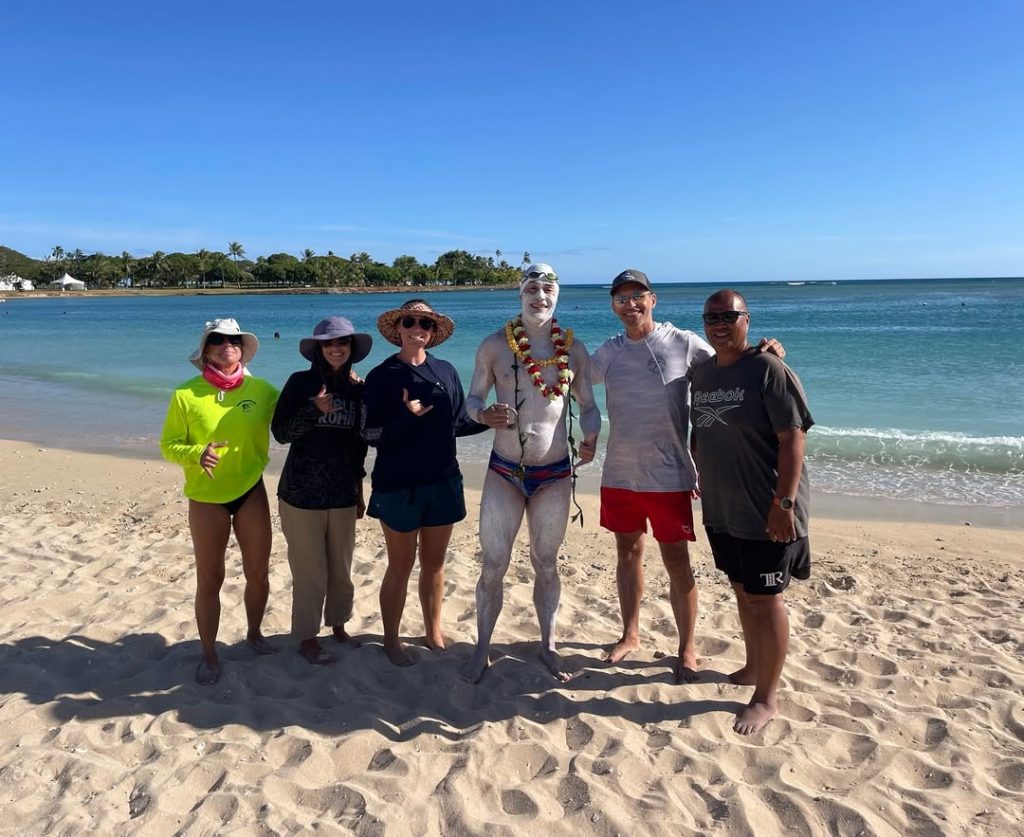
Image Credit: Michael Moreau @islandofmrmoreau on Instagram
Born to Swim
Michael Moreau often describes himself as someone who felt at home in the water long before he understood why. He explained that “according to my parents, I could swim before I could walk,” and that his earliest memories were shaped by a sense that the pool was where he was naturally meant to be. He went on to become a standout swimmer through high school and college, winning national championships and setting records that still stand. But as adulthood took shape, he stepped away from competitive swimming for nearly twenty years, trusting that chapter of life had closed.
In his mid forties, something shifted unexpectedly. Videos and articles featuring ultramarathon swimmers like Diana Nyad and Ross Edgley began appearing in his feeds, and each story reminded him that some athletes refused to let age soften their ambitions. He found himself wondering, as he put it, “when I started hearing these stories about people who had not given up on the opportunity to really test the limits, I thought, ‘Why can’t I do this thing?’” That question lingered long enough for him to consider returning to a sport he had once dominated, but he insisted it could not be a nostalgic attempt to reclaim past glory. It needed to be new, and difficult, and meaningful.
That need for something unfamiliar is what ultimately led him to the world of ultramarathon open water swimming. Distances beyond ten kilometers, unpredictable currents, marine life, boat traffic, and the total absence of pool‑side predictability created a type of challenge he had never experienced. He explained that “this is uncharted territory for me. This is something that I feel like I need to pursue,” and once the idea took hold, he committed fully. Training for the Molokai Channel in Hawaii became his first major target, and when he completed the 42 kilometer crossing in 13 hours and 11 minutes, becoming the fourteenth fastest in history, he found himself searching immediately for something even more unusual.
The Unusual Idea That Became His Obsession
After the Molokai accomplishment, Moreau began considering challenges that felt different from standard open water routes. That is when he encountered the record held by Egyptian swimmer Shehab Allam, whose handcuffed swim set an 11.6 kilometer benchmark. At first, his reaction mirrored the public. As he admitted, “the first thing that went through my head is the same thing that I think goes through a lot of people’s heads: That’s wild. Why would you even do anything like that?” Yet the longer he examined the idea, the more the technical difficulty appealed to him. Because up to ninety percent of a swimmer’s propulsion comes from their arms, swimming while handcuffed felt like a puzzle waiting to be solved.
The solution, as he saw it, rested in his historically strong breaststroke kick. If his legs could take over where his arms were unavailable, he could potentially build a strategy that relied on precision, endurance, and rhythm rather than traditional propulsion. Once he successfully surpassed Allam’s record in Hawaii during a handcuffed swim in May 2025, he began to imagine what had previously seemed unrealistic: attempting the entire 20 Bridges route around Manhattan while restrained. He admitted that “if I’m able to pull this off, this will be the defining moment of my open water career,” and that belief guided every part of his preparation.
Veteran swimmer Capri Djatiasmoro, who had completed the Manhattan loop herself, responded with concern when she learned of his plan. She remembered thinking, “he mentioned handcuffs and I said, ‘Wow. Good luck with that.’” The difficulty was obvious, but so were the risks. With limited arm movement, rescuing him quickly in an emergency would become significantly harder, and currents in certain parts of Manhattan are notorious even for unrestrained swimmers. Still, the idea had taken hold in Moreau’s mind, and he continued refining his approach.
Training Himself Into the Impossible
Moreau’s preparation involved a radical reorganization of his daily life. He relocated so he could use a 24 hour, 25 yard pool whenever necessary. Long nights, early mornings, and breaks between his demanding creative director job all funneled into training sessions designed to simulate the sensation of restricted movement. He described the strange looks he received from other swimmers, saying that “I’m training in a pool with a silicone ring tied around my arms and everybody is thinking I’m doing this weird drill,” but the repetition strengthened both his body and his confidence.
Weeks of nonstop practice eventually brought his weekly distance to nearly 65,000 yards. He also trained off Coney Island in rougher water so he could experience unpredictable conditions. Along the way, doubts surfaced repeatedly. He admitted there was “a lot of second guessing” and a cycle of asking himself “is this even worth the trouble?” But the more he trained, the more he found ways to manage fear. He reminded himself that many of the dangers swimmers imagine, from sharks to sudden debris to “deadly bacterias,” are far less common than the mind suggests.
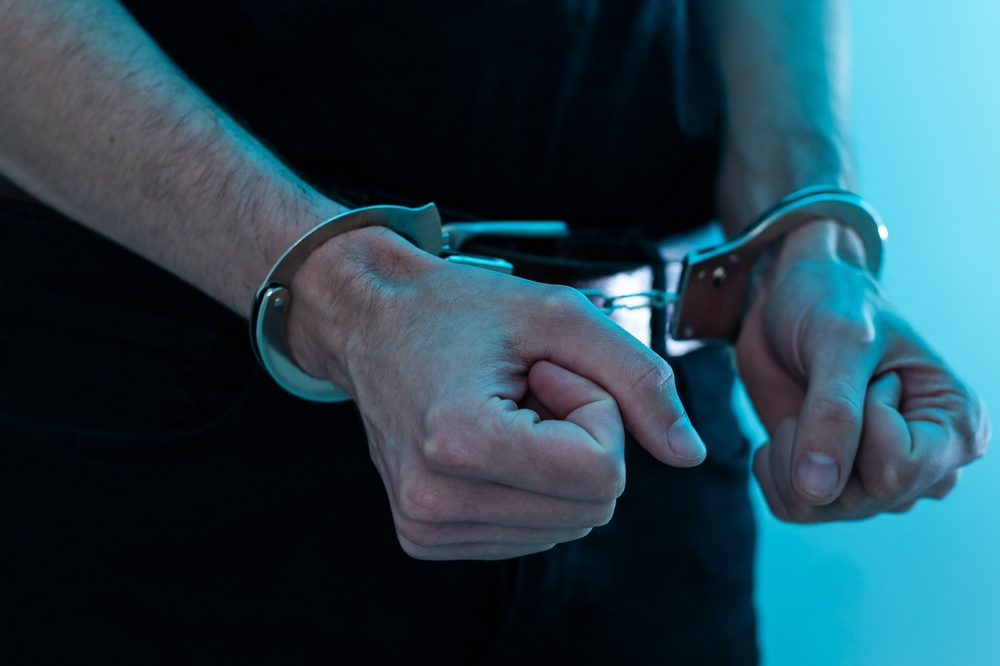
According to Allam, the previous record holder, the difficulty of removing arm use altogether required an “adaptation to remove one of the biggest elements that can support you in any swim” and demanded enormous focus on the legs and lower body. He understood the effort required and even expressed confidence that his record would one day be broken. His recognition served as further motivation for Moreau as he finalized the details of his attempt.
By the time the morning of the swim arrived, he had assembled an experienced support crew that included Djatiasmoro, his sister, a boat captain, a kayaker, and a Guinness World Records official. They would monitor his safety, track his time, and react quickly if conditions shifted unexpectedly. The only thing left was for Moreau to trust the training he had spent months perfecting.
The Swim That Changed Everything
The moment he jumped in on September 9, 2025, Moreau described feeling “euphoric.” The early stretch of the East River went smoothly, and he reached Hell Gate far ahead of schedule. But as he entered the Harlem River, conditions shifted abruptly. The change in current direction, combined with shallow and disorienting water, felt, in his words, like “hitting a brick wall.” Without arms to stabilize or guide himself, he had to rely entirely on rhythm and leg power to stay oriented.
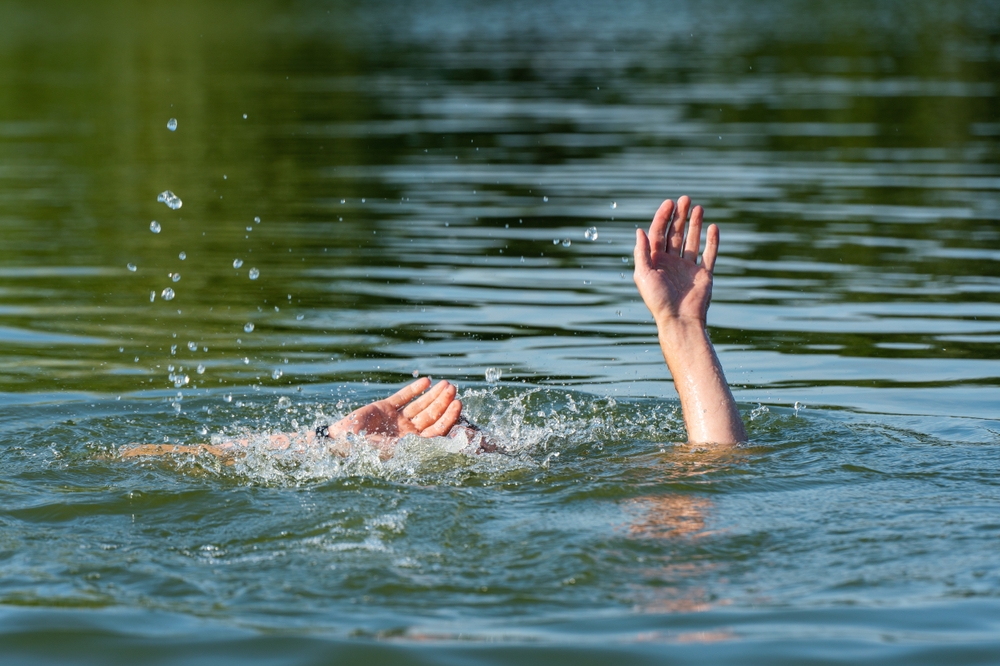
The Hudson River, which many swimmers consider the home stretch, introduced the most dangerous moment of the entire journey. Construction on the Lincoln Tunnel had created an unexpected current that swept toward a barge, and Moreau unknowingly passed through the zone where that pull was strongest. Only later did his crew tell him how close he came to being dragged under. He admitted, “I had no idea until after the swim… how dire that situation was,” and that realization reframed what he had thought was merely another tiring stretch of the route.
Despite the hidden danger, the final miles delivered an unexpected opportunity. His kayaker told him he could finish in under ten hours if he increased his pace. He responded instantly, thinking “hell yeah, let’s do this,” and sprinted the remaining distance with everything he had left. When he reached Brookfield Place and saw his final time of 9 hours and 41 minutes, he said he “let it all out,” releasing months of doubt, pressure, and fear.
The achievement earned him two Guinness World Records and left him with cellulitis in both legs, an uncomfortable but treatable reminder of how hard he had pushed himself. Moreau summed up the experience by saying, “to have that far fetched pipe dream where literally everybody is telling me, you’ve gone too far, this is madness at this point finally crystallized into reality… was monumental.”
Featured Image Credit: Michael Moreau @islandofmrmoreau on Instagram