
Your cart is currently empty!
Inside a Texas Cave, Archaeologists Found Something That Rewrites What We Know About North America’s Earliest Hunters
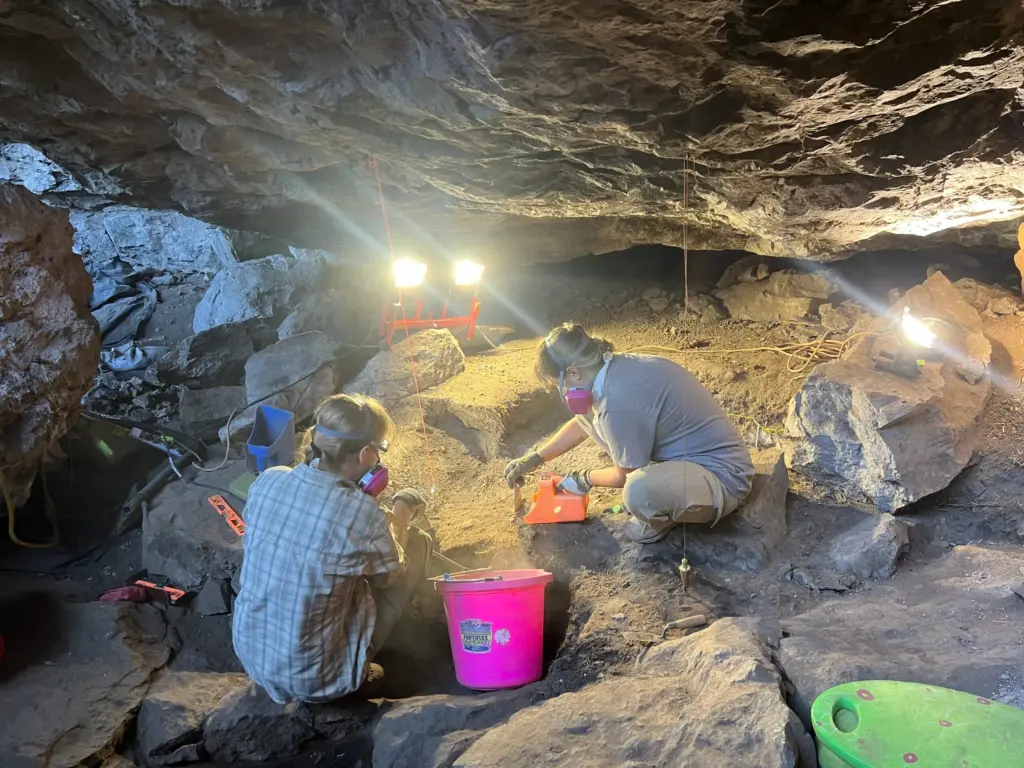
Deep in the Big Bend region of western Texas, not far from the Rio Grande and the border with Mexico, a remote rock shelter sat largely undisturbed for thousands of years. Researchers began excavating the San Esteban Rockshelter in 2019. What they expected to find were fragments, the kind of partial, degraded remnants that most archaeological digs in North America produce. Stone points, maybe. Scattered bone. The usual incomplete picture of a past that rarely holds its shape.
Contents
show
What they found instead has left the archaeological community reconsidering what early hunters in North America were truly capable of.
A Fire, a Hunter, and Six Millennia of Silence
Before the weapons, before the headlines, there was a simpler scene. A person walked to the back of a cave south of present-day Marfa, Texas, sometime around 4,500 B.C. They built a small fire. Working by its light, they sorted through a kit of hunting tools, setting aside the broken ones. Then they left.
Researchers pieced that scene together not from written records, but from physical evidence left behind in layers of dry sediment. A hearth. Fossilized human waste. A folded pronghorn hide was placed on top of a rock with the kind of casual tidiness that suggests the owner expected to return. None of it was disturbed for roughly 6,500 years.
When archaeologist Bryon Schroeder, director of the Center for Big Bend Studies at Sul Ross State University, came across the pronghorn hide, its fur was still intact. Still retaining its original color. Tanned by human hands millennia before anyone now alive was born.
“We all just sat there and stared at it in wonder,” Schroeder told Texas Parks and Wildlife magazine. “Somebody folded that hide up and sat that right on top of this rock. And nobody touched it for 6,000 years.”
What Was Waiting in the Cave
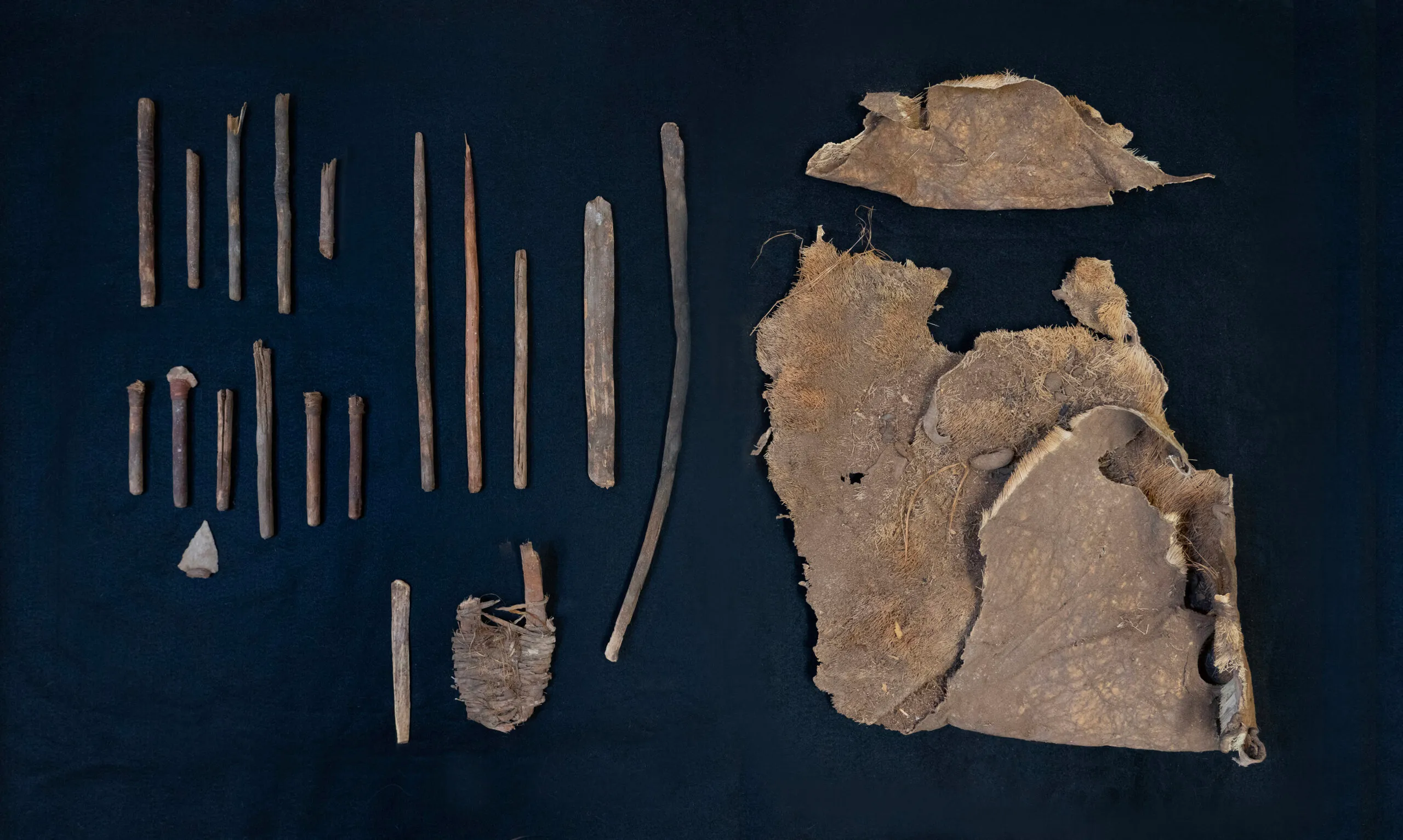
Over six years of excavations, the team from the Center for Big Bend Studies and the Odyssey Archaeological Research Fund at the University of Kansas pulled an extraordinary collection of artifacts from the San Esteban Rockshelter. Each field season added new pieces. Each piece pointed toward the same conclusion that whoever left this cave had been carrying one of the most sophisticated mobile hunting systems ever documented from this era in North America.
At the center of the cache sat the components of an atlatl, a spear-throwing device that gave early hunters a significant mechanical advantage. By extending the effective length of a thrower’s arm, an atlatl allowed hunters to launch darts at targets from distances of up to 160 feet, with far greater force than an unaided throw could produce. Four dart nock ends were found, each broken in the same place, each containing shallow cups designed to fit against the atlatl’s spur. Part of the spear-thrower itself was also recovered.
Attached to those darts were foreshafts, six wooden shafts fitted with knapped stone tips, designed to connect to the main dart shaft and be replaced when damaged. Two of those foreshafts still had their stone points embedded. Others retained only the broken bases. Four additional hardwood foreshafts were recovered without stone tips. Researchers believe those were used for a different purpose entirely, poison delivery.
Also found among the cache was a straight-flying boomerang. Not the returning variety familiar to most people, but a heavier, aerodynamically shaped weapon designed to fly straight and strike small game with enough force to kill or incapacitate. CBBS assistant professor Devin Pettigrew has made replicas to test in the field, studying how it might have functioned in both hunting and combat. Straight boomerangs have been found at sites across the world, with the oldest coming from Poland and dating to roughly 30,000 years ago. Finding one in this Texas cave, as part of what may be an intact contemporaneous kit, places San Esteban in a significant global conversation about early human technology.
Why Any of It Survived

Wooden tools do not last. Leather bindings do not last. Given enough time and moisture, organic materials break down completely, leaving behind only the stone components that archaeologists typically work from. Most of what early hunters carried simply does not survive to be found.
Big Bend’s arid climate changed that equation at San Esteban. Extremely dry conditions meant that wood, hide, and leather bindings all held their structure across thousands of years. Preserved wood of this age is rare enough to be considered extraordinary. Finding multiple wooden components in a single cache, in a condition that allows for detailed study, is the kind of outcome researchers do not plan for.
As Schroeder put it to the New York Times, “We were just stunned, because I’ve never seen that stuff. It makes the past way less abstract. It’s like, ‘Wow, these people were people.’”
That reaction captures something real about what preserved organic material does for archaeology. Stone tools tell researchers that people were present, that they shaped rock into useful forms, and that they had some grasp of materials and function. Wood tells a richer story. It can be tested to reconstruct the environment of the time. It reveals craftsmanship. It carries the marks of hands that worked it into shape, bending green branches over hot coals until steam came out both ends, forming curves that dried into functional weapons.
Reading the Weapons
Each component of the cache carries its own information, and Pettigrew has been working to extract it. On the straight boomerang, he noted a detail about how the wood aged in the desert air. “The medial edge of the boomerang is cool,” he told Texas Parks and Wildlife. “The wood desiccates in the desert environment and cracks down the center where the medulla is still intact, a common issue in woodworking.” He traced how the weapon was made and how it eventually failed, impact after impact, widening the cracks until the weapon split.
On the atlatl components, researchers face a complication known in the field as the Old Wood Problem. Radiocarbon dating on the spear-thrower produced an older age than the dart foreshafts, suggesting it may predate the rest of the kit by a meaningful margin. But Schroeder believes that gap likely reflects the age of the wood used to make it rather than a genuine difference in when the components were deposited. Ancient craftspeople often used older wood, deadfall, and salvaged timber to make their tools, and radiocarbon dating cannot distinguish between when a tree died and when a person worked it into shape. Untangling that question requires additional analysis.
One critical question still awaits an answer. Researchers have not yet confirmed whether all the objects in the cache belonged to a single hunting kit deposited at one time, or whether they accumulated over separate periods from different occupants of the cave. Pettigrew was direct about what the team still lacks. “We don’t yet have the socket ends we need to understand how the foreshafts attach to the main shafts,” he said. “We’re also missing the proximal end of the atlatl, but we know enough about this type to reconstruct what it may have looked like.”
Those missing pieces matter. If all the components turn out to be contemporaneous, the cache becomes something larger than a collection of old tools. It becomes a complete weapon system, assembled and carried by a single hunter, offering a rare and unusually clear picture of how early North Americans equipped themselves for survival.
More Questions, More Seasons
Alongside the weapons, researchers found fossilized human waste that could yield dietary information and DNA from the cave’s ancient occupants. Work is ongoing with Indigenous groups to gain the necessary approvals before any testing proceeds. Bone fragments found throughout the site have also begun to paint a picture of the animals these hunters pursued. Pronghorn appear frequently in the record, and researchers are now working to identify what other species were hunted and how they were processed for food.
San Esteban is not a site that gives up all its secrets at once. Excavations began in 2019, and the team has returned every year since, finding new artifacts each time. Human activity at the site dates back more than 13,000 years, placing Big Bend among the oldest continuously occupied areas on the continent. Each season adds another layer to a record that has been building across millennia.
Schroeder has been careful not to overstate what the cache represents before the full analysis is complete. Peer-reviewed publication of the findings is still in progress. But he has also been clear about what it would mean if the remaining questions resolve in the way the evidence currently suggests.
“If it really is a contemporaneous kit,” he told Texas Parks and Wildlife, “it’s a pretty monumental finding.”
What a Cave South of Marfa Tells Us
For decades, the archaeological record of early North America leaned heavily on stone. Points and blades, scrapers and cores, durable objects that outlasted everything around them. What San Esteban offers is a corrective to that narrow picture. Behind the stone tips sat wooden shafts. Behind the shafts sat leather bindings. Behind the bindings sat a person who knew how to make all of it work together, who could replace a broken foreshaft in the field and keep hunting.
James David Kilby, an expert in hunter-gatherer anthropology at Texas State University who was not part of the research team, noted to the New York Times that finds like this one “remind us that stone tools are just one component of these much more complex tool assemblages.”
Big Bend has been producing evidence of early human life for years. San Esteban has now given that evidence its most vivid form yet: a hunting kit, a folded hide, a cold hearth, and the clear outline of a person who stopped in a cave, sorted their gear, and moved on. Researchers are still trying to catch up with where they left off.
Featured Image source: Center for Big Bend Studies. https://cbbs.sulross.edu/6500-hunting-kit-west-texas-nyt