
Your cart is currently empty!
Michael Black Recalls Confronting Armed Suspect At Pawtucket Arena

Michael Black had no reason to think Monday afternoon would be anything other than ordinary. A friend’s son was playing hockey, and Black had made his way to Dennis M. Lynch Arena in Pawtucket, Rhode Island, to cheer him on. Senior Night was underway. Families packed the bleachers with signs and the kind of low, comfortable energy that surrounds youth sports on a winter afternoon. Players warmed up on the ice. Somewhere in the stands, a parent had a camera out. None of it pointed to what was about to happen.
Contents
show
Within minutes, Black would find himself at the center of one of the most harrowing events Rhode Island has seen in years. A shooting inside the arena left two people dead, three others critically wounded, and a community shaken to its core. What Black chose to do in those moments, and what it cost him physically, has since drawn national attention, though he has made clear he wants none of it.
His account, shared with reporters in the hours following the attack, paints a picture of a man who acted without hesitation and without a plan, driven entirely by instinct in a situation that gave him almost no time to think.
When the Sounds Started
View this post on Instagram
Black was seated in the bleachers when the first shots rang out. At first, he processed them the same way most people inside the arena did.
“I heard two shots, and I said, ‘balloons popping.’ I heard another popping and recognized it was not a balloon.”
Senior Night decorations had filled the building, and popping sounds were not out of place. Black was far from alone in that initial misread. Izzy Sousa, a high school student present at the game, later told The Providence Journal that when the first three shots rang out, the crowd around her assumed the same thing. When the sounds kept coming, that assumption collapsed fast.
What followed, by multiple accounts, was immediate and total chaos. Sousa described a stampede as the crowd surged toward the exits. Spectators dropped to the floor or ducked behind seats. Players behind the glass went down at once. Those out on the ice did not react right away, but within seconds, they were skating hard toward the exit tunnels. Audio footage circulating on social media captured at least 14 shots fired in roughly 17 seconds, a relentless burst that left no room for confusion about what was happening. Black had already made up his mind.
One Decision in the Bleachers
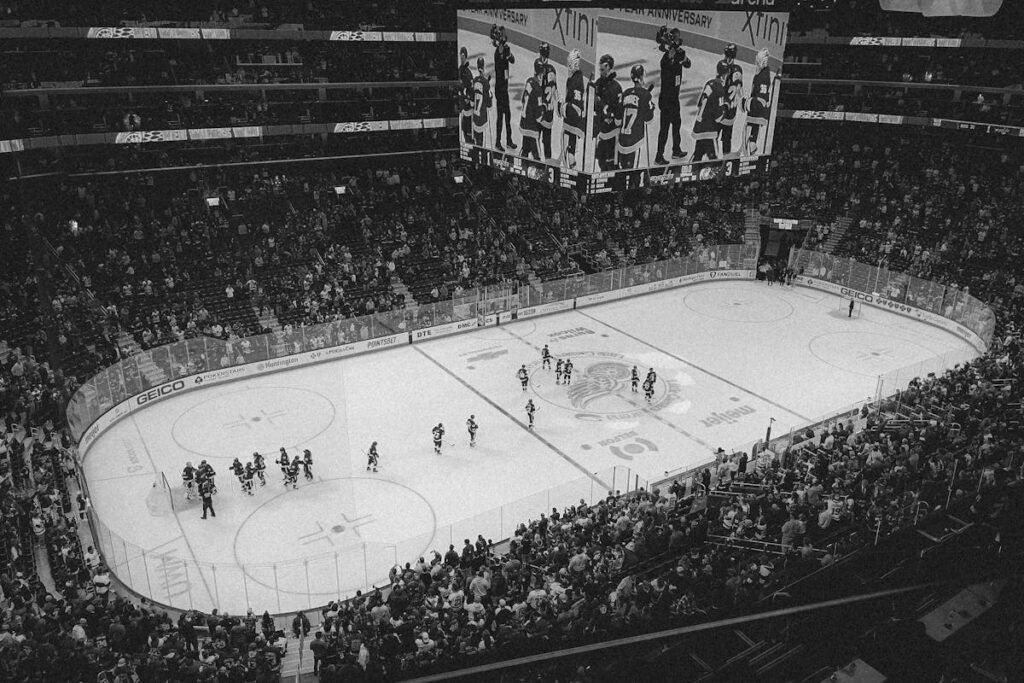
He turned to his wife and a friend beside him and told them to run. Then he stood up on the bleachers and scanned for the shooter.
What came next was not calculated. Black has said as much. He lunged toward the gunman and grabbed for the weapon. His left hand caught in the chamber of the gun, jamming it. Whether that happened by accident or pure reflex may not matter, because the result was concrete. With his hand stuck in the chamber, the weapon could not fire again.
Other bystanders moved in at nearly the same moment. Several people worked together to wrestle the shooter to the ground. During the struggle, multiple loaded magazines fell from the shooter’s possession. When he hit the ground and landed on his back, he reached into a pocket and produced a second firearm. He turned it on himself.
Black later described the physical reality of those few seconds with the kind of spare, practical language that characterized his entire account. He mentioned the shell casings ejected during the initial gunfire that burned his face. He spoke about his hand with the same matter-of-fact tone. Once police arrived on scene, he handed over one of the firearms he had recovered and praised the emergency response, including ambulance crews and the hospital staff who treated his injuries. His left hand ultimately required stitches.
Beyond the physical toll, what comes through most clearly in Black’s retelling is the near-total absence of self-importance. He was there, he saw what was happening, and he moved. By his own account, there was not much more to it.
What the Police Said
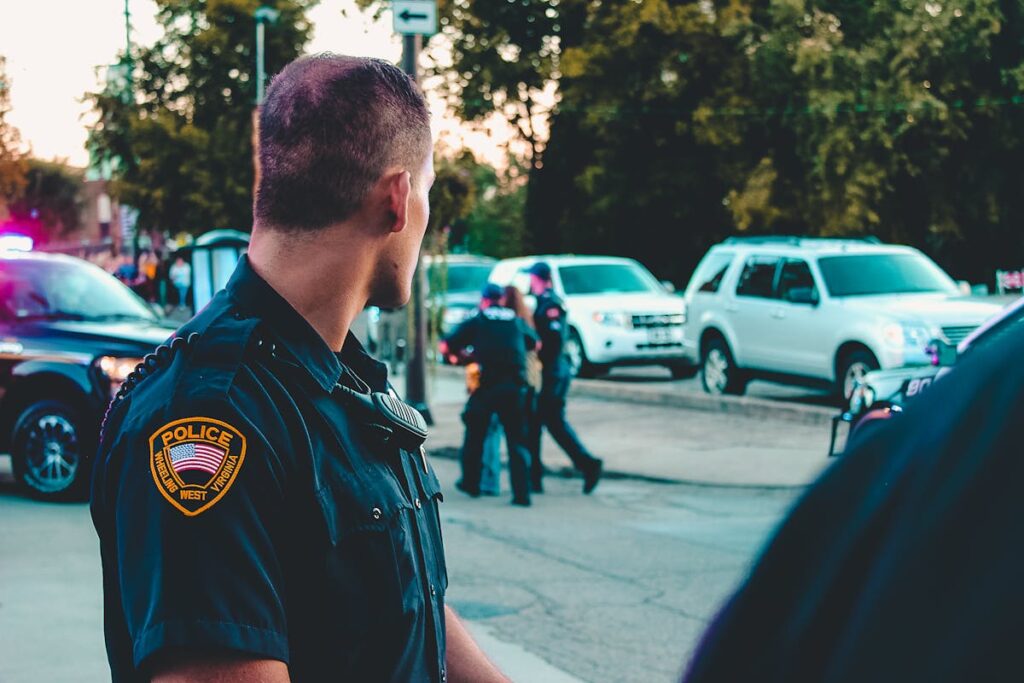
Pawtucket Police Chief Tina Goncalves addressed reporters at a press conference Monday night. She declined to walk through the specifics of the intervention, citing the active investigation, but she left no ambiguity about its impact on how the attack ended. “A good Samaritan stepped in and interjected in the scene, and that’s probably what led to a swift end of this tragic event.”
Goncalves identified the shooter as Robert Dorgan, 56, who had also gone by the name Roberta Esposito. Dorgan was a parent of a North Providence High School senior and had been at the arena that afternoon. Police described the attack as targeted and said it appeared to stem from a family dispute. By Monday evening, investigators had spoken with more than 100 witnesses, and the investigation remained open and active.
An ATF source cited by Fox News described the shooting as a domestic violence incident that escalated into a murder-suicide. Dorgan shot and killed his ex-wife, Rhonda, and his son Aidan. He also shot three other individuals, including two additional family members and a family friend, before dying from a self-inflicted gunshot wound.
At Pawtucket Police Department headquarters after the attack, a woman who identified herself as Dorgan’s daughter spoke briefly to reporters. She said her father had mental health issues and that he was very sick. Her account was short and without elaboration, delivered outside a building where investigators were still at work inside.
A Hero Who Won’t Take the Title
When reporters and others began calling Black a hero, he pushed back without hesitation. “That’s not the right definition for me. There’s heroes in my life, and I would definitely not put that definition towards myself.”
He redirected attention toward the other bystanders who had jumped in around him, framing the intervention as a group effort rather than a solo act. For Black, what happened at Lynch Arena was not a personally defining moment. It was several people responding to an emergency with whatever they had available.
That refusal to accept credit sits at the center of how he has handled the public attention in the days since. He has spoken about the shooting in direct, practical terms, describing what he saw and what he did without any editorializing. He praised the people who helped him. He said nothing to suggest he viewed his own actions as out of the ordinary.
Who Robert Dorgan Was
People close to the family told Fox News that Dorgan had transitioned in 2020 and begun going by the name Roberta Esposito. That same year, Dorgan reported to North Providence police that his father-in-law wanted him removed from the family home over his gender transition. His then-wife had cited gender reassignment surgery and personality disorder traits in initial divorce paperwork before those grounds were later amended to irreconcilable differences. Their divorce was finalized in 2021, with records listing Dorgan as living in Jacksonville, Florida, and working as a truck driver at the time.
Family contacts told Fox News that the gender transition had been a source of ongoing conflict within the family for years before Monday’s attack. Goncalves said her department was looking at every possible factor that may have preceded the shooting. No specific motive beyond the broad framing of a domestic and family dispute had been confirmed as of Monday evening.
The Victims Left Behind
Police withheld the names of the victims Monday night, saying that information would follow after families were properly notified. Local outlet WPRI reported that among those killed were the mother of a hockey player and a sibling of a player who had been in the building for the game. Two survivors remained in critical condition as of Tuesday. Pawtucket Mayor Donald Grebien described them as fighting for their lives.
Dorgan left behind two other children who lost both parents in the span of a single afternoon, a high school hockey player and a daughter studying to become a nurse. All players at the game were accounted for and unharmed. Coventry Public Schools Superintendent Don Cowart confirmed in a statement that every member of the Coventry Boys Hockey team present at the arena was safe.
FBI Director Kash Patel posted on X that FBI Boston had responded to the scene and would offer state and local law enforcement any resources necessary. Rhode Island Interscholastic League announced Monday night that all games across the state would be suspended out of respect for the victims. Mayor Grebien released an official statement describing what should have been a joyful Senior Night that instead became a scene of violence and fear, and offered prayers for everyone present at the arena that afternoon.
A City Left Searching
Pawtucket is a working-class city where hockey is woven into the fabric of winter. Senior Night at a local rink is not a rare occasion. Families come out, cheer, and take photographs. Monday afternoon at Dennis M. Lynch Arena was supposed to be exactly that kind of evening.
Instead, it became a crime scene that drew federal resources, prompted a statewide suspension of youth athletic events, and put a man named Michael Black in front of cameras he clearly did not seek. He came to watch a game. He left with stitches in his hand, burns on his face, and a story that, by his own account, is not really about him at all.
Whether the public agrees with that assessment is another matter. What is beyond dispute is that Goncalves stood at a podium Monday night and made plain, in her own words, that what Black did changed how that afternoon ended. Two people were already gone by then. Without Black and the others who moved when most people ran, that number could have been higher.