
Your cart is currently empty!
Scientists Discovered a Million-Year-Old Skull That Could Change the Entire Human Evolution Timeline

A crushed fossil sat in storage for decades, dismissed as just another example of an ancient human species scientists already understood. Nobody paid much attention to the badly deformed skull discovered in China back in 1990. Researchers labeled it, cataloged it, and moved on to other discoveries that seemed more promising.
Contents
show
But advanced technology has a way of revealing secrets hidden in plain sight. When scientists finally applied modern reconstruction techniques to this forgotten relic, they discovered something that challenges everything we thought we knew about human origins. What they found could double the timeline of human evolution and flip our understanding of where Homo sapiens first emerged on this planet.
Crushed Fossil From 1990 Finally Gets Its Moment
Yunxian 2, as scientists call the skull, came from the Yunxian region of China’s Hubei province. Workers discovered it on a terrace of the Hanjiang River in the Yunyang district. Two crania emerged from the site, with Yunxian 2 showing better preservation than its companion, Yunxian 1.
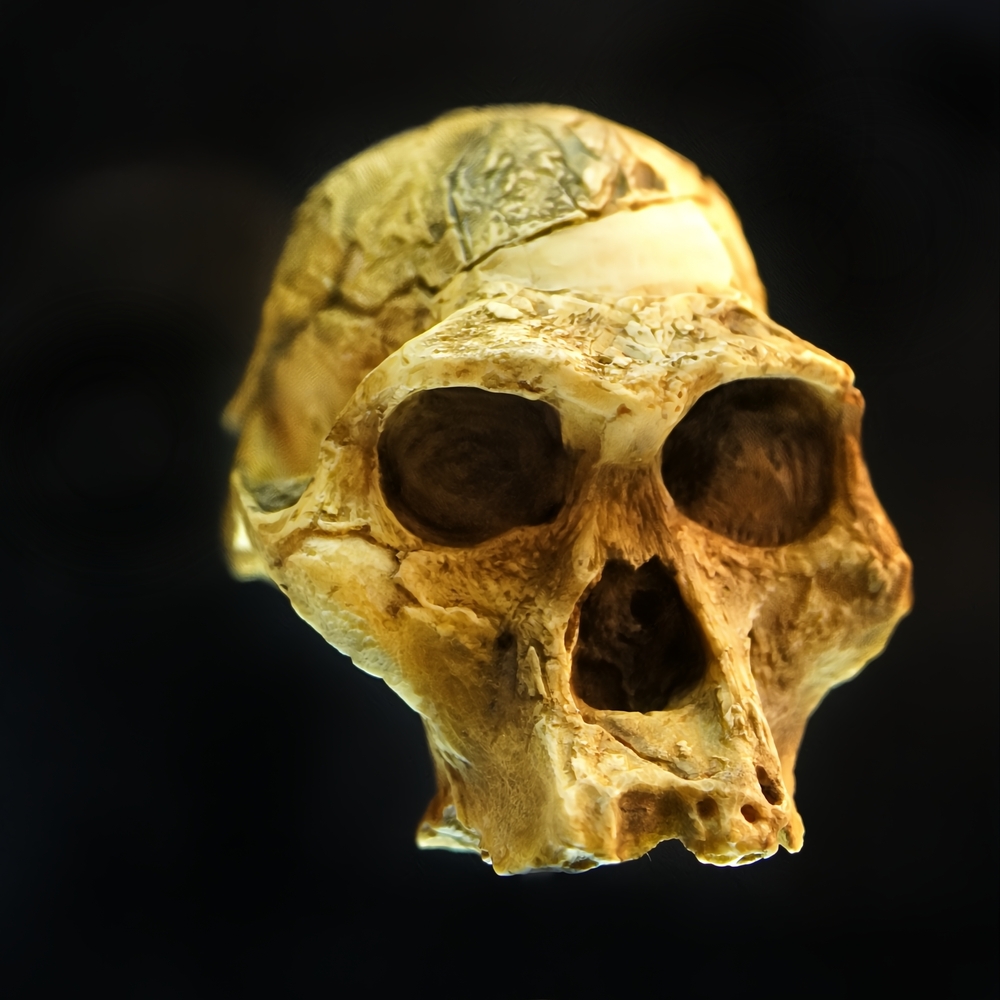
The condition posed immediate challenges. Fragmentation and displacement made interpretation difficult. Researchers recently found a third skull, Yunxian 3, which still awaits preparation and study. Yet even the better-preserved Yunxian 2 arrived badly crushed, its true form obscured by a million years of geological pressure.
Initial examination relied on what scientists could see with their eyes and basic tools. Based on age estimates between 0.94 and 1.10 million years and some obvious physical traits, experts assigned it to Homo erectus, a primitive human species. Case closed, or so everyone thought.
Advanced CT Scans Reveal What Naked Eye Couldn’t See
Modern technology changed the game. High-resolution CT imaging penetrated the fossil in ways impossible three decades ago. Sophisticated digital techniques allowed researchers to see beyond surface damage and geological distortion.
Scientists employed CT image segmentation, digitally splitting fossil bones from the surrounding matrix. Fragment separation and repositioning corrected the distortion piece by piece. Virtual reconstruction emerged from careful analysis of small fractures and displacement patterns rather than plastic deformation.
Previous attempts at reconstruction used landmark-based realignment and mirroring of counterparts. New methods developed in recent years offered more precision. Researchers even incorporated elements from Yunxian 1 to fill gaps, grafting the zygomatic bone and tip of the left maxilla, where Yunxian 2 showed damage. Results painted a different picture than anyone expected.
Skull Matches Different Human Species Entirely

The overall shape and size of the brain case pointed away from Homo erectus. Teeth characteristics suggested something else entirely. Scientists now believe Yunxian 2 belongs to Homo longi, also known as dragon man, a group more closely linked to the mysterious Denisovans who lived alongside our ancestors.
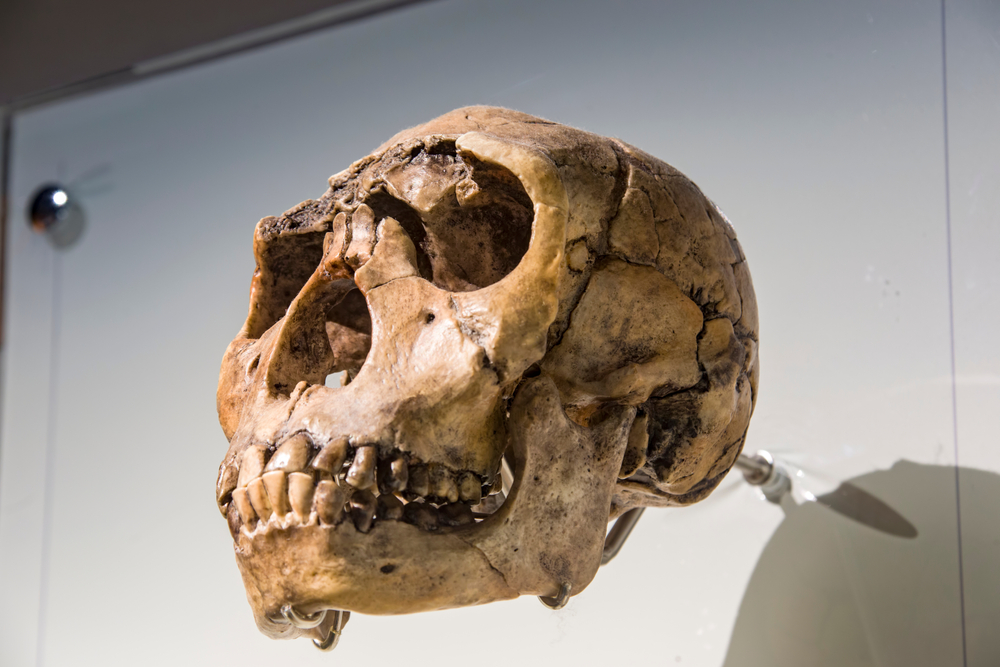
The reconstructed skull shows a large, long cranium with a broad, flat braincase. Moderate endocranial capacity measures about 1,143 cubic centimeters. Thick brow ridges dominate the face. A broad basicranium and palate support a long, low vault when viewed from the side. High, projecting face features, wide nasal apertures, and large, high cheekbones.
Yet certain features separate it from typical Homo erectus specimens. Absence of a strongly angulated occipital bone stands out. No occipital bun appears, unlike Neanderthals. Mosaic morphology combines primitive traits from earlier hominins with derived features shared with modern lineages.
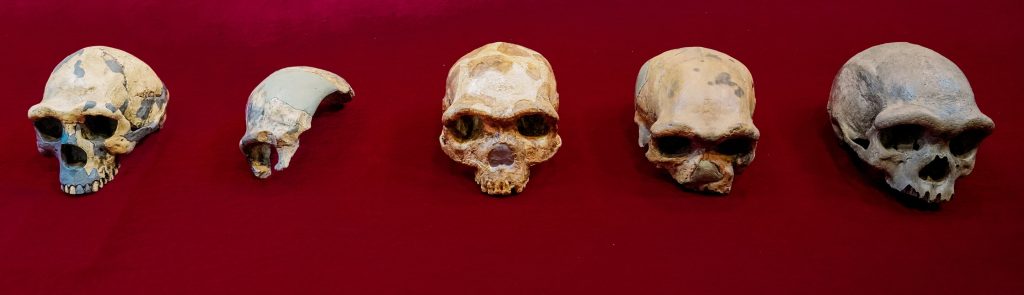
Geometric morphometric analysis using 533 landmarks compared 26 complete hominin fossils with 153 recent human specimens. Yunxian 2 clustered with Asian fossils, including Dali, Jinniushan, and Harbin, forming a distinctive group separate from both Homo erectus and modern Homo sapiens.
Split Between Modern Humans and Relatives Happened Way Earlier
Professor Chris Stringer, an anthropologist and research leader in human evolution at London’s Natural History Museum, emphasized the magnitude of these findings: “This changes a lot of thinking because it suggests that by 1 million years ago our ancestors had already split into distinct groups, pointing to a much earlier and more complex human evolutionary split than previously believed. It more or less doubles the time of origin of Homo sapiens.”
Previous estimates placed divergence between Neanderthals and Homo sapiens at 0.5 to 0.7 million years ago. New analysis pushes that split back by at least 400,000 years. Origin of the longi clade reaches back about 1.2 million years ago, slightly older than the Yunxian fossils themselves. The origin of the sapiens clade dates to approximately 1.02 million years ago.
Divergence between the longi and sapiens clades occurred around 1.32 million years ago. Neanderthals, widely considered a sister species to Homo sapiens, split from both groups at roughly 1.38 million years ago according to Bayesian tip-dating analysis.
Closest Fossil to the Great Branching Point
Yunxian 2 sits near the theoretical time of origin for both longi and sapiens clades. Phylogenetic analysis places it within the longi clade, yet its mosaic features may preserve transitional characteristics from just before the major split.
Stringer added context about its importance: “This fossil is the closest we’ve got to the ancestor of all those groups.”
Narrow temporal gap between Yunxian and deeper longi nodes suggests rapid early diversification. Both sapiens and Neanderthal clades show similar patterns, indicating a burst of evolutionary branching during this period. Features present in Yunxian 2 represent a snapshot of human evolution at a pivotal moment.
Computational Analysis Maps Just Five Big Human Lineages
Analysis of a wider selection of fossils reveals that large-brained humans evolved along just five major branches over the last 800,000 years. Asian erectus forms one branch. Heidelbergensis occupies another. Sapiens, Neanderthals, and Homo longi, including Denisovans, complete the set.
Parsimony analysis and phylogenetic modeling using 57 selected fossil operational taxonomic units produced a majority consensus tree. Branch lengths correspond proportionally to division ages measured in thousands of years. Internal nodes show median ages with confidence intervals indicating when major splits occurred.
Most Asian Chibanian hominins previously labeled “archaic Homo sapiens” actually belong together in the longi clade. Dali, Jinniushan, Xujiayao, and Hualongdong specimens join Xiahe and Penghu mandibles to form this monophyletic group. Longi clade shares nine derived characters as synapomorphies, including larger cranial capacity, lower and longer frontal squama, narrower interorbital breadth, and deeper glabellar inflexion.
Mysterious Denisovans Finally Get a Family
Denisova Cave in Russia’s Altai Mountains yielded fragmentary fossil humans genetically identified as a clade distinct from both Homo sapiens and Neanderthals. Known from very few specimens, Denisovans remained enigmatic figures in human evolution.
Parsimony analysis based on limited informative characters suggests Denisovans most likely belong to the longi clade. Shared derived features appear in preserved specimens, including reduction of the metacone of upper M3 teeth, strengthening of Carabelli’s cusp, and increases in M2 hypocone and cusp 5 size.
Mitochondrial DNA analyses place Denisovans outside the divergence between Homo sapiens and Neanderthals. Nuclear genome sequences suggest they form a sister group to Neanderthals. Different results from separately inherited mitochondrial and autosomal DNA create apparent contradictions, though both patterns make logical sense depending on the rooting points chosen for phylogenetic trees.
First Homo Sapiens Might Have Come From Western Asia
Traditional understanding places human origins firmly in Africa. New evidence challenges this long-held view. The geographic location of Yunxian fossils in China, combined with their position near the base of both longi and sapiens clades, raises intriguing possibilities.
The common ancestor of Neanderthals, Denisovans, and modern humans potentially lived in western Asia rather than Africa. Evidence remains incomplete, yet the pattern suggests human evolution followed a more complex geographic path than simple African origins followed by global dispersal.
More fossils from Asia will help clarify the picture. Yunxian 3, still awaiting preparation, might provide additional insights. Middle Pleistocene sites across the continent could yield specimens that fill remaining gaps in our understanding.
Solving the “Muddle in the Middle”
Palaeoanthropologists have struggled for decades with a confusing array of human fossils dating between 1 million and 300,000 years ago. Researchers call this period the “muddle in the middle” because specimens showed such diverse characteristics that classification schemes broke down.
Stringer described the study as a landmark step toward resolving these long-standing debates. Yunxian 2 helps explain Middle Pleistocene morphological diversity by showing how different lineages already existed and were diverging rapidly during this period.
Rather than transitional variants all leading toward Homo sapiens, these fossils represent multiple evolutionary clades pursuing separate paths. Some led to Neanderthals in Europe. Others evolved into Homo longi across Asia. Still others became modern Homo sapiens, though where and when remain open questions.
Not Everyone Convinced But All Agree It’s Exciting
Dr. Frido Welker, an associate professor in human evolution at the University of Copenhagen who was not involved in the research, offered measured enthusiasm: “It’s exciting to have a digital reconstruction of this important cranium available. If confirmed by additional fossils and genetic evidence, the divergence dating would be surprising indeed. Alternatively, molecular data from the specimen itself could provide insights confirming or disproving the authors’ morphological hypothesis.”
Findings run counter to some recent analyses based on genetic comparisons of living humans and ancient DNA. Discrepancies mean conclusions will likely spark debate within the scientific community. Bootstrap methods tested the robustness of phylogenetic inferences, suggesting potential reconstruction errors have minimal influence on conclusions.
Yet genetic data from the Yunxian specimen itself could provide definitive answers. Molecular analysis would either confirm morphological hypotheses or reveal problems with current interpretations. Additional fossils from the same time period would strengthen or challenge these new ideas about human origins.
One Crushed Skull Opens Up Whole New Chapter
A fossil dismissed as ordinary for three decades has become a game-changer. Technology revealed truths hidden by geological damage and time. What seemed like a straightforward classification turned into evidence for radically different human origins.
Timeline for human evolution doubled from previous estimates. Asia’s role elevated from peripheral to central. Simple linear progression from African origins to global dispersal gives way to complex branching patterns with multiple lineages coexisting and potentially interbreeding.
More questions emerge than answers. Where exactly did the first Homo sapiens arise? How did different lineages interact when they met? What genetic legacy did Denisovans and other longi clade members leave in modern populations? Yunxian 2 opens doors to new research directions while challenging comfortable assumptions about our evolutionary past. Human origins story grows more complex and more fascinating with each discovery that forces us to reconsider what we thought we knew.