
Your cart is currently empty!
How a Simple Agate Became a Dinosaur Discovery

For more than a century, a delicate pink and white sphere sat quietly in the Mineralogy Collection of the Natural History Museum in London. It was admired for its beauty and symmetry and regarded as a fine example of agate. Generations of curators cataloged it, moved it, displayed it and stored it again without suspecting that the specimen was anything other than a visually appealing mineral. Yet within its smooth rind and banded interior lay a story far older and far more complex than anyone realized.
Contents
show
In recent years, a chance encounter at a mineral show in France changed the narrative entirely. What began as a routine display preparation evolved into a discovery that now reframes early fossil collecting history and deepens scientific understanding of one of the largest animals ever to walk the Earth. The revelation that this specimen is likely a titanosaur egg dating back around 60 million years demonstrates how museum collections, scientific expertise and the simple act of paying attention can converge to uncover extraordinary truths.
The story of this agate turned dinosaur egg is not only about a fossil but also about the interplay of volcanic landscapes, ancient ecosystems, scientific progress and the persistence of unanswered questions. This article explores its journey from mineral curiosity to prehistoric relic and the wider implications of its reidentification.
A Specimen Hidden in Plain Sight
When the agate specimen was first registered in 1883, it was recognized as an aesthetically interesting mineral. Measuring roughly fifteen centimeters across and nearly spherical, it displayed pale pink and white banding inside a thin exterior. Collected in central India by Charles Fraser sometime between 1817 and 1843, its origin was noted, but few additional details accompanied it.
The Victorian era hosted rapid developments in geology and natural history, yet the study of dinosaurs was still forming its foundations. The word dinosaur had only been introduced in 1842. Fossil eggs would not be scientifically recognized until 1923. Within that scientific landscape, categorizing the object as agate was appropriate and reflected the knowledge available at the time.
Museum collections often contain such artifacts whose significance shifts with new scientific perspectives. Specimens can remain dormant for decades, waiting for future researchers to question old assumptions. In this case, the agate drew renewed attention in 2018 when it was selected for display in the museum’s Membership Rooms. Robin Hansen, a mineral curator, prepared the piece and noted its pleasing symmetry but had no immediate indication of its deeper identity.
The Lightbulb Moment in France

Later that year, Hansen attended a mineral show in France, an environment where curators and researchers encounter a vast array of geological specimens. While exploring different displays, a dealer presented an agatised dinosaur egg. It was spherical, contained a thin outer layer and showed darker agate filling its interior. The resemblance to the museum specimen was unmistakable.
Hansen recognized the similarities and immediately recalled the specimen recently placed on display. The comparison triggered a reconsideration of what had long been accepted. Upon returning to London, Hansen consulted two of the museum’s dinosaur specialists, Professor Paul Barrett and Dr Susannah Maidment.
The team examined the specimen closely. They observed that the exterior texture resembled eggshell and noted the presence of features suggesting that additional rounded objects had once been clustered with it. These impressions aligned with common characteristics of dinosaur nesting sites. To investigate further, they attempted to use CT scanning to visualize internal structures. However, the density of the agate prevented the scanner from revealing finer details.
Even without internal imaging, external clues and contextual information pointed strongly toward a biological origin rather than a purely mineral one. As the curators analyzed the evidence, the hypothesis that the specimen was a dinosaur egg gained considerable support.
Reconstructing a Victorian Discovery

Tracing the specimen’s history proved to be a critical step in affirming its significance. Hansen followed its documentation back to Fraser, whose collecting occurred decades before dinosaur eggs were recognized or even widely theorized. The object had likely been regarded simply as an unusual mineral formation of considerable beauty.
Its early collection date positions it among the earliest known dinosaur egg discoveries. If its identification as a titanosaur egg is verified, it may represent one of the first complete dinosaur eggs ever found. This possibility highlights the value of museum archives as repositories not only of specimens but of overlooked scientific potential.
The fact that Fraser gathered the specimen during the early nineteenth century speaks to the curiosity and thoroughness of naturalists during that time. Although they lacked modern analytical tools, their careful documentation ensured that later scientists could revisit their findings with new questions and technologies.
Titanosaurs and Their Remarkable Reproduction Strategy
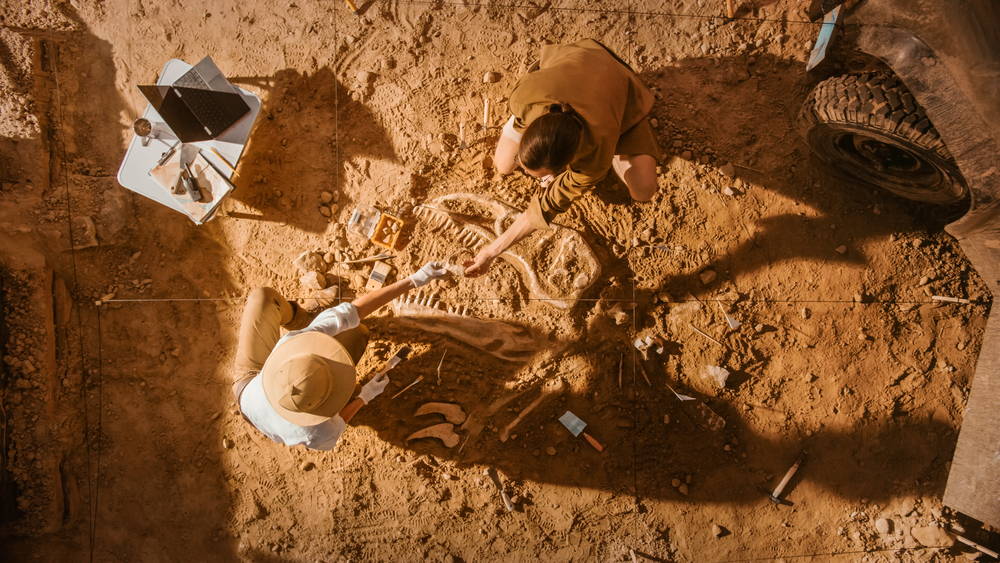
The identification of the specimen as a titanosaur egg is supported by its size, surface texture and geographic origin. Titanosaurs were the most common dinosaurs living in what is now India during the Late Cretaceous. Reaching lengths of up to thirty-seven meters and weights exceeding fifty tons, they were among the largest land animals to have ever existed.
Despite their immense size, titanosaurs laid relatively small eggs. Their reproductive strategy favored quantity over size, with clutches that often contained thirty to forty eggs. This approach resembles that of modern reptiles such as crocodiles and sea turtles rather than mammals that invest heavily in a few offspring.
Titanosaurs likely did not provide parental care after laying their eggs. Instead, they placed them in suitable environments where temperature and conditions could support incubation without direct supervision. The volcanic landscapes of prehistoric India may have offered ideal warmth for this purpose.
Eggs discovered across different continents show consistent characteristics that support these interpretations. The similarities between specimens from India, China and Argentina suggest that titanosaurs maintained comparable nesting behaviors across large geographic distances.
India During the Late Cretaceous

To understand how agate came to fill a dinosaur egg, it is necessary to consider the geological environment of ancient India. During the Late Cretaceous, India was an island drifting northward across what is now the Indian Ocean. The region experienced intense volcanism, especially within an area known today as the Deccan Traps.
The Deccan Traps are composed of massive layers of basalt formed by repeated lava flows. These eruptions reshaped the landscape, burying vegetation, sediments and sometimes entire ecosystems beneath thick volcanic deposits. Within these layers, gas bubbles created cavities that over time were filled with minerals such as quartz and agate.
Fossils of titanosaurs have been found between sequences of basaltic layers, indicating cycles in which volcanic activity covered the region, followed by periods during which dinosaurs repopulated the area before new eruptions occurred. Researchers believe that titanosaurs may have been drawn to the geothermally warm soil when selecting nesting sites.
In this context, a newly laid clutch of eggs could easily have been engulfed by volcanic debris. The thermal conditions would have been lethal to the embryos but ideal for preservation. Over many millions of years, silica-rich groundwater seeped through the rock and permeated the hollow interior left behind after organic material decomposed. Gradual mineral deposition created the distinctive banded patterns now visible within the specimen.
Challenges of Identifying Fossilized Eggs

Determining whether a spherical mineral filled object is truly a fossil egg is a nuanced process. External texture, shell remnants and geological context all play important roles, yet these indicators can sometimes mimic purely mineral structures.
In this case, the specimen presented several promising characteristics. The thin rind surrounding the agate bore similarities to eggshells documented in other titanosaur specimens. The arrangement of impressions on the outer surface suggested that multiple eggs were once positioned together. Combined with its Indian origin and Late Cretaceous age, the evidence leaned strongly toward a biological explanation.
CT scanning, a common non destructive method for examining fossil interiors, was less effective due to the agate’s density. This limitation underscores the challenges scientists face when analyzing specimens that have undergone complex mineralization processes. Even advanced imaging cannot always penetrate dense geological materials, leaving researchers to rely on surface features and comparative analysis.
Nonetheless, multiple lines of evidence converged to form a convincing interpretation. By comparing the specimen with other known titanosaur eggs and drawing upon geological context, the museum’s dinosaur specialists reached a strong consensus.
Museum Collections as Engines of Discovery

This reidentification speaks to the broader importance of museum collections. Millions of specimens sit in storage in museums around the world, many of them cataloged in periods when scientific knowledge and tools were far more limited than today. Modern researchers continue to uncover new insights from historical collections by applying updated techniques and forming interdisciplinary collaborations.
A specimen considered ordinary or unremarkable in one era may hold clues that only become visible under new scientific frameworks. The agate turned dinosaur egg demonstrates how institutions serve not only as repositories of the past but also as active sites of ongoing discovery.
Researchers often describe museums as libraries of the natural world. Each specimen functions as a volume containing information that can be read and interpreted through scientific inquiry. Over time, new technologies emerge to reveal chapters that were previously inaccessible. Many discoveries arise not through field expeditions but through renewed examination of existing collections.
How Mineralization Preserves Biological Structures
The process that transformed this egg into agate reflects a broader phenomenon in which organic materials provide templates for mineral formation. When biological structures are buried rapidly under sediment or volcanic debris, they can decompose in environments that later allow minerals to precipitate into the empty cavities.
In this case, the mineralization process likely began soon after the egg was buried. As volcanic rock cooled around it, internal soft tissues deteriorated. Silica-rich water then entered the cavity repeatedly over long spans of geological time. With each flow of mineral-laden fluid, thin layers of agate formed. The result is a polished interior composed of concentric bands, preserving the shape of the original egg even though its biological contents have disappeared.
This type of fossilization illustrates how geological processes can preserve the form of a biological object without retaining organic material. It also shows how mineral specimens and fossils sometimes overlap, challenging assumptions about what belongs in mineralogy collections versus paleontology archives.

Reconsidering What Museums Can Reveal
The discovery raises intriguing questions about how many other specimens sitting quietly in storage might contain similar surprises. As technology improves, researchers may uncover additional reidentifications that shed new light on prehistoric life.
Collections assembled during the nineteenth and early twentieth centuries were often extensive, and not all items received the detailed analysis that would be standard today. Shifts in scientific interpretation are inevitable as new methods and comparative datasets emerge.
This case also illustrates the importance of interdisciplinary communication within museums. Mineral curators, paleontologists, geologists and imaging specialists all contributed perspectives that shaped the final interpretation. Collaboration is often the key to recognizing that an object belongs to a different scientific narrative than originally assumed.
A Window Into Prehistoric Behavior
Beyond its mineral beauty, the specimen offers a glimpse into titanosaur reproductive behavior. Its size and shell texture match eggs from known titanosaur nesting sites. The suggestion that multiple eggs once clustered together aligns with observed patterns in titanosaur clutches.
By studying eggs like this one, scientists refine their understanding of how these massive animals reproduced, selected nesting environments and responded to environmental pressures. Each egg provides information about clutch size, distribution and geological context. Even when mineralized, eggs can help paleontologists reconstruct ancient reproductive strategies.
The volcanic setting of the Deccan Traps adds another layer of insight. Titanosaurs repeatedly returned to this landscape despite intermittent eruptions. The warm soils likely played a role in incubation. At the same time, volcanic events contributed to the fossilization of their nests. This interplay between life and geological activity shaped the preservation of many fossils found in the region.
A New Perspective on an Old Collection
The transformation of a pink and white agate sphere into a confirmed piece of dinosaur history demonstrates the evolving nature of scientific understanding. What was once admired solely for its mineral beauty has become a rare window into the Late Cretaceous world. Its journey from a Victorian collection to a modern scientific revelation reflects the importance of curiosity, observation and collaboration.
This specimen highlights how museums preserve not only objects but also potential knowledge. As scientific methods develop and researchers continue to revisit old collections, new discoveries will undoubtedly emerge. The agate turned dinosaur egg shows that remarkable stories can remain hidden within familiar objects, waiting for someone to notice the details that others overlooked.
In recognizing the specimen’s true identity, scientists have expanded our understanding of titanosaur behavior, volcanic landscapes and fossilization processes. The discovery affirms that even after millions of years underground and more than a century on a museum shelf, an object can still surprise us. The past remains full of mysteries, and museums provide the space where those mysteries can finally come to light.