
Your cart is currently empty!
Scientists Verify Viking Arrival in North America 500 Years Ahead of Columbus

A handful of Canadian hemlock splinters, unearthed in Viking farmsteads on Greenland, has quietly rewritten the story of who first bridged the Atlantic. The new timber analysis shows that Norse crews sailed west for generations—hauling prized lumber home as early as the 11th century and still trading in North American planks 300 years later—long before Columbus set eyes on the ocean he hoped to conquer.
Contents
show
A Timber Trail Across the Atlantic

Archaeologists examined more than eight thousand tiny wood chips recovered from five Viking farms in south-western Greenland that were occupied between AD 1000 and 1400. Among the local willow and birch they spotted two clear outsiders: hemlock and jack pine. Both trees grow naturally in North America and would have been unknown in medieval Europe. Their presence shows that Viking sailors were not only capable of crossing the Atlantic but were confident enough to turn those journeys into routine supply runs.
Lísabet Guðmundsdóttir, the study’s lead author, notes that “timber was as valuable to Norse settlers as steel is to modern builders,” making long voyages worthwhile when local forests could no longer meet demand. The fragments came from ordinary homes and from Garðar, the bishop’s estate, revealing a social divide in access to imported wood. Everyday families relied on driftwood and scrub, while elites added exotic North American planks to their storerooms alongside European oak and beech.
Radiocarbon dating places some of the imported wood in the late thirteenth and early fourteenth centuries, centuries before Columbus was born. The findings suggest that trans-Atlantic contact continued for generations, supporting the idea that L’Anse aux Meadows in Newfoundland was not a one-off adventure but part of a wider, long-lived network of exploration, trade, and resource gathering. (
Why Greenland’s Vikings Needed Foreign Wood
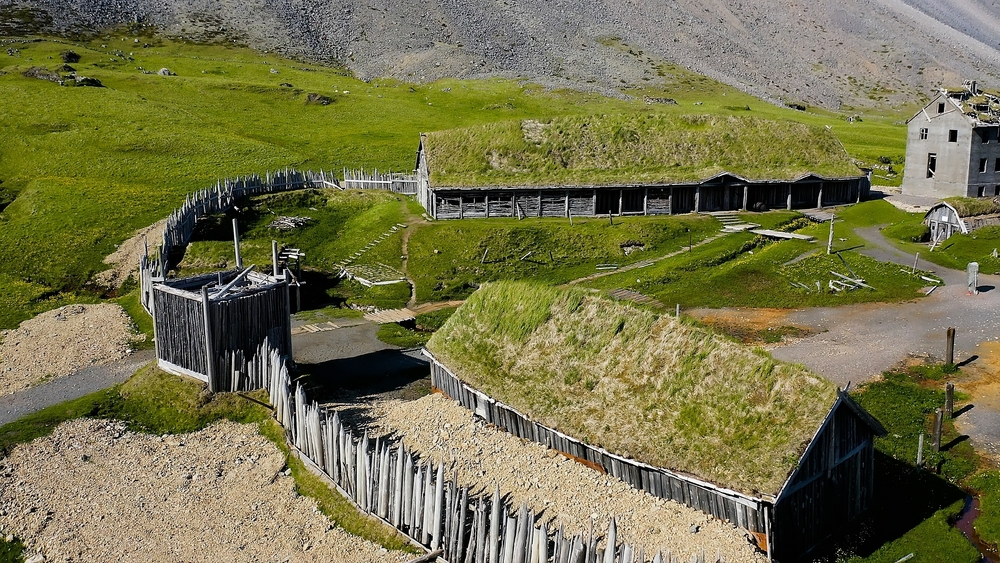
Greenland’s sparse tundra offered little more than stunted willow and birch—fine for kindling but useless for building sturdy longhouses, seaworthy boats, or the carved roof beams that signaled status in Norse society. As farmsteads multiplied after AD 985, local trees vanished quickly, and driftwood became a precious commodity doled out by the tides. Shortages grew so acute that craftsmen sometimes split whalebone into roofing slats.
Against this backdrop, timber-rich North America became a lifeline. The study shows that Greenland colonists first tapped European sources, importing oak, beech, and Scots pine aboard merchant vessels that sailed the familiar route via Iceland. Yet by the 1200s they were looking west. Hemlock and jack pine from the Canadian coast solved two problems at once: they provided long, straight boards ideal for ship repairs and helped elites signal their reach in a world where prestige hinged on goods from afar.
The logistical feat was considerable. A single cargo run to Newfoundland required mastering fickle North Atlantic winds, navigating sea ice, and timing the voyage so that crews could fell trees, season planks, and return before winter sealed Greenland’s fjords. Archaeologist Lísabet Guðmundsdóttir notes that such journeys “speak to an organized supply chain rather than isolated exploration,” implying regular contact between Greenland’s settlements and North American forests for at least a century. The wood, in other words, carried not just warmth but evidence of an enduring trans-Atlantic economy
From Norway to Newfoundland
The best-known Viking base in the Americas lies at L’Anse aux Meadows on the northern tip of Newfoundland. Excavations have uncovered long-houses, an iron smithy, and discarded ship-repair nails, showing that the outpost functioned as a workshop hub rather than a fleeting campsite. Artifacts such as butternut shells—native to forests hundreds of kilometers south—prove that crews traveled deeper into the continent to gather supplies before returning to Greenland.
Tree-ring analysis of timber from the settlement has pinpointed felling dates to AD 1021, anchoring Norse presence in North America at least 471 years before Columbus embarked from Spain. The Cambridge timber study adds context by demonstrating that contact continued for generations after that initial landfall, with wood from eastern Canada later turning up in Greenland’s elite manors. Together, the two lines of evidence sketch a supply chain that linked three coasts: Norway, Greenland, and North America.
Scholars note that the voyages were pragmatic. Greenland’s dwindling forests meant builders needed fresh planks for barns, boats, and churches, while Newfoundland offered towering pine and hemlock ready for the axe. The return cargoes of seasoned lumber likely passed through L’Anse aux Meadows for trimming and iron-nailing before the hard sail back across the Labrador Sea. The site, now a UNESCO World Heritage landmark, therefore acts as a tangible ledger of Viking engineering and their quiet mastery of trans-Atlantic logistics.
Microscope Clues and Carbon Clocks
The Greenland fragments were too small for DNA testing, so researchers relied on classic timber forensics. They sliced wafer-thin sections, stained them, and viewed the cell walls under a light microscope. Every tree species has a signature arrangement of vessels and fibers: hemlock displays spiral-thickened tracheids, while jack pine shows paired resin canals. Those anatomical “fingerprints” matched only trees native to eastern Canada.
Next came radiocarbon dating. Tiny shavings were combusted and measured for the decay of carbon-14, providing felling dates that cluster between AD 1280 and 1350. That window coincides with Greenland’s peak population, a time when local wood shortages were most acute, strengthening the case for purposeful trade rather than driftwood flukes.
To rule out European sources, the team compared the samples against medieval lumber from Norway, Scotland, and Iceland. None shared the same microscopic traits. They then fact-checked Viking sagas describing voyages to “Markland,” thought to be modern Labrador, noting that jack pine forests grow near its coast. The convergence of anatomy, radiocarbon, and historical texts led the authors to conclude that the planks crossed the Labrador Sea on Viking decks
Carving Connections Across the Atlantic
The trail of microscopic wood fibers stretching from Canadian forests to Greenland farmsteads reframes Viking history as a story of sustained ingenuity rather than a brief stunt of bravery. By proving that Norse sailors crossed the Atlantic centuries before traditional textbooks say global exploration began, the study restores their place among the world’s most accomplished mariners and highlights how resource scarcity can spark bold solutions. Their voyages stitched three continents into a single supply chain, showing that even a rugged colony perched on the Arctic fringe could stay connected through skill, courage, and a clear grasp of what its people needed to thrive.
For today’s readers, the lesson is twofold: first, that the past is still full of surprises waiting to be teased from seemingly humble clues, and second, that global networks are not a modern invention. Nearly a millennium ago, Viking carpenters and captains showed how collaboration, trade, and knowledge sharing can bridge oceans. Their legacy invites modern societies to approach current challenges—from resource shortages to climate resilience—with the same blend of curiosity, cooperation, and audacity that once carried Nordic longships beyond the edge of every known map.
Source:
- Guðmundsdóttir, L. (2023). Timber imports to Norse Greenland: lifeline or luxury? Antiquity, 97(392), 454–471. https://doi.org/10.15184/aqy.2023.13