
Your cart is currently empty!
Why Fetterman’s Wardrobe Choice Became One of the Night’s Biggest Stories
When Pennsylvania Senator John Fetterman walked into the chamber for President Donald Trump’s State of the Union address, the reaction was immediate and widespread, and it had nothing to do with a fiery exchange or dramatic protest. It was about what he was wearing. Fetterman, long recognized for his hoodies and gym shorts even in formal government settings, arrived in a traditional suit and tie. In Washington, where presentation and symbolism often carry as much weight as policy positions, that single wardrobe change became one of the most talked-about moments of the night. Within minutes, social media posts began circulating, with users dissecting the meaning behind the outfit and speculating about what it might signal in an already tense political environment.
Contents
show
At 56, Fetterman has built much of his public persona around rejecting the polished, carefully curated image that many Americans associate with career politicians. His casual style has been both praised as authentic and criticized as disrespectful, even contributing to the Senate reinforcing formal dress expectations in the past. That history made his appearance in a suit at one of the most formal political events of the year feel significant to many observers. For some, it was a simple gesture of respect for the office and the moment. For others, it raised deeper questions about party alignment, political strategy, and whether the Pennsylvania Democrat is carving out a path increasingly independent from his colleagues.
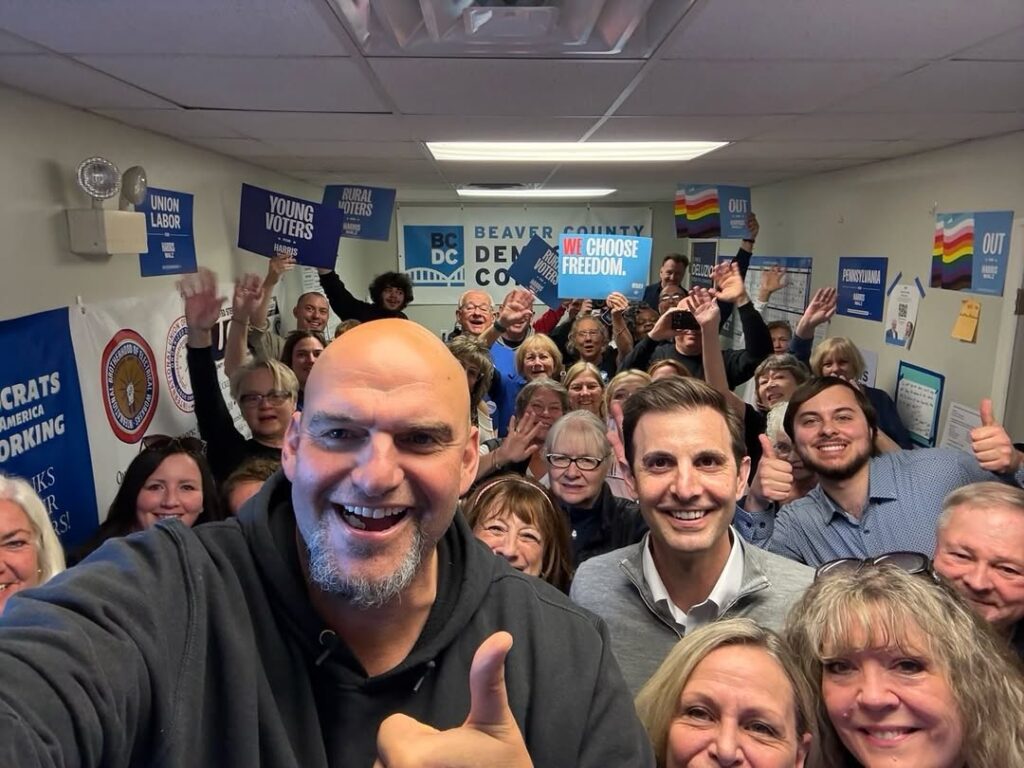
Image via johnfetterman
A Reputation Built on Rejecting Tradition
Fetterman’s unconventional style has never been accidental. From his early days in politics, he has leaned into a working-class image that distances him from the stereotype of elite Washington insiders. Hooded sweatshirts, athletic shorts, and boots became visual shorthand for his brand, signaling that he prioritized substance over ceremony. Supporters often argue that his attire reflects the everyday Pennsylvanians he represents, reinforcing the idea that leadership does not require a uniform of tailored suits and silk ties.
That approach, however, generated controversy when he joined the Senate. His refusal to conform to traditional dress norms sparked debate about decorum and professionalism, eventually contributing to the chamber passing a rule reinforcing business attire requirements. Critics said the Senate floor demanded a certain level of formality to preserve institutional respect. Supporters countered that voters elected him for his ideas, not his wardrobe. Against that backdrop, his decision to wear a suit to the State of the Union became more than just a fashion choice. It was a noticeable departure from the image he had cultivated.
Social media reactions reflected the surprise. One person posted, “Democrat Sen. John Fetterman is WEARING A SUIT for President Trump’s SOTU!” Another wrote, “Now we know this is REALLY official business!” A third added, “Once again, we can learn who rules over us by simply noticing who Fetterman will put a suit on for,” while another commented, “Fetterman wore a suit last night, and if that doesn’t show respect, I don’t know what does.” One user summed up the shock by saying, “John Fetterman, IN A SUIT, shakes Trump’s hand before his speech. WOW.” The volume and intensity of these reactions showed just how closely Americans scrutinize even the smallest visual signals from public officials.
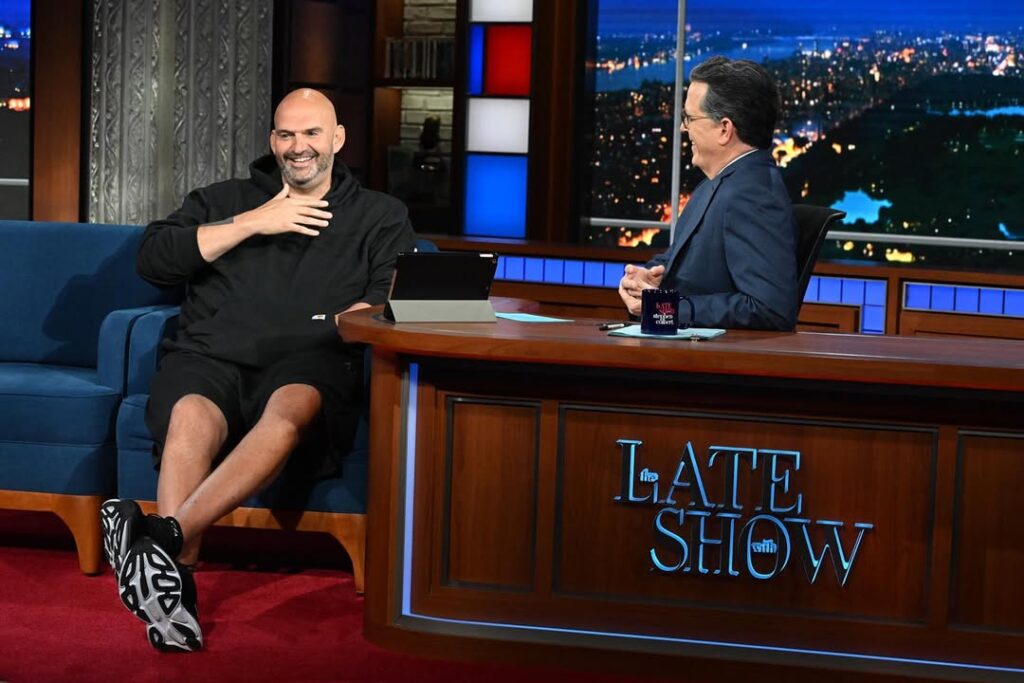
Image via johnfetterman
The Handshake That Sparked Debate
The suit was only part of the story. Fetterman was also the only Democrat who shook President Donald Trump’s hand as he entered the chamber for the address. At a time when many members of his party chose to boycott the event entirely, that handshake stood out as a moment of visible civility in a room charged with partisan tension. Images of the exchange quickly circulated online, amplifying questions about what message Fetterman intended to send.
He addressed the moment directly during a Fox News appearance the following day. “I shook his hand, of course,” Fetterman said. “He walked in, and I’m always going to do that, for sure.” His explanation was straightforward and framed the gesture as a matter of basic courtesy rather than political endorsement. For Fetterman, it appeared to be about institutional norms and personal consistency rather than a sudden ideological shift.
The broader context made his actions more striking. According to an Axios report, nearly half of Democratic lawmakers boycotted the speech. Others who attended did so while wearing protest pins referencing immigration enforcement policies or the slow release of Jeffrey Epstein files. Texas Democratic Rep. Al Green was removed from the address after holding up a sign that read, “BLACK PEOPLE AREN’T APES!,” referencing a controversial video posted on Trump’s Truth Social platform account. Democratic Rep. Ilhan Omar shouted, “You should be ashamed!,” when Trump criticized Democrats, and Rep. Rashida Tlaib called him a “liar.” In contrast to those acts of protest, Fetterman’s handshake and formal attire projected a different kind of message, one centered on participation rather than confrontation.
Here’s Senator John Fetterman, looking pretty dapper in his suit, as he prepares to enter the Senate chamber.
— The Shallow State (@OurShallowState) September 28, 2023
Fox News now has to scramble to replace several prime-time segments. pic.twitter.com/CDlV1MW99Q
A Growing Divide Within the Party
Fetterman’s actions during the State of the Union did not occur in isolation. In recent months, he has increasingly frustrated some members of his party by taking positions that align more closely with Republicans on certain issues. He recently sided with Republicans on Israel and criticized Democrats over what he described as “Betrayal.” His willingness to publicly challenge his own party has complicated his standing within progressive circles that once viewed him as a reliable ally.
After the address, Fetterman described Democrats as “disappointing” for choosing not to attend Trump’s speech. That comment reinforced a pattern of outspoken critique that has defined his recent public appearances. Rather than quietly disagreeing behind closed doors, he has opted to voice his concerns openly, even when doing so invites backlash from fellow Democrats. For some voters, that independence is refreshing and signals a commitment to personal conviction over party discipline.
However, others argue that such gestures risk undermining party unity at a time when many Democrats believe strong, coordinated resistance is necessary. The divide highlights a broader strategic debate within the party about how to respond to Trump’s rhetoric and policy agenda. Should opposition be loud and visible, or should it take the form of engagement and negotiation inside the chamber? Fetterman’s approach suggests he believes that participation in institutional rituals does not equate to surrendering ideological differences.
Senator Fetterman never wore a suit his whole life.
— Parody Jeff (@BackupJeffx) February 13, 2026
But for Netanyahu’s Congress visit, he suited up impeccably.
𝗪𝗵𝘆 𝗮𝗹𝗹 𝗼𝗳 𝘁𝗵𝗶𝘀 𝗼𝗻𝗹𝘆 𝗳𝗼𝗿 𝗜𝘀𝗿𝗮𝗲𝗹 ? pic.twitter.com/sIuPxx81vS
Symbolism in Modern Politics
In today’s political environment, symbolism travels quickly and often overshadows policy details. A single photograph can frame a narrative before speeches are even analyzed. The State of the Union, with its carefully choreographed setting and national audience, amplifies every gesture. Lawmakers understand that what they wear, where they sit, and how they react can become defining images of the evening.
Throughout American political history, clothing and coordinated visuals have been used to communicate solidarity or dissent. Lawmakers have worn specific colors to highlight causes, donned pins to protest policies, and staged walkouts to signal opposition. Fetterman’s suit entered that long tradition of visual messaging, though in a way that surprised many observers precisely because it ran counter to his established persona.
For supporters, the suit symbolized respect for the office and recognition of the event’s gravity. For critics, it raised questions about whether he was softening his stance or seeking broader appeal. The fact that such a basic wardrobe choice generated nationwide discussion illustrates how little room exists for neutral interpretation in a polarized era. Every action is filtered through partisan expectations, and deviation from those expectations often sparks intense reaction.
What This Means Going Forward
Fetterman has built his political identity on bluntness and a willingness to defy categorization. He has criticized opponents and allies alike, and he has shown little hesitation in challenging party orthodoxy. The State of the Union appearance reinforced that pattern by demonstrating that he is comfortable standing apart from his colleagues when he believes it is appropriate.
Whether the suit signals a long term repositioning or simply reflects the formal nature of the event remains uncertain. It is possible that Fetterman viewed the State of the Union as an occasion deserving traditional attire regardless of who occupied the presidency. It is also possible that he recognizes the political value of projecting institutional respect at a time when many voters express fatigue with constant partisan conflict.
What is undeniable is that the moment sparked a broader conversation about civility, protest, and strategy in American politics. In a chamber where some lawmakers chose absence and others chose vocal resistance, Fetterman chose attendance, a suit, and a handshake. That choice has now become part of his evolving political story, one that continues to challenge assumptions about party loyalty and public presentation.
A Suit, A Signal, A Statemt
At first glance, the story appeared simple. A senator known for hoodies wore a suit. But the reaction revealed something deeper about the state of American politics and the expectations placed on public figures. Fetterman’s decision touched on questions of respect, identity, and how elected officials should navigate moments of sharp division.
Some Americans will interpret his actions as pragmatic and respectful. Others will see them as unnecessary or even troubling. Yet the debate itself underscores the power of symbolism in shaping public perception. In modern politics, how leaders show up can resonate just as strongly as the policies they advocate. For John Fetterman, one evening in formal attire was enough to ignite a nationwide discussion about party divisions, personal conviction, and the evolving meaning of political decorum.”