
Your cart is currently empty!
Tangled Cosmic Strings From the Big Bang Could Explain Why Matter Won

Back in 1867, a renowned British physicist named Lord Kelvin proposed something peculiar. He imagined atoms as tiny knots twisted into an invisible substance called the aether. Scientists dismissed his idea within decades. Atoms, they discovered, were built from subatomic particles, not tangles in space. Kelvin’s vision seemed destined for the dustbin of scientific history. But ideas have a funny way of returning when you least expect them.
Contents
show
More than 150 years later, a team of Japanese physicists has breathed new life into Kelvin’s forgotten concept. Their research, published in Physical Review Letters, suggests that knotted structures in the fabric of reality may hold answers to one of science’s most stubborn questions. And if they’re right, we might soon have a way to test their theory by listening to the faint hum of the cosmos itself.
A Universe That Shouldn’t Exist
Consider, for a moment, a strange problem. According to our best understanding of the Big Bang, the universe should have started with perfectly equal amounts of matter and antimatter. Every particle of matter has an antimatter twin with the same mass but opposite charge. When these twins meet, they annihilate each other in a flash of pure energy.
If everything had balanced out, all matter and antimatter should have destroyed each other completely. Nothing would remain but radiation. No stars. No planets. No galaxies. No life.
Simple calculations reveal something extraordinary. Everything we observe today, from the smallest atom to the largest galaxy cluster, exists because of an almost imperceptible imbalance. For every billion matter-antimatter pairs in the early universe, just one extra particle of matter survived. One in a billion. A rounding error in cosmic terms, but that tiny surplus made all the difference.
Standard physics cannot explain where that extra matter came from. Predictions fall short by enormous margins. Scientists call the problem baryogenesis, and it has puzzled researchers for decades.
Muneto Nitta, a professor at Hiroshima University’s International Institute for Sustainability with Knotted Chiral Meta Matter, sees this puzzle as nothing less than existential. “This study addresses one of the most fundamental mysteries in physics: why our Universe is made of matter and not antimatter,” Nitta said. “This question is important because it touches directly on why stars, galaxies, and we ourselves exist at all.”
An Unexpected Discovery
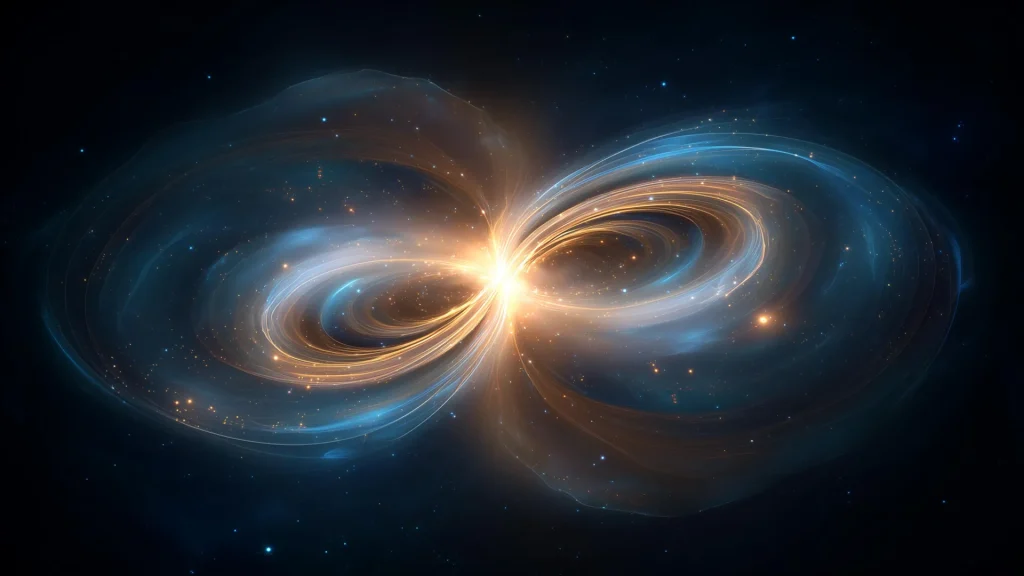
Nitta worked with Minoru Eto of Hiroshima University and Yu Hamada of the Deutsches Elektronen-Synchrotron in Germany. All three researchers are also affiliated with Keio University in Japan. Together, they stumbled onto something nobody had noticed before.
Their approach combined two extensions of standard physics that scientists have studied for decades, but always separately. One is called Peccei-Quinn symmetry. It solves a puzzle about why neutrons don’t behave the way theory predicts, and it introduces a hypothetical particle called the axion that many believe could be dark matter. Another is the B-L symmetry, short for Baryon Number Minus Lepton Number. It explains why neutrinos, those ghostly particles that pass through entire planets without noticing, have any mass at all.
Nobody had examined what happens when you put these two symmetries together in the same model.
“Nobody had studied these two symmetries at the same time,” Nitta said. “That was kind of lucky for us. Putting them together revealed a stable knot.”
What emerged from their calculations was a type of structure physicists call a knot soliton. Imagine two different kinds of cosmic strings, thin defects in spacetime itself, winding around each other and locking into place. One type carries magnetic flux while the other behaves like a superfluid vortex. Their differences, oddly enough, make them compatible. Together they form something stable, something that resists unraveling.
Cracks in the Fabric of Space
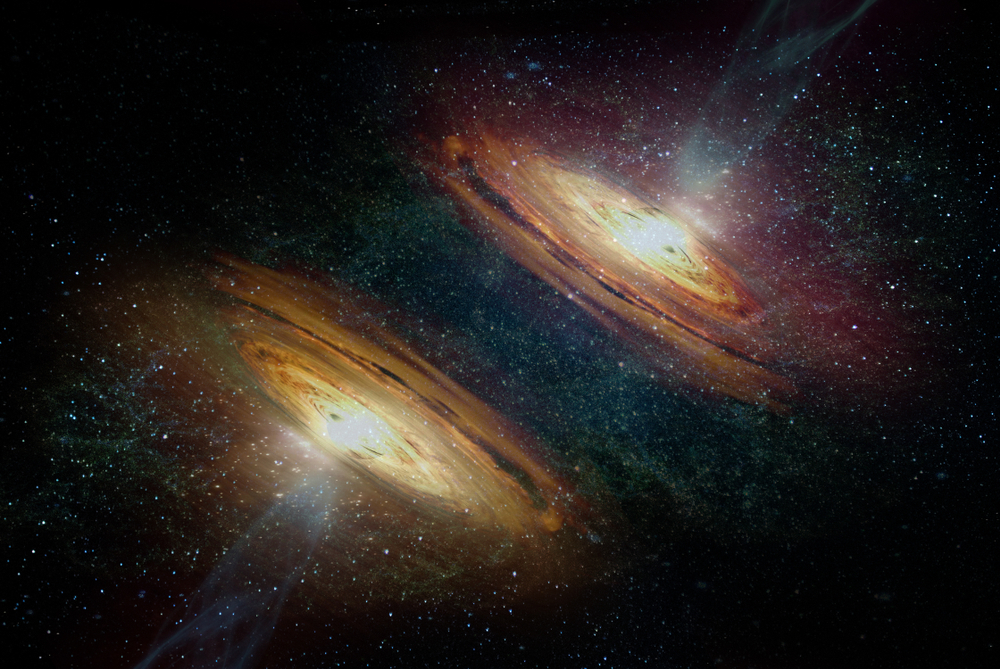
To understand how these knots could have formed, we need to travel back to the earliest moments after the Big Bang.
As the newborn universe expanded and cooled, it went through a series of dramatic transitions. Picture water freezing into ice, but not smoothly. Imperfections appear. Cracks form. In the cosmic case, these imperfections took the form of thread-like defects called cosmic strings.
Many cosmologists believe such strings may still exist somewhere out there. Despite being thinner than a proton, just an inch of cosmic string would weigh as much as a mountain. As the universe grew, networks of these strings would have stretched, twisted, and tangled, preserving information about conditions in the earliest moments of existence.
When the B-L symmetry broke, it produced strings that acted like magnetic flux tubes. When the Peccei-Quinn symmetry broke, it created superfluid vortices carrying no magnetic flux. Because these two types of defects differ so much, they can fit together in a specific way. One provides a structure for the other to latch onto. Charge gets pumped from one into the other, opposing the natural tension that would normally cause loops to shrink and snap. What remains is a locked configuration. A cosmic knot.
When Knots Ruled Everything
Radiation in the expanding universe gradually lost energy as its wavelengths stretched with the growth of space. But knots behaved more like ordinary matter. Their energy density decreased far more slowly. As expansion continued, knots began to overtake radiation. Their stored energy started to dominate the evolution of the cosmos.
For a brief window in cosmic history, knots ruled everything. Scientists call it the knot-dominated era.
But nothing lasts forever. Eventually, the knots began to collapse through a process called quantum tunneling. In classical physics, particles cannot cross certain energy barriers. But quantum mechanics allows for something almost magical. Particles can slip through barriers as if passing through walls, appearing on the other side without ever technically crossing.
When knots collapsed, they released their stored energy in a shower of particles. Among these were heavy right-handed neutrinos, a direct consequence of the B-L symmetry woven into the knots’ structure. These massive, elusive particles then decayed into lighter, more stable forms. And here is the crucial detail. That decay process favored matter over antimatter. Just slightly. Just enough.
Yu Hamada described the implications in vivid terms. “In this sense, they are the parents of all matter in the universe today, including our own bodies, while the knots can be thought of as our grandparents.”
Numbers That Add Up
When the researchers traced through the mathematics encoded in their model, something remarkable happened. They calculated how efficiently knots would produce right-handed neutrinos, how heavy those neutrinos would be, and how hot the universe would become when they decayed. From these calculations, the matter-antimatter imbalance we observe today emerged naturally.
Assuming a realistic mass of about 10¹² giga-electronvolts for the heavy right-handed neutrinos, and assuming knots transferred most of their stored energy into creating these particles, the model predicted a reheating temperature of roughly 100 GeV.
Why does that number matter? Because 100 GeV happens to mark the universe’s final opportunity for generating matter from a neutrino imbalance. Below that temperature, the electroweak processes that convert neutrino asymmetry into an excess of matter would shut down permanently. Any colder and the window closes forever. The model, in other words, lands precisely where it needs to land.
Listening to the Early Universe
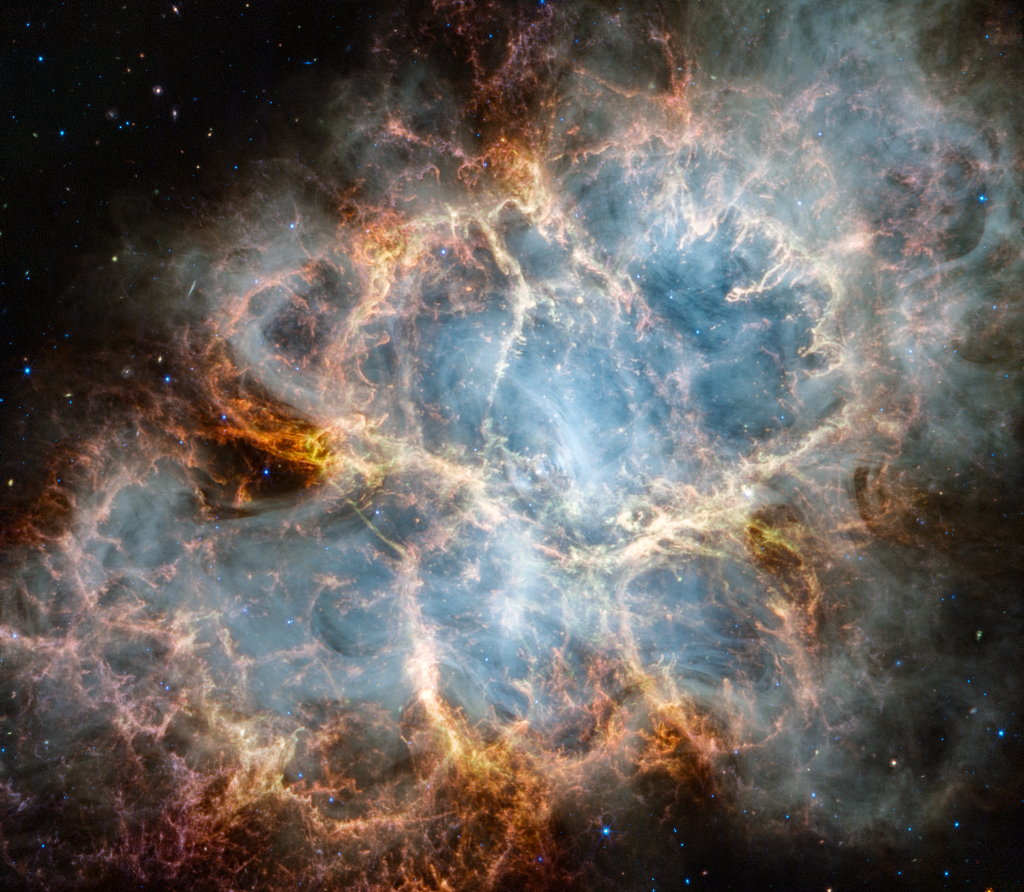
Perhaps most exciting is the possibility of testing this theory. Reheating the universe to 100 GeV would have affected the cosmic background of gravitational waves, shifting its frequency pattern in a specific way. Future observatories may be able to detect that subtle signature.
Several ambitious projects are already in development. LISA, the Laser Interferometer Space Antenna, will launch from Europe. Cosmic Explorer is planned for the United States. DECIGO, the Deci-hertz Interferometer Gravitational-wave Observatory, will come from Japan. Each of these instruments could one day pick up the faint echo of a knot-dominated era, if such an era ever existed.
Minoru Eto pointed out that their results rest on solid mathematical foundations. Cosmic strings are topological solitons, objects defined by quantities that remain the same no matter how much you twist or stretch them. That stability means the conclusions don’t depend heavily on specific model details. Even though the work remains theoretical, the underlying mathematics won’t change.
A Fuller Story of How Everything Began
Lord Kelvin originally imagined knots as the basic building blocks of matter itself. His specific proposal turned out to be wrong. But the spirit of his idea may yet prove valuable.
The researchers believe their findings provide, for the first time, a realistic particle physics model where knots play a key role in the origin of matter. If future gravitational wave observations confirm the predicted signature, we would have evidence that the universe really did pass through a phase when tangled structures briefly dominated everything.
Much work remains. Theoretical models and simulations need refinement. Predictions must connect more precisely with observational signals. But the path forward is clearer than it has ever been.
Somewhere in the faint hum of spacetime, answers may be waiting. We just need to learn how to listen.