
Your cart is currently empty!
Water, Power, and Backlash: The Hidden Cost of America’s AI Ambitions
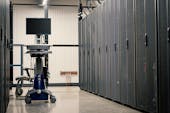
Beverly Morris thought she had found paradise. In 2016, she retired to a quiet stretch of rural Georgia, surrounded by trees and far from city noise. Her home in Mansfield offered everything she wanted for her golden years.
Contents
show
Nine years later, paradise looks different. A massive windowless building now sits 400 yards from her front porch, humming with servers and blinking lights. Morris can no longer use her water without fear. She hauls buckets to flush her toilet. And she is far from alone in her frustration.
Across America, communities are waking up to an uncomfortable reality about artificial intelligence. Behind every ChatGPT query, every AI-generated image, every cloud storage request sits a physical building that drinks water, devours electricity, and transforms quiet neighborhoods. A sharp backlash has begun, with billions of dollars in projects now delayed or blocked. Georgia has become ground zero in a fight that could reshape how America builds its digital future.
One Woman’s Water Crisis

Morris believes the construction of Meta’s data center disrupted her private well, causing sediment to build up and contaminate her supply. She had to fix the plumbing in her kitchen to restore water pressure, but what flows from her tap still carries residue.
“I’m afraid to drink the water, but I still cook with it, and brush my teeth with it,” Morris told the BBC.
Meta disputes any connection between its facility and her water problems. A company spokesperson said that being a good neighbor remains a priority, and an independent groundwater study found that data center operations did not affect local groundwater conditions. Morris remains unconvinced. Her dream home, she says, is no longer perfect.
Her story reflects a pattern emerging in communities nationwide. As tech giants race to build AI infrastructure, residents living nearby bear costs that never appear on corporate balance sheets.
A Building Boom Unlike Any Before
Cloud computing requires physical space. More than 10,000 data centers now operate worldwide, with most located in America. Between 2018 and 2021, facilities in the U.S. doubled in number. Fueled by AI investment, that figure doubled again by 2024.
Scale has grown alongside quantity. Meta’s planned Hyperion facility in Louisiana will draw more than twice the power of New Orleans. Another Meta project in Wyoming will consume more electricity than every home in the state combined. Atlanta led the nation in data center construction last year, turning Georgia into a magnet for developers seeking cheap power and generous tax breaks.
AI workloads represent the fastest-expanding segment of data center activity. Unlike traditional cloud storage or web searches, artificial intelligence tools trained on large language models require exponentially more computing power. A single five-second AI-generated video uses about as much electricity as running a microwave for over an hour.
Millions of Gallons, Evaporated
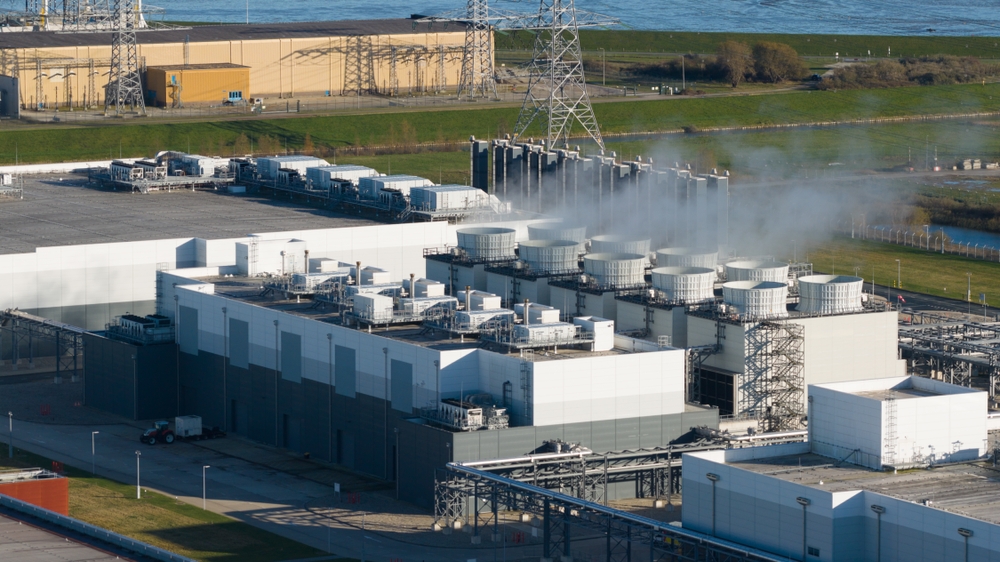
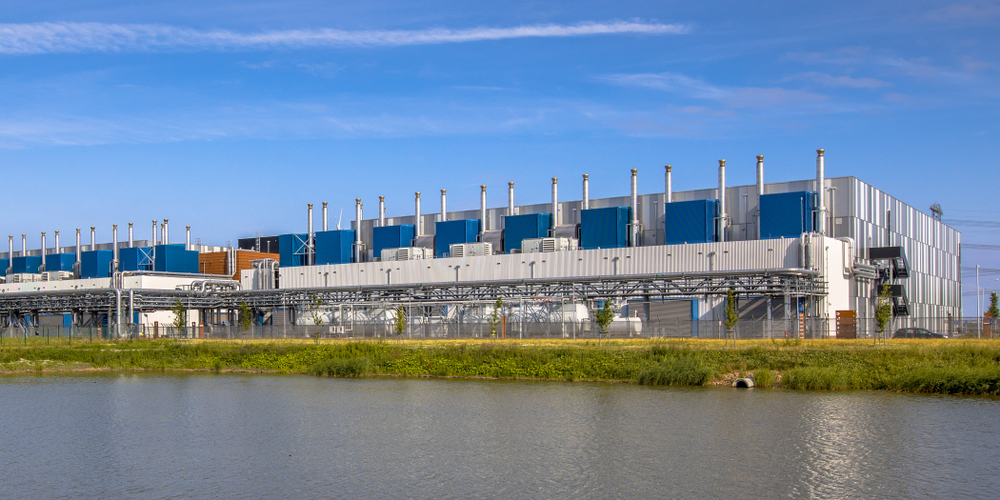
Servers generate intense heat. Without cooling, chips overheat and fail. Many facilities use evaporative cooling systems, where water absorbs heat and evaporates into the atmosphere.
A mid-sized data center consumes as much water as a small town. Larger facilities can require up to 5 million gallons daily, matching the needs of a city with 50,000 residents. Global AI demand could account for 4.2 to 6.6 billion cubic meters of water withdrawal by 2027, exceeding the annual water withdrawal of four to six times that of Denmark.
Researchers at UC Riverside estimate that GPT-3 needs to drink a 500ml bottle of water for roughly 10 to 50 responses, depending on location and weather conditions. Estimates vary, with OpenAI CEO Sam Altman suggesting consumption could be as low as one-fifteenth of a teaspoon per query. What remains clear is that water disappears at scale, drawn from local sources that serve farms, homes, and ecosystems.
In Newton County, Georgia, one Meta data center uses 500,000 gallons daily, representing 10 percent of the entire county’s water consumption. New permit requests would use up to 6 million gallons per day, more than doubling what the county currently consumes.
Water problems extend beyond cooling. Power plants that supply data centers also use significant amounts of water to generate electricity. When researchers account for both on-site and off-site consumption, the true water cost of artificial intelligence grows far larger than most companies report.
Pollution Fears and Cloudy Creek Water

Gordon Rogers runs Flint Riverkeeper, a nonprofit that monitors the health of Georgia’s Flint River. He took BBC reporters to a creek downhill from a construction site for a new data center. A volunteer scooped water into a clear plastic bag. It came out cloudy and brown.
Activists point to sediment runoff and flocculants, chemicals used in construction to bind soil and prevent erosion. If those chemicals escape into water systems, they can create sludge that harms aquatic life and downstream users.
“A larger wealthier property owner does not have more property rights than a smaller, less wealthy property owner,” Rogers said.
QTS, the company building the facility, says its data centers meet high environmental standards and bring millions in local tax revenue. Yet construction work often falls to third-party contractors, leaving residents to deal with consequences that companies never see.
Local Governments Hit the Brakes
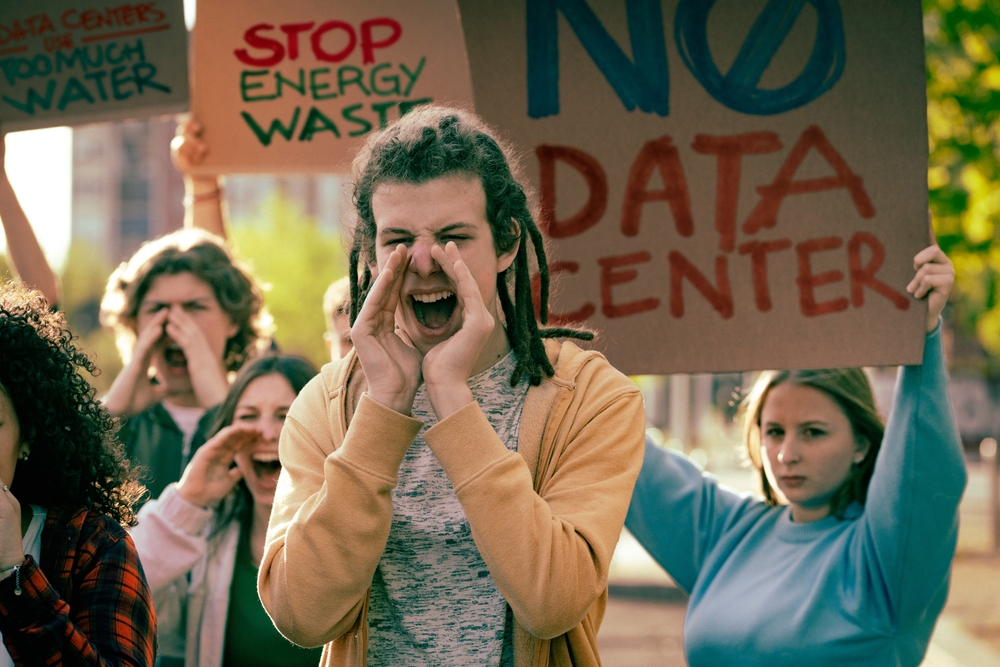
Frustration has translated into political action. At least 10 Georgia municipalities have passed moratoriums on data center construction, with Atlanta suburb Roswell joining the list earlier this month. Municipalities in 14 states have enacted similar freezes. Pressure group Data Center Watch reports $64 billion in projects delayed or blocked nationwide. Bernie Sanders proposed a national moratorium last month.
State representative Ruwa Romman introduced HB 1012, proposing what could become America’s first statewide data center moratorium. Her bill would halt new projects until March 2027, giving state, county, and municipal officials time to develop regulations. Republican state representative Jordan Ridley co-sponsored the measure, saying local governments need time to create zoning codes with public input.
Maryland and Oklahoma lawmakers are considering similar measures. What started as scattered local resistance has grown into a coordinated movement spanning party lines.
Electric Bills and Voter Anger
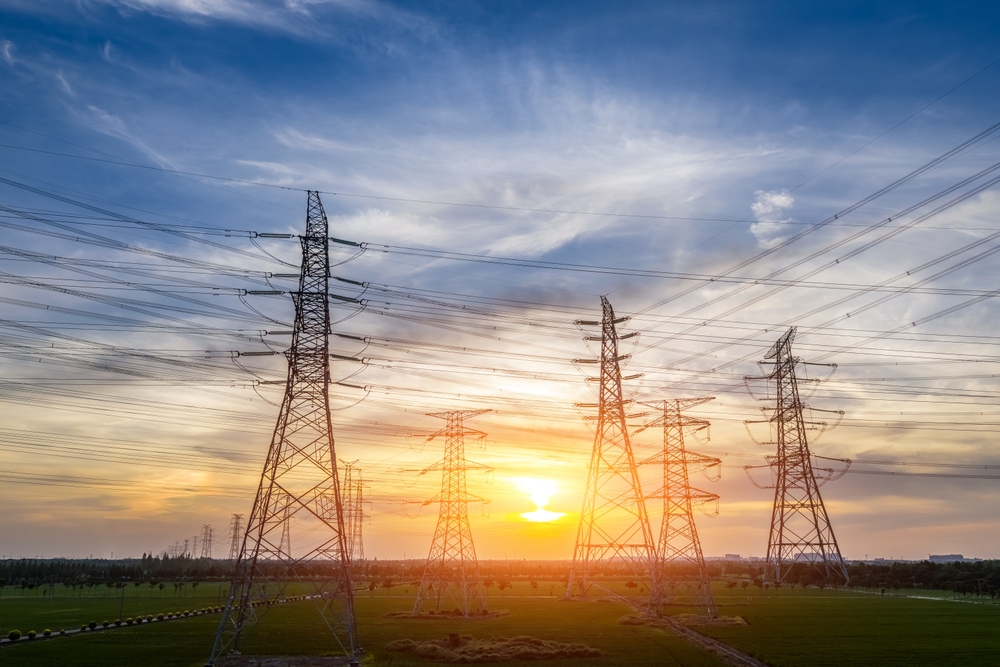
Georgia Power just won approval for 10 additional gigawatts of energy capacity, the largest amount ever sought in a multi-year plan before the state’s Public Service Commission. Data center demand drove that request, and fossil fuels will supply most of the new power.
Georgia’s electricity rates have risen by a third in recent years. Charles Hua of PowerLines explains that Georgia Power profits from new capital investments, creating an incentive to build rather than improve efficiency. Ratepayers across the service area shoulder infrastructure costs while tax revenues benefit only host communities.
Public Service Commission member Peter Hubbard captured the mood in a recent editorial. Georgians “see data centers receiving tax breaks as their power bills go up,” he wrote. Voters elected progressive Democrats to two of five commission seats in November, breaking the agency’s all-Republican makeup for the first time in nearly two decades. Another seat faces a vote this November.
Romman, who is also running for governor, framed her moratorium as giving Georgians time to vote on the commission members who approve energy projects. If Democrats gain a majority, the commission may no longer rubber-stamp every request from Georgia Power.
Northern Virginia Offers a Glimpse of the Future
Roughly two-thirds of global internet traffic passes through Northern Virginia. About 300 facilities operate in just a handful of counties, with dozens more planned or under construction. Loudon County expects to collect nearly $900 million in data center taxes this fiscal year, approaching its entire operating budget.
Yet the economic picture carries complications. Construction jobs are temporary. Operational employment remains slim. Julie Bolthouse of the Piedmont Environmental Council recalls when AOL’s campus in the region employed 5,300 people, with pedestrian trails, tennis courts, and basketball courts. New data centers on that demolished site will employ about 100 to 150 people behind security fences.
Thousands of diesel backup generators create air quality issues, spewing particulate matter and nitrogen oxides that can worsen asthma and heart disease. While classified as emergency backup power, these generators can run for up to 50 hours at a time during demand response periods.
Tech Giants Promise Change
Amazon Web Services says it aims to return more water to watersheds than it withdraws by 2030. Will Hewes of AWS says the company invests in leak repairs, rainwater harvesting, and treated wastewater for cooling. Google and Microsoft have committed to becoming water positive by 2030.
Some companies are securing independent clean power. Microsoft signed a 20-year agreement to purchase energy from the Three Mile Island nuclear plant. Yet even facilities using recycled water remove that water from downstream flows, affecting supply for other users.
Alternatives exist. Closed-loop water systems use less water but require more electricity. Immersion cooling, where servers sit in synthetic oil baths, reduces water needs but remains expensive and rare. Researchers note that running AI workloads during cooler hours or in water-efficient regions could cut consumption without new technology.
Difficult Trade-Offs Ahead
Communities face impossible choices. Powering Texas data centers with natural gas would require 50 times more water than solar generation and 1,000 times more than wind. Yet wind power uses the least water while requiring four times as much land as solar and 42 times as much as natural gas.
Louisiana regulators approved three new gas plants to meet demand from Meta’s Hyperion facility. Tax revenues will benefit host communities while infrastructure costs and air pollution spread across entire regions.
Piedmont Environmental Council pushes for greater transparency, noting that companies often arrive with non-disclosure agreements that hide water, energy, and emissions data. Without that information, communities cannot make informed decisions about what they are trading away.
No Turning Back
Professor Rajiv Garg of Emory University studies cloud computing. He sees data centers as permanent fixtures of modern life.
“There’s no turning back,” Garg told the BBC.
President Donald Trump has vowed to build the largest AI infrastructure project in history. Georgia’s humid climate and cheap power continue to attract developers. Researchers project U.S. data center water consumption could double or quadruple by 2028, reaching 150 to 280 billion liters annually.
For residents like Beverly Morris, the future of tech has already arrived. Her quiet retirement home now sits in the shadow of American ambition, and the water from her tap carries the sediment of progress she never asked for.
Smarter infrastructure, rainwater harvesting, and long-term planning could reduce the strain. But that requires communities to factor in true costs before opening their doors. As one water advocate put it, data centers are like vampires. They can only enter if invited inside.