
Your cart is currently empty!
Nowhere to Go: How Trump’s New Housing Rule Could Evict Thousands of American Children

Somewhere in Los Angeles, a woman who has lived in the United States for nearly three decades is having conversations with her teenage children that no parent should have to have. Where would they go if they had to leave? Would family members abroad have room for them? Would her children, who grew up in America and know little else, be able to adapt?
Contents
show
She is not alone. Across the country, in cities like New York, Chicago, and Houston, families with mixed immigration status are watching a federal proposal move through Washington that could determine whether they keep a roof over their heads. For many of them, that roof sits above subsidized housing they have lived in legally for years, sometimes decades.
On Thursday, the Department of Housing and Urban Development released a proposed rule that would reshape who qualifies for federally assisted housing in America. At its center is a question that has divided policymakers, advocates, and communities for years, and one that now carries far more urgency than it did the last time Washington tried to answer it.
What HUD Just Proposed
Federal housing assistance has long operated under a system that accommodates families where some members are eligible for aid, and others are not. Under current HUD regulations, these mixed-status families receive what is known as prorated assistance, calculated according to the proportion of family members who qualify. An undocumented parent living with three U.S.-born children, for example, would see the household’s subsidy reflect the children’s eligibility while the parent receives nothing.
HUD’s proposed rule would end that arrangement as a long-term option. Prorated assistance would become a 30-day temporary buffer, meant to cover families whose immigration status is still being verified. Once that window closes, any family with an ineligible member would face removal from the program entirely.
Beyond that, the rule would require housing authorities to report any tenant found ineligible for rental aid to U.S. Citizenship and Immigration Services. Starting Friday, the proposal will be open for public comment for 60 days. HUD must consider those comments before issuing a final version of the rule, and that process, as history shows, is rarely a formality.
Turner Makes His Case
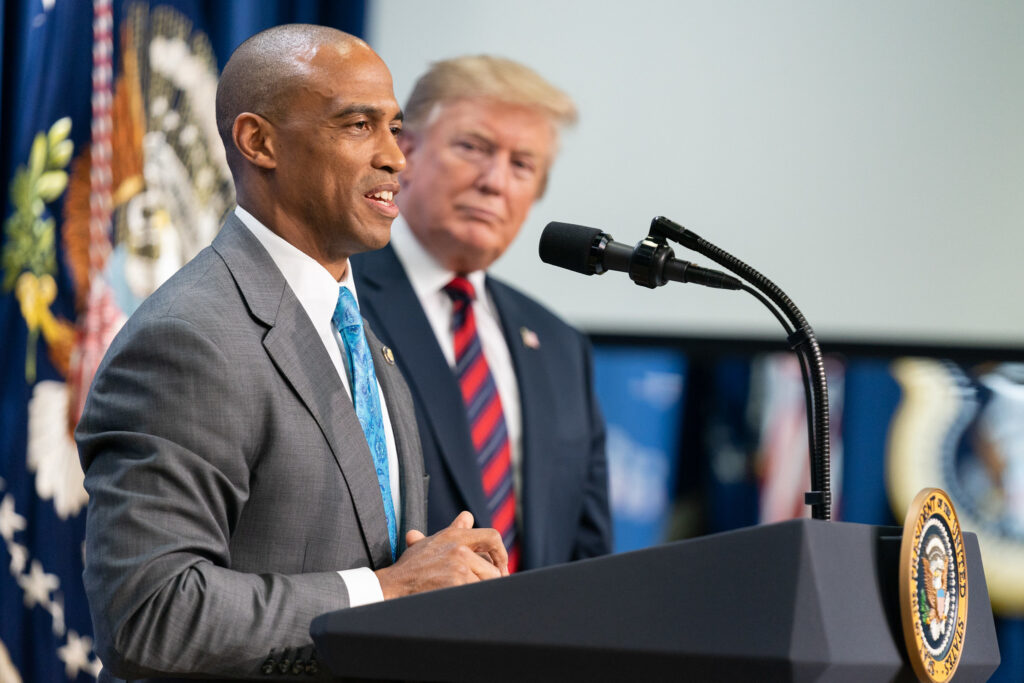
HUD Secretary Scott Turner has not been shy about where he stands. In a Washington Post opinion piece published Wednesday, he called for ending what he described as the exploitation of public housing resources by those who have no legal right to them. He put a number on the problem as he sees it, estimating that around 24,000 individuals currently receive support through the existing mixed-status provisions, and that the proposed rule could redirect $218 million in federal spending away from ineligible residents.
“Under President Trump’s leadership, the days of illegal aliens, ineligibles, and fraudsters gaming the system and riding the coattails of American taxpayers are over,” Turner said in a statement accompanying the announcement. “We have zero tolerance for pushing aside hardworking U.S. citizens while enabling others to exploit decades-old loopholes.”
Turner and other administration officials argue that federal rental assistance was designed for Americans in need, not for households where at least one member entered or remained in the country without legal authorization. For them, the rule is a matter of fairness. Waitlists for HUD housing stretch years in many cities, and only about one in four Americans who qualify for federal rental assistance actually receive it. Against that backdrop, they argue, prioritizing eligible applicants is not only reasonable but overdue.
HUD’s press release announcing the proposal carried a headline that left little room for interpretation, reading “Illegals, Ineligibles and Fraudsters, Pack Your Bags,” complete with emoji. It was a tone that signaled the administration’s intent to treat this not as a technical regulatory adjustment but as a public message.
The Families Behind the Numbers

Step back from the policy language, and what emerges is a portrait of families who built their lives inside a system that, until now, allowed them to stay.
If the rule becomes law, nearly 80,000 people could face eviction, according to a recent analysis by the Center on Budget and Policy Priorities. Among them, nearly 37,000 are U.S. citizen children, born on American soil, holding passports that their parents do not.
One woman who lives in public housing in Los Angeles agreed to speak with NPR on condition that her name not be used. She and her husband came from Mexico close to 30 years ago. She cleans houses. Her husband works as a butcher. One of their sons came with them as a young child and has lived under the protections of the Deferred Action for Childhood Arrivals program, though that program has faced mounting pressure from the current administration.
Her younger children are still teenagers. Asked what would happen to them if the family had to leave, she did not hesitate. “They might not have a place to call home and to come back to,” she said.
A second Los Angeles resident, also anonymous, described a household held together under significant strain. Her husband is Guatemalan, all four of their children were born in the U.S., and two of those children have health conditions that limit her ability to work full-time. Her husband works as a day laborer, a job that has grown less reliable since Immigration and Customs Enforcement expanded its operations in Los Angeles. They applied for rental assistance after the bathroom ceiling in their previous apartment caved in.
Asked about the possibility of losing their subsidized home, she put it plainly. “The government doesn’t want people living on the streets, but we won’t have any other option.”
A Conservative Argument With a Caveat

Among conservatives and right-leaning policy groups, the proposed rule has drawn broad support, though not without some reservations about how it would work in practice.
Project 2025, the Heritage Foundation’s policy blueprint, called for exactly this kind of change, arguing that HUD’s primary obligation runs to American citizens in need. Howard Husock of the American Enterprise Institute supported the principle in a New York Post column last year, writing that changing policy for potential new tenants made sense on fairness grounds and would reduce any financial incentive for illegal immigration.
However, Husock drew a line at evicting people already living in subsidized housing under legal leases. Removing families who entered into agreements with public agencies in good faith, he argued, was neither practical nor wise.
That tension runs through much of the conservative commentary on the rule. Supporters of stricter immigration enforcement generally back the policy’s direction, but few have fully addressed what happens to tens of thousands of U.S. citizen children if their parents are forced out.
Local housing agencies, for their part, have pushed back on the suggestion that they have been lax. La Shelle Dozier, CEO of the Council of Large Public Housing Authorities, said in a statement that housing agencies are “faithful stewards of taxpayer dollars” and are committed to serving America’s most vulnerable families. Agency officials say they have been following a longstanding, bipartisan policy, not bending rules.
What Advocates Say the Math Gets Wrong

Housing and immigration advocates have challenged the administration’s framing on both policy and economic grounds. Because undocumented family members receive no subsidy, mixed-status households pay more in rent than fully eligible families receiving the same level of assistance. Marie Claire Tran-Leung of the National Housing Law Project argues that removing these families would not free up resources. It would shrink them.
“Net result is to make more housing available for everyone, including people who are on the waiting list,” Tran-Leung told NPR. Advocates also warn that mass evictions of this scale would push thousands of families into poverty and homelessness at a moment when cities across the country are already managing record numbers of people living outside or in shelters.
Shamus Roller, the National Housing Law Project’s executive director, framed the proposal in broader terms, arguing that it misidentifies the cause of the housing crisis and would damage programs that serve the country’s most vulnerable residents, regardless of immigration status.
Beyond the immediate impact, advocates point to a more systemic concern. Requiring housing authorities to report ineligible tenants to immigration authorities would turn public housing offices into de facto enforcement arms of ICE. For advocates, that crosses a line from housing policy into immigration surveillance.
A Fight That Has Happened Before
None of this is entirely new. HUD proposed a near-identical rule during Trump’s first term, and it ran into a wall of opposition. More than 30,000 public comments were submitted, overwhelmingly against the measure. Immigrant families, housing advocates, and local officials pushed back hard, and the rule was never finalized. Before the administration could try again, the COVID-19 pandemic redirected Washington’s attention. When President Biden took office, the proposal was withdrawn. Advocates have carried the lessons from that experience into this fight.
“We defeated this unlawful proposal during the first Trump administration and we’re ready to fight back with our allies and do it again,” Roller said in a statement released Thursday.
That history matters for several reasons. It shows the 60-day comment period is not a rubber stamp. It shows that organized opposition can slow or stop a rule even when an administration is determined to see it through. And it gives advocates a legal roadmap. Tran-Leung has already noted that the volume and substance of comments from the first round could factor into any court challenge to the current proposal.
Sixty Days, and Counting

Between Thursday’s announcement and any final rule, a long road runs through public comment, agency review, and almost certain litigation. HUD is required to genuinely consider what it receives during the comment period, and with advocates already mobilizing, the volume is expected to be significant.
Large cities with high concentrations of immigrant residents, New York and Los Angeles among them, would bear the heaviest impact if the rule is enacted. Local officials in both cities have signaled resistance, and legal challenges are widely expected to follow any finalization.
For the families caught in the middle, the 60-day window is not an abstraction. It is the amount of time between now and a clearer picture of what their lives might look like. Some will file comments. Some will consult lawyers. Some will quietly pack, just in case.
And some, like the woman in Los Angeles who has cleaned houses and raised children and tried to build something permanent in the only country her kids have ever known, will keep having the hardest possible conversations with the people they love most.