
Your cart is currently empty!
How a 27-Year-Old Rewrote the Story of the Universe Section
Adam Riess helped build one of the most important scientific theories of the last century. His measurements changed how physicists understand the cosmos, earned him a Nobel Prize in Physics, and shaped the story humanity tells itself about how everything ends. Now he wants to tear that story apart.
Contents
show
At 55, Riess sits in his office at Johns Hopkins University with a graph-paper notebook on the shelf behind him. Its yellowing pages contain the pen scratches that once rewrote cosmology. But those calculations, and the grand theory they supported, may not survive what he’s found since.
Something in the data doesn’t add up. And Riess believes it points to a problem far bigger than a rounding error.
Riess began the work that would define his career at 27. By 1998, he had carefully measured the distances of far-off galaxies from Earth, tracking how quickly they were moving away. Astronomers had known for nearly a century that the universe was expanding, but Riess’s results carried a shock. Galaxies were receding faster than anyone expected.
He shared the findings with colleagues in a flustered email sent on the eve of his honeymoon. A striking pattern had emerged, one that pointed toward a profound conclusion. Something was causing the expansion of the universe to accelerate.
Theorists moved quickly to explain the observation. They proposed dark energy, a faint repulsive force that fills all of space. In small volumes, it amounts to almost nothing. But across truly cosmic distances, dark energy’s cumulative strength can drive galaxy clusters apart. As more space opens between galaxies, the repulsive force grows stronger still, speeding up the expansion.
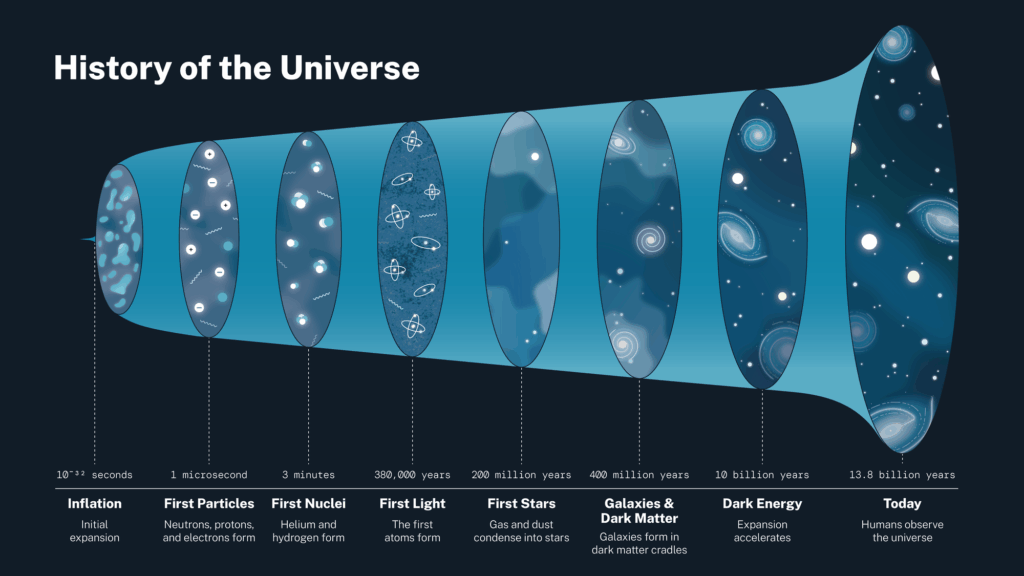
Dark energy became the final piece of what scientists now call the standard model of cosmology, a unified theory of how the universe began, how it organized itself into galaxies, and how it will end. Few people played a larger role in establishing that model than Riess.
What Dark Energy Supposedly Means for the End of Everything
If dark energy behaves the way the standard model predicts, the future is bleak. Trillions upon trillions of years from now, it will push every galaxy beyond the observable horizon. Stars will burn out. Matter and energy will dilute into a cold equilibrium, a thin, featureless void.
Physicists call it heat death. Over time, the concept escaped academic textbooks and became one of our most widely known secular stories about how the cosmos ends. It is elegant, terrifying, and, according to Riess, possibly wrong.
A Nobel Prize Changes Your Life in Strange Ways
When Riess returned from Stockholm in 2011, he noticed something had shifted. People around him started behaving differently. Some went quiet. Others picked arguments over trivial points, perhaps so they could boast of having challenged a Nobel laureate. Invitations arrived for panels, talks, science fairs, and political commentary on subjects he knew nothing about. He was even recruited to run major scientific institutions.
Riess considered it. Leading a NASA mission or running a university carried obvious appeal. But he hated fundraising, and more importantly, he felt he still had scientific contributions to make. He told me that scientists often convince themselves they can step away to lead an institution and then return to research later. But by the time they finish, the data has moved on, and the software has changed. “The science passes them by,” he said. Riess stayed on the research frontline.
96 Percent of the Universe Is Still a Mystery
Even in 2011, the standard model carried enormous gaps. According to its own math, 96 percent of the universe consists of dark energy and dark matter. No scientist had directly detected either one. Cosmologists had strong theoretical reasons to believe both exist in some form, but every attempt to observe them in the actual universe had come up empty. Something major appeared to be missing.
To make progress, theorists needed better data. And better data meant more precise measurements of the distances to galaxies from Earth, exactly the kind of work Riess had spent his career perfecting.
Two Numbers That Should Match. They Don’t.
Riess measures cosmic expansion by photographing a specific type of supernova in distant galaxies. Because these explosions always reach a known luminosity, their observed brightness reveals their distance. Dimmer means farther.
But the process is far from simple. Light from surrounding stars, from the Milky Way, and from the Sun contaminates every image. Interstellar dust blocks some of the supernova’s light. Telescope circuits introduce noise. Hundreds of thousands of camera pixels behave differently from one another and need calibration before every observation. Riess had spent years mastering these delicate corrections, and in 2011, he developed an even better technique for the Hubble Space Telescope. He said the idea came to him in a swimming pool.
As more precise data accumulated, a problem emerged. Riess’s calculation of the current expansion rate, based on galaxy distances, kept disagreeing with a second method. That second approach skips the galaxies entirely and instead looks at the afterglow of the Big Bang, extrapolating the expansion rate forward using the standard model’s assumptions.
Riess expected the gap between the two numbers to close with further observations. It did the opposite. It grew. Cosmologists gave the discrepancy a name that stuck. They called it the Hubble tension.
Something Smells Wrong With the Standard Model
Riess investigated whether the early-universe observations feeding the rival measurement might contain errors. He found none. No one else could find any either. And if both sets of observations were sound, the problem pointed to something more unsettling. Not at the data, but at the theory connecting them.
Riess told me it had the feel of a broken theory rather than a broken measurement. If the standard model were to collapse, the field of cosmology would face its most significant upheaval in decades. So would the grand story about how the universe ends. And with careers, reputations, and existential questions all hanging in the balance, the Hubble tension started generating real tension among the people who study it.
Not Everyone Is Ready to Sound the Alarm
Wendy Freedman at the University of Chicago has made her own measurements using different exploding stars. A version of the Hubble tension appears in her data too, but it’s smaller. She wants many more galaxy distances before concluding. Colin Hill at Columbia and Sean Carroll at Johns Hopkins both consider the tension real but premature grounds for discarding the standard model. David Spergel, president of the Simons Foundation and a longtime heavyweight in the field, said bluntly that it’s too early to start celebrating the standard model’s demise.
Riess grew visibly frustrated discussing the pushback. He blamed what he called the sociology of the field, accusing a group of early-universe cosmologists of dismissing conflicting data. He sent his measurements to George Efstathiou, a well-respected cosmologist who had been a vocal skeptic of the Hubble tension. Efstathiou responded positively, calling the data very convincing. But when contacted separately, he was more cautious, saying he couldn’t rule out the possibility that something in Riess’s numbers might still be wrong.
DESI Fires a Second Shot at the Standard Model
While the debate over the Hubble tension continued, new evidence arrived from an unexpected direction. In Arizona’s Sonoran Desert, a powerful observatory called the Dark Energy Spectroscopic Instrument began mapping millions of galaxies using 5,000 robotically controlled optical fibers. Each fiber locks onto a different galaxy every 20 minutes. Over five years, DESI will chart cosmic expansion across time at a scale no instrument has attempted before.
Its first data release, last year, hinted at something startling. Dark energy appeared to have been stronger in the early universe and was losing force over time. A second release, based on three years of observations, strengthened the signal. If confirmed, dark energy is fading, something the standard model says should never happen.
What It Means If Dark Energy Is Fading
In the simplest version of the standard model, dark energy’s strength remains fixed for eternity. A weakening dark energy would demand, as one cosmologist put it, a wholesale revision of the theory. Textbooks would need rewriting.
And the implications stretch far beyond physics classrooms. If dark energy fades to zero, the universe may stop expanding altogether. It could settle into a static arrangement of galaxies. Intelligent life could persist far longer than heat death would allow. If dark energy turns negative, it could reverse the expansion entirely, pulling galaxies back together into a hot, dense singularity resembling the conditions of the Big Bang. Perhaps that would mark the beginning of an entirely new cycle of creation. Or perhaps not. Either way, the deep future of the universe is suddenly wide open.
Multiple Cracks Opening Up
Riess had an advanced look at the latest DESI data before the public release. When he opened the file in his office, a smile spread across his face. He compared the standard model to a cracking egg, predicting it wouldn’t break cleanly in one place. “You would expect to see multiple cracks opening up,” he said.
Whether those cracks widen remains to be seen. New observations will arrive from DESI, from the Vera Rubin Observatory in Chile’s Atacama Desert, and from other instruments in space. For years to come, cosmologists on both sides will be refreshing their inboxes on data-release days. Riess, meanwhile, expressed frustration that theorists aren’t working harder on the puzzle. He described himself as someone providing clues and killing time while waiting for the next great theoretical mind to come along.
When last reached for comment, Riess was attending a cosmology conference in Switzerland. He sounded close to giddy. After years of comfortable consensus, disagreement had returned to the field. Arguments were sharpening. Positions were hardening. “The field is hot again,” he told me. A new universe suddenly seemed possible.
Adam Riess, astrophysics, Big Bang theory, cosmic expansion rate, cosmology debate, dark energy, dark matter, DESI observatory, future of the universe, heat death universe, Hubble Space Telescope, Hubble tension, James Webb Space Telescope, Nobel Prize physics, Space Science, standard model cosmology, universe expansion, Vera Rubin Observatory