
Your cart is currently empty!
What Birds Live In The Arctic? Birds Advice

The Arctic is a region of cold climates. It consists of the Arctic Ocean, parts of Alaska (United States), Canada, Greenland (Denmark), Iceland, Finland, Norway, Sweden, and Russia. Surprisingly, a lot of birds stay there year-round, surviving the chilliest weather.
Contents
show
So, what birds live in the arctic? Many birds live in, migrate to, and breed in the arctic regions. The list includes puffins, terns, auks, razorbills, cormorants, eiders, gannets, guillemots, loons, kittiwakes, fulmars, buntings, jaegers, ptarmigan, gulls, phalaropes, turnstones, sanderlings, and some specific falcons, eagles, hawks, and owls.
In this blog, we’re now going to highlight some of these amazing feathered friends that call this region their home. Once finished reading this, we suggest taking a quick look at the shortlist of non-migratory birds in North America.
Related Blog: 30 Birds That Live in Antarctica
Birds That Live in the Arctic
1. Atlantic Puffin
Atlantic puffins, also known as ‘see parrots’ and ‘clowns of the sea’ are one of the most popular seabirds in the Arctic region. They feature striking black-and-white plumage and colorful (often orange, yellow, and grey) beaks and feet.

Most of the time, Atlantic puffins stay on open waters. They’re often seen dive-bombing and standing with many fish hanging out of their beaks. To keep themselves warm and survive during Arctic storms, these beautiful birds have waterproof feathers.
2. Arctic Tern
As the name suggests, Arctic terns remain in the north. However, these birds migrate from the Arctic to Antarctica and vice versa, flying around 60,000 miles. During the summer months, they head to the Arctic to breed. When winter comes, they migrate back to Antarctica.
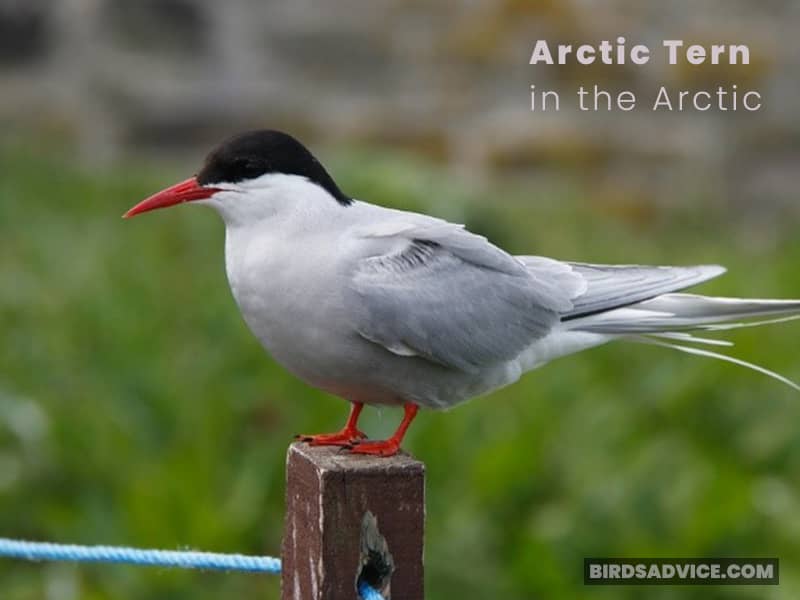
In appearance, they’re light grey with a white rump, red legs, and a forked tail. Besides, they’re also magnificent hunters, gently hovering over the sea and then plunging themselves deep into the water to catch crustaceans and fish.
3. Little Auk
Little auks, also known as flying penguins, are one of the most common birds in the Arctic region. They come with bold black-and-white plumage with 21 cm (8.27 inches) length and a wingspan of 38 cm (15.35 inches). They’re the smallest birds in the auk family.
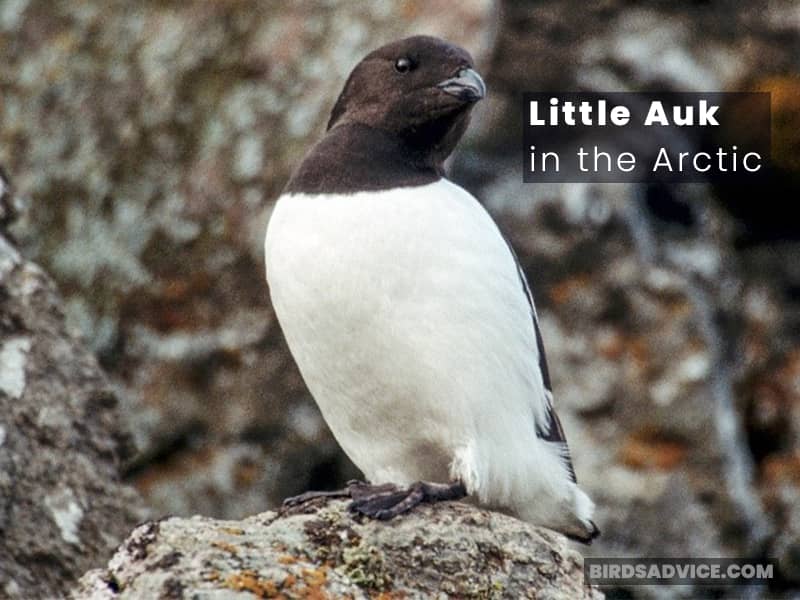
During the spring and summer months, little auks are usually available on marine cliffsides. In winter, they protect themselves from the cold by hiding between large rocks. Typically, they dive underwater to catch invertebrates and copepods.
4. Razorbill
Razorbills mainly live in the subarctic regions of the Atlantic Ocean. During the winter, they’re mostly available in northern boreal waters. Their breeding colonies are sea cliffs of Canada, Greenland, Iceland, Faeroe Island, Britain, Ireland, Sweden, Finland, and Norway.

Razorbills feature mostly black appearance with a white underside and black webbed feet. Typically, males are slightly larger than females. Most importantly, their plumage is identical. Fish, marine worms, and crustaceans are their favorites.
5. Double-crested Cormorant
Double-crested cormorants are year-round residents on the south coasts of Alaska, which belongs to the Arctic. Apart from coasts, these birds prefer almost any aquatic habitats, including bays, lakes, rivers, swamps, large reservoirs, small inland ponds, etc.

Their adults come with brown-black plumage with a slightly yellow-orange face. However, young ones are entirely brown with a bit pale on the breast and neck. During breeding seasons, adult double-crested cormorants grow white or black feathers.
6. King Eider
King Eiders usually live and nest in both dry and wet locations of arctic tundra, not far from water sources. In appearance, the adults are mostly black on the body with an orange plate above the bills. The males have red bills while the females have black ones.

These duck-like birds prefer arctic willow, bearberry, crowberry, dwarf birch, purple saxifrage, pendant grass, and various sedges. In winter, some of them migrate to warmer regions, but others remain in the same area year-round.
7. Common Eider
Common eiders, also known as St. Cuthbert’s ducks or Cuddy ducks, are one of the most common seabirds in the Arctic. Typically, they live in the arctic during their breeding seasons only. Their winter range doesn’t extend farther south from their nesting territory.

Common eiders mainly eat mollusks. Aside from that, they feed on mussels, crabs, crustaceans, aquatic insects, echinoderms, and small fish. In winter, they love to eat mollusks as well. They’re 50 to 71 cm long and can fly up to 70 mph (113 kph).
8. Northern Gannet
Northern gannets love to stay in large bays and open oceans. These large, heavy-bodied seabirds usually nest on cliffs in Atlantic Canada and Iceland. With a dagger-like bill, they’re mostly white with a yellowish head and neck.

In the arctic region, northern gannets stay in their breeding seasons. They have small airbags under their skin, which protect them in their high-impact dives. They can even float on water with the help of those airbags.
9. Black Guillemot
Black guillemots are native to eastern North American and northern Atlantic coasts. These black-and-white birds are widely distributed in low and high arctic regions. Their breeding habitats include shorelines, islands, and cliffs.

In appearance, black guillemots are mostly deep black with white patches on the wings and bright red feet. These birds mainly feed on crustaceans, fish, and other benthic invertebrates. To catch these aquatic foods, they dive towards the seafloor.
10. Common Loon
Common loons are out there in oceans and lakes surrounded by open tundra. These birds are mainly available in the Alaskan breeding range. During winter, they remain within a few miles of land. Scientists believe that common loons have been with us for twenty million years.

In winter, common loons mostly feed on bay anchovies, crabs, flounder, gulf menhaden, lobster, shrimp, and silversides. In the fall, their parents leave their babies and migrate to different coastal areas to overwinter.
11. Red-throated Loon
Red-throated loons, also known as red-throated divers, primarily breed in the arctic. These birds are medium-distance migrants, traveling along the coast a mile or so offshore in small groups. They’re usually 55 to 67 cm long.

As their name suggests, red-throated loons have vibrant red throat patches, especially visible during breeding seasons. They mainly feed on aquatic insects, crustaceans, copepods, leeches, mollusks, squid, and a variety of fish.
12. Snow Goose
Snow geese mainly breed on the sub-arctic and arctic tundra. These birds are usually available in ponds, streams, marshes, bays, and wet grasslands. When winter weather strikes, they head to the southern Mississippi, northwestern Gulf Coast, and north-central Mexico.

Typically, snow geese feed on seeds, grains, leaves, and stems on the ground. In the winter, they eat leftover grains and seeds on farmland. In order to stay warm in harsh winter, they stay in southern coastal marshes, wet grasslands, and bays.
13. Tundra Swan
Tundra swans remain in the arctic during breeding seasons. However, these birds are readily available in the United States, Canada, Europe, and the Caribbean. During the winter months, they prefer to stay in the farther south, particularly the northern states of the USA.
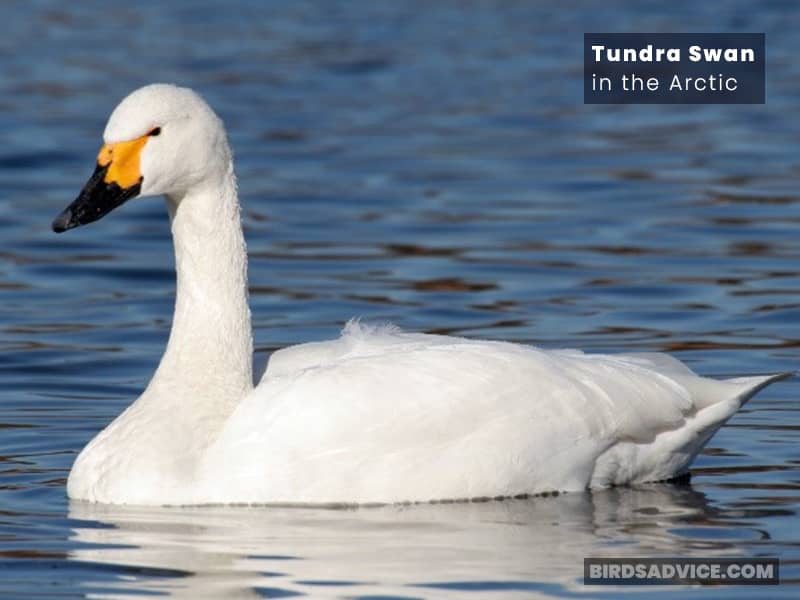
Typically, tundra swans eat aquatic plants, grains, mussels, and a few shellfish. During winter, they consume underlying plant roots that grow in shallow water. When winter hits hard, they tuck one of their feet in order to cope with the weather.
14. Long-tailed Duck
Long-tailed ducks mainly breed in high islands of the Arctic. These birds mostly overwinter along the Pacific and the Atlantic Ocean coasts. They’re black with a white face patch in summer but white with rich brown, grey, and black on the face in winter.

Mollusks, crustaceans, and some small fish are their favorites. However, they prefer mollusks in winter. Besides, they’re also prodigious divers, diving as deep as 200 feet. To catch invertebrates and small, they swim with their wings.
15. Black-legged Kittiwake
Black-legged kittiwakes live in subarctic and arctic regions. These birds can be available throughout Alaska, Canada, and the northern coasts of the Atlantic. They overwinter further south from Saint Lawrence Island to the southern coast of New Jersey.
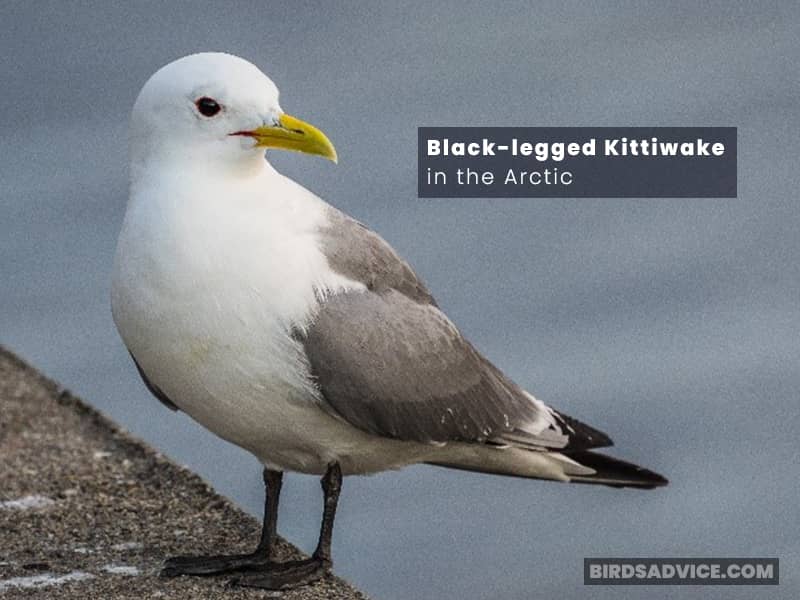
In appearance, breeding adults feature clean white below and pale grey above with black wingtips. These birds have yellow bills and jet-black legs and feet. On the other hand, nonbreeding adults come with a darkish patch behind the ear.
16. Northern Fulmar
Northern fulmars, also known as Arctic fulmars and fulmar petrels, are readily available in subarctic regions of the North Pacific and the North Atlantic Oceans. These birds are willing to overwinter in the North Atlantic.

Most of them appear white below and grey above, looking quite similar to large gulls. They mainly feed on small crustaceans, squid, and small fish. By diving into shallow waters, these birds capture their food with their sharp-edged, hooked bills.
17. Snow Bunting
Snow buntings are found in the high Arctic tundra of North America, Iceland, Norway, Russia, Siberia, and more. In winter, these birds migrate to the northern temperate zones, such as north of the United States, south of Canada, etc.

In appearance, breeding males are white below and black above. However, breeding females have white plumage with a brown back. In most seasons, these birds feed on seeds, grasses, weeds, sedges, buds, and insects.
18. Parasitic Jaeger
Parasitic jaegers, also known as Arctic Skuas, usually breed in the north of North America, particularly the dry tundra and coastal marshes in the Arctic. During winter, these birds are usually out there on the open Pacific and Atlantic Oceans.

Typically, parasitic jaegers are thoroughly dark blackish-brown with a whitish belly and yellowish neck. These birds mainly feed on insects, berries, rodents, small birds, bird eggs, and stolen fish from other birds.
19. Long-tailed Jaeger
Long-tailed jaegers, also known as long-tailed skuas, are the smallest of the jaeger family. These birds breed in the high Arctic of North America and Eurasia. During the winter months, they stay in the south Atlantic and Pacific regions.

In appearance, long-tailed jaegers have thin, pointed wings with little to no white flash underside of wings. Both breeding males and females have long tails. Crustaceans, insects, small birds, and fish are their favorites.
20. Rock Ptarmigan
Rock ptarmigans, also known as thunder birds in Japan, hare feet in Greece, and snow chickens in America, breed across the Arctic and Subarctic North America and Eurasia on the tundra and rocky mountainsides. These birds are excellently adapted to the severe cold.

Having scarlet patches above the eyes, breeding males remain white in summer but molt into brown with time. On the other hand, breeding females have camouflaged plumage with some white patches on their wings and legs. In winter, they’re white with dark eyes.
21. Great Black-backed Gull
Great black-backed gulls, being the largest gulls in the world, are usually available throughout the Arctic region, including southern Greenland, Iceland, Scandinavia, and Russia. These birds overwinter in as far south as Florida.

Adults have white below and slaty-black above with dull pink legs and yellow bills. You’ll notice a red spot near the tip and dark eyes. Besides, great black-backed gulls are scavengers, eating anything in shallow waters.
22. Red Phalarope
Red phalaropes, also called grey phalaropes in Europe, breed in the Arctic regions of North America and Eurasia. In winter, these birds migrate to tropical ocean regions. The females are brighter and more colorful than the males.

Typically, red phalaropes feed on crustaceans, mollusks, and insects. When they stay on the tundra, they prefer eating aquatic insects, worms, small mollusks, small fish, and bits of plant materials. During winter, they maintain the same diet if available.
23. Ruddy Turnstone
Ruddy turnstones breed on the high arctic tundra of Eurasia and North America, particularly Northern Alaska, Arctic Canada, and Baffin Island. These birds overwinter along the coastlines of almost all continents. Some of them travel more than 6,500 miles to migrate.

In appearance, breeding males are white below. They have black-and-white markings on the head and throat. On the other hand, breeding females are similar to their males but a bit paler. Various insects, mollusks, and crustaceans are their favorites.
24. Sanderling
Sanderlings are small Arctic wading birds. These birds look quite like dunlins and sandpipers. Basically, they breed in the high Arctic regions of Eurasia and North America, particularly the Canadian Arctic Archipelago, Greenland, and Nunavut.

In appearance, sanderlings are white below and light grey above. Regardless of seasons, these birds have black bills and legs. Besides, they mostly feed on a wide variety of small creatures, like sand crabs and other invertebrates on beaches.
25. Western Sandpiper
Western sandpipers mostly nest in the Arctic tundra, particularly Alaska and Eastern Siberia. During winter, these birds migrate along the Pacific Coast. Some of them reach the Atlantic Coast in the fall and stay there to overwinter.

Western sandpipers are brown, black, gold, and rufous on the above. They have white underparts and dark bills and legs. Besides, they mostly feed on flies, beetles, spiders, small mollusks, marine worms, and small crustaceans.
26. Ruffed Grouse
Ruffed grouses are year-round residents in the United States and Canada. These birds mainly breed throughout much of Canada. In winter, they stay in southern tropical regions and coastal areas of the Pacific Ocean.

In appearance, ruffed grouses are reddish or greyish brown. They have a finely barred tail and a black band near the tip. Typically, ruffed grouses feed on twigs, leaves, and buds. In winter, they eat catkins and the buds of broad-leaved trees.
27. Snowy Owl
Snowy owls are year-round residents in the Arctic regions of the Palearctic and North America. These birds mostly breed on the tundra. When harsh winter strikes, they head as far south as Texas and Florida along with the lower temperate states.

Snowy owls appear entirely white with yellow eyes and some brown or black markings throughout the body and the wings. These birds prefer eating voles, lemmings, and other small rodents. They can even feast on insects, crustaceans, amphibians, and fish.
28. Peregrine Falcon
Although peregrine falcons can be seen across North America, they’re out there in the Arctic tundra during the breeding season. However, they overwinter in Central and South America. For your information, they’re the fastest birds in the world, reaching speeds over 300 kph.

Adult peregrine falcons feature blue-grey above with barred underparts. Their heads are dark with thick sideburns. Primarily, these birds feed on smaller birds. They catch their prey in flight. Their favorite prey is feral pigeons.
29. White-tailed Eagle
White-tailed eagles are out there all over the world. However, these birds are rarely seen in the high Arctic regions. In winter, they often remain in low coastal spots, marshes, and estuaries. Coastal areas are their favorites to overwinter.

In appearance, white-tailed eagles are brown overall with pale heads and necks. These birds look massive in flight due to their broad wings. Basically, they’re opportunistic hunters and carrion feeders. However, they love to eat fish, rabbits, and small birds.
30. Rough-legged Hawk
Rough-legged hawks, also known as rough-legged buzzards, breed in the Subarctic and Arctic regions of Russia, Europe, and North America. In winter, these birds migrate to southern Canada and the Central United States.

When it comes to appearance, rough-legged hawks are dark brown with black rounded eyes and pale underwings. During the breeding season, these birds of prey mainly feed on voles and lemmings. In winter, mice, voles, and shrews are their favorites.
Final Words
In order to survive harsh Arctic weather, there are some key factors that Arctic birds need. The list includes a reliable source of food, fresh water, shelter, and physical adaptations of the birds themselves. The birds that stay in the Arctic manage everything they require.
However, we hope you’ve learned a lot about what birds live in the Arctic. If you know a bird that we didn’t include in the article, you can comment down below. Have you ever fed any Arctic birds? If so, share the experience with us.
Image Source:
- Stock.adobe.com
- Istockphoto.com
- Flicker.com
- Commons.wikimedia.org
- Pxhere.com
- Gettyimages.com
- Pixabay.com