
Your cart is currently empty!
This Startup Wants to Launch Mirrors Into Space to Sell Sunlight After Dark
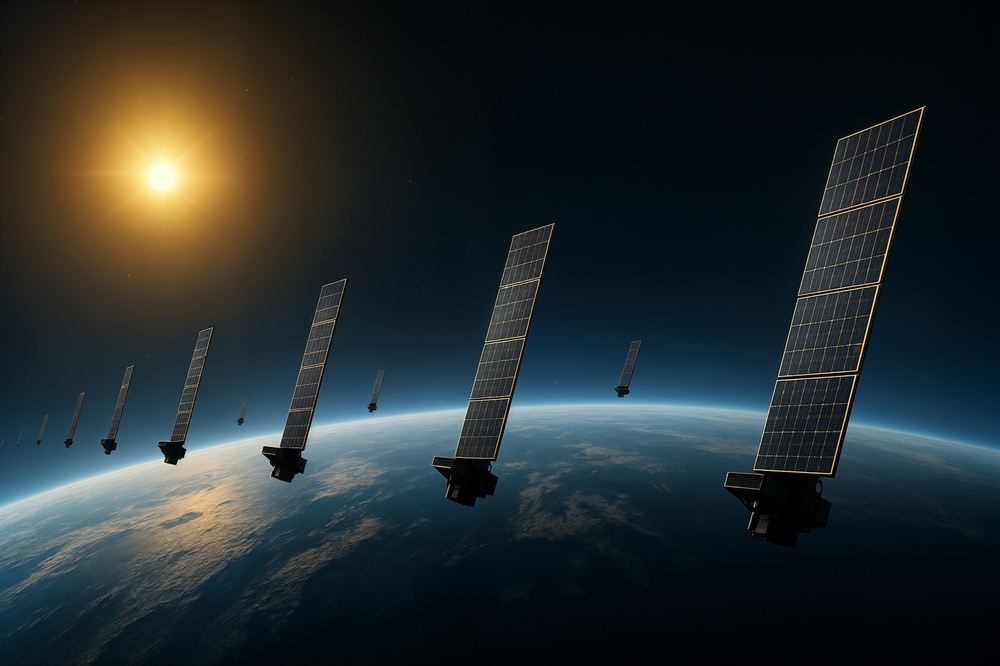
Solar panels are fantastic tools for generating clean electricity, but they share one undeniable flaw. When the sun goes down, the power stops flowing. For decades, the energy industry has simply accepted the arrival of night as a natural pause button. Now, a team of aerospace engineers is challenging that assumption with a very different approach to renewable energy. Instead of waiting for dawn, they are developing a way to catch sunlight from orbit and beam it directly to specific spots on Earth.
Contents
show
Sunlight After Sunset

Solar power is a leading source of renewable energy, but it has a major blind spot. When the sun goes down, electricity production stops. A California startup named Reflect Orbital wants to fix this by offering sunlight on demand. The company was founded by aerospace engineer Ben Nowack and mechanical engineer Tristan Semmelhack. Their plan involves sending a group of satellites into low Earth orbit to bounce sunlight directly down to specific spots on the ground.
These satellites will carry large mylar mirrors. Orbiting about 370 miles above Earth, the mirrors will catch sunlight that is still shining in space and angle it down to solar farms sitting in the dark. Reflect Orbital chief executive officer Ben Nowack highlighted the main hurdle for solar power during a recent energy conference. He pointed out that while solar panels are excellent at producing electricity, the timing is often off. “The problem is that solar energy is not available when we actually want it,” Nowack stated. He noted that if the industry can fix the issue of nighttime downtime, solar energy can be used much more effectively.
The team has already tested the idea on a smaller scale. They used a hot air balloon to lift a large mylar mirror into the sky and angled it to reflect light onto solar panels nearly 800 feet below. The test successfully generated about 500 watts of energy per square meter of panel. If Reflect Orbital can recreate this success in space, solar farms could generate electricity all night long. This would give power grids a massive boost exactly when people are at home turning on their lights and appliances.
There’s an App for That—Sunlight On Demand

The concept of buying sunlight might sound like a futuristic movie plot, but the company is already setting the stage for commercial sales. Reflect Orbital recently released a demonstration video showing exactly how a customer might interact with their service. In the short clip, a user opens a mobile app, selects a specific geographic location on a map, and orders a beam of light to be sent directly to those exact coordinates.
While the app shown was a prototype to illustrate the concept, it highlights a very modern business model. The goal is to make purchasing orbital light as simple as ordering food delivery or booking a ride from a smartphone. However, the primary buyers will not be average people looking to light up their backyards for a late evening party. The main customers will be large solar power plants. These facilities can dramatically increase their daily energy output and profits if they can buy an extra hour or two of sunlight before dawn or right after dusk.
There is clearly an eager market for this unique service. Shortly after the company created a webpage allowing people to apply for early access, they received a massive wave of interest. The founders reported that more than 30,000 applications were quickly submitted by individuals and businesses wanting a spot on the waitlist. The startup is currently aiming to launch its first official satellite into orbit by late 2025. If that mission goes according to plan, solar farm operators will soon be able to log in, select their location, and pay to keep their panels working in the dark.
Protecting the Night Sky
While the idea of extending daylight excites the renewable energy sector, it also raises alarm bells for others. Astronomers and environmentalists are voicing significant concerns about the potential impact of placing giant mirrors in space. The night sky is already crowded with satellite networks that often interfere with telescope observations. Adding highly reflective objects designed to beam sunlight down to Earth could make this problem worse for scientists trying to study the universe.
Beyond astronomy, there are questions about how artificial daylight might affect local ecosystems. Many nocturnal animals rely on natural darkness for hunting, mating, and navigation. A sudden beam of intense light hitting the ground could confuse wildlife and disrupt their natural behaviors.
Reflect Orbital is aware of these valid worries. The company insists that its technology is not designed to turn night into day for entire cities. Instead, the mirrors will focus light into very tight, concentrated beams. These beams will be directed specifically at existing solar farms. These energy facilities are usually located in remote areas away from sensitive natural habitats.
Additionally, the light will only shine on a specific location for a short time as the satellite quickly passes overhead. The startup emphasizes that its goal is to provide a precise delivery of light to power plants, rather than creating a glowing sky for everyone else.
Continuous Power, No Lithium Required

Our battery technology has improved, but it still faces significant limitations. Large scale storage is expensive and depends heavily on lithium mining, which carries its own environmental costs. Furthermore, batteries degrade over time and do not generate new power. They simply hold onto what was already captured.
This bottleneck is what makes the idea of orbital sunlight so appealing. Rather than storing energy, the goal is to continuously create it. Interestingly, the concept of bouncing light from space is not completely new. Back in 1993, Russian engineers tested a similar idea with a project named Znamya-2. They successfully deployed a space mirror that briefly cast a wide, moving beam of light across Europe. It was a groundbreaking moment, but the technology of the 1990s was too bulky and the project was eventually abandoned.
Today, modern aerospace engineers are attempting to revive and perfect that early experiment. Instead of launching one massive reflector, the current strategy involves deploying a network of small, lightweight satellites equipped with ultra thin mylar sheets.
The mechanics required to pull this off are incredibly complex. These modern satellites must orbit the Earth at thousands of miles per hour while constantly adjusting their angles. Their goal is to keep a steady, concentrated beam of light on a single solar farm below. It requires flawless precision and advanced software to account for the speed of the spacecraft and the rotation of the planet.
A Bold Leap for Clean Energy
The push for clean energy is forcing innovators to look past traditional boundaries. Sending mirrors into orbit to harvest sunlight is certainly a bold leap. If this project is successful, it could fundamentally change how the world generates and consumes electricity. Power grids would no longer be entirely at the mercy of the setting sun. As a result, the heavy reliance on fossil fuels during early evening hours could drop significantly across the globe.
However, the path forward is still full of obstacles. Engineers must prove that these orbital reflectors can consistently track solar farms with pinpoint accuracy while traveling at extremely high speeds. Beyond the technical hurdles, companies will need to navigate strict aerospace regulations and win over a skeptical public. Balancing the urgent need for renewable energy with the protection of the environment and the night sky will require careful oversight and ongoing research.
The coming years will reveal whether this ambitious idea can move from a prototype to a reliable daily utility. With test launches scheduled in the near future, the energy sector is watching the skies closely. Even if space mirrors face unexpected delays or regulatory roadblocks, the project proves that the search for sustainable power is pushing human creativity to entirely new heights.