
Your cart is currently empty!
James Webb Telescope Just Confirmed a Cosmic Mystery That Physics Cannot Explain
For decades, astronomers believed they were steadily building a complete understanding of the cosmos. Every new telescope, every deep space observation, and every scientific breakthrough seemed to bring humanity closer to answering some of the universe’s biggest questions. Researchers felt increasingly confident that the fundamental laws governing cosmic expansion were well understood.
Contents
show
That confidence was supported by decades of successful observations and mathematical models. Scientists developed detailed theories explaining how galaxies formed, how stars evolved, and how the universe expanded after the Big Bang. These models accurately predicted many cosmic phenomena and became the foundation of modern cosmology.
However, one measurement continued to challenge those assumptions. Despite advances in technology and increasingly precise observations, a critical number refused to align with expectations. Instead of confirming existing theories, it exposed a growing contradiction that scientists could not easily explain.
Today, researchers believe this discrepancy may point to something far more significant than a simple calculation error. Evidence suggests that our current understanding of the universe may be incomplete. If true, the discovery could lead to entirely new physics and reshape how humanity understands reality itself.
The Mystery That Refuses to Go Away
The scientific puzzle at the center of this debate is known as the Hubble Tension. It revolves around the Hubble Constant, a value used to measure how quickly the universe is expanding. While the concept appears straightforward, obtaining a consistent measurement has proven surprisingly difficult.
For years, astronomers have relied on multiple techniques to calculate the expansion rate of the cosmos. In theory, these methods should produce nearly identical results because they are measuring the same physical phenomenon. Instead, they continue to generate conflicting answers.
As observational tools have improved, scientists expected the disagreement to disappear. Historically, many scientific disputes have been resolved through better instruments and more accurate data. Researchers initially assumed the Hubble Tension would follow a similar path.
Yet the opposite has happened. The discrepancy has remained stubbornly persistent despite increasingly sophisticated observations. Rather than shrinking over time, the gap between measurements has become one of the most significant challenges facing modern cosmology.
Two Measurements. Two Different Universes
One method for calculating the universe’s expansion focuses on the modern cosmos. Astronomers observe nearby stars and galaxies, measuring their distances and tracking how quickly they move away from Earth. These observations provide a direct estimate of the current expansion rate.
Using this approach, scientists consistently arrive at a value between 73 and 74 kilometers per second per megaparsec. Numerous independent studies have produced similar results, strengthening confidence in the measurement. The consistency suggests that the observations themselves are reliable.
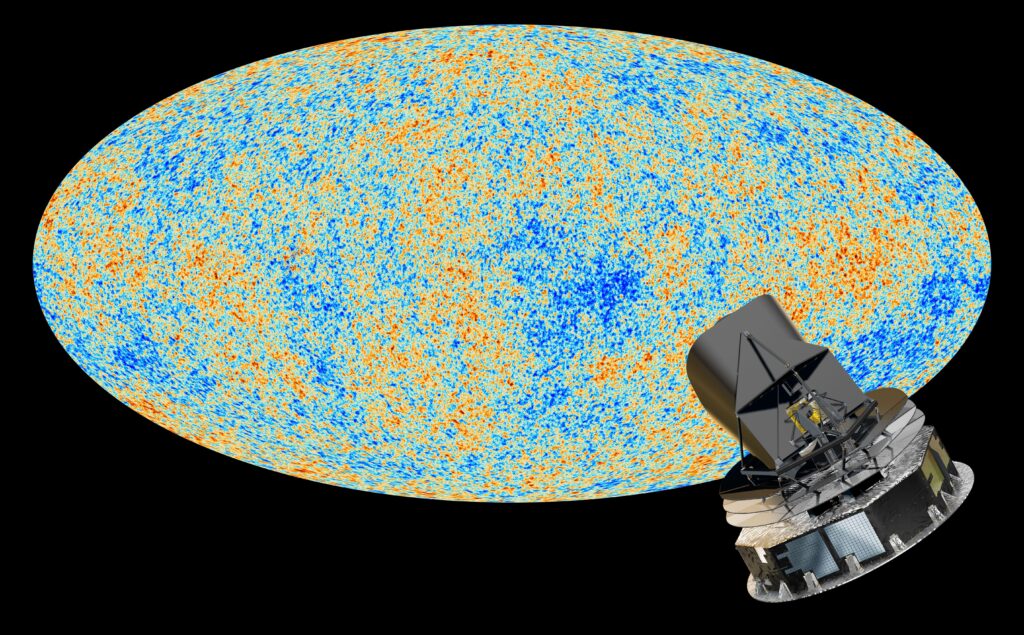
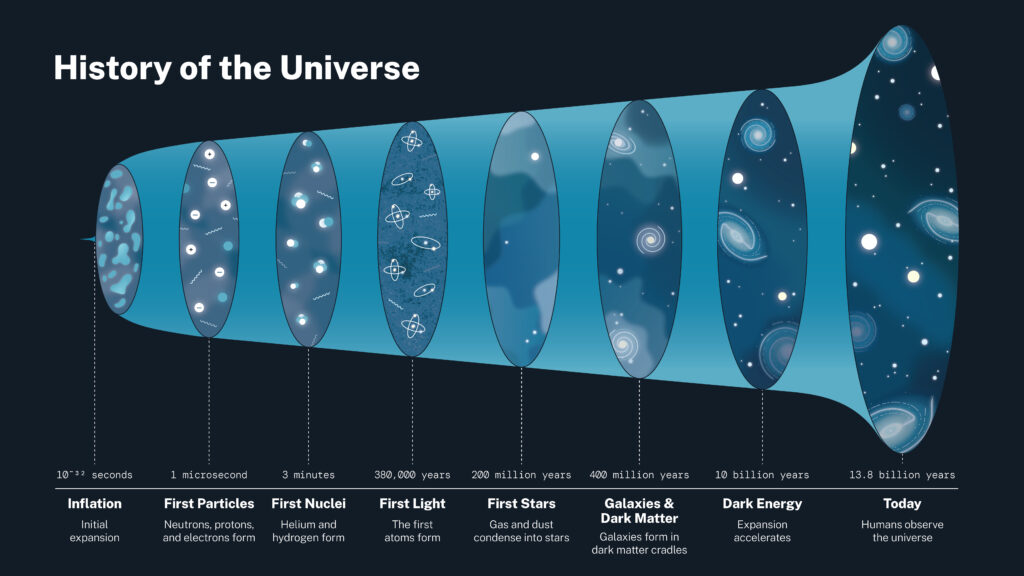
The second method takes a very different approach. Instead of examining nearby galaxies, researchers study the cosmic microwave background, the faint radiation left behind by the Big Bang. This ancient signal provides a snapshot of the universe when it was only a few hundred thousand years old.
By analyzing this early universe data and applying established cosmological models, scientists predict what the expansion rate should be today. Surprisingly, this method produces a value closer to 67 or 68 kilometers per second per megaparsec. The difference may appear small, but in cosmology it represents a major contradiction.
James Webb Just Raised the Stakes
Many scientists hoped the James Webb Space Telescope would finally settle the debate. As the most advanced space observatory ever built, Webb was expected to provide unprecedented precision and help identify any hidden errors in previous measurements.
Researchers led by Nobel Prize winner Adam Riess used Webb’s powerful instruments to reexamine the observations behind the Hubble Tension. Their objective was straightforward. They wanted to determine whether earlier measurements had been affected by subtle inaccuracies or limitations in older technology.
The results surprised many experts. Instead of weakening the discrepancy, Webb confirmed it. The telescope produced measurements that closely matched those obtained by the Hubble Space Telescope, reinforcing the higher expansion rate observed in the local universe.
This outcome eliminated one of the most popular explanations for the disagreement. Critics had long argued that older instruments might be introducing distortions into the data. Webb’s findings suggest that the discrepancy is genuine, making the mystery even more difficult to ignore.

Why Webb’s Confirmation Matters
The James Webb Space Telescope represents a major leap forward in observational astronomy. Its advanced infrared instruments allow scientists to study distant cosmic structures with extraordinary clarity and precision. Many researchers viewed Webb as the ultimate test of previous measurements.
If Webb had supported the lower expansion rate predicted by early universe observations, the Hubble Tension might have faded away. Scientists could have attributed the discrepancy to observational limitations or calibration issues in older datasets.
Instead, Webb strengthened confidence in the higher expansion rate measured in the nearby universe. This confirmation suggests that the disagreement is not simply the result of faulty observations. Something deeper may be influencing the measurements.
As a result, the Hubble Tension has evolved from a technical disagreement into a serious challenge for theoretical physics. Researchers are increasingly considering the possibility that unknown physical processes may be affecting the universe in ways current models cannot explain.
What Could Be Missing From Physics?
Scientists do not yet know what is causing the discrepancy between the two expansion rates. However, the persistence of the Hubble Tension has inspired numerous theories aimed at explaining the conflicting observations. Each possibility carries profound implications for our understanding of the cosmos.
Some researchers believe dark energy may behave differently than current models predict. Others suggest that unknown particles could have influenced conditions in the early universe. These hypothetical particles may have altered cosmic evolution in subtle but important ways.
Another possibility involves modifications to gravity itself. Einstein’s theory of general relativity has successfully explained countless observations, but some scientists wonder whether it remains fully accurate on the largest cosmic scales. Small adjustments could potentially resolve the discrepancy.
Additional theories include temporary bursts of energy shortly after the Big Bang or even the existence of hidden dimensions beyond those we currently perceive. While none of these ideas has been confirmed, they demonstrate how seriously researchers are taking the possibility of new physics.
The Dark Energy Question
Dark energy remains one of the greatest mysteries in modern science. Researchers estimate that it makes up roughly 68 percent of the universe, yet its true nature remains unknown. Scientists can observe its effects but cannot directly detect it.
The primary evidence for dark energy comes from observations showing that the universe’s expansion is accelerating. Rather than slowing down due to gravity, galaxies appear to be moving apart at an increasing rate. Dark energy is the leading explanation for this phenomenon.
Some cosmologists suspect that dark energy may be directly connected to the Hubble Tension. If its properties changed over time, particularly during the universe’s earliest stages, it could help explain why different measurement methods produce conflicting results.
This possibility has generated significant interest because it offers a potential solution to two major mysteries at once. Understanding dark energy could not only resolve the Hubble Tension but also reveal new insights into the fundamental structure of reality.
What Scientists Are Looking For Next
Future observatories may provide the evidence needed to resolve the Hubble Tension. Several major projects are expected to collect unprecedented amounts of cosmological data over the coming years. These missions will allow scientists to study the universe with greater precision than ever before.
Among the most anticipated projects are the Nancy Grace Roman Space Telescope, the European Space Agency’s Euclid mission, and the Vera C. Rubin Observatory. Each will contribute valuable observations that could help clarify the source of the discrepancy.
These instruments will measure billions of galaxies and map large portions of the cosmos. By tracking how cosmic structures evolve over time, researchers hope to identify patterns that current observations may have missed. Such discoveries could provide crucial clues.
Some scientists believe improved measurements alone will eventually reveal the answer. Others suspect that entirely new theories will be necessary. Regardless of the outcome, the next generation of observations promises to transform our understanding of the universe.

The Universe May Be Stranger Than We Imagined
One of the most remarkable aspects of science is that confusion often leads to discovery. Throughout history, unexpected discrepancies have frequently opened the door to revolutionary breakthroughs. The Hubble Tension may represent another such turning point.
What began as a disagreement between measurements has evolved into one of the most intriguing mysteries in modern physics. The persistence of the discrepancy suggests that the universe may be revealing something important about its underlying nature.
Humanity has repeatedly discovered that reality is more complex than previously imagined. From relativity to quantum mechanics, major scientific advances have often emerged when observations challenged established beliefs. The current mystery may follow a similar path.
Whatever ultimately explains the Hubble Tension could transform our understanding of existence itself. Whether the answer involves dark energy, new particles, modified gravity, or something entirely unexpected, the universe may once again prove that it is far stranger than we ever imagined.
Sources
- Riess, A. G., Anand, G. S., Yuan, W., Casertano, S., Dolphin, A., Macri, L. M., Breuval, L., Scolnic, D., Perrin, M., & Anderson, R. I. (2024). JWST observations reject unrecognized crowding of Cepheid photometry as an explanation for the hubble tension at 8Σ confidence. The Astrophysical Journal Letters, 962(1), L17. https://doi.org/10.3847/2041-8213/ad1ddd
- Webb telescope’s largest study of universe expansion confirms challenge to cosmic theory. (2024, December 9). The Hub. https://hub.jhu.edu/2024/12/09/webb-telescope-hubble-tension-universe-expansion/
- Freedman, W. L., Madore, B. F., Jang, I. S., Hoyt, T. J., Lee, A. J., & Owens, K. A. (2024, August 12). Status report on the Chicago-Carnegie Hubble Program (CCHP): measurement of the Hubble Constant using the Hubble and James Webb space telescopes. arXiv.org. https://arxiv.org/abs/2408.06153