
Your cart is currently empty!
Trump Branded Smartphone Opened Up By Experts Reveals Unexpected Global Supply Chain
The Trump Organization promised a patriotic smartphone that would represent American manufacturing and a new alternative in the mobile industry. However, a detailed teardown of the much-discussed Trump Phone has revealed a surprising reality beneath its gold-colored exterior.
Contents
show
Experts who opened the device discovered that many of its internal elements closely matched an existing Taiwanese smartphone, raising fresh questions about its origin, manufacturing claims, and reliance on overseas supply chains.
Experts Take Apart The Trump Phone And Discover A Familiar Design
The Trump Phone entered the market with heavy branding around American identity, luxury aesthetics, and a promise of delivering a product aligned with Donald Trump’s political image. Its bright gold appearance and strong marketing language helped it gain immediate attention across social media and news platforms.
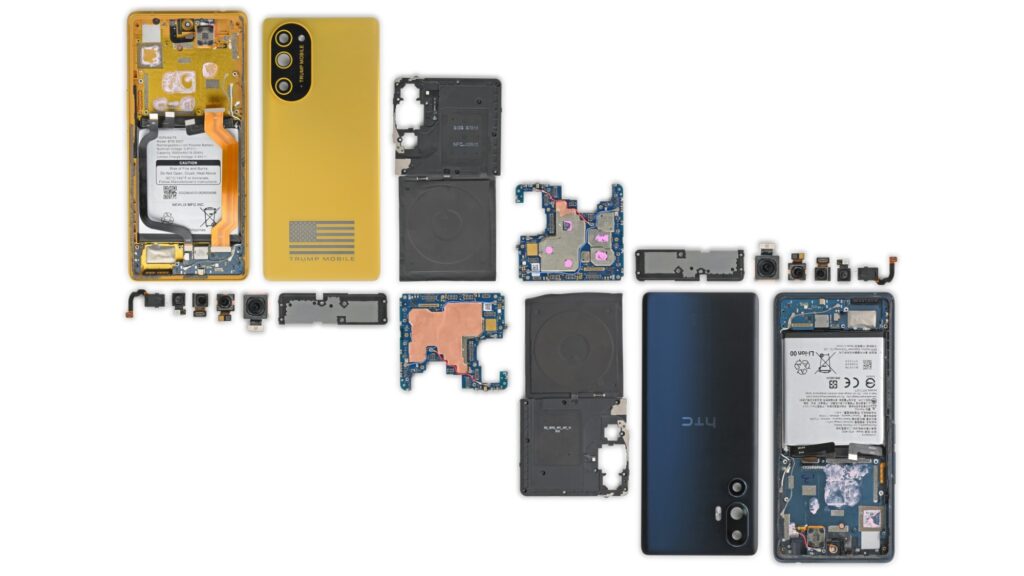
When repair specialists and technology analysts got their hands on the device, they decided to examine exactly what was inside. The teardown was conducted by iFixit, a company known for breaking down consumer electronics to understand their construction, repairability, and components.
According to the investigation, the internal design of the Trump Phone appeared almost identical to the HTC U24 Pro, a smartphone produced by the Taiwanese company HTC. The layout of the motherboard, camera systems, battery placement, and several other internal structures strongly resembled the existing HTC model.
The findings suggested that the Trump Phone was not a completely original piece of technology designed from the ground up. Instead, analysts concluded that it was essentially a rebranded HTC U24 Pro with cosmetic changes, including the distinctive gold-colored exterior that became its signature feature.
The Device Contains Components Manufactured In China
One of the most controversial discoveries involved the origin of the parts inside the smartphone. While the phone’s branding emphasized American values and domestic manufacturing, the teardown showed that many components came from global suppliers, including manufacturers based in China.
Modern smartphones rely on complex international supply chains. Even companies that assemble devices in certain countries frequently use parts produced in multiple regions because electronic components require specialized manufacturing facilities and years of industrial development.
The Trump Phone appeared to follow the same industry pattern. The teardown identified components that could be traced back to Chinese suppliers, creating a sharp contrast between the product’s marketing image and the global manufacturing reality behind modern electronics.
The discovery quickly became a point of political and technological debate because Donald Trump has repeatedly criticized dependence on Chinese manufacturing and has promoted policies aimed at bringing more production back to the United States.
Why Most Smartphones Depend On Global Supply Chains
The controversy surrounding the Trump Phone also highlights a larger issue facing the technology industry. Building a smartphone entirely from parts made in one country is exceptionally difficult because production is spread across a worldwide network of companies.
A single smartphone can include processors, displays, memory chips, cameras, sensors, batteries, and dozens of other specialized parts. Different regions dominate different areas of production due to decades of investment and technical expertise.
Some of the major sources of smartphone components include:
- China, which plays a major role in electronics manufacturing and component assembly.
- Taiwan, known for advanced semiconductor technology and consumer electronics development.
- South Korea, which produces displays, memory technology, and other critical components.
- Japan, which supplies precision materials, sensors, and electronic parts.
Because of this interconnected system, even technology companies that emphasize local production often remain dependent on international suppliers for many components.
The Trump Phone therefore represents a broader challenge in modern manufacturing. Creating a fully domestic smartphone would require rebuilding an enormous industrial ecosystem that currently spans multiple continents.
The HTC Connection Raises Questions About The Phone’s Development
The resemblance between the Trump Phone and the HTC U24 Pro has led many technology observers to question how much original engineering went into the product. Rebranding existing devices is not uncommon in the smartphone industry, particularly among smaller brands entering the market.
Companies sometimes purchase designs from established manufacturers and customize them with different software, external materials, or branding. This approach allows businesses to launch devices more quickly without investing billions of dollars into research and development.
However, the Trump Phone attracted greater attention because of the political messaging attached to it. The device was marketed as a symbol connected to American innovation and economic independence, making the discovery of foreign connections especially noteworthy.
Technology experts noted that using existing hardware is not automatically unusual or deceptive. The controversy mainly centers around whether the marketing created expectations that the phone was more uniquely American in its design and manufacturing than the teardown suggests.
The Political Debate Surrounding The Discovery
The findings have added another chapter to the ongoing debate about trade, globalization, and domestic manufacturing in the United States. Donald Trump has long made reducing reliance on Chinese manufacturing a central theme of his economic policies.
Supporters of stronger domestic production argue that bringing manufacturing back to America could improve national security, create jobs, and reduce dependence on foreign suppliers. Critics, however, argue that completely separating from international supply chains would dramatically increase costs and create major logistical challenges.
The Trump Phone controversy illustrates how difficult these goals can be to achieve in the consumer technology sector. Smartphones represent some of the most globally integrated products ever created, with materials and components moving through multiple countries before reaching consumers.
As the debate continues, the teardown serves as a reminder that political messaging and modern manufacturing often collide with the complicated realities of global technology production.
What The Discovery Means For Consumers And The Tech Industry
For consumers, the teardown offers a closer look at how branding and manufacturing can sometimes tell different stories. A device’s appearance, name, or marketing campaign does not always reveal where its technology originates or where every component was produced.
The case also demonstrates why independent examinations by repair specialists and technology researchers remain valuable. Teardowns provide transparency about how products are built and allow consumers to better understand what they are purchasing.
The smartphone industry is likely to remain dependent on international partnerships for the foreseeable future. The expertise required to produce advanced electronics is spread across many countries, making complete self-sufficiency a difficult goal.
The gold-colored Trump Phone may have been designed to symbolize American identity, but its internal hardware reveals a much more international story about the way modern technology is actually made.
Source
Mokhtari, S. (2026, June 13). Teardown confirms the Trump phone is a Gold-Painted HTC U24 Pro. iFixit. https://www.ifixit.com/News/117789/teardown-confirms-the-trump-phone-is-a-gold-painted-htc-u24-pro