
Your cart is currently empty!
The Untold Story Behind Vijay Mallyas White House Above Bengaluru

Few luxury homes can claim to be visible from miles away. Even fewer look like the White House while sitting on top of a 33-storey skyscraper. Yet in the heart of Bengaluru, one of India’s most unusual properties has spent more than a decade standing empty, despite carrying a price tag estimated at around $20 million.
Contents
show
The mansion was designed for one of India’s most flamboyant businessmen, Vijay Mallya. Complete with a helipad, infinity pool, landscaped gardens and sweeping views across the city, it was meant to become the ultimate symbol of wealth. Instead, it has become one of modern architecture’s biggest unanswered questions.
A Mansion That Defies Almost Every Rule of Luxury Living
From street level, Kingfisher Towers already commands attention. Rising above Bengaluru’s Central Business District near Cubbon Park, the luxury residential development ranks among the city’s most prestigious addresses.
But the feature that captures almost everyone’s attention is not found inside the apartments.
It sits on the roof.
Perched roughly 400 feet above the ground is a sprawling private mansion designed to resemble the White House. Instead of occupying valuable land, the entire residence crowns the skyscraper itself, creating what many have called a “White House in the Sky.”
The property reportedly spans around 40,000 square feet and was planned as a fully self-contained luxury estate. Its design includes an infinity swimming pool overlooking Bengaluru, expansive landscaped gardens, multiple terraces, a gym, private entertainment areas and even a rooftop helipad.
Unlike traditional penthouses, which usually occupy one or two upper floors, this residence was conceived as a standalone villa placed on top of the building.
That alone makes it one of the most unusual residential projects ever attempted.
The Childhood Home That Inspired an Extraordinary Idea

While the mansion’s appearance has fuelled countless headlines, the story behind its design is far more personal than many realise.
During a recent podcast conversation with entrepreneur Raj Shamani, Vijay Mallya explained that the original house standing on the Kingfisher Towers site was much more than another luxury property.
It was his childhood home.
“That was the bungalow where I grew up and where my father lived. It originally stood on the same land where Kingfisher Towers now stands,” Mallya recalled.
As Bengaluru expanded into one of India’s fastest-growing cities, the land became increasingly valuable. Prestige Group Chairman Irfan Razack approached Mallya with a proposal to redevelop the property into a high-end residential tower.
According to Mallya, what happened next began almost as a joke.
“I jokingly told my friend Razack that I’d only agree if they could place my family bungalow on top of the building,” he said. “To my surprise, he agreed, and that’s exactly what they did.”
The result was an engineering challenge unlike anything the developers had previously attempted.
Rather than preserving the original bungalow, they recreated its concept high above the city, allowing Mallya to retain the emotional connection to his childhood home while unlocking the commercial value of one of Bengaluru’s most sought-after pieces of land.
The development also made financial sense.
Mallya explained that redeveloping such valuable real estate would significantly strengthen the business prospects of the project, making the ambitious construction worthwhile despite its extraordinary complexity.
Building a House in the Sky Was Far From Simple
Creating a luxury villa on solid ground is difficult enough.
Building one that appears to float above a skyscraper presented an entirely different set of engineering problems.
The mansion sits on an enormous cantilever structure extending from the rooftop of Kingfisher Towers. Supporting a residence of this size required careful structural planning to ensure the weight could be safely distributed throughout the building.
Prestige Estates Projects Chairman Irfan Razack later acknowledged just how demanding the construction had become.
“It was a challenge to construct the mansion on a huge cantilever at that height, but we have ensured we built it exactly the way it was conceived,” he said.
He added that the company intended to complete the project according to the original agreement before handing it over.
The engineering involved went well beyond simply placing walls on a rooftop.
Every major feature had to be adapted for its unusual location. The infinity pool required advanced waterproofing systems. Landscaped gardens needed specially designed drainage. Heavy construction materials had to be transported hundreds of feet into the air while maintaining the structural integrity of the tower beneath.
The finished vision promised uninterrupted panoramic views across Bengaluru, stretching from Cubbon Park to the nearby M. Chinnaswamy Stadium and beyond.
Few private homes anywhere in the world offer a comparable perspective.
Kingfisher Towers Became One of Bengaluru’s Most Exclusive Addresses
Even without its rooftop mansion, Kingfisher Towers occupies a unique place in Bengaluru’s luxury property market.
Located beside Cubbon Park, the development sits within one of the city’s most desirable neighbourhoods, combining central access with expansive green surroundings that are increasingly rare in India’s rapidly growing technology hub.
The tower itself houses dozens of luxury apartments designed for high-net-worth residents.
Over the years, several prominent business figures have reportedly owned homes within the building, including Infosys co-founder Narayana Murthy and Zerodha co-founder Nikhil Kamath.
For buyers, the appeal extended well beyond prestige.
Residents enjoy security, privacy, premium facilities and sweeping city views, all within minutes of Bengaluru’s commercial centre.
Yet despite the impressive list of residents and amenities, the rooftop mansion continues to overshadow everything else associated with the building.
Visitors frequently notice it long before they learn who lives inside the tower below.
Its resemblance to the White House, combined with its seemingly impossible location, has transformed it into one of Bengaluru’s most recognisable architectural landmarks.
Ironically, the building’s most famous residence has never welcomed its intended owner.
A Dream That Slowly Turned Into an Unfinished Landmark

Construction of the mansion began during the early 2010s alongside the development of Kingfisher Towers.
For several years, progress appeared steady.
As the residential tower neared completion, work continued on the elaborate rooftop villa that would eventually crown the project.
Then events outside the construction site dramatically changed its future.
Around the same period, Vijay Mallya’s financial and legal problems surrounding Kingfisher Airlines intensified. Mounting debt, regulatory investigations and court proceedings increasingly dominated headlines.
In 2016, Mallya left India for the United Kingdom while legal cases against him continued.
His departure had immediate consequences extending far beyond the courtroom.
Construction on the rooftop mansion slowed before eventually coming to a standstill.
The lavish residence that had been envisioned as one of India’s most spectacular private homes suddenly became an unfinished shell overlooking Bengaluru.
Years passed.
The infinity pool remained unused.
The landscaped gardens were never fully completed.
The helipad never received its first landing.
What had started as an intensely personal tribute to a childhood home gradually transformed into one of the country’s most expensive abandoned residential projects.
Today, the mansion still sits above Kingfisher Towers as a striking reminder of an ambition that remains suspended between architectural achievement and unresolved legal reality.
Legal Battles Left the Mansion Frozen in Time

The story of the sky mansion cannot be separated from the downfall of Vijay Mallya’s business empire.
For years, Mallya cultivated an image of luxury and extravagance. Dubbed the “King of Good Times,” he built a business portfolio that included United Breweries, Kingfisher Airlines, a Formula One team, cricket franchises, yachts, private jets and an extensive collection of luxury properties.
His rooftop mansion was intended to be another statement of that lifestyle.
But while construction was progressing, financial pressure on Kingfisher Airlines continued to mount.
The airline, once positioned as India’s premium carrier, struggled with rising fuel costs, mounting debt and fierce competition. It eventually ceased operations in 2012, leaving banks attempting to recover billions in unpaid loans.
The situation escalated dramatically in 2016 when Mallya left India for the United Kingdom.
Indian authorities later accused him of fraud and money laundering connected to unpaid loans linked to the airline. Mallya has consistently denied wrongdoing, maintaining that the collapse of Kingfisher Airlines was a business failure rather than a criminal enterprise.
Regardless of the competing claims, the legal proceedings had an immediate impact on his assets.
According to Mallya, the unfinished penthouse is now caught up in the liquidation proceedings involving United Breweries Holdings Limited (UBHL).
Speaking on Raj Shamani’s podcast, he explained why the residence remains untouched.
“It’s tied up in the UBHL liquidation proceedings. Once that’s resolved, the property can be restored.”
He also said he continues working to resolve the legal issues surrounding the property.
Meanwhile, Indian courts have continued to hear matters connected to his case, and his extradition from the United Kingdom has remained the subject of lengthy legal proceedings.
As long as those disputes continue, the mansion remains in limbo.
An Empty Home Worth Millions
Luxury homes are usually built to be enjoyed.
This one has become something else entirely.
Despite being close to completion, the mansion has reportedly never been occupied. Its swimming pool has never hosted a party. The rooftop gardens have never become the peaceful retreat they were intended to be. The helipad has never welcomed its owner’s arrival.
Instead, the residence has become a permanent fixture of Bengaluru’s skyline, attracting curiosity from photographers, drone operators and architecture enthusiasts.
Every few months, fresh aerial photographs circulate online, prompting people to ask the same question.
Why would someone spend millions building a dream home they never lived in?
Part of the fascination comes from the contrast itself.
The house represents extraordinary luxury, yet it remains inaccessible.
It dominates the skyline, yet almost nobody has seen its interior.
Unlike famous historic buildings that become museums after being abandoned, this mansion remains private property, hidden behind walls and unfinished spaces.
Its mystery has become part of its identity.
The Engineering Achievement Still Impresses Experts

Although the legal dispute often dominates headlines, architects and engineers continue to admire the technical achievement behind the project.
Constructing a residence of this size above a high-rise required solving challenges rarely encountered in residential construction.
Every additional tonne placed on the rooftop affected the building beneath it.
Structural engineers had to account for wind loads, weight distribution, seismic considerations and long-term durability while maintaining the comfort and safety of residents living below.
The cantilever supporting the mansion became one of the project’s defining features.
Rather than simply extending the tower upward, engineers created a platform capable of carrying what effectively functions as a standalone luxury villa.
Prestige Estates Chairman Irfan Razack described the construction as one of the company’s most demanding assignments, noting that the team had worked to build the residence exactly as originally envisioned despite its complexity.
That achievement remains visible today.
Even unfinished, the mansion continues to demonstrate what modern engineering can accomplish when conventional design limits are pushed.
The White House Comparison Only Tells Part of the Story
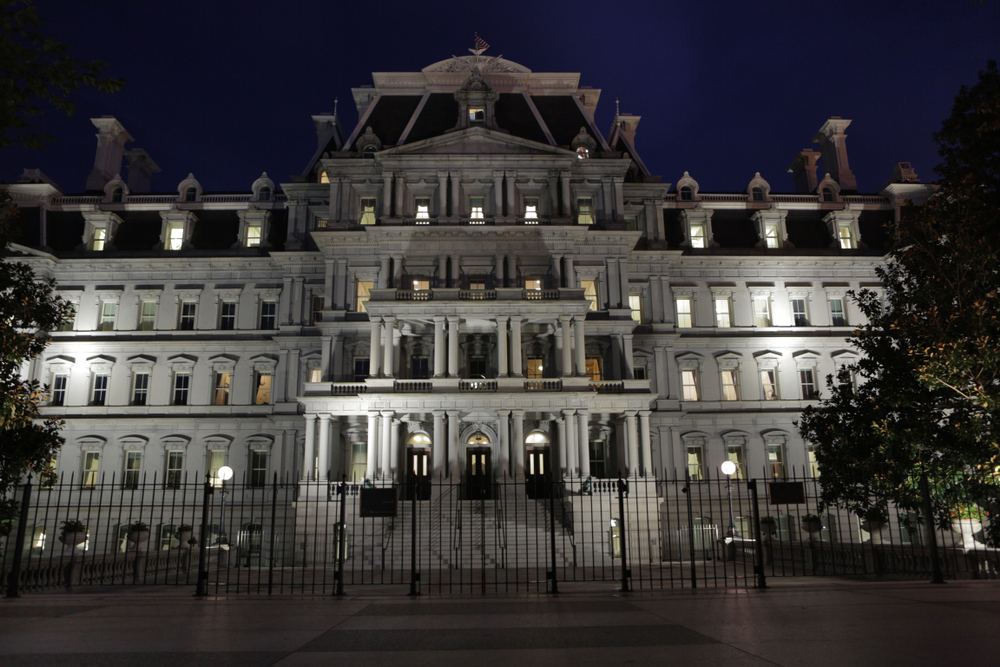
The mansion’s resemblance to the White House has made it famous across social media and international news outlets.
The comparison is easy to understand.
Its white exterior, symmetrical appearance and grand proportions immediately remind many viewers of the official residence of the President of the United States.
Yet the similarities largely end there.
The Bengaluru mansion was never intended to function as a replica in every architectural detail.
Instead, it borrowed visual inspiration while incorporating features suited to modern luxury living.
Unlike Washington’s White House, the rooftop residence includes amenities such as an infinity pool, expansive rooftop terraces and panoramic views stretching across one of India’s busiest cities.
Its elevated position also gives it a presence unlike almost any other private residence.
Rather than being surrounded by gardens at ground level, the mansion rises above the skyline itself, making it visible from numerous parts of Bengaluru.
This unusual placement has transformed it into an architectural landmark, even though most people know it only from photographs.
One of India’s Most Talked-About Homes Faces Stiff Competition
The rooftop mansion is undoubtedly among India’s most recognisable luxury properties, but it is far from the country’s most expensive residence.
That distinction generally belongs to Antilia in Mumbai.
Owned by billionaire Mukesh Ambani, the 27-storey private residence reportedly cost billions of dollars to construct and features multiple helipads, hundreds of staff members, entertainment facilities and luxury amenities spread across an entire vertical estate.
The comparison highlights two very different approaches to extreme wealth.
Antilia functions as a completed family residence and remains occupied.
Mallya’s sky mansion represents an unfinished vision that has become frozen in time.
Both homes attract international attention, but for entirely different reasons.
One showcases what unlimited resources can build.
The other demonstrates how even enormous wealth cannot always overcome legal and financial uncertainty.
The Mansion’s Future Remains Uncertain
More than a decade after construction began, nobody can say with confidence what lies ahead for the White House-inspired residence.
Mallya has expressed hope that the legal issues surrounding the property will eventually be resolved, allowing restoration work to continue.
Whether that happens remains uncertain.
If the liquidation proceedings conclude and ownership issues are settled, the mansion could still become one of India’s most spectacular private homes.
Years of inactivity would likely require extensive restoration before anyone could move in, but the structure itself continues to stand prominently above Kingfisher Towers.
There is also the possibility that ownership could eventually change hands.
Given its location in one of Bengaluru’s most desirable neighbourhoods and its worldwide recognition, the property would almost certainly attract significant interest if it were ever offered for sale under clear legal circumstances.
Until then, it remains suspended between ambition and reality.
Every day, thousands of people pass beneath Kingfisher Towers without knowing the full story behind the mansion that watches over the city. What began as an attempt to preserve a cherished childhood home evolved into one of India’s most remarkable engineering projects, only to become an unfinished monument to a chapter of business history that is still unfolding.
For now, the White House in the Sky remains exactly as it has for years: complete enough to capture the imagination, unfinished enough to keep people wondering whether anyone will ever call it home.