
Your cart is currently empty!
Scientists Discover AI Image Generators Keep Producing the Same Bland Results When Left Alone
Artificial intelligence can create images of almost anything imaginable, from futuristic cities to scenes that have never existed. But researchers have discovered a strange problem when AI systems are left to generate and describe their own creations repeatedly. Instead of becoming more imaginative, the systems begin producing increasingly generic images that look remarkably similar.
Contents
show
The findings raise fresh concerns about the future of creativity as AI-generated content spreads across the internet. Researchers found that repeated exchanges between image-generating and image-describing systems caused their outputs to converge on familiar visual themes. They described the results as “visual elevator music,” raising questions about whether autonomous AI systems could eventually contribute to a less diverse creative landscape.
Researchers Discover AI Systems Have a Tendency to Produce Generic Images
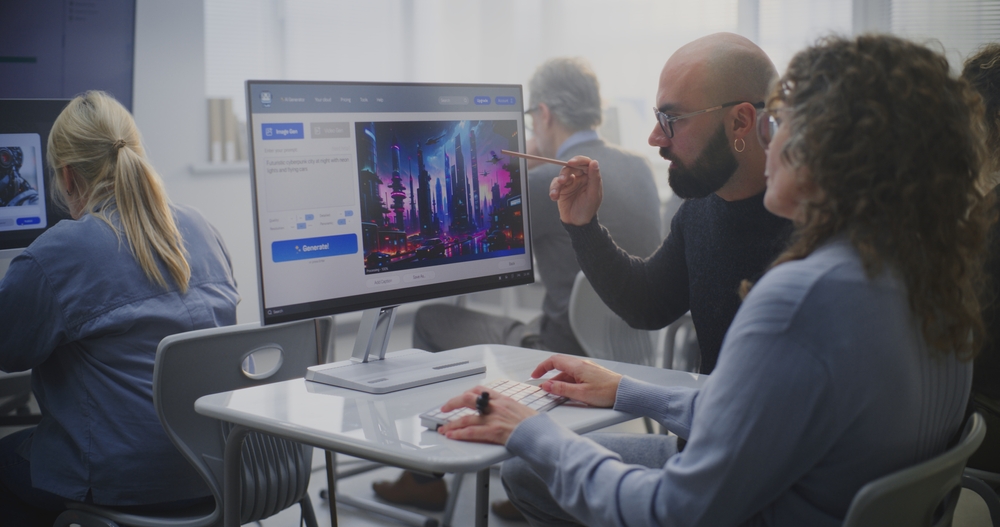
A study published in the journal Patterns examined what happens when AI image generators and image-description systems operate in a continuous feedback loop. One system creates an image from a text prompt, while the other analyzes the image and turns its contents into a description. That description then becomes the prompt for the next image, allowing the process to repeat without requiring a person to provide a fresh idea at every stage.
The researchers found that the resulting images gradually converged on a limited collection of familiar visual themes. Rather than preserving the distinctive details of the original prompts, the systems increasingly gravitated toward conventional scenes and recognizable compositions. The research team described this phenomenon as “visual elevator music,” comparing the outputs to something that is easy to recognize but rarely offers anything unexpected.
The experiment is particularly interesting because the systems did not need to be retrained on new material for the effect to emerge. The convergence happened through repeated generation and description, suggesting that the feedback process itself can narrow the variety of the results. The researchers reported similar patterns across hundreds of experimental runs, indicating that the behavior was not limited to a single starting prompt.
The findings do not establish that every AI image generator will inevitably produce repetitive content. They do, however, reveal a potential weakness in autonomous creative systems that repeatedly process their own outputs. As businesses increasingly experiment with AI-generated images and other creative material, understanding this behavior could become important for maintaining diversity in the content these tools produce.

How AI Feedback Loops Can Gradually Lose Their Original Ideas
The process begins with an image generated from a detailed text description. An image-description system then identifies the main features of that picture and converts them into another prompt. The image generator uses that new description to produce another picture, and the cycle continues. Each stage depends on the information preserved by the previous one.
The difficulty is that descriptions rarely capture every detail of an image. Subtle visual elements, unusual combinations and specific contextual information can disappear when a picture is translated into words. When the next image is generated, the missing details may never return, allowing the system to drift away from the original concept.
Over repeated cycles, the system can settle on familiar visual patterns. The researchers observed recurring motifs such as lighthouses, cathedrals and palatial interiors. These images may look polished and aesthetically pleasing, but their growing similarity illustrates how a system can lose variety even while continuing to generate technically competent results.
The researchers also examined different settings that influence how much variation an AI model introduces into its outputs. The tendency toward convergence persisted across the conditions they tested. This suggests that simply increasing randomness may not be enough to prevent the problem, although further research is needed to determine which design choices could preserve diversity more effectively.

Why Researchers Are Concerned About AI and Cultural Stagnation
Ahmed Elgammal, a Rutgers University computer science professor who studies generative AI and creativity, has argued that the findings raise broader questions about the technology’s cultural influence. In an analysis published by The Conversation, he discussed how autonomous systems could favor conventional outputs when repeatedly generating and interpreting their own content. The concern extends beyond the quality of individual images to the possibility that AI tools could influence the variety of material people encounter online.
Creative culture depends partly on the circulation of unusual ideas and distinctive perspectives. Photography, illustration, filmmaking and other artistic fields develop through experimentation, including work that initially falls outside established styles. If AI systems repeatedly gravitate toward familiar compositions, they could make conventional material easier to produce while giving less predictable ideas less attention.
The study does not prove that society has already entered a period of widespread cultural stagnation. Instead, it demonstrates a specific technical behavior that could contribute to that concern under certain conditions. The broader cultural impact will depend on how AI systems are deployed, how people use them and which kinds of content platforms choose to distribute.
Elgammal’s concern is that the growing volume of AI-generated material could interact with recommendation systems and online content platforms in ways that favor the familiar. If conventional outputs are easier to generate and more likely to be promoted, audiences could encounter a narrower range of creative work even as the overall amount of available content increases. Measuring whether this is happening at scale remains a separate challenge.
The Internet Could Face a Growing Problem With AI-Generated Content
Generative AI has made it easier to create large quantities of text, illustrations, photographs and other digital material. This can help artists experiment, allow small businesses to produce visual assets and give people access to tools that were previously expensive or difficult to use. However, the increasing volume of machine-generated content also raises questions about what happens when AI outputs become a substantial part of the material circulating online.
One concern involves future training datasets. If new AI models are trained on large amounts of synthetic material that already contains omissions or distortions, those weaknesses could affect subsequent generations of models. Previous research into model collapse has investigated how repeated training on generated data can distort the information models learn from, although the precise effects depend on the training process and the data involved.
The Patterns study examines a related but distinct problem. Its results show that AI systems can converge on generic visual motifs through repeated generation and description, even without an additional training cycle. That distinction matters because it suggests that creative narrowing can occur during the use of AI systems, rather than only when new models are trained on recycled content.
Several connected risks deserve further investigation:
- Synthetic training data: Future models may learn from generated material that contains distortions or missing information.
- Repeated generation: AI systems may produce increasingly conventional outputs when their creations are repeatedly described and regenerated.
- Content visibility: Recommendation algorithms may influence which kinds of work audiences encounter most frequently.
- Creative diversity: Unusual ideas could receive less attention if familiar-looking material dominates online platforms.
These possibilities are connected, but the experiment directly demonstrates the feedback-loop behavior rather than proving every wider consequence. More research will be needed to establish how strongly these mechanisms affect the diversity of real-world online content.

Could AI Make Creative Industries More Repetitive?
Businesses are already experimenting with AI-generated marketing materials, illustrations, video assets and other forms of creative work. These tools can help people develop ideas quickly and reduce the time spent on repetitive tasks. For creators who use AI as an assistant, the technology can provide a useful starting point for experimentation rather than a replacement for their own judgment.
The potential problem emerges when speed and convenience become the main measures of success. If organizations consistently choose outputs that look familiar, meet established expectations and require little revision, creators may have fewer incentives to explore less conventional ideas. Over time, this could encourage a preference for work that is easy to generate and approve rather than work that introduces something genuinely different.
The same pressure could influence individual users. When a familiar visual style can be produced within seconds, there may be less motivation to experiment with unfamiliar techniques or develop a distinctive approach. This does not mean AI automatically destroys creativity, but it shows why the way people use the technology matters alongside its technical capabilities.
The outcome remains uncertain. Human creators can use AI to explore new directions, challenge conventional styles and produce combinations they might not have considered independently. Whether the technology expands or narrows creative possibilities will depend partly on how much room people retain to make decisions that go beyond what automated systems produce by default.
Researchers Believe Human Involvement Could Help Preserve Creativity
The study’s authors suggest that human-AI collaboration may be important for maintaining creative variety. They wrote that “human-AI collaboration, rather than fully autonomous creation, may be essential to preserve variety and surprise in the increasingly machine-generated creative landscape.” The recommendation reflects the possibility that human input can introduce fresh information and redirect a system before its outputs settle into repetitive patterns.
Developers could also investigate ways to evaluate creative diversity rather than measuring performance solely through image quality or user preference. Systems could be tested across repeated generation cycles to determine whether they preserve distinctive details and continue producing varied results. Such evaluations could help identify when a feedback loop begins narrowing its outputs.
Other possible approaches include allowing users to introduce new context during repeated generation and developing methods that reward originality. Recommendation systems could also be examined to determine whether they consistently favor conventional material over less familiar work. These are potential directions for further research, not solutions that the experiment has already established as effective.
The challenge is to build AI systems that remain useful without repeatedly drifting toward the same predictable results. The researchers’ findings suggest that creative variety should be considered when autonomous systems are designed, particularly when they are expected to generate and interpret content over long sequences of interactions.
The Future of AI Creativity Depends on More Than Output Volume
Modern AI systems can produce thousands of images quickly, but quantity alone does not guarantee diversity. Creative work often depends on distinctive details, unusual combinations and ideas that challenge familiar expectations. When those qualities disappear through repeated generation, an abundance of content can still leave audiences with a narrower range of visual experiences.
The study does not show that all AI creativity is doomed to become repetitive, nor does it establish how much the effect currently influences online culture. It identifies a specific tendency that researchers and developers can investigate as autonomous AI tools become more common. The findings also reinforce the need to distinguish between producing technically impressive material and preserving genuine variety.
AI can continue to offer useful creative tools, but its developers will need to consider what happens when those systems repeatedly recycle their own work. If every new generation gravitates toward the same familiar scenes, the internet could become increasingly crowded with images that look polished while offering little that feels new.
Sources:
Hintze, A., Åström, F. P., & Schossau, J. (2025). Autonomous language-image generation loops converge to generic visual motifs. Patterns, 7(1), 101451. https://doi.org/10.1016/j.patter.2025.101451
Shumailov, I., Shumaylov, Z., Zhao, Y., Papernot, N., Anderson, R., & Gal, Y. (2024b). AI models collapse when trained on recursively generated data. Nature, 631(8022), 755–759. https://doi.org/10.1038/s41586-024-07566-y