
Your cart is currently empty!
Passenger Complains About Sitting Next to a Dog and Gets an Unexpected Surprise

A passenger reportedly asked to be moved away from a dog during a flight, but the outcome was very different from what she may have expected. According to a story shared online by Chantal Rochelle, the flight attendant returned with an unexpected solution that sent Rochelle and her tiny Maltipoo, Capri, to first class instead.
Contents
show
The incident has sparked a debate about airline etiquette, passenger expectations, and whether someone who objects to sitting beside an animal should be treated as unreasonable. While some people thought the passenger had asked for too much, others pointed out that there can be legitimate reasons for wanting to sit away from a dog.
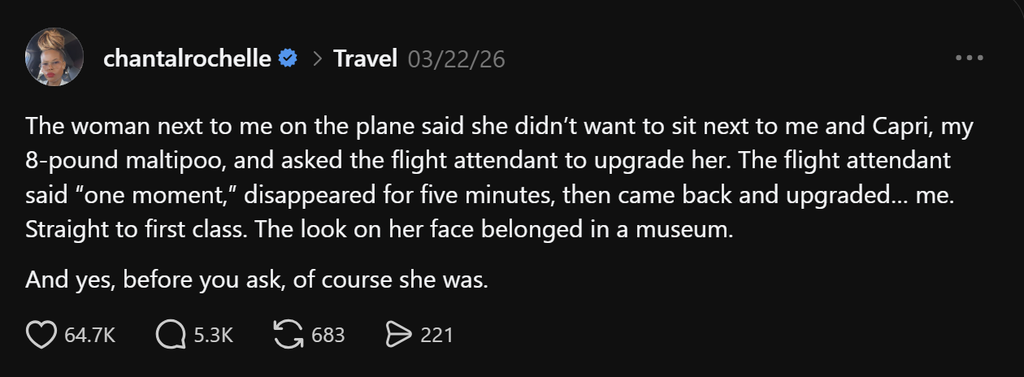
Image Credits – Threads @chantalrochelle
The Flight Started With an Uncomfortable Seating Situation
According to Rochelle’s account, the incident happened in March when she boarded a flight with Capri, her eight-pound Maltipoo. The small dog was accompanying its owner when the woman seated next to them apparently made it clear that she did not want to sit beside the animal.
Rochelle shared the encounter on Threads under the account @chantalrochelle. She explained that the neighboring passenger asked a flight attendant to move her to a better seat, although she reportedly did not explain why she objected to sitting beside Capri.
For Rochelle, the situation took an unexpected turn when the flight attendant became involved. What initially appeared to be a fairly ordinary request to change seats soon developed into an incident with a much more surprising outcome.
Air travel often requires passengers to share limited space with people they have never met. Most travelers have preferences about where they sit, how much room they have, and who occupies the seats around them. Problems can arise when those preferences conflict, particularly when someone expects airline staff to find an immediate solution.
In this case, the presence of a small dog became the source of the disagreement. However, the detail that captured attention was the passenger’s reported request to be moved up rather than simply seated somewhere else.
The Flight Attendant Returned With a Surprise
After the woman reportedly asked to be moved, the flight attendant responded with a short statement before walking away. According to Rochelle, the attendant said, “One moment,” and left to deal with the request.
The exchange might have ended with a simple seat change, which would have allowed the passengers to continue their journeys without further disagreement. Instead, the attendant returned a few minutes later with a decision that gave the story its unexpected twist.
Rochelle said the flight attendant upgraded her and Capri to first class. The passenger who had reportedly wanted a better seat was left watching the dog and its owner receive the upgrade instead.
The decision transformed what could have been a routine seating complaint into a memorable travel anecdote. Rather than moving the complaining passenger into the more desirable cabin, the attendant chose a solution that benefited the person she had objected to sitting beside.
Rochelle later described the other passenger’s expression in her Threads post. “The look on her face belonged in a museum,” she wrote.
That comment became one of the most memorable details in the account because it captured the apparent surprise of the moment without requiring a lengthy explanation. The passenger had asked for a change, but the final arrangement was reportedly very different from the one she had anticipated.
The supplied account does not explain the flight attendant’s reasoning or establish whether the airline had additional seats available in first class. It also does not include a statement from the airline. The details of the encounter therefore remain based on Rochelle’s description of what happened.
Why the Dog’s Upgrade Became the Main Talking Point
The reported outcome was unusual enough to make the story stand out from the familiar complaints associated with flying. Passengers regularly encounter crowded cabins, disagreements about seating, and situations in which they must ask staff for assistance. A dog and its owner being upgraded after another passenger objected to their presence offered a different kind of ending.
Part of the appeal came from the reversal of expectations. The passenger reportedly wanted to be moved to a better seat, yet the person she had complained about received the upgrade. Capri, meanwhile, became the unlikely center of the story despite having no role in the disagreement.
The situation also raised questions about what passengers can reasonably expect when they ask airline staff to intervene. Requesting help with a seating concern is one thing, while asking for a move to a more desirable cabin introduces another consideration.
There is an important difference between requesting a seat away from a particular situation and expecting to receive an upgrade. A passenger may have a genuine reason for wanting a different seat, but that does not automatically mean first class is the appropriate solution.
The story does not establish precisely how the woman phrased her request beyond Rochelle’s description. It is therefore difficult to determine the full extent of her expectations or whether any misunderstanding occurred during the exchange.
Nevertheless, the reported decision gave the encounter a memorable twist. The flight attendant’s solution meant the dog and its owner ended up with the better seating arrangement, turning an ordinary complaint into an incident people could debate from several perspectives.
Some Commenters Thought the Passenger Was Asking Too Much

Reactions to Rochelle’s account were divided, with some commenters focusing on the apparent expectation that the passenger should receive an upgrade simply because she did not want to sit beside a dog.
One person responded with a joke about the situation, writing, “She already had a ‘pupgrade‘ and asked for an inferior upgrade? What a silly lady.”
The comment played on the idea that Capri had effectively received an upgrade of her own before the other passenger asked to be moved. When the attendant reportedly upgraded Rochelle and the dog, the joke became even more fitting for readers who viewed the outcome as an amusing reversal.
For those commenters, the distinction was straightforward. A passenger who feels uncomfortable sitting beside an animal can ask to change seats, but expecting a move to first class is a different proposition.
Their criticism centered on the reported request rather than the mere fact that the woman did not want to sit beside Capri. The two issues are not necessarily the same, and that distinction became central to the discussion.
The attendant’s decision also gave the story an element of unexpected fairness in the eyes of some readers. Instead of rewarding the complaint with a more desirable seat, the attendant reportedly found a solution that allowed Rochelle and Capri to move away from the original seating arrangement.
However, the available account does not establish whether the attendant intended the decision as a lesson for the passenger. It would be speculation to claim that the upgrade was designed to embarrass her or prove a point. The reason for the decision was not provided.
What can be established from Rochelle’s account is that the attendant made a choice that surprised the people involved and became the defining moment of the story.
Other Readers Pointed Out That Dog Allergies Can Be Serious
Not everyone who commented on the incident viewed the passenger’s objection as unreasonable. Some readers highlighted a practical concern that can easily be overlooked when a story is framed around a disagreement involving a pet.
One commenter explained why they would have approached the situation differently, writing, “I would have asked to be moved. Not upgraded. I have severe allergies to dog hair.”
That response introduced a significant distinction into the conversation. Someone may want to avoid sitting beside a dog for health reasons, and such a concern should not automatically be interpreted as an insult toward the animal or its owner.
Rochelle’s account does not say that the passenger had allergies, and the woman reportedly did not provide a reason for wanting to move. There is no basis for concluding that allergies played a role in this particular encounter.
Even so, the comment illustrates why passengers and observers should be cautious about making assumptions. A person who asks to be seated away from an animal may have a personal preference, a fear of dogs, or a health concern. Without further information, it is impossible to know which explanation applies.
For someone with a serious allergy, sitting near an animal could be a genuine concern rather than a matter of comfort. Asking a flight attendant whether another seat is available can be a reasonable way to address that problem, although the options will depend on the circumstances.
The question of an upgrade is separate. A request to move away from an animal does not automatically establish that a first-class seat should be provided, especially when the reasons for the request and the available seating arrangements are unknown.
This is why the discussion surrounding Rochelle’s story has more than one side. The reported demand for a better seat attracted criticism, but the underlying desire to avoid sitting beside a dog should not, by itself, be treated as proof of entitlement.
What the Incident Reveals About Airline Etiquette
The encounter highlights the awkward decisions that can arise when passengers with different needs share a confined space. A request that seems minor to one traveler may feel important to another, and airline staff must decide how best to respond to competing preferences.
Passengers also have different ideas about what constitutes a reasonable solution. Someone who wants more legroom may ask about an upgrade, while another person might simply prefer an empty neighboring seat. A traveler who objects to sitting beside an animal may have a practical concern that needs to be explained.
The difficulty comes when a request is treated as an entitlement rather than a question about available options. Asking staff for help allows them to assess the situation, while insisting on a particular outcome can make an already uncomfortable encounter more difficult.
In Rochelle’s account, the flight attendant did not immediately grant the passenger’s request. Instead, the attendant briefly left before returning with an unexpected arrangement. That decision resolved the immediate seating issue for Rochelle and Capri, although the account does not establish whether the other passenger was subsequently offered another seat.
There are several sensible approaches passengers can take when a similar problem arises during a flight:
- Explain the concern clearly. If sitting beside an animal creates a genuine problem, tell the flight attendant what the issue is rather than relying on a general objection.
- Ask about available alternatives. A different seat may be sufficient to resolve the problem without requiring a move to a more expensive cabin.
- Recognize that options may be limited. The crew may not have an appropriate alternative available, particularly when seating arrangements are already established.
- Avoid assuming bad intentions. A passenger who asks to move may have a reason that other travelers do not know about.
- Keep expectations realistic. Asking for assistance gives staff an opportunity to help, but it does not guarantee a specific seat or an upgrade.
These suggestions do not require passengers to agree about every situation. They simply recognize that a seating disagreement is easier to address when the people involved explain their needs and allow staff to consider the available options.
Why the Full Context Still Matters
Viral stories often spread because one detail makes an encounter easy to understand at a glance. In this case, the image of a tiny dog receiving a first-class upgrade after another passenger reportedly requested a move provided an obvious hook.
That detail, however, does not reveal everything about the interaction. Readers have Rochelle’s account of the complaint and the attendant’s response, but they do not have a full explanation from the passenger or the airline.
The absence of that additional context does not erase the reported outcome. It simply limits what can responsibly be concluded about the people involved and the reasons behind their actions.
It would be easy to turn the incident into a story about a passenger who was deliberately punished for making a demand. Yet the supplied account does not establish that the attendant intended to embarrass her or that the upgrade was arranged as a response to her attitude.
Similarly, it would be unfair to assume that the passenger had a medical reason for wanting to move. Although allergies are a legitimate possibility in general, Rochelle’s account does not identify them as the explanation in this case.
The clearest distinction is between the request to sit elsewhere and the reported request for an upgrade. The first may be reasonable depending on the circumstances, while the second raises questions about expectations and what the airline can offer.
Keeping that distinction in view allows the story to remain entertaining without turning an incomplete account into a definitive judgment about the passenger’s character.
Capri’s Unexpected First-Class Moment Left a Lasting Impression
Rochelle’s story stands out because the final outcome reportedly reversed the expectations surrounding the original complaint. A passenger wanted to avoid sitting beside a dog, the flight attendant briefly stepped away, and Capri and her owner ended up in first class.
The detail that made the encounter memorable was not simply that a dog received an upgrade. It was the contrast between the passenger’s reported request and the solution the attendant ultimately provided.
There is room to laugh at the unexpected ending while recognizing that passengers can have legitimate reasons for wanting to change seats. The account does not establish why the woman objected to Capri, and the attendant’s reasoning remains unknown.
For anyone flying with or sitting near an animal, the practical lesson is straightforward: explain genuine concerns, ask for reasonable assistance, and leave room for staff to determine what options are available. An upgrade may make for a memorable viral story, but a workable seating arrangement is often all a difficult situation needs.