
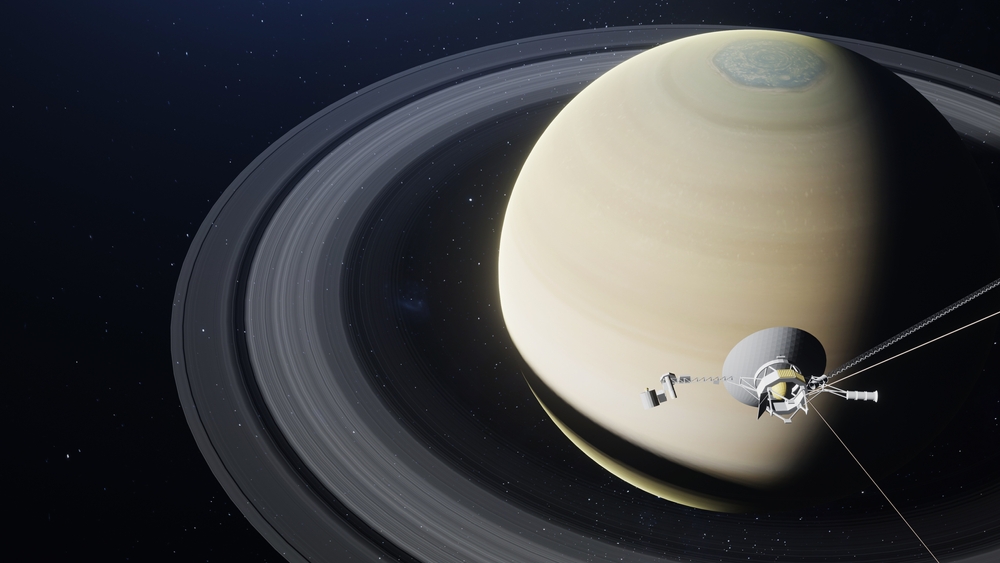
A spacecraft launched nearly half a century ago is about to reach a distance so enormous that a beam of light leaving Earth would need an entire day to catch up with it. Voyager 1, humanity’s most distant human-made object, is expected to reach the extraordinary one-light-day milestone on November 18, 2026, marking another historic moment in one of NASA’s longest-running space missions.
To celebrate, NASA is inviting people around the world to participate in an unusual global event involving golden lights and flashing smartphones. The initiative will allow participants to send a symbolic message in Morse code while NASA prepares a special discussion about the spacecraft’s journey, the science it continues to collect, and the extraordinary challenges of keeping a machine operating so far from Earth.
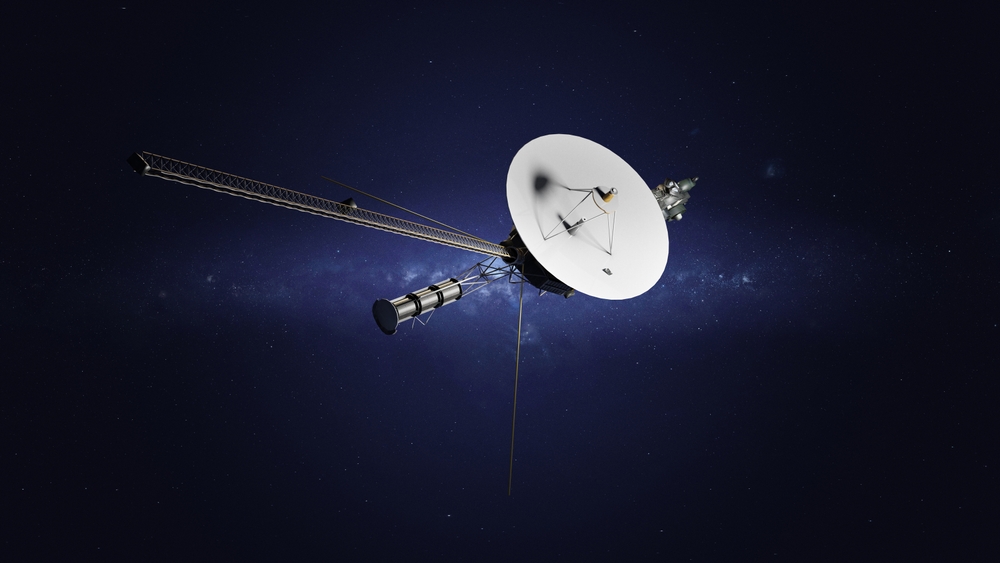
Voyager 1 Is About To Reach A Distance Few Can Comprehend
When NASA launched Voyager 1 in 1977, its primary mission was to explore the outer planets. Nearly 50 years later, the spacecraft has travelled farther than any other human-made object and is approaching a milestone that puts its extraordinary distance into perspective. On Wednesday, November 18, 2026, Voyager 1 is expected to reach one light-day from Earth, meaning light travelling from our planet would need approximately 24 hours to reach it.
The distance involved is more than 16 billion miles, equivalent to approximately 25.9 billion kilometres. For most people, numbers of this size are almost impossible to picture, particularly when compared with familiar journeys on Earth. Even travelling at the speed of light, which is approximately 186,000 miles per second, a signal would need an entire day to cross the distance separating our planet from the spacecraft.
Voyager 1’s journey began during a very different era of technology. Smartphones, modern satellite navigation, and many of the technologies people now depend on did not exist when the spacecraft first left Earth. Yet the probe has continued travelling through space, collecting scientific observations and remaining an important part of NASA’s exploration programme.
The milestone also demonstrates the extraordinary engineering involved in keeping a spacecraft operational for so long. Voyager 1 has travelled beyond the planets it was originally designed to investigate, and its mission has continued into an environment that scientists are still working to understand. Its one-light-day achievement offers a striking measurement of just how far human exploration has reached.
NASA Wants People Around The World To Create A Wave Of Golden Light
NASA has chosen an unusual way to celebrate the achievement, inviting people to participate in an initiative called “Shine Bright for Voyager’s Light-Day.” The event will take place on Tuesday, November 17, the evening before Voyager 1 reaches its one-light-day milestone. Participants are encouraged to create a symbolic wave of golden light around the planet after sunset.
The idea involves using smartphones and tablets to flash the letters VGR in Morse code. VGR is Voyager’s call sign, and NASA has created a dedicated website that allows participants to generate the signal using their devices. Rather than requiring specialist equipment or complicated preparations, the activity gives people an accessible way to join the worldwide celebration.
Anyone interested in taking part can follow these steps:
- Visit NASA’s website: Open the dedicated Shine Bright for Voyager page at https://go.nasa.gov/shinebright.
- Activate the signal: Use the website to make your smartphone or tablet flash VGR in Morse code.
- Join after sunset: Participate in the symbolic golden-light celebration on November 17.
- Capture the moment: Take photographs or videos of your device displaying the signal.
- Share online: Post your pictures or videos on social media and tag @NASA.
NASA is encouraging participants to share their recordings so the celebration can reach people beyond those taking part in person. The campaign creates a public connection to a spacecraft that is now so distant that even light needs a full day to reach it. The contrast between a small smartphone flashing on Earth and a probe travelling billions of miles away gives the event its unusual appeal.
What One Light-Day Actually Means For Voyager 1
A light-day is a measurement of distance based on how far light travels in 24 hours. Since light moves at approximately 186,000 miles every second, the distance covered during a full day is enormous. Astronomers use light-based measurements to describe vast distances across space, where ordinary units such as miles and kilometres can become difficult to interpret.
For Voyager 1, reaching one light-day means that a signal travelling from Earth at the speed of light would take approximately 24 hours to arrive. The same enormous separation also affects communications between NASA and the spacecraft. Information cannot be exchanged instantly, and mission teams must account for the time required for signals to travel across such an immense distance.
NASA relies on its Deep Space Network to maintain communications with the Voyager spacecraft. The network uses powerful antennas to communicate with distant probes and receive information sent back towards Earth. Operating this system is particularly important for missions like Voyager, where the spacecraft are far beyond the planets and continue travelling through interstellar space.
The milestone also provides a fascinating way to understand the scale of human exploration. Voyager 1 has travelled so far that a message sent from Earth would spend an entire day travelling before reaching its destination. Its distance represents decades of continuous movement through space and a mission that has outlasted many of the technologies that existed when it launched.
Voyager 1 And Voyager 2 Were Designed For A Rare Planetary Alignment
The Voyager mission began with an unusual opportunity in planetary exploration. NASA designed the twin spacecraft to investigate the outer planets by taking advantage of a planetary alignment that occurs approximately once every 176 years. This rare arrangement allowed the probes to follow trajectories that made visiting multiple outer planets possible during their journeys.
Voyager 1 and Voyager 2 followed different paths through the solar system, allowing them to explore different planetary environments. Their original objectives focused on the outer planets, but the missions eventually extended far beyond those initial destinations. The spacecraft continued travelling after completing their planetary exploration objectives, opening up opportunities to study regions of space that had previously remained beyond direct spacecraft observation.
Voyager 1 entered interstellar space in 2012, becoming the first of the twin spacecraft to cross beyond the heliosphere. Voyager 2 followed in 2018 after travelling along a different trajectory. Their entry into interstellar space represented a significant development in the mission, as both probes could now provide observations from beyond the Sun’s protective bubble.
The two spacecraft continue to provide unique scientific observations of the environment outside the heliosphere. Their journeys have allowed researchers to examine conditions beyond the region influenced by the solar wind, giving scientists valuable information about the space surrounding our solar system. Their continued operation has also turned the mission into an extraordinary long-term engineering achievement.
The Space Beyond The Sun Is Still Being Studied
The heliosphere is an enormous protective bubble created by the Sun through the constant release of charged particles known as the solar wind. It extends far beyond the planets and influences the surrounding space environment. Although the Sun’s influence reaches enormous distances, the heliosphere has a boundary where conditions begin to change as the solar system meets the surrounding interstellar environment.
Voyager 1 and Voyager 2 have both travelled beyond this protective region, allowing them to collect observations from interstellar space. Their measurements provide scientists with an opportunity to study an environment that cannot be examined in the same way using instruments located near Earth. Having two spacecraft following different trajectories also provides valuable observations from separate locations beyond the heliosphere.
The scientific importance of these missions extends beyond their original planetary objectives. Their continued observations help researchers investigate the environment surrounding the solar system and improve their understanding of the transition between the heliosphere and interstellar space. These measurements offer a rare opportunity to study conditions in a region that is extremely difficult to reach.
Both probes remain important sources of scientific information despite their age and enormous distance from Earth. Their continued work is one of the reasons NASA is bringing together members of the mission team to discuss their status and the challenges involved in maintaining them. The upcoming event will give audiences an opportunity to hear about the spacecraft’s current operations and the science they continue to gather.
NASA Is Bringing The Voyager Mission Team Together For A Special Event
NASA’s celebrations will continue on Thursday, November 19, when the Jet Propulsion Laboratory hosts a special moderated discussion involving mission members and NASA leadership. The event is scheduled for 12 p.m. Eastern Time, or 9 a.m. Pacific Time, and will focus on the status of Voyager 1 and Voyager 2, their scientific observations, and the difficulties of operating spacecraft across such enormous distances.
The discussion will take place in JPL’s von Kármán Auditorium in Southern California. The venue has a connection to Voyager’s history, as JPL previously hosted mission briefings there during the spacecraft’s grand tour of the outer planets. A question-and-answer session with media representatives and other audience members will follow the discussion.
The announced participants include Nicky Fox, associate administrator of NASA’s Science Mission Directorate; Jonathan Lunine, chief scientist at NASA JPL and professor of planetary science at Caltech; and Suzanne Dodd, Voyager project manager at NASA JPL. They will be joined by Linda Spilker, Voyager project scientist at NASA JPL; Kareem Badaruddin, Voyager mission manager at NASA JPL; and Jamie Rankin, Voyager deputy project scientist at Princeton University.
People who want to watch the event online can find viewing information through NASA’s official livestream page at https://www.nasa.gov/live. The event will also include a preview of NASA’s upcoming Voyager documentary, which is planned for release in 2027 to mark the mission’s 50th anniversary. The documentary will provide another opportunity to look back at the mission and the people responsible for keeping it going.
Keeping A Spacecraft Operating For Nearly 50 Years Is No Easy Task
Voyager’s longevity presents an extraordinary challenge for the engineers and scientists responsible for the mission. Both spacecraft were launched in 1977, meaning their operations have continued across several decades of technological development. Their continued journeys require teams to work with equipment designed in an earlier era while maintaining communication with probes now located billions of miles from Earth.
Distance creates one of the biggest operational difficulties. Commands and information must travel across enormous stretches of space, while the Deep Space Network provides the infrastructure needed to communicate with the probes. Even a routine exchange involves significant delays because radio signals cannot travel faster than light.
NASA’s November 19 discussion will address the challenges involved in keeping both spacecraft functioning over such vast distances. The mission team will also discuss the unique science the probes continue to gather from interstellar space. Their experience operating Voyager provides valuable insight into the technical demands of long-duration space exploration.
NASA JPL built and operates the Voyager spacecraft, while the Deep Space Network is also managed by the laboratory. JPL is managed by Caltech in Pasadena, California, and the Voyager mission receives funding from NASA’s Heliophysics Division at NASA Headquarters in Washington. The continued involvement of these teams has allowed the mission to remain active long after its original planetary exploration objectives were completed.
Voyager’s 50th Anniversary Is Already Approaching
The one-light-day milestone arrives just ahead of another major moment in the mission’s history. In 2027, Voyager 1 and Voyager 2 will reach their 50th anniversary, marking half a century since their original launches in 1977. What began as an ambitious mission to explore the outer planets has become one of NASA’s longest-running space exploration projects.
The upcoming documentary is part of NASA’s plans to mark the anniversary. A preview will be shown during the November 19 event, ahead of its planned release in 2027. The documentary is expected to bring renewed attention to the spacecraft, their scientific achievements, and the people who have worked to keep them operating throughout their extraordinary journeys.
The anniversary also offers an opportunity to reflect on how dramatically the mission has evolved. The spacecraft were originally sent to investigate the outer planets, but their journeys eventually carried them beyond the heliosphere and into interstellar space. Their continued observations have given scientists access to information from a region that neither probe was originally expected to explore for so many decades.
By the time the mission reaches its 50th anniversary, Voyager 1 will have travelled for almost five decades since leaving Earth. Its approaching one-light-day milestone provides an especially striking measurement of that achievement, showing just how far a human-built spacecraft can travel when a mission continues long beyond its original objectives.
A Signal From Earth Will Take A Full Day To Reach Voyager 1
When people around the world flash their smartphones on November 17, they will be taking part in a celebration connected to one of humanity’s most distant achievements. The following day, Voyager 1 is expected to reach one light-day from Earth, meaning even a signal travelling at the speed of light will need approximately 24 hours to reach the spacecraft.
The probe’s journey began in 1977 with a mission to explore the outer planets. Nearly half a century later, it remains part of NASA’s scientific exploration of the space beyond our solar system. A flashing smartphone may seem like a small gesture compared with the distance Voyager has travelled, but it will represent a remarkable connection between people on Earth and a spacecraft continuing its journey through interstellar space.